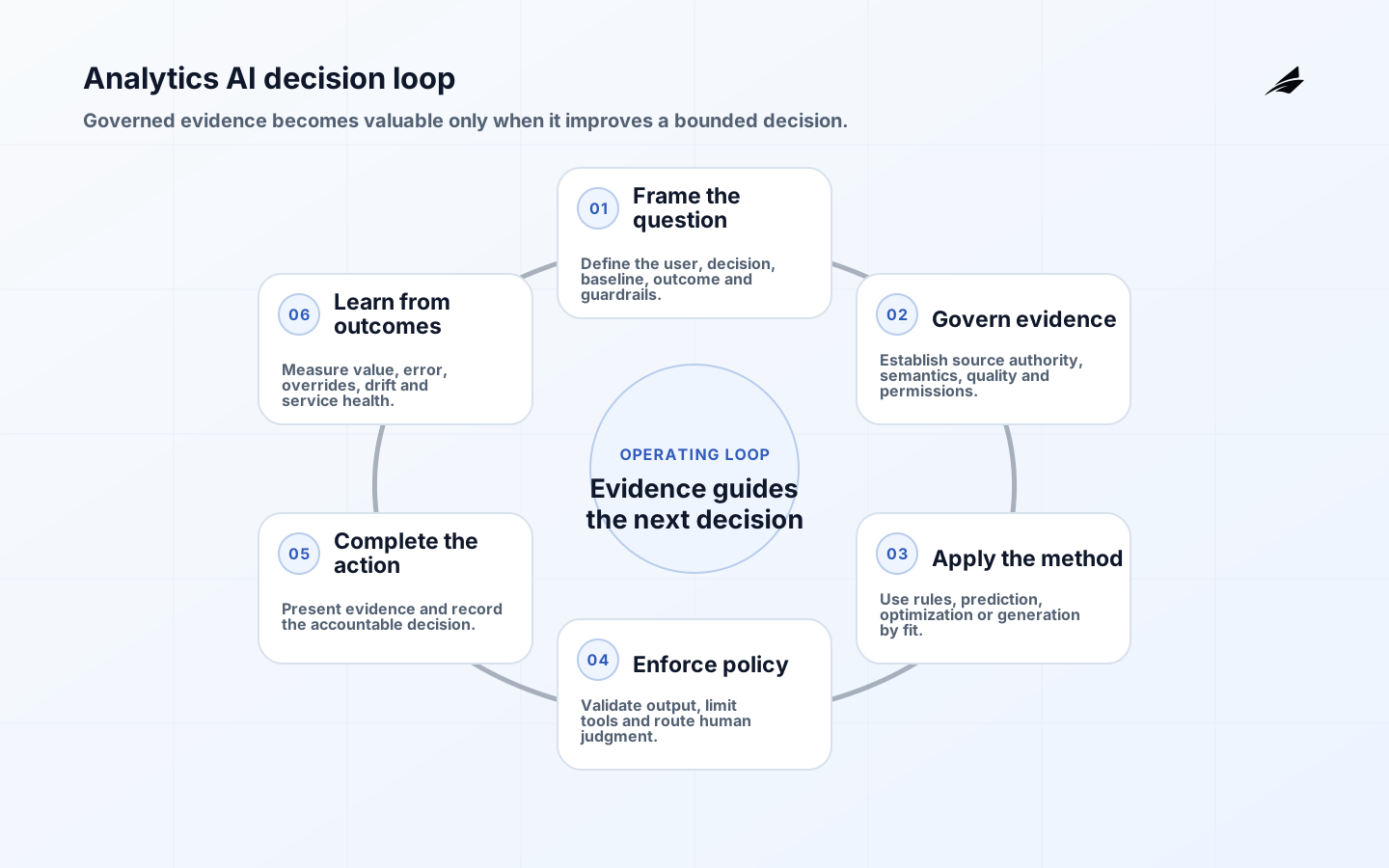
Analytics artificial intelligence is the use of governed data, analytical methods and AI capabilities to improve a recurring decision. It may forecast demand, rank cases, detect anomalies, explain a variance or help an analyst explore evidence. The value is not the model in isolation. It comes from connecting reliable inputs to a clear decision, constrained action and learning loop. This guide gives business, data and technology teams a shared operating model for doing that responsibly.
For execution details, use the analytics AI implementation checklist and analytics AI FAQ. The broader data analytics AI guide helps compare adjacent approaches. This article focuses on architecture, roles and day-to-day use: what each layer does, where human judgment sits and how the system keeps earning trust after launch.
What analytics artificial intelligence includes
The term spans several patterns. Descriptive analytics summarizes what happened. Diagnostic analysis explores why. Predictive models estimate an outcome. Optimization recommends an action under constraints. Generative AI can translate questions into queries, summarize evidence or produce narrative explanations. A business workflow may combine them: a forecast identifies likely shortages, optimization proposes transfers, and a language model explains assumptions to a planner. Calling every dashboard AI obscures these differences and makes validation harder.
Choose the least complex pattern that solves the decision. Deterministic calculations are appropriate when definitions are stable and exact. Statistical or machine-learning models help when relationships must be learned from examples. Generative models are useful where language and unstructured information matter, but outputs require grounding and validation. Human judgment remains essential for novel context, contested objectives and consequential exceptions. Architecture should expose which component produced each claim instead of blending evidence and generated prose into one authoritative-looking answer.
| Pattern | Useful for | Primary control |
|---|---|---|
| Rules and metrics | Stable definitions, thresholds and compliance calculations | Versioned logic and reconciled source data |
| Predictive model | Forecasting, classification, ranking and anomaly detection | Representative evaluation and drift monitoring |
| Optimization | Allocating scarce resources under explicit constraints | Approved objective, constraints and feasibility checks |
| Generative AI | Search, explanation, extraction and drafting | Grounding, output validation and user review |
| Human decision | Novel tradeoffs, exceptions and accountable judgment | Authority, context, challenge and recorded rationale |
Design around the decision, not the available model
Map the present decision from trigger to outcome. Identify who requests analysis, which records they inspect, where they wait, how exceptions are resolved and when outcome data becomes available. Then define the intervention. A churn score is not an outcome; a prioritized retention conversation with an eligible customer is. The model may improve ranking while policy controls contact frequency and offer limits. This separation prevents a probability from becoming an unauthorized decision and reveals whether process delay, not prediction quality, is the real constraint.
Write success measures at three levels. Decision quality asks whether choices improve. Workflow performance covers speed, effort and completion. System health covers data, model and service reliability. Include guardrails such as complaint rate, disparate error, unnecessary review and unsafe actions. The NIST AI RMF emphasizes context because the same capability can create very different risks across uses. A summarizer for internal meeting notes and a system influencing credit decisions should not share one approval path.
Build a governed data and semantic foundation
Analytics AI inherits the meaning and history of its data. Establish authoritative records for customers, products, transactions and outcomes; document metric definitions; and reconcile identifiers across source systems. A revenue field may represent booked, billed or collected value depending on context. Without semantic ownership, a model can learn a technically consistent relationship that answers the wrong business question. Data products should publish schema, freshness, quality checks, owner, access conditions and known limitations so consumers can judge fitness.
Preserve provenance through ingestion, transformations, features, retrieval and outputs. The W3C PROV-O recommendation supplies interoperable concepts for entities, activities and agents, while teams can implement an appropriately simple lineage model. Record source snapshots and transformation versions for material decisions. Apply purpose limitation, minimization, retention and access controls; the NIST Privacy Framework treats privacy as risk arising from data processing across a lifecycle, not merely a security setting.
| Data question | Operational evidence | Failure it prevents |
|---|---|---|
| What does it mean? | Business definition, unit, grain and allowed values | Models optimizing a mislabeled target |
| Where did it come from? | Source, timestamp, transformation and owner | Unreproducible analysis |
| Is it current enough? | Refresh objective, observed lag and stale-data behavior | Decisions based on old state |
| Who may use it? | Purpose, role, region, consent or contract conditions | Unauthorized reuse |
| How does quality fail? | Tests, thresholds, quarantine and remediation owner | Silent propagation of corrupt records |
Use a layered analytics AI architecture
A dependable architecture separates systems of record, governed preparation, analytical or model services, orchestration and the decision interface. The orchestration layer retrieves approved context, calls models, validates outputs, applies policy and records state. The interface shows users the recommendation, evidence, uncertainty and permitted actions. Observability spans the path so an incident can be traced to a source feed, transformation, model version, prompt, retrieval result or downstream API. This is more supportable than hiding business rules inside a notebook or prompt.
For retrieval-augmented generation, index only approved sources and retain document identity, version, access labels and effective dates. Enforce source permissions at retrieval time, not just during indexing. Require citations that resolve to the exact supporting passage, then test whether the passage actually entails the answer. Tool-using systems need typed schemas, input validation, least-privilege credentials, idempotency and explicit authorization for writes. A language model may propose an action; deterministic application code decides whether that action is permitted.
Assign roles and decision rights
The business owner accepts the outcome and process risk. A data owner governs meaning, access and quality. The product owner manages user value and backlog. Data science or analytics teams develop and evaluate methods. Engineering operates pipelines and services. Security, privacy, legal and domain specialists set relevant constraints. An independent approver may be required for higher-impact releases. Name a single incident leader and a retirement owner. Committees provide challenge, but accountability should resolve to people with authority and time.
Human oversight must be designed as work. Reviewers need the source evidence, uncertainty, reason for escalation and available alternatives. Measure review time, agreement, correction quality and signs of automation bias. Allow a reviewer to reject, defer or seek expertise without penalizing sensible caution. The OECD transparency principle supports disclosure of AI interaction, capabilities and limitations, plus information that enables affected people to understand and challenge outcomes where appropriate.
Operate the system as a changing service
Production changes even when code does not. Customer behavior shifts, source systems migrate, labels arrive late, regulations change and vendors update models. Monitor data contracts, distribution, quality, latency, cost, output behavior, human overrides and outcome measures. Define service objectives for the end-to-end decision, not only the model endpoint. An available model with a stale feature feed is not a healthy service. Route alerts to owners with playbooks and authority to degrade, disable or revert capability.
Use a change taxonomy. Routine infrastructure patches may follow normal controls; a new target definition, retrieval corpus, model family or automated action may require renewed impact assessment and evaluation. ISO guidance on AI management systems describes a Plan-Do-Check-Act approach, which fits this operating reality. Review incidents and near misses for systemic causes, update test sets with valid lessons, and avoid training directly on every complaint without checking labels and unintended feedback loops.
Practical example: inventory decision intelligence
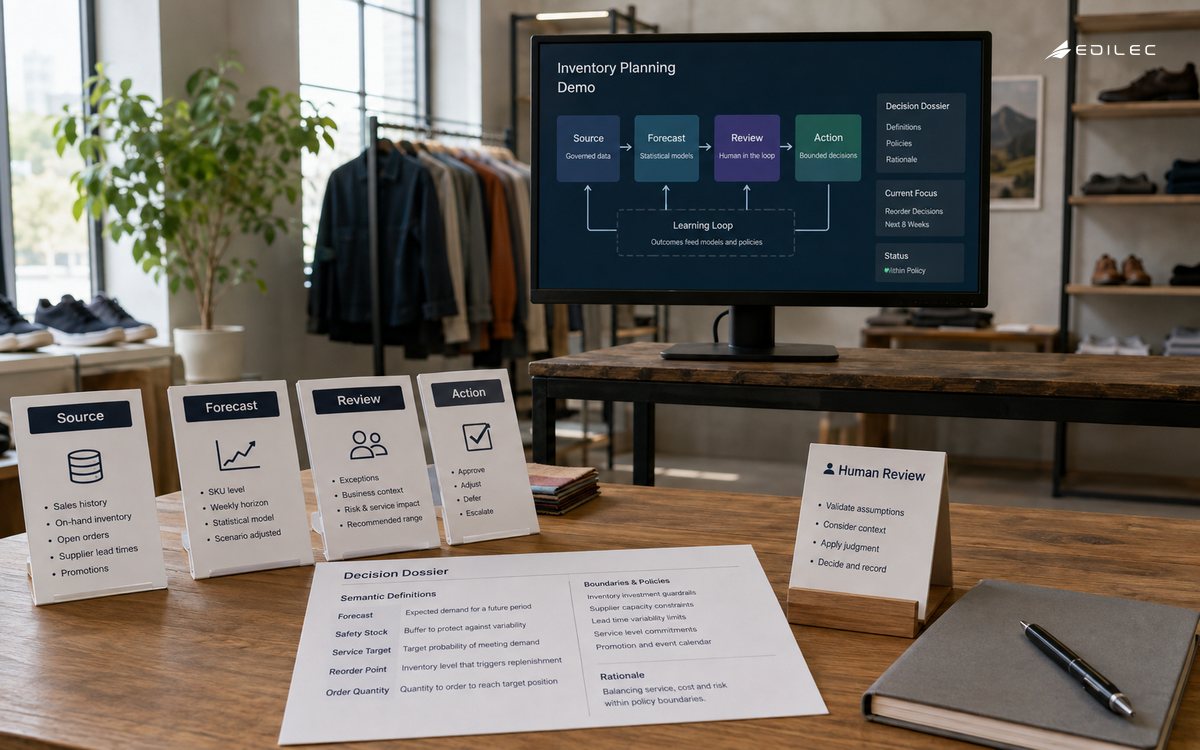
Consider a distributor that wants fewer stockouts without excessive inventory. The team defines a weekly transfer decision by item and location. Governed records combine sales, stock, open orders, lead times, promotions and capacity. A forecasting model estimates demand distributions, an optimizer proposes transfers under truck and service constraints, and a planner reviews unusual recommendations. The interface shows source freshness, forecast interval, binding constraints and expected effect, rather than presenting one unexplained quantity.
The pilot compares selected locations with a matched baseline over representative demand cycles. Measures include service level, inventory days, transfer cost, planner time, overrides and performance by item class. Guardrails cap transfer value and prohibit movement of regulated goods. If the model is unavailable, planners receive the last verified report and exception queue. Outcomes feed evaluation, but the team investigates promotion changes and supply disruption before treating error as model drift. This is analytics artificial intelligence as an operated decision system.
Evaluate analytics AI products with your own decision evidence
Vendor demonstrations usually use clean data and favorable questions. Give shortlisted products representative, approved scenarios that include missing fields, conflicting sources, permissions and ambiguous language. Ask the vendor to show logs, source handling, model-change controls, regional processing and failure behavior. Score completed task quality and review burden, not conversational fluency. Confirm whether evaluation and monitoring data can be exported without exposing sensitive prompts or records.
Separate platform capability from implementation responsibility. A vendor may provide model hosting, retrieval, safeguards and telemetry, while the customer must still configure data, define policy, test outcomes and support users. Document each dependency and the response if it changes. Negotiate notice, retention, deletion, incident cooperation and termination before production. The strongest feature is of limited value when the customer cannot understand a decision or move the workflow elsewhere.
Key takeaways
- Start with a recurring decision and compare AI with simpler analytical patterns.
- Govern business meaning, source rights, quality and provenance before model work.
- Separate records, preparation, models, orchestration, policy and user experience.
- Make oversight a usable workflow with real authority and visible evidence.
- Monitor the end-to-end decision service and reassess material changes.
- Measure outcomes and guardrails, not model performance in isolation.
Frequently asked questions
Does analytics AI replace business intelligence?
Usually not. Governed reporting and metrics remain essential for shared facts, control totals and diagnosis. AI can add prediction, optimization or language interaction, but it depends on the semantic and quality foundation that mature business intelligence provides.
Should a team buy an analytics AI platform or build one?
Buy common infrastructure when it meets integration, security, evidence and portability needs; build the decision-specific workflow and controls that differentiate the business. Evaluate total operating responsibility, data movement, model choice, observability and exit costs rather than comparing feature lists alone.
Conclusion
Analytics artificial intelligence works when reliable evidence, an appropriate analytical method and accountable human action form one observable loop. Design the decision first, preserve meaning and provenance, constrain model authority, and operate the whole service through change. Teams that do this can use sophisticated capabilities without confusing novelty with value or a plausible answer with a governed business decision.