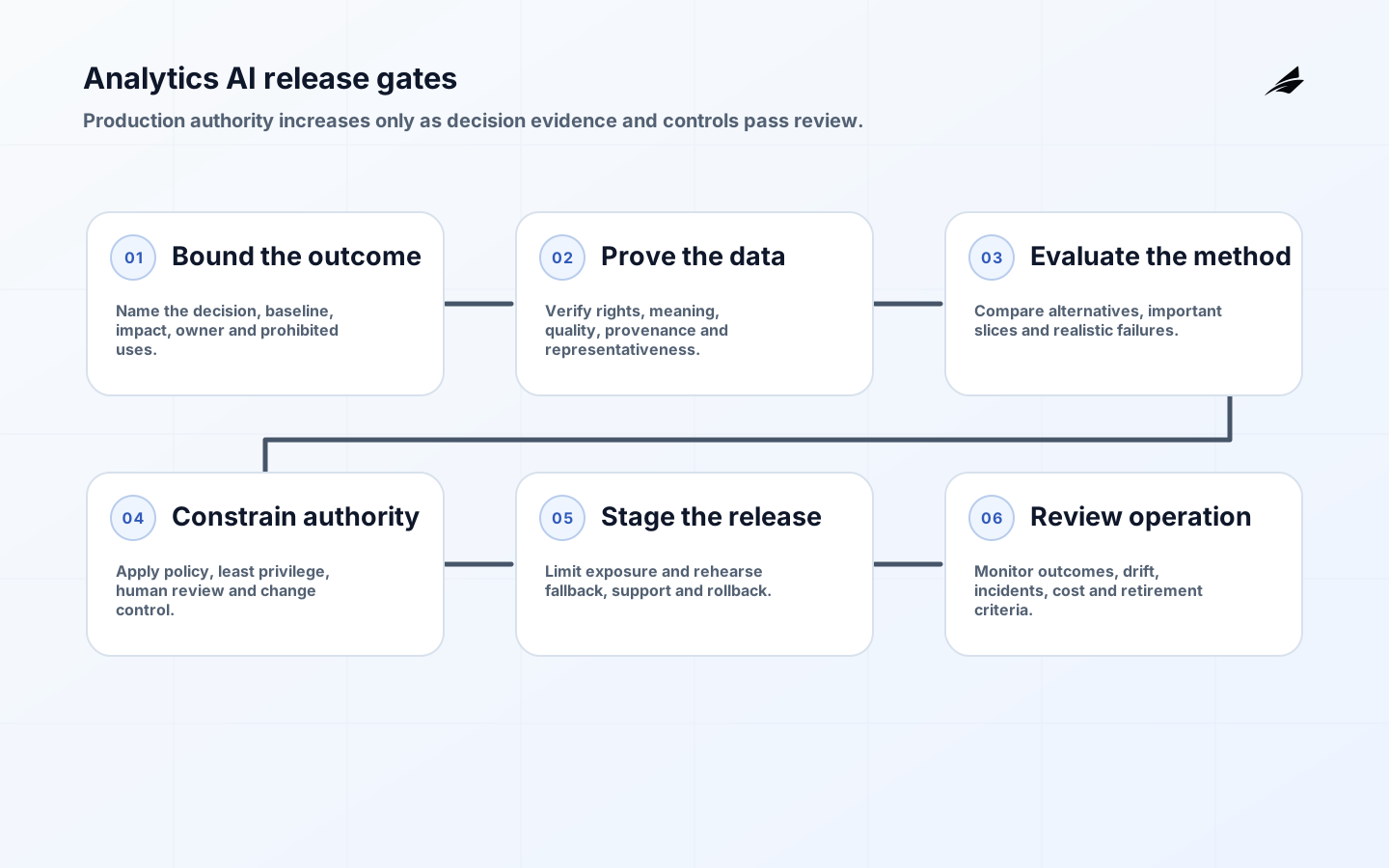
An analytics artificial intelligence implementation checklist should answer a harder question than whether a model can produce an interesting result: can a named team use that result to make a better decision repeatedly, within an acceptable risk boundary? Begin with the decision, the affected people and the operational consequence. Then prove the data, model, workflow, controls and support path before expanding access. This checklist turns those proofs into release gates for analytics and AI systems.
Use it alongside the analytics AI operating guide, the analytics AI FAQ and the data analytics AI implementation checklist. The sequence matters: a polished interface cannot repair unclear metric ownership, unsuitable training data or an action that nobody is authorized to take.
1. Define the analytics AI outcome and decision boundary
Write one decision statement: who decides what, using which output, by when, and what happens next. A demand forecast may recommend replenishment quantities; it should not silently place orders unless authority, limits and reversal procedures are explicit. Record the current baseline, such as forecast error, analyst effort, stockouts or decision latency. A use case without a baseline cannot demonstrate improvement, and a target without an owner will not survive a disagreement between business, data and technology teams.
Classify impact before choosing architecture. Consider financial value, safety, employment, access to essential services, privacy and the cost of a wrong or delayed decision. The NIST AI RMF organizes work around Govern, Map, Measure and Manage, reinforcing that measurement belongs inside governance rather than at the end. Define prohibited uses, required human review, escalation conditions and a safe non-AI path while the design is still inexpensive to change.
| Gate | Evidence required | Reject or revise when |
|---|---|---|
| Outcome | Decision statement, baseline, target and accountable owner | The output is interesting but no workflow decision changes |
| Impact | Affected groups, failure consequences and risk tier | Consequential use has no challenge or override route |
| Scope | Users, regions, products, channels and exclusions | A pilot is described as enterprise-ready |
| Authority | Action limits, approvals and fallback owner | The model can trigger an irreversible action without control |
2. Pass the data readiness and provenance gate
Inventory every source used for training, retrieval, evaluation and live inference. For each source, name the steward, legal or contractual basis, collection context, refresh cadence, permitted purpose, retention rule and downstream consumers. Confirm that identifiers, timestamps, units and categories retain the same meaning across systems. The current ISO/IEC 25012 data quality model provides a useful vocabulary for requirements such as accuracy, completeness, consistency, credibility and currentness; teams should translate those characteristics into thresholds for the specific decision.
Test representativeness against the deployment population, not merely the available dataset. Look for missing segments, delayed labels, selection effects, duplicate entities, target leakage and historical decisions that encode an undesirable policy. Preserve lineage from source snapshot through transformations to features and evaluation sets. Production records should identify the data and model version behind a material output. If rights, provenance or quality cannot be established, reduce scope, acquire better data or stop; uncertainty should not be disguised by model sophistication.
3. Select and evaluate the model against realistic alternatives
Compare the proposed model with a simple rule, existing report and non-AI workflow. Use a holdout that reflects operating conditions, then test slices corresponding to important products, locations, user groups and rare but costly events. Choose metrics that represent the decision: calibration may matter more than raw accuracy when scores trigger thresholds; recall may dominate when missing an event is costly; precision may dominate when each false alert consumes scarce review capacity. Report confidence intervals and sample sizes so small segments do not create false certainty.
For generative systems, evaluate groundedness, harmful or misleading content, information leakage, prompt attacks, refusal behavior and the reliability of citations or tool calls. The NIST Generative AI Profile identifies risks including confabulation, data privacy, information integrity and cybersecurity. Create representative and adversarial test sets from approved material, define who adjudicates ambiguous results, and retain failed cases. A single aggregate score is not an acceptance test for an open-ended system.
| Evaluation layer | Example measure | Release evidence |
|---|---|---|
| Business | Decision cycle time, avoided loss or analyst capacity | Controlled comparison against the baseline |
| Model | Error, calibration, precision/recall and slice performance | Versioned test set, code and signed result |
| Human factors | Override quality, comprehension and review burden | Observed usability test with target roles |
| Safety and security | Leakage, abuse, prompt attack and failure containment | Red-team cases and resolved findings |
| Operations | Latency, availability, cost and recovery | Load test, budget alert and fallback rehearsal |
4. Implement governance, security and human control
Create an AI system record linking the owner, purpose, impact tier, data, model or vendor, evaluation, approvals, deployment locations, incidents and retirement date. ISO/IEC 42001 frames AI management as a continuing management system, so approval should have conditions and an expiry rather than becoming permanent. Separate model development from release authority for higher-impact systems. Require change review when the model, prompt, retrieval corpus, decision threshold, source data, user population or downstream action changes materially.
Apply least privilege to data, model endpoints, tools and administrative functions. Protect secrets, filter untrusted inputs where appropriate, validate structured outputs and authorize every external action in application code. Human review must be operationally credible: reviewers need enough context, time, competence and authority to disagree. Record overrides and outcomes without treating disagreement as reviewer failure. Provide affected users a clear explanation and challenge path where the context calls for it, consistent with the OECD robustness and safety principle.
5. Prove rollout, fallback and operating ownership
Release through a bounded cohort with named entry and exit criteria. Shadow mode can compare outputs without changing decisions; recommendation mode can preserve human authority; limited automation can cap value, volume or affected population. Do not call an uncontrolled demonstration a pilot. A valid pilot uses production-like data, identities, latency, support and monitoring, while limiting exposure. Brief users on purpose and limits, not on how to trust the system. Observe whether they verify, ignore, over-rely on or work around recommendations.

Rehearse dependency failure, stale data, model unavailability, unsafe output, excessive cost and rollback to a previous version. The fallback may be a queue, rule set, last verified report or manual process, but it needs capacity and an owner. Define first-line support, model and data escalation, incident leadership, vendor contacts and business communication. Retain deployment manifests and configuration so the team can reconstruct what ran. Procurement must secure notice of material vendor changes, useful logs, export rights and an exit path.
6. Monitor decision quality, drift and value
Monitor the pipeline and the decision it supports. Technical signals include schema violations, missingness, feature distribution, retrieval failures, model latency, token or compute cost and endpoint errors. Quality signals include delayed ground truth, calibration, slice performance, reviewer overrides and complaint patterns. Business signals include cycle time, loss avoided, service quality and adoption by eligible users. Set alert thresholds with action owners; a dashboard that nobody is expected to act on is only storage.
Schedule review according to risk and rate of change. Investigate trends before adjusting thresholds, because an apparent drift may reflect seasonality, a product launch or a broken upstream feed. Maintain an incident definition broad enough to capture harmful decisions, privacy events and control bypasses, not only outages. Review whether the system is still necessary: a successful process redesign may remove the need for a model. Retirement includes disabling endpoints, revoking access, preserving required records and confirming downstream consumers have moved.
Run an evidence-based production review
Bring business, data, engineering, risk and operations owners into a release review with the actual evidence open. Walk one representative decision from source record through transformation, model output, policy, user action and outcome. Then walk a failure: stale data, unsupported input, model outage or reviewer rejection. Confirm each owner can find the relevant version, explain the control and execute the fallback. Close gaps with dates instead of accepting verbal assurances.
Record the release decision, conditions, monitoring thresholds and next review date. Approval may limit users, transaction value, geography or automation until additional evidence exists. A rejection should state what would support reconsideration. This creates a usable governance trail and prevents teams from repeating debates after staff or vendors change. It also makes progressive expansion a deliberate risk decision rather than an informal consequence of early success.
Implementation takeaways
- Tie the system to one owned decision, baseline and measurable target.
- Prove source rights, semantics, quality and deployment representativeness.
- Compare against simple alternatives and evaluate important slices and failure modes.
- Authorize actions in deterministic controls and make human review workable.
- Roll out in bounded stages with tested fallback, support and vendor exit.
- Monitor decision outcomes and retire systems whose value or control case no longer holds.
Frequently asked questions
How long should an analytics AI pilot run?
Long enough to encounter representative volume, operating conditions and delayed outcomes. Calendar duration alone is misleading. Define the number and variety of decisions, required rare cases, ground-truth delay and acceptance thresholds before starting; extend or stop if those conditions are not met.
What accuracy is good enough for production AI?
There is no universal percentage. The threshold depends on the baseline, error consequences, class balance, review capacity and action. Evaluate decision utility, calibration and segment performance alongside accuracy, and require stronger containment where errors can materially affect people or safety.
Conclusion
A useful analytics artificial intelligence implementation checklist makes evidence accumulate from a bounded outcome to an operated, reviewable system. Release only when the data can be defended, realistic tests pass, authority is constrained, fallback works and owners can see whether decisions improve. That discipline converts a promising model into a dependable capability and gives the organization a principled way to pause, change or retire it.