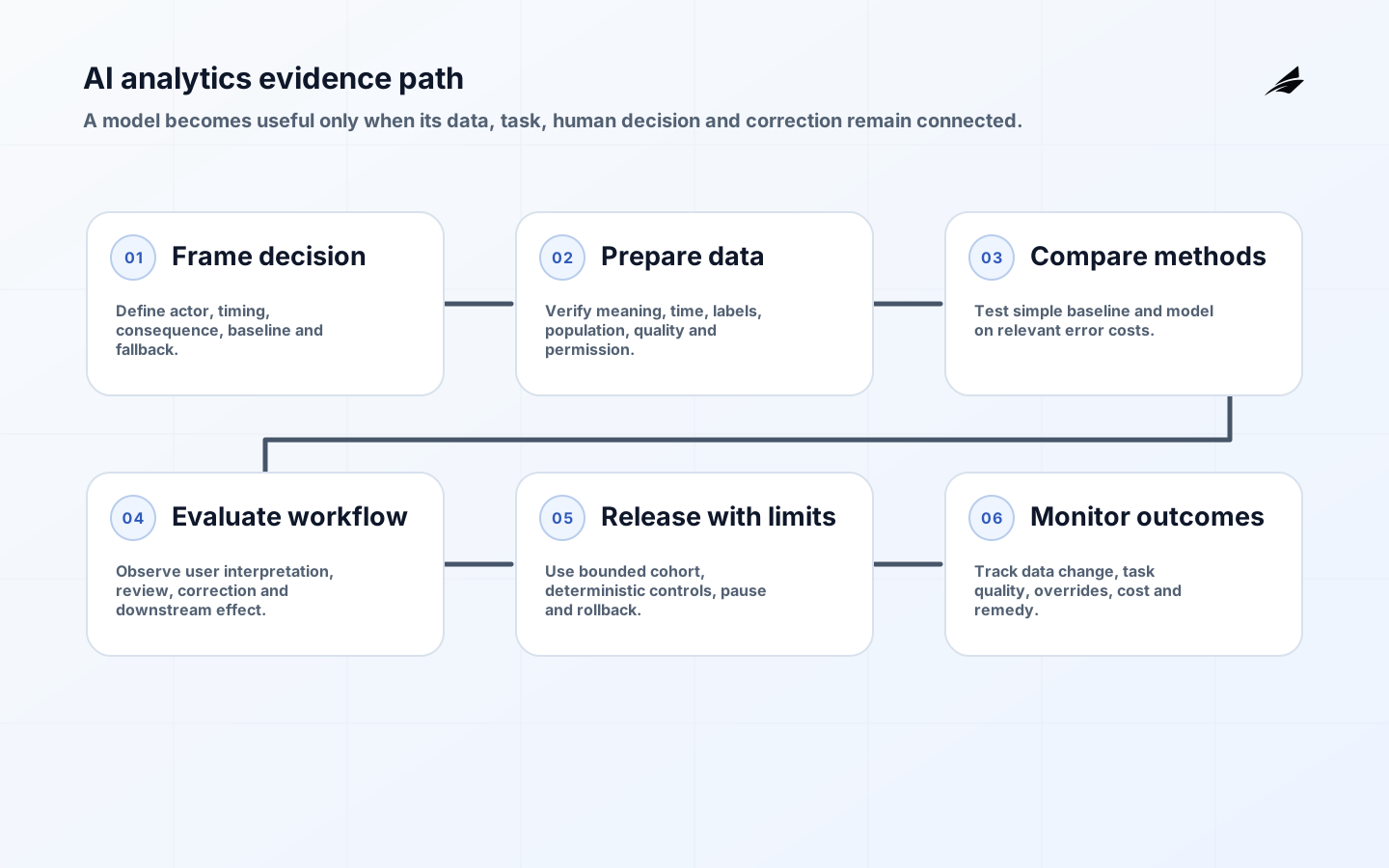
Artificial intelligence in data analytics adds learned classification, prediction, anomaly detection, natural-language interaction or content generation to an analytical workflow. It can help a team find patterns and work through evidence faster, but it does not make weak source data authoritative or turn correlation into causation. The business value comes from improving a defined decision while preserving the ability to inspect evidence, challenge an output and correct the underlying record.
This guide is a practical companion to the AI analytics implementation checklist, the AI analytics FAQ, the data and artificial intelligence guide and its implementation checklist. It is written for business teams choosing a first use case and for data teams turning that choice into an operated service.
Where artificial intelligence fits in data analytics
Use AI when the task contains a repeatable pattern that ordinary reporting or explicit rules do not handle well. Classification can route documents or cases. Regression and forecasting can estimate demand or risk. Anomaly detection can prioritize unusual behavior. Natural-language systems can help users formulate queries or summarize retrieved findings. Each pattern has a different label requirement, error mode and explanation need; the phrase AI analytics should not collapse them into one product category.
Start with the least complex method that meets the outcome. A governed dashboard may be safer and cheaper than a generated narrative. A rules engine may outperform a model where policy is explicit. A statistical forecast with prediction intervals may be more useful than a black-box score. Record the baseline method, because a model that looks impressive in isolation may not improve the current decision.
| Use case | Useful evaluation | Human role |
|---|---|---|
| Case classification | Precision and recall by class plus rework | Resolve uncertain and high-impact cases |
| Demand forecast | Error by horizon, season and segment | Apply known events and capacity judgment |
| Anomaly detection | Useful findings per reviewed alert | Investigate cause and label outcomes |
| Generated explanation | Grounded accuracy, omission and action quality | Verify evidence before reliance |
| Recommendation | Incremental outcome against baseline | Approve consequential choice and exceptions |
Frame the decision before preparing data
Write the decision statement: who acts, what evidence is available at that time, what options exist, how quickly action is needed and what happens when the system is wrong. Define a baseline and guardrails. For example, a collections model may aim to prioritize accounts for review, not decide that a customer is unwilling to pay. That boundary changes labels, permissions, user interface and remedy.
Identify affected people and groups, including those represented poorly in historical data. The NIST AI RMF asks organizations to map context and measure and manage risk under cross-cutting governance. Use that structure to document purpose, expected benefit, foreseeable misuse, severity, users, oversight and retirement. A use-case record should change when the workflow or population changes.
Prepare fit-for-purpose analytical data
Map every feature to an authoritative source, business meaning, observation time and permitted use. Prevent target leakage by excluding information that would not exist when a prediction is made. Preserve historical definitions and corrections so training and evaluation reproduce the real decision point. Split data by time where deployment predicts the future, and keep a final evaluation set outside iterative tuning.
The UK Government Data Quality Framework treats quality as fitness for purpose and emphasizes lifecycle assessment and communication. Define completeness, uniqueness, consistency, timeliness, validity and accuracy rules only where they matter to the use. Investigate root causes at collection or process boundaries instead of repeatedly cleaning symptoms in a model pipeline.
| Data check | Question | Failure response |
|---|---|---|
| Population coverage | Who is absent or sparsely represented? | Limit scope, collect evidence or add review |
| Label validity | Does the label represent the intended outcome? | Relabel, use a proxy transparently or stop |
| Time integrity | Was every feature available at decision time? | Remove leakage and rebuild evaluation |
| Source change | Did collection, policy or meaning change? | Version, segment and reassess comparability |
| Use permission | Is this purpose and access authorized? | Restrict, minimize or obtain a valid basis |
Evaluate the task, not only the model
Choose metrics from the error costs. Accuracy is misleading with rare events; precision and recall show different tradeoffs. Forecasts need error by horizon and segment, not only one aggregate. Ranking needs value at the number of cases a team can review. Compare with the baseline and estimate uncertainty. Review slices by relevant population, source, geography, product and time, while protecting privacy and avoiding unsupported conclusions from small samples.

Run the full workflow with representative users. Measure whether they understand confidence and limitations, whether review catches severe errors, how often they override, and where work moves downstream. The GAO artificial intelligence resources group accountability around governance, data, performance and monitoring. A strong test package connects those areas: approved purpose, traceable data, task results and a plan for live change.
Use generative analytics with bounded authority
A generative assistant can translate a question into a governed query, retrieve approved definitions and draft a narrative. Keep metric computation deterministic where possible, show source and filter context, and distinguish retrieved facts from generated interpretation. Validate generated queries against schemas and access policy before execution. Never allow free-form model output to become a database command or financial transaction without deterministic checks.
The NIST Generative AI Profile covers risks such as confabulation, data privacy, information security and harmful bias. Build a test set of real questions, ambiguous language, prompt injection in retrieved content, unavailable data and requests outside permission. Return a safe limitation or route to an analyst when evidence is missing. Logging should support investigation while minimizing sensitive prompts and outputs.
Release and monitor the analytical service
Version data contracts, transformations, features, model, prompt, policy and user interface. Promote through a registry or equivalent approval record, canary to a bounded group and preserve rollback. Monitor freshness, schema, input distribution, missingness, task quality, override, latency, cost and downstream outcome. Drift is a signal to investigate; it is not automatic proof that retraining will help.
Use provenance to connect output to source and responsible transformation. W3C PROV-O defines entities, activities and agents that can inform a practical lineage model. Assign owners for data incidents, model incidents, user corrections and business outcomes. Establish pause and fallback behavior, periodic review and retirement criteria. ISO/IEC 42001 reinforces maintained AI governance and continual improvement across organizations that provide or use AI.
Worked example: prioritizing invoice exceptions
Suppose accounts payable staff review invoices that fail deterministic validation. The decision is which exception to review first, not whether an invoice should be paid automatically. Baseline the queue age, touches, duplicate payments, reviewer capacity and escalation. Candidate features might include mismatch type, amount band, supplier history and document completeness, using only information available when the exception enters the queue. Exclude protected or proxy attributes unless purpose and controls justify them.
Compare a simple priority rule with a ranking model. Evaluate useful high-risk cases found in the first number reviewers can handle, missed severe cases, performance by supplier and business unit, and reviewer correction. Present the reason as source facts rather than a personality-style risk label. Keep payment authorization and bank-detail change under existing deterministic and dual-approval controls. In shadow mode, verify that prioritization would improve queue outcomes without starving ordinary cases.
After release, monitor queue composition, age, source quality, override and realized loss or rework. A new procurement policy may change both features and labels, so investigate drift before retraining. Give reviewers a correction control and route recurring data errors to procurement or supplier onboarding owners. The model is successful only if the end-to-end exception service improves within its quality and fairness guardrails; a higher offline ranking score is insufficient.
Document the boundary for auditors and future product teams: the rank is a workload aid, not evidence of fraud, supplier quality or intent. Retain the source facts and reviewer decision according to policy, and avoid exporting the score into unrelated supplier evaluations. Review whether teams are over-trusting the first results or neglecting lower-ranked work. These use controls prevent a narrow operational model from silently becoming a general-purpose judgment about organizations.
Before each quarterly review, sample cases from every priority band and trace them back to source. Compare reviewer capacity assumptions with actual throughput, and check whether suppliers or invoice types have moved between bands because of data collection rather than risk. Reapprove the operating threshold, document unresolved uncertainty and tell users what changed. This keeps the ranking aligned with a current queue instead of allowing an old optimization target to become permanent policy.
Key takeaways
- Choose AI only after defining the decision, baseline, consequence and least-complex viable method.
- Build time-correct, permitted and representative data with explicit quality limitations.
- Evaluate end-to-end task outcomes and severe failures with representative users.
- Keep metric computation, permission and consequential actions under deterministic controls.
- Monitor data, model, workflow, cost and corrections under named production owners.
Frequently asked questions
Can a business use AI analytics with a small dataset?
Sometimes. A simpler statistical model, transfer learning or retrieval over governed documents may work, but claims must match evidence. Small samples increase uncertainty and make slice comparisons fragile. Prefer a narrow task, cross-validation where appropriate, strong domain review and a baseline that may reveal rules are sufficient.
Does predictive accuracy prove the cause of an outcome?
No. Prediction exploits association under observed conditions. Causal questions require a suitable design, assumptions and often experiments or quasi-experimental methods. Do not convert a useful risk signal into a claim that a person, feature or intervention caused the result.
Will AI replace dashboards and analysts?
It may change how users explore evidence and how analysts spend time, but governed metrics, domain judgment, experimental design and accountability remain. Design AI as a tool inside the analytical operating model, measure redistributed work, and keep a route to inspect the underlying data.
Conclusion
Artificial intelligence in data analytics is most useful when it narrows uncertainty for a real decision without hiding evidence or authority. Fit-for-purpose data, baseline comparison, workflow evaluation, controlled generation and lifecycle monitoring turn a promising model into a dependable analytical service. The goal is better decisions with visible limits, not more automated output.