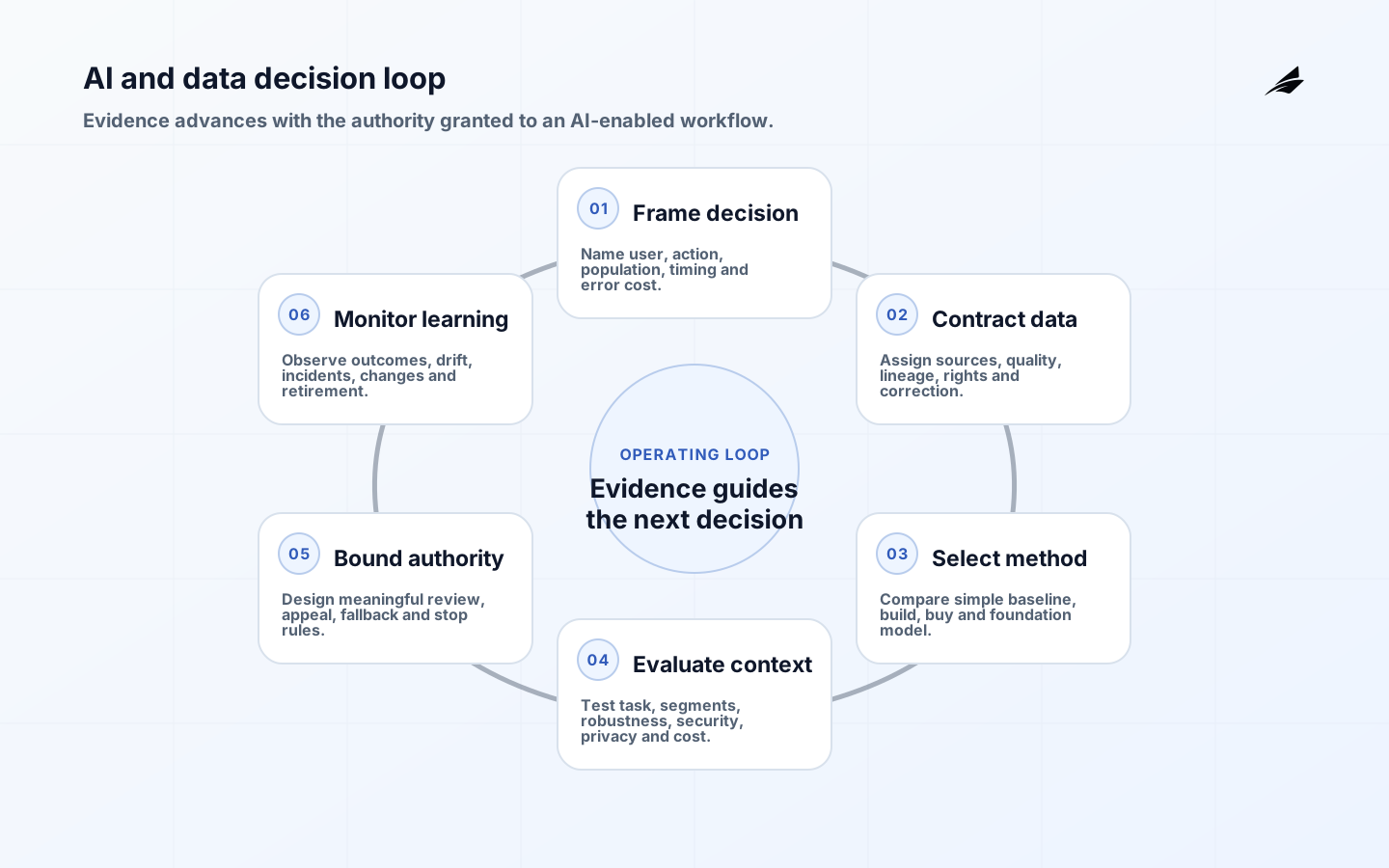
AI and data programs succeed when a defined decision receives trustworthy inputs, a fit-for-purpose method and accountable oversight. They fail when teams buy an AI capability before identifying the user, consequence of error and evidence needed to operate it. This FAQ answers the practical questions leaders should settle from use-case selection through monitoring. It applies to predictive models, classification, optimization and generative AI, while recognizing that controls should scale with impact.
For a stepwise delivery path, use the AI and data implementation checklist and the broader data and AI implementation checklist. The AI and data practical guide provides additional planning context.
What does an AI and data program include?
It includes the decision or workflow, source records, acquisition, quality controls, features or context, model, user experience, human authority, evaluation, deployment and feedback. A model is one component. For example, a demand forecast is useful only if planners know its horizon, covered items, uncertainty and how overrides affect replenishment. Assign owners for the business outcome, data products, model behavior, application and risk. A single “AI owner” cannot legitimately approve every domain assumption and consequence.
The NIST AI Risk Management Framework uses Govern, Map, Measure and Manage to connect organizational controls with contextual risk and evaluation. Use it as a flexible structure, not a guarantee. Build an inventory that includes third-party and embedded AI. Record purpose, users, data, authority, affected groups, deployment status and material dependencies so oversight is based on the real estate.
| Use pattern | Primary evidence | Common safeguard |
|---|---|---|
| Forecast | Backtesting by horizon, segment and regime | Uncertainty display and planner override |
| Classification | Precision, recall and error cost by relevant group | Confidence threshold and review queue |
| Optimization | Objective, constraints and scenario behavior | Hard limits and feasible fallback |
| Generative assistant | Task success, groundedness, unsafe output and latency | Source citation, filtering and escalation |
| Automated decision | Outcome validity, fairness, legality and appeal | Bounded authority and meaningful human review |
How do we know whether data is ready?

Start with fitness for the stated purpose. Identify the authoritative source, observation unit, event time, label definition, population and expected delay. Profile missingness, duplicates, impossible values, changing codes and representation across important segments. Check whether the information available during training will actually exist at decision time; leakage can produce excellent offline scores and poor production behavior. Preserve lineage from model input back to source and transformation version.
Data quality is not one score. Timeliness may matter more than completeness for fraud triage, while historical consistency may dominate a long-range forecast. Set purpose-specific rules and route failures. Document licensing, consent, retention and permitted use. The NIST Privacy Framework helps teams connect data processing with privacy risk. De-identification reduces some risks but does not automatically make linkage or sensitive inference impossible.
Should we build, buy or use a foundation model?
Compare the simplest viable method first. A deterministic rule, search system or standard statistical model may be cheaper, easier to validate and more stable. Buy when a vendor supplies a mature capability and the organization can evaluate it in context. Build when proprietary data or workflow creates meaningful differentiation and the team can support the lifecycle. Foundation models suit broad language or multimodal tasks, but add provider, grounding, prompt injection, content and cost risks.
Run a representative evaluation before commitment. Give every option the same task set, baseline and acceptance criteria. Include rare but consequential cases and dependency failure. For generative systems, the NIST Generative AI Profile identifies risks such as confabulation, harmful bias, privacy, information integrity and supply-chain concerns. Contract for model-version notice, data use, security evidence, incident support, export and exit.
What should evaluation measure?
Measure task performance, error consequence, robustness, latency, security, privacy and operating cost. Break results down by product, geography, language or affected group where meaningful. Averages can conceal unsafe pockets. Compare against the current process and a simple baseline. Evaluation data must be separated from development and refreshed as the environment changes. Have domain experts review disputed cases and document why an answer is acceptable rather than collecting preference scores without criteria.
The GAO artificial intelligence guidance organizes accountability around governance, data, performance and monitoring. That framing is useful for acceptance: a technically strong model still fails if authority or monitoring is absent. Define release thresholds and stop conditions before seeing final results. Track known limitations and populations outside scope in user-facing workflow, not only in a model card that operators never see.
What does meaningful human oversight require?
The reviewer needs time, competence, relevant evidence and authority to disagree. A mandatory click after an opaque recommendation is not oversight. Show inputs, uncertainty, sources and policy context appropriate to the task. Route low-confidence or high-impact cases to qualified staff. Monitor whether users simply accept outputs, whether overrides improve outcomes and whether queue pressure makes review nominal. Design an appeal or correction path for people affected by consequential errors.
Legal obligations depend on use and jurisdiction. The official EU AI Act text uses risk-based requirements and phased application dates; organizations need a current legal assessment of role, system and territory. Do not label a system compliant based on a vendor statement alone. Maintain evidence for classification, intended purpose, instructions, oversight and post-market monitoring where applicable.
How should AI be monitored in production?
Observe input quality, population shift, model or prompt version, task success, harmful errors, latency, cost, overrides, complaints and downstream outcomes. Distribution drift is a signal to investigate, not proof of failure. Outcome labels may arrive late, so combine leading indicators with periodic retrospective evaluation. Log enough context to reproduce material decisions while minimizing sensitive data. Monitor dependencies such as retrieval indexes, policies, external APIs and feature pipelines; model metrics alone miss many incidents.
Set escalation and rollback authority. A safe response may disable one automated action, revert a model, narrow a population or switch to manual workflow. Rehearse the fallback and ensure staff capacity exists. Review incidents for technical and governance causes: unclear purpose, missing owner, poor data contract or incentive can recur even after a model patch. Retire models deliberately and preserve required decision evidence.
| Production signal | Interpretation question | Possible response |
|---|---|---|
| Input shift | Did the population or collection process change? | Investigate source; rerun segmented evaluation |
| More overrides | Are reviewers correcting error or avoiding responsibility? | Sample cases; improve model or workflow |
| Rising latency | Is a dependency or context size responsible? | Degrade gracefully; optimize or change route |
| Outcome gap | Which segment and error type drives harm? | Restrict use; retrain or redesign decision |
| Cost spike | Did volume, retries or model choice change? | Set limits; route simple tasks differently |
How do we prove value without overstating it?
Baseline the complete workflow, including waiting, rework, review and exception handling. Measure completed tasks, decision quality, cycle time, avoided loss, user effort and risk controls. Separate model contribution from process redesign. Use a pilot with a comparison group or phased rollout when practical. Include evaluation, monitoring, human review, provider usage and remediation in total cost. A demo that writes quickly may save little if staff spend equal time verifying every claim.
Create scale gates based on evidence: representative performance, operating ownership, security tests, fallback, user adoption and favorable unit economics. A pilot should be allowed to conclude that AI is not the right intervention. Preserve useful data and workflow improvements even when the model is retired. This keeps the program focused on decisions and service outcomes instead of defending sunk investment.
Key takeaways
Maintain a decision register linking every production use to its latest purpose, owner, evaluation, approved version and monitoring view. Review it after model, data, policy or provider changes. This small control prevents an experiment from quietly becoming a permanent decision service without renewed evidence or support.
What should an AI vendor provide?
Ask for intended purpose, supported and excluded uses, model and service versions, evaluation methods, relevant segment results, security architecture, data retention, training-data use, sub-processors, incident notice, monitoring interfaces and change policy. Require enough access to run your own representative tests. A generic accuracy figure or responsible-AI statement cannot establish fitness for a particular population and decision. Clarify whether prompts, uploaded records, corrections or outputs may be used to train provider systems and how deletion propagates.
Contract terms should address availability, latency, usage limits, intellectual property allocation, audit evidence, model updates, export and transition. Preserve a route to retrieve decision records after a model version is withdrawn. Evaluate provider concentration and the operational effect of a policy or price change. For high-impact use, a provider refusal to explain known limitations or support independent evaluation is itself material selection evidence.
- Frame AI around a named decision, population, consequence and accountable owner.
- Judge data quality against purpose and preserve lineage to authoritative records.
- Compare build, buy and simpler baselines on the same representative evaluation.
- Give human reviewers evidence, capacity and authority to intervene.
- Monitor workflow outcomes and dependencies, then retain a tested fallback and retirement path.
More AI and data questions
Do we need perfect data before starting?
No, but you need measured, purpose-fit data and a plan for known gaps. A bounded pilot can expose quality work. Do not hide missing labels or unrepresented populations behind an experimental label when outputs affect real people.
How often should a model be retrained?
There is no universal schedule. Retrain when monitored evidence and validated data show that a new model is likely to improve the defined objective. Automatic frequent retraining can amplify bad labels or operational anomalies.
Conclusion
Reliable AI is a managed decision system, not a model endpoint. Connect governed data, contextual evaluation, meaningful oversight and production learning. Teams that can explain the purpose, evidence, authority and fallback are positioned to gain value without granting technology more trust than it has earned.