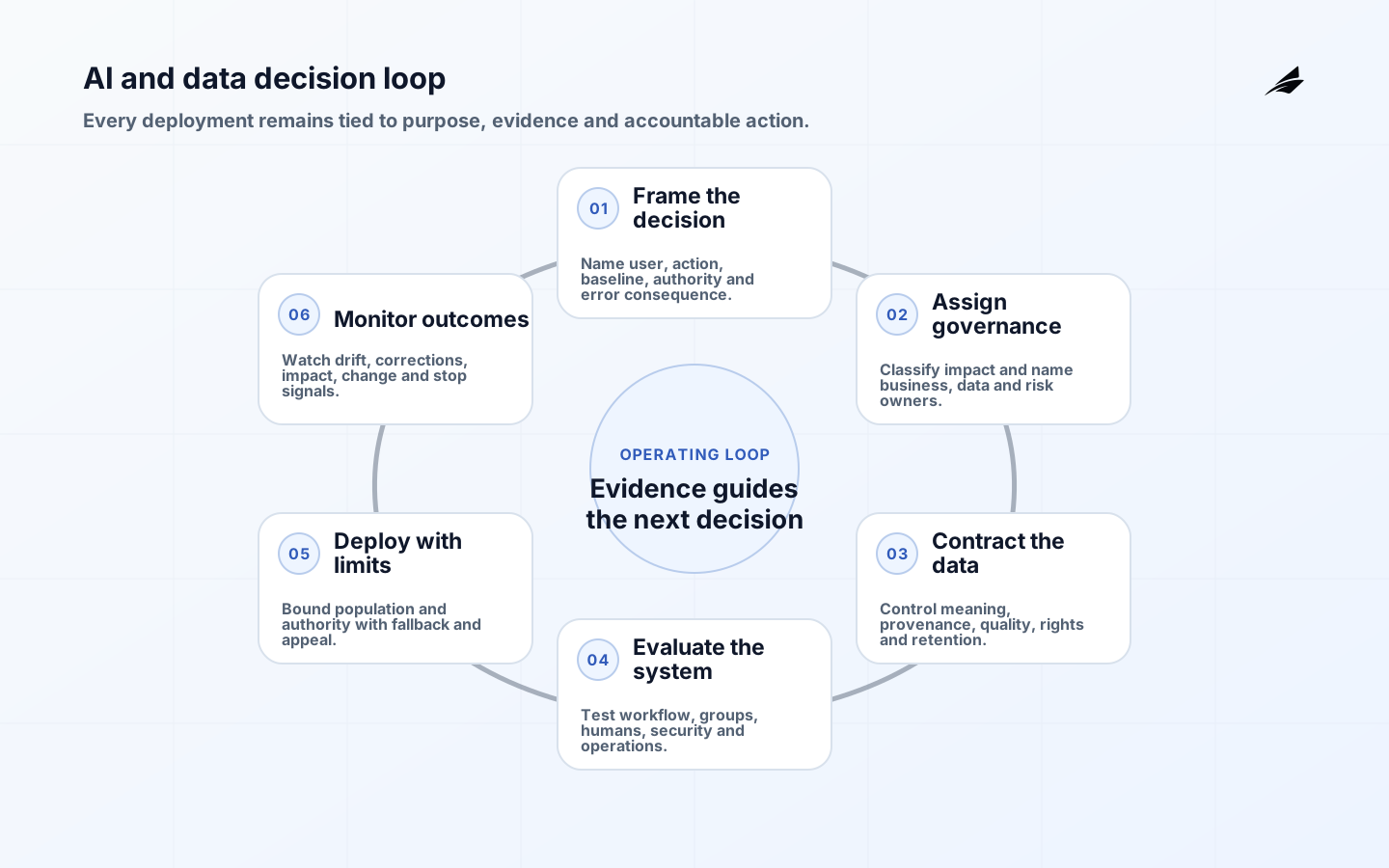
AI and data programs create value only when a system improves a defined decision or workflow with acceptable consequences. Buying a model, centralizing data or launching a chatbot is not the outcome. Business teams need to know who is affected, which action changes, what evidence supports the output, when a person intervenes and how the organization detects failure. This AI and data practical guide supplies that operating frame.
Continue with the AI and data implementation checklist, AI and data FAQ and broader data and AI governance FAQ. The essential move is to manage the complete system: purpose, data, model, interfaces, users, vendors and feedback. Model accuracy alone cannot show that a process is lawful, useful, fair, secure or recoverable.
1. Frame an AI use case as a business decision
Write a one-page use-case record naming the user, affected population, input, output, action, frequency, baseline, expected value and cost of error. Distinguish assistance from authority. A model that drafts a response for review has a different risk profile from one that denies a service or changes a price. Record prohibited uses and the conditions that trigger escalation, suspension or a non-AI fallback.
The NIST AI Risk Management Framework organizes work through Govern, Map, Measure and Manage and treats governance as continuous across the lifecycle. Use Map to understand context and impacts before discussing a model. Include operations, legal, privacy, security, domain experts, frontline users and representatives of affected groups where consequence warrants it. Their job is to expose assumptions a technical benchmark will not reveal.
| Use-case question | Strong answer contains | Warning sign |
|---|---|---|
| Who decides? | Named user, authority, review and appeal route | The system or vendor is treated as the owner |
| What improves? | Baseline, target, population and measurement period | General productivity without a measurable workflow |
| What can go wrong? | Error modes, affected parties, severity and fallback | Only average model accuracy is considered |
| Which data is needed? | Purpose, provenance, fields, rights and retention | All available data is copied first |
| When does use stop? | Threshold, owner, containment and communication | No one has suspension authority |
2. Establish ownership and proportional governance
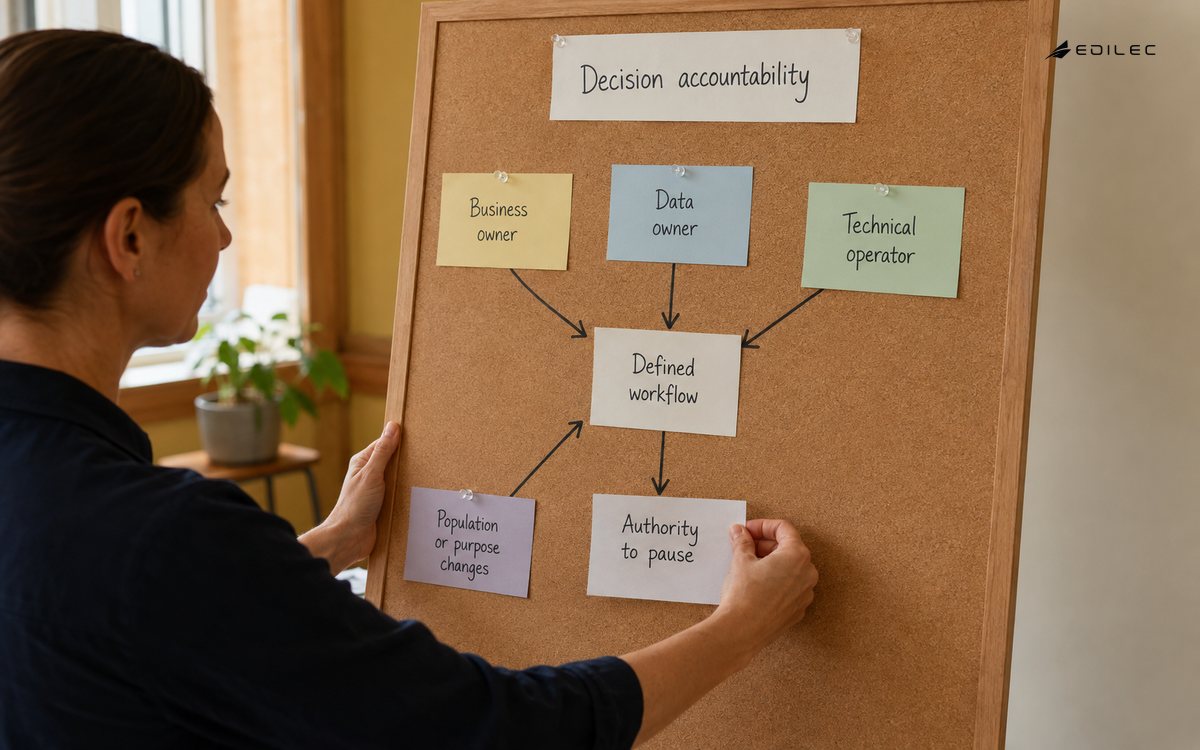
Create an inventory of AI systems and material automated decisions, including purchased features embedded in software. Assign a business owner accountable for purpose and outcomes, a data owner, technical operator, risk reviewers and a person authorized to pause use. Classify by impact and authority so review effort is proportional. Reassess when the population, model, data, integration or decision authority changes; a low-risk pilot can become material through quiet expansion.
The OECD AI Principles were updated in 2024 and emphasize human rights and democratic values, transparency, robustness and accountability. Applicable law remains contextual. The European Commission’s AI Act overview describes a risk-based regime with prohibitions, high-risk obligations and transparency duties on staged application dates. Determine roles, jurisdictions and intended purpose with qualified counsel instead of treating a voluntary framework as legal clearance.
3. Govern data from source to decision
Build a data contract for each authoritative source. Record owner, identifiers, field meaning, collection context, permitted purpose, population, quality rules, sensitivity, retention, refresh, transformation and change notification. Preserve lineage from output back to model or prompt version and source snapshot where feasible. Split training, tuning and evaluation data to avoid leakage, and keep a protected holdout that reflects the intended operating context.
When personal data is involved, apply data protection from design. The ICO AI and data protection guidance covers lawfulness, fairness, transparency, purpose limitation, minimization, accuracy, storage limitation, security and accountability, while noting that its guidance is under review following UK legislative change. The NIST Privacy Framework provides a risk-management structure. Inventory inference, logging, annotation and support access, not just the obvious input table.
4. Evaluate the system against real consequences
Define acceptance before tuning. Measure task performance by relevant subgroup, location, time period and difficult scenario; include false-positive and false-negative costs, calibration where probabilities are used, latency, availability, security, privacy and user comprehension. For generative systems, create scenario sets for factuality, unsupported claims, unsafe instructions, data disclosure, prompt manipulation, citation quality and refusal behavior. Human evaluation needs a rubric, trained reviewers, disagreement handling and recorded examples.
Compare the AI-assisted workflow with the current baseline and a simpler alternative. A modest model may be preferable if it is cheaper, explainable enough for the task and easier to operate. Test the surrounding application: retrieval, prompts, tools, permissions, caching, display, feedback and fallback. The NIST AI RMF Playbook offers suggested actions for the framework’s outcomes; tailor them to the use-case profile rather than turning every suggestion into an undifferentiated checklist.
| Evaluation layer | Example measure | Acceptance evidence |
|---|---|---|
| Business outcome | Completion time, error correction, loss avoided or service quality | Controlled comparison to a dated baseline |
| Model behavior | Precision and recall, calibration, groundedness or scenario pass rate | Versioned dataset, rubric and reproducible result |
| Affected groups | Performance and error severity across relevant populations | Sample rationale and reviewed disparities |
| Human control | Override quality, review time and automation bias indicators | Observed workflow test and reviewer feedback |
| Operations | Latency, cost, drift, incident and fallback behavior | Load, resilience and rollback exercise |
| Transparency | User understanding, notice and decision reconstruction | Usability evidence and retained lineage |
5. Design human oversight and bounded deployment
A human-in-the-loop label is not a control unless the reviewer has information, competence, time, independence and authority to reject the output. Show uncertainty and source evidence where appropriate, avoid interface defaults that encourage automatic acceptance, and provide a meaningful correction or appeal route. Sample accepted and rejected outputs to determine whether review is working. If reviewers approve nearly everything at impossible speed, investigate automation bias or workload pressure.
- Pilot with a bounded population, limited authority, explicit duration and non-AI fallback.
- Version model, prompts, retrieval sources, feature logic, evaluation set and deployment configuration together.
- Restrict tools and data to least privilege; separate development credentials from production authority.
- Publish user instructions, limitations, notices and routes to challenge or correct consequential output.
- Set release gates for risk review, security testing, privacy assessment, operational readiness and business acceptance.
- Rehearse model or vendor unavailability, harmful output, data corruption, rollback and incident communication.
6. Monitor outcomes, drift and change
Monitor what matters to the decision, not only model telemetry. Track input shifts, missing fields, performance proxies, correction and appeal rates, subgroup outcomes, unsafe events, latency, cost, human overrides, user abandonment and business results. Some ground truth arrives late, so define interim signals and retrospective evaluation. Route alerts to owners with authority and attach a playbook for containment, investigation, notification, fallback and reapproval.
Treat model, data, prompt, policy and vendor updates as controlled changes. Re-run affected evaluations and record why an update was accepted. Periodically challenge whether the AI remains necessary; process or policy changes may produce the outcome with less risk. Retire systems deliberately by removing integrations and access, preserving required decision records, informing users, ending supplier processing and verifying data deletion under applicable obligations.
Key takeaways
Practical example: a service team proposes AI to prioritize incoming cases. It defines the action as queue ordering, not automatic rejection, and measures time to first review against the existing rule-based process. Data owners document the source and meaning of case fields, remove proxy fields without a justified purpose, and preserve a holdout spanning case types and seasonal demand. Evaluators compare missed urgent cases and waiting time by relevant groups, while reviewers can override every recommendation and record a reason. The pilot has a four-week limit, daily safety review and rule-based fallback. Expansion depends on better service time without unacceptable disparity, unreviewed cases or growing correction rates.
- Define AI as a bounded decision system with a user, action, baseline and consequence of error.
- Inventory purchased and embedded AI, then scale review to intended purpose, authority and impact.
- Create data contracts and lineage that cover collection, transformation, inference, logging and deletion.
- Evaluate the entire workflow on representative scenarios, groups, human behavior and operating conditions.
- Give people genuine intervention authority and test whether oversight works under realistic workload.
- Monitor production outcomes and retain the ability to suspend, fall back, change safely and retire.
Frequently asked questions
Should a business build a data platform before choosing AI use cases?
Establish reusable data capabilities, but let prioritized decisions expose which records, quality and latency actually matter. A platform built without use cases often centralizes data without resolving meaning or ownership. Start with a small portfolio of decisions and improve shared foundations as repeated needs become clear.
What model accuracy is good enough?
There is no universal threshold. Compare performance with the current workflow and acceptable error by type, population and consequence. A high average can hide severe subgroup failure; a lower score may still create value in a reversible drafting task. Define acceptance and fallback before seeing the preferred model’s result.
Can a vendor’s assurance report replace internal evaluation?
No. Vendor evidence informs due diligence but cannot prove fitness for your data, users, integration and decision context. Test representative scenarios, inspect contract and change terms, understand data use and subprocessors, and retain a route to monitor, suspend and export. Responsibility follows the deployed use, not the procurement label.
Conclusion
Before approving expansion, require one decision record that a non-specialist owner can challenge. It should identify intended purpose, affected population, system and supplier versions, data sources, evaluation period, key results by relevant group, known limitations, human authority, monitoring signals, fallback and review date. Attach the evidence rather than summarizing it as “model approved.” This record gives operations a reliable baseline when an input changes or a complaint arrives, and it prevents a pilot result from being reused silently for a different population, decision or level of authority.
Reliable AI and data work begins with a decision worth improving and continues through accountable governance, governed data, context-specific evaluation, meaningful human control and production learning. This approach makes innovation faster to trust because teams know which evidence permits expansion and which signals require correction or shutdown.