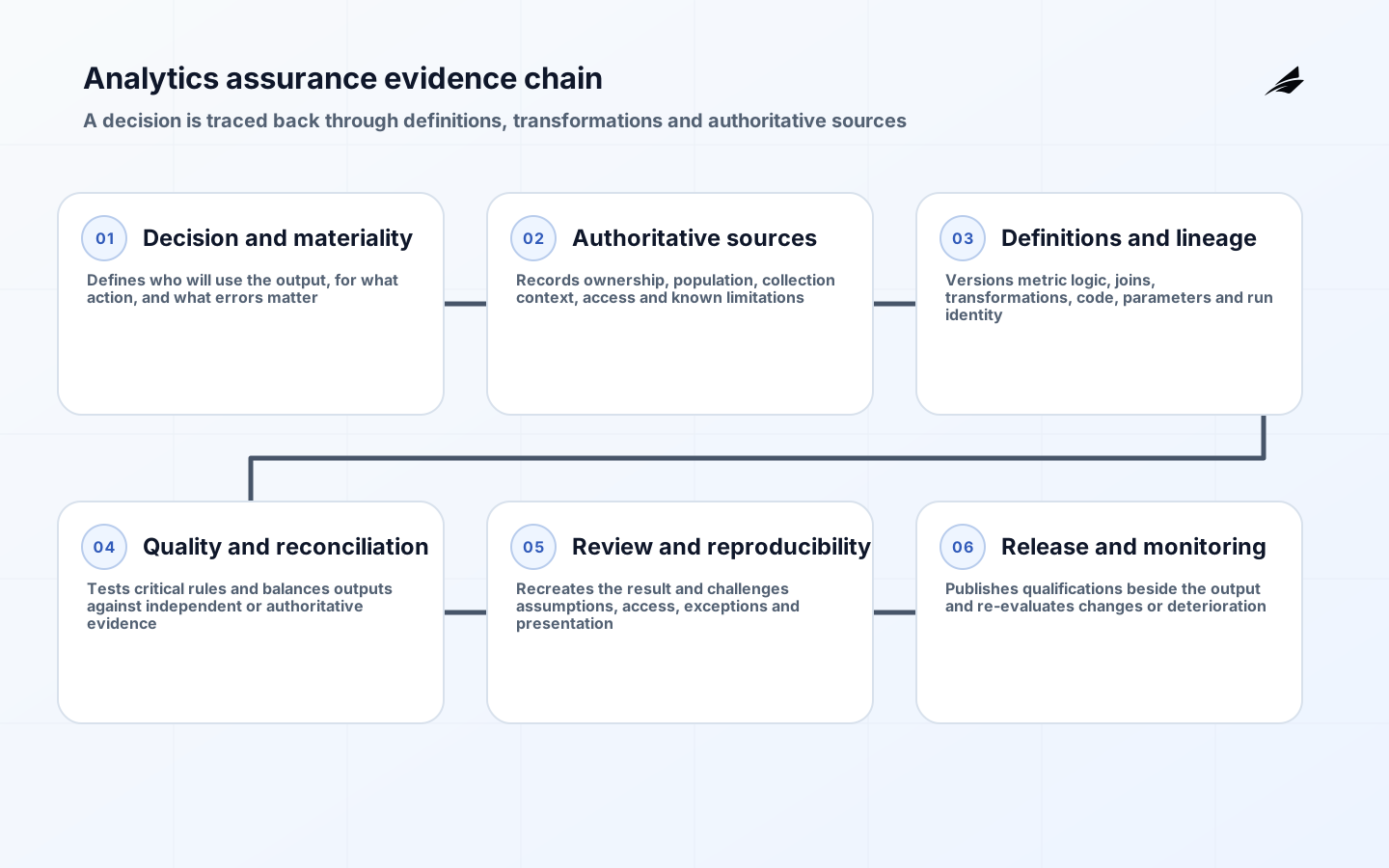
Data analytics assurance is not a technical task but a strategic imperative that demands clear boundaries, realistic expectations, and transparent risk management. Organizations often underestimate the complexity of ensuring data reliability, leading to costly failures in decision-making. This article focuses on practical, actionable steps to define scope, identify critical risks, and establish delivery protocols that balance effectiveness with resource constraints. Unlike generic frameworks, this approach emphasizes real-world applicability without over-engineering, ensuring that analytics initiatives deliver value without unnecessary overhead.
Defining Scope: Avoiding the Over-Engineering Trap
Scope definition is the first critical step in data analytics assurance. Many organizations attempt to cover the entire data ecosystem, resulting in unmanageable projects. Instead, focus on specific, high-impact use cases. For example, a retail company might prioritize customer behavior analysis over financial forecasting. This targeted approach reduces complexity and ensures that resources are allocated where they will have the greatest impact. The key is to identify the minimum viable scope that addresses the most pressing business needs without expanding into areas where data quality is inherently unstable.
- Identify one primary business objective that the analytics system must support
- Map data sources directly tied to that objective
- Exclude data streams with low relevance or high noise levels
This method prevents scope creep and ensures that the analytics system remains focused. By limiting the scope to a single, well-defined use case, teams can achieve faster validation and more reliable results. The U.S. Government Accountability Office highlights that over-engineering often stems from attempting to address too many use cases simultaneously, which dilutes the value of the analytics initiative.
Critical Risks: Beyond the Obvious
Data analytics projects face risks that extend beyond data quality issues. These include integration challenges, model drift, and external data source reliability. For instance, a financial institution using third-party market data might encounter sudden changes in data providers, leading to inaccurate forecasts. Understanding these risks requires a nuanced approach that goes beyond surface-level data validation. The UK Government Data Quality Framework emphasizes that risk assessment must consider both internal and external factors, including data source stability and regulatory compliance.
| Risk Category | Example | Mitigation Strategy |
|---|---|---|
| Data Source Reliability | Third-party market data providers discontinuing services | Implement dual data sources with automatic failover |
| Model Drift | Machine learning models becoming less accurate over time | Schedule regular retraining cycles with performance metrics |
| Integration Complexity | Legacy systems incompatible with modern analytics tools | Use API-based integration with fallback mechanisms |
This table illustrates how even well-structured data analytics systems can face significant challenges. Mitigation strategies must be practical and directly tied to the specific risk context. The UK Government Data Quality Framework provides guidance on how to assess and address these risks without overcomplicating the process.
Delivery Protocols: Iterative Validation Over Perfection
Data analytics assurance should prioritize iterative validation rather than a single, comprehensive review. This approach allows teams to identify and address issues early, reducing the likelihood of major failures later. For example, a healthcare organization might validate a patient analytics model in phases: first with a small pilot group, then expanding to a larger population based on initial results. This method ensures that the system remains robust and adaptable without requiring extensive upfront resources.

- Conduct a pilot test with a small, representative sample
- Measure key performance indicators (KPIs) at each stage
- Adjust the model based on feedback before full-scale deployment
The Code of Practice for Statistics supports this iterative approach by emphasizing the importance of incremental validation in statistical reporting. This method not only reduces risk but also builds confidence in the analytics system through continuous improvement.
Compliance Verification: Ensuring Regulatory Alignment
Compliance with regulations is a critical aspect of data analytics assurance. Organizations must ensure that their analytics systems adhere to relevant laws and standards, including applicable privacy, records, sector, and contractual obligations. The UK Government Data Quality Framework provides a structured approach to compliance verification, focusing on data accuracy, transparency, and accountability. This ensures that analytics initiatives do not inadvertently violate legal requirements, which could lead to significant penalties or reputational damage.
For instance, a financial institution must verify that its analytics system complies with data privacy laws when processing customer information. This involves regular audits of data handling practices and ensuring that sensitive data is protected through encryption and access controls. The NIST Privacy Framework offers a practical guide for implementing these checks without overburdening the analytics pipeline.
Real-Time Validation: The Balancing Act
Real-time validation is essential for maintaining data reliability in dynamic environments. However, implementing real-time checks can be resource-intensive. The key is to strike a balance between speed and accuracy. For example, a logistics company might use real-time validation for shipment tracking but rely on batch processing for financial reporting. This approach ensures that critical systems receive timely validation without overwhelming the infrastructure.
| Use Case | Validation Frequency | Resource Impact |
|---|---|---|
| Shipment Tracking | Real-time | Moderate |
| Financial Reporting | Daily | Low |
| Customer Behavior Analysis | Weekly | High |
This table demonstrates how different use cases require varying levels of validation. By tailoring the validation strategy to the specific needs of each use case, organizations can optimize resource allocation while maintaining data reliability.
Managing Uncertainty: Acknowledging What We Don't Know
Data analytics assurance inherently involves uncertainty. Organizations must acknowledge this and develop strategies to manage it effectively. For example, when data sources are unpredictable, teams should build in flexibility to adjust the analytics pipeline without disrupting operations. The U.S. Government Accountability Office notes that uncertainty is a natural part of data analytics, and the focus should be on adaptive responses rather than eliminating it entirely.
- Document known uncertainties in the project scope
- Build contingency plans for data source disruptions
- Use probabilistic models to quantify risk exposure
This approach ensures that teams remain prepared for unexpected challenges without over-engineering the solution. By focusing on manageable uncertainties, organizations can maintain a realistic timeline for analytics delivery while still achieving reliable results.
Cost Implications: Avoiding Hidden Expenses
Cost overruns are common in data analytics projects due to poor scope definition or inadequate risk management. For instance, a narrow analytics estimate can grow substantially when source investigation, data repair, reconciliation, and control evidence were omitted. The key to avoiding these costs is to define clear scope boundaries and implement robust risk assessment protocols early in the project lifecycle.
- Conduct a detailed cost-benefit analysis before project initiation
- Allocate a contingency budget for unexpected risks
- Use phased delivery to control costs
The UK Government Data Quality Framework provides a cost-effective approach to risk management, emphasizing that early identification of risks can prevent significant financial losses. This framework helps organizations avoid the pitfalls of underestimating the scope of data analytics assurance.
Data Reliability Assessment Methods
Implement a multi-tiered validation approach for data reliability, starting with automated schema checks to ensure structural integrity. This includes verifying data types, required fields, and format constraints against predefined templates. Next, execute statistical validation rules to detect anomalies such as outliers, missing values, and inconsistent patterns. Finally, conduct manual spot checks on high-risk datasets to validate real-world applicability and business relevance.
Integrate the assessment with continuous monitoring via the Government Data Quality Framework's real-time validation layer. This ensures that any deviations from expected quality standards are flagged immediately for remediation. The framework's predefined thresholds for accuracy, completeness, and timeliness must be dynamically adjusted based on the dataset's operational context and stakeholder requirements.
- Completeness and validity thresholds derived from the decision and critical fields
- Accuracy checks against an independent or authoritative source where feasible
- Timeliness and reconciliation limits owned by the users of the output
- Documented exceptions that block, qualify, or permit release
Data Reliability Assessment Methodology
Set quality thresholds from the intended decision, materiality, source behavior, and cost of error rather than copying a universal percentage. Record the rule, rationale, population, calculation, owner, response, and conditions that qualify or block use. Monitor the same rule over time and investigate changes at the source. The Government Data Quality Framework emphasizes fitness for purpose and clear communication of limitations; it does not prescribe one accuracy or incident-response threshold for every dataset.
Key takeaways
Data analytics assurance is a strategic process that requires careful scope definition, risk identification, and iterative validation. By focusing on high-impact use cases and implementing practical risk mitigation strategies, organizations can ensure that their analytics systems deliver reliable results without excessive cost or complexity.
Frequently asked questions
What is data analytics assurance?
Data analytics assurance refers to the process of validating that data analytics systems produce reliable, accurate, and trustworthy results. It involves assessing the quality, integrity, and compliance of data analytics outputs to ensure they meet business needs and regulatory requirements.
Why is scope definition important in data analytics assurance?
Scope definition is critical because it prevents over-engineering and ensures that resources are allocated to high-impact areas. Without clear boundaries, analytics projects can become unmanageable, leading to delays, cost overruns, and reduced effectiveness.
How do we manage uncertainty in data analytics assurance?
Managing uncertainty involves acknowledging what is unknown, building contingency plans, and using probabilistic models to quantify potential risks. This approach ensures that teams remain adaptable without over-engineering the solution.
What are the cost implications of poor data analytics assurance?
Poor data analytics assurance can lead to significant cost overruns due to unanticipated data quality issues, integration challenges, and compliance failures. Organizations that neglect this step may face financial losses, regulatory penalties, and reputational damage.
Conclusion
Analytics assurance is a decision about fitness for purpose, not a promise that every value is perfect. The work should connect a named decision to authoritative sources, transformation lineage, quality rules, reconciliations, access controls, reproducible outputs, known limitations, and an accountable release decision. Start with the most consequential output, test both the numbers and the process that produced them, and communicate qualifications beside the result. Assurance remains credible only when changes to data, code, definitions, and use trigger proportionate re-evaluation.