Analytics assurance services provide evidence that an analytical result is fit for its intended decision. Assurance is broader than checking whether a dashboard loads or a query returns rows. It connects user need, source quality, transformation logic, statistical or machine-learning assumptions, presentation, access, release control and monitoring. The required rigor should follow the consequence of error: a weekly internal trend and an automated eligibility decision do not need identical controls, but both need an explicit quality claim.
This implementation checklist is for organizations commissioning or formalizing an assurance capability across reporting, forecasting, experimentation and decision models. It complements the analytics assurance FAQ and the broader data and analytics implementation checklist. The central deliverable is an evidence trail that lets a reviewer reproduce the output, understand limitations and decide whether it may be used.
Classify the decision and assurance level
Write an analytical use statement: who uses the output, for which decision, at what cadence, for which population and with what consequence. Identify affected parties and foreseeable misuse. State whether the output describes, predicts, recommends or automatically triggers action. Set a risk tier using financial, safety, legal, customer and reputational impact, reversibility and scale. Higher tiers require stronger independence, test depth, approval and post-release surveillance.
Define acceptance before development. Specify required accuracy or uncertainty, freshness, coverage, stability, interpretability and privacy, along with conditions that block release. Record assumptions that cannot be verified and who accepts residual risk. NIST's information quality standards emphasize utility, integrity and objectivity, including clear, complete presentation and sound methods for analytical results. Those dimensions make a useful top-level review frame.
| Assurance tier | Typical use | Minimum review |
|---|---|---|
| Exploratory | Hypothesis generation with no direct action | Peer review, provenance and prominent limitations |
| Operational | Recurring staffing, inventory or service decisions | Tested data contract, reconciliation and business owner approval |
| Material | Financial reporting, pricing or customer treatment | Independent method review, controlled release and retained evidence |
| High consequence | Safety, rights or automated adverse action | Specialist legal/domain review, challenge testing and human override |
| External publication | Public statistics or claims | Disclosure review, reproducibility and corrections process |
Establish source contracts and provenance
Inventory every source with owner, collection purpose, population, units, time basis, update behavior, access classification and known limitations. Preserve lineage from source field to published measure. A source contract should define schema, semantics, expected volume, timeliness and change notification. For third-party data, record license, retrieval time and version. Do not treat an available table as suitable evidence until the generating process is understood.
The UK Government Data Quality Framework describes quality as fitness for purpose and recommends knowing users, assessing throughout the lifecycle, communicating clearly and anticipating change. Select dimensions relevant to the use: completeness, uniqueness, consistency, timeliness, validity and accuracy are common, but representativeness or linkage quality may be decisive. Define thresholds by critical field and decision rather than applying one generic score.
Make transformations reproducible and reviewable
Version code, configuration, metric definitions, reference data and environment dependencies. A released output should be traceable to a source snapshot or immutable partition, transformation commit and parameter set. Separate raw capture, standardized data, analytical models and presentation. Use deterministic builds where feasible and preserve seeds for stochastic methods. Restrict manual spreadsheet adjustments; when unavoidable, store them as reviewed input records with reason, owner and effective period.
Test at boundaries and invariants. Schema tests catch missing or changed fields; domain tests catch impossible values; reconciliation compares counts and totals; unit tests verify business rules; property tests check invariants; regression tests compare accepted outputs; and end-to-end tests prove a representative release. Include late data, duplicates, time-zone changes, reopened records and empty partitions. A green pipeline only proves that implemented checks passed, so reviewers must assess whether the checks cover the stated risk.
| Control point | Evidence | Release blocker example |
|---|---|---|
| Source intake | Schema, volume, freshness and owner checks | Critical feed outside agreed coverage |
| Transformation | Code review, unit tests and reconciliation | Unexplained difference from control total |
| Method | Assumption review and benchmark comparison | Performance below approved threshold |
| Presentation | Definition, uncertainty and accessibility review | Material caveat hidden from users |
| Publication | Approval, version manifest and rollback plan | Output cannot be reproduced from retained inputs |
Validate analytical methods against the real use
For descriptive metrics, review denominator, weighting, grouping, suppression and handling of missing values. For forecasts or models, define the baseline, holdout strategy, temporal leakage controls, calibration, uncertainty and error by relevant subgroup or operating condition. Compare with a simple benchmark; complexity that does not improve the decision adds risk. Test sensitivity to plausible changes in assumptions and identify where the method should abstain or be overridden.
Independent challenge should be proportionate but real. The reviewer needs enough separation to question the objective, source suitability, implementation and interpretation. Supply a concise assurance pack rather than expecting code inspection alone: use statement, risk tier, lineage, test results, validation report, limitations, approvals and monitoring plan. Resolve findings by evidence, scope reduction or explicit risk acceptance; do not convert unresolved concerns into vague future work while releasing unchanged.
Communicate quality, uncertainty and limitations
Present the metric definition, population, period, refresh time and material exclusions close to the output. Use ranges or intervals where point precision is misleading. Distinguish provisional from finalized data and observed from modeled values. The Government Data Quality Framework's practical guidance recommends metadata and clear communication of strengths and limitations. A caveat buried in documentation does not protect a user making a rapid decision.
Review visual accessibility, labels, units and export behavior. Prevent small groups or sensitive attributes from being exposed through filtering or differencing. Define who may view row-level evidence and who may only see aggregates. If the analysis influences an individual, provide the explanation, contest and human-review process required by the applicable policy and law. Assurance must cover how the output is consumed, not only how it is calculated.
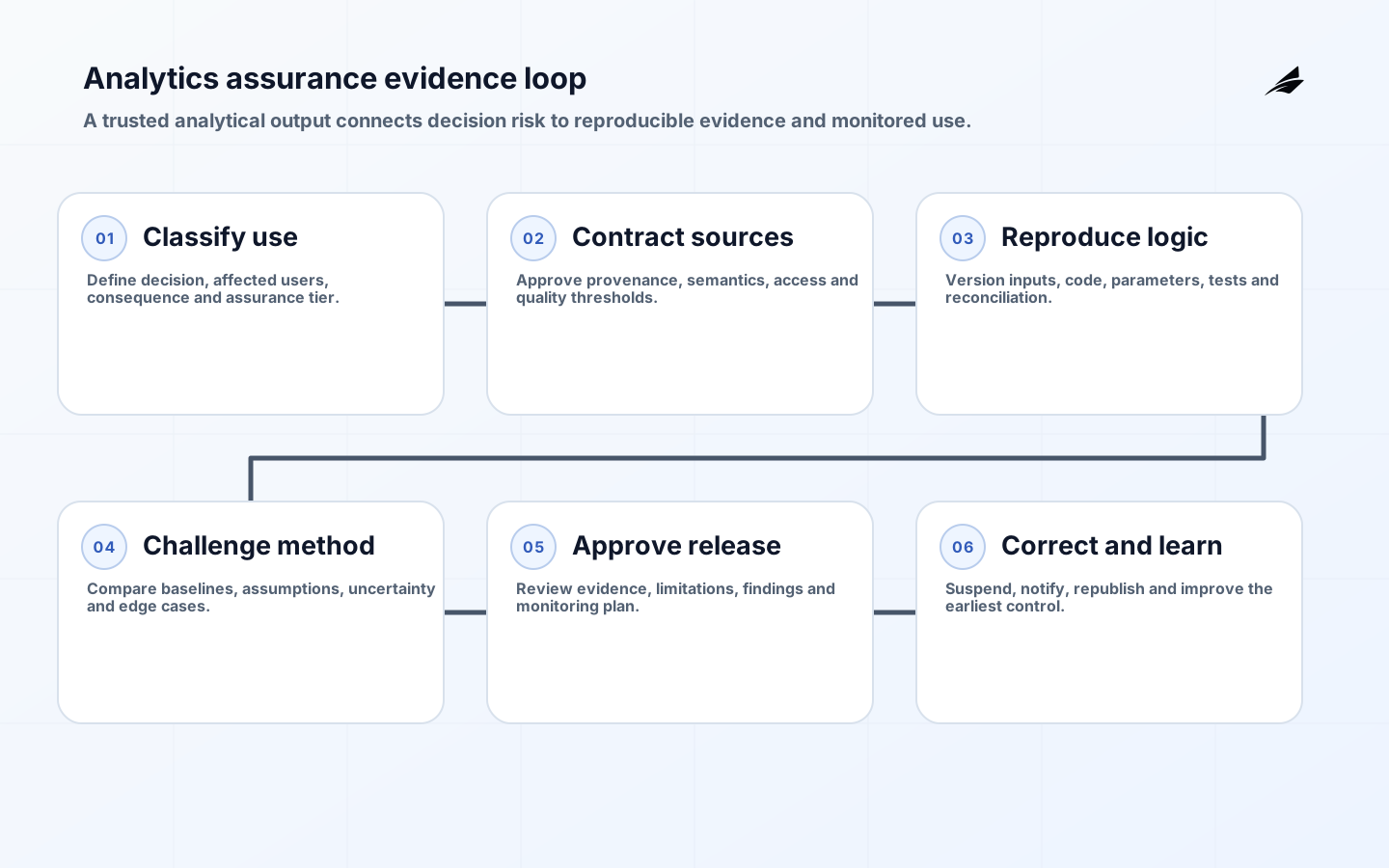
Implement assurance through a six-stage evidence loop
- Define the decision, users, consequences, risk tier and acceptance criteria.
- Approve source contracts, provenance, lawful access and quality thresholds.
- Build versioned transformations with tests and reconciliation controls.
- Validate the method against a baseline, edge cases and relevant conditions.
- Obtain proportionate independent review and release with a complete manifest.
- Monitor use, drift and incidents; correct outputs and improve controls.

Monitor analytical use and correct the record
Monitor source freshness and quality, pipeline tests, model or metric stability, output access and downstream decisions. Track overrides, user challenges and manual workarounds. A stable accuracy aggregate can hide degradation in one region or subgroup, so use the segmentation approved during validation. Microsoft's Power BI auditing guidance illustrates how curated audit data and a semantic model can support platform monitoring; apply equivalent governance to the chosen stack.
Create a correction policy before publication. Define who can suspend an output, notify users, republish history and preserve the original and corrected versions. Assess whether prior decisions need review. Conduct a blameless root-cause analysis across collection, contract, code, review and use, then add a control at the earliest effective point. Publish limitations and corrections with enough clarity that downstream users can update their own records.
Assurance suppliers should also transfer capability. Require documented methods, runnable tests, versioned code, data contracts, review templates and training for internal owners. Confirm that the organization can rerun a release, interpret failures and commission an independent challenge without relying on one consultant's private environment. Define evidence ownership and retention in the contract, including secure return or deletion of supplied data. At service close, have the receiving team reproduce a selected output and execute the suspension and correction procedure. A report declaring quality is less valuable than a repeatable control system the organization can continue to operate.
Schedule assurance according to change, not only the calendar. Reassessment should follow a new source, revised definition, material code change, changed population, new automated use or significant incident. For stable low-risk outputs, periodic review may suffice; for consequential models, continuous quality signals and frequent challenge may be necessary. Maintain a dependency map so one upstream change identifies all affected outputs. This risk-based trigger model directs review effort to actual exposure while avoiding the false confidence of an annual sign-off after the analytical system has already changed.
Key takeaways
- Scale assurance to the consequence, reach and reversibility of the decision.
- Preserve provenance from source collection through transformation and publication.
- Test source fitness, implementation, method and user interpretation separately.
- Use independent challenge and explicit release evidence for material analytics.
- Monitor actual use and maintain a transparent suspension and correction process.
Frequently asked questions
Who should own analytics assurance?
The decision owner accepts use risk, data owners attest source meaning, engineers own pipeline controls, analysts own method and interpretation, and an assurance or independent reviewer challenges the evidence. One accountable release owner should confirm that all required approvals and unresolved findings are visible.
Does every dashboard need independent validation?
Not at the same depth. Low-risk exploratory work may use peer review and prominent limitations. Recurring operational or externally published outputs need more formal evidence. High-consequence models require qualified independent challenge. Document the tier so rigor is consistent and review capacity follows risk.
What should an assurance sign-off contain?
Record the output and version, intended use, assurance tier, evidence reviewed, tests and validation results, limitations, open findings, monitoring plan, approvers and date. A sign-off is a bounded decision based on evidence, not a permanent claim that the analysis can never fail.
Conclusion
Analytics assurance turns trust from a reputation into inspectable evidence. Define the use and risk, contract the sources, make transformations reproducible, challenge the method and communicate limitations at the point of decision. With monitored release and correction controls, teams can improve analytical products without asking users to accept opaque numbers on faith.