AI data analytics uses machine learning or generative models to classify, forecast, detect patterns, explain results or help people explore data. It can shorten the path from a question to an investigation, but it cannot repair an undefined metric, missing lineage or weak decision process. The central buyer question is not whether a tool can generate a chart. It is whether the organization can trace, test and act on the resulting insight with an error tolerance appropriate to the decision.
The Data Analytics Artificial practical guide helps teams frame the capability, while the implementation checklist covers production preparation. This FAQ addresses recurring decisions about use cases, semantic layers, generative interfaces, privacy, validation, cost and operating ownership.
Which AI analytics use cases are worth pursuing?
Start where a repeated decision has enough volume, data and consequence to justify improvement. Forecasting demand, detecting anomalous transactions, classifying support cases, prioritizing maintenance and finding drivers of churn can be suitable when a baseline exists. Natural-language exploration can help occasional users formulate queries, but the output should be constrained by approved metrics and permissions. Automated narrative summaries are useful when they point to evidence and communicate uncertainty.
Avoid starting with an enterprise chatbot that claims to answer any business question. Scope a user, dataset, decision and update cadence. Measure current analyst time, decision delay, error and missed opportunity. Test a simpler dashboard, alert or rule alongside the AI option. Some questions are infrequent enough that expert analysis is cheaper and safer than maintaining a production model.
| Use case | AI contribution | Human responsibility | Guardrail |
|---|---|---|---|
| Demand forecast | Estimate likely range and drivers | Choose inventory or staffing action | Prediction intervals and backtesting |
| Anomaly detection | Rank unusual patterns | Determine cause and consequence | Known-event replay and alert budget |
| Natural-language BI | Translate a question into governed query logic | Check interpretation before acting | Semantic layer, permissions and query preview |
| Narrative summary | Describe changes and possible contributors | Validate material claims and context | Source citations and prohibited causal language |
| Case classification | Suggest category and priority | Handle ambiguity and exceptions | Confidence threshold and correction capture |
What data foundation is required?
Create an owned analytical contract for important datasets: source, grain, keys, allowed values, transformation logic, freshness, permitted use and quality tests. Define business metrics once in a governed semantic layer where possible. “Active customer” or “gross margin” should not change meaning when a user switches from a dashboard to a conversational interface. Record lineage to source and transformation versions so an analyst can reproduce an answer at the time it was produced.
Assess quality in relation to use. The Census Bureau’s information quality guidance discusses utility, objectivity and integrity; those dimensions are useful beyond official statistics. A dataset can be technically valid but unfit for a forecast because the collection process changed. Test representation, missingness, label quality, leakage and historical coverage. Assign owners to remediation and define how the AI feature behaves when a freshness or quality threshold fails.
Can generative AI safely answer questions about company data?
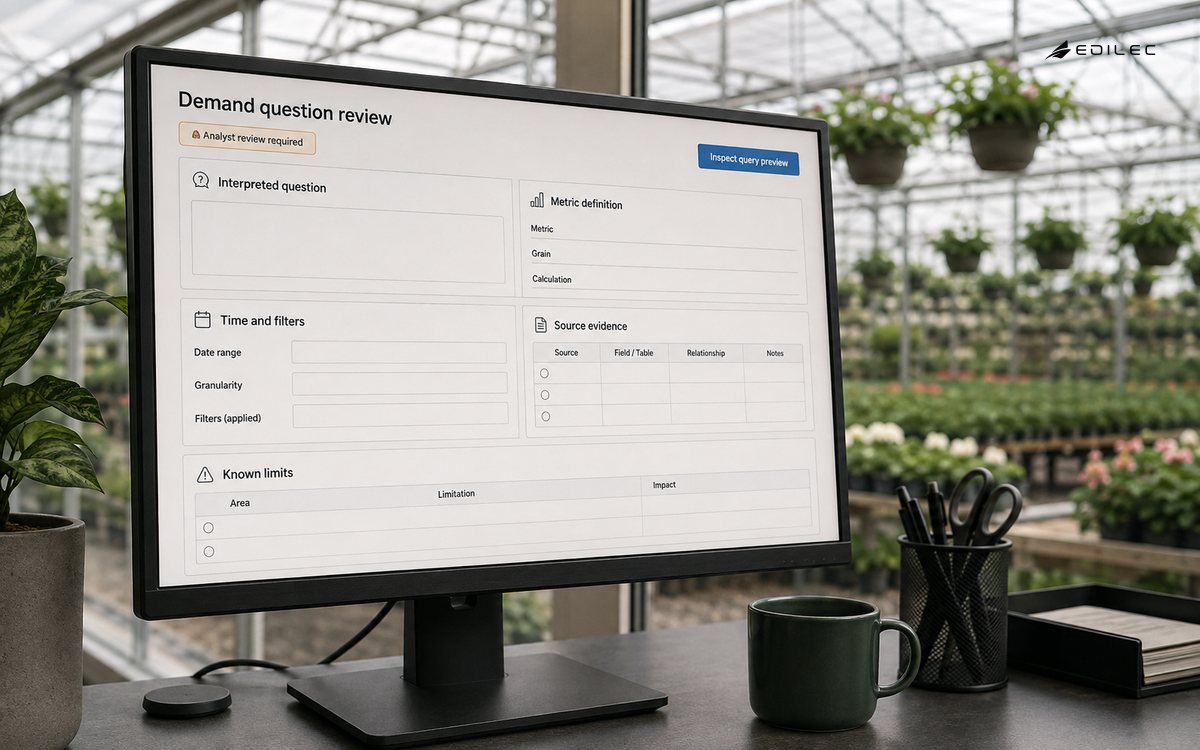
It can assist through retrieval, semantic query generation and explanation, but the model should not invent business logic or bypass row-level access. Resolve user identity before retrieval, enforce source-system permissions, restrict accessible schemas and validate generated queries. Show the interpreted question, filters, time period, metric definition and sources. For high-consequence decisions, require review of the underlying result rather than accepting fluent prose as evidence.
Treat prompt injection and malicious content inside documents as data-security threats. Separate instructions from retrieved content, allowlist tools, constrain queries, limit result size and log actions. Redact or minimize sensitive data sent to model services. Check provider retention, training use, location and version-change terms. NIST’s generative AI profile highlights confabulation, information integrity, privacy and cybersecurity risks that apply directly to conversational analytics.
How should AI-generated analysis be validated?
Use a versioned evaluation set of real questions, known answers, edge cases and permission boundaries. Score metric selection, filter interpretation, query validity, numerical accuracy, source support, uncertainty communication and safe failure. For predictive systems, add out-of-time validation, calibration and segment performance. Compare the AI workflow with the existing baseline, including the time a person spends checking or correcting results.
Do not ask reviewers only whether an answer looks helpful. Require evidence and a rubric. Test misleading premises, sparse data, changing definitions, unavailable sources and adversarial instructions. Track severe-error rate separately from average quality. A small number of confident but unsupported financial or operational claims can make an otherwise impressive system unsuitable for unsupervised use.
| Validation layer | Test | Failure response |
|---|---|---|
| Data | Freshness, completeness, contract and lineage | Block or label the analysis and notify the owner |
| Semantics | Metric, grain, filter and time interpretation | Request clarification or show query preview |
| Model | Accuracy, calibration, robustness and segment result | Abstain, route to analyst or retrain |
| Access | User entitlement and sensitive-field handling | Deny and create a security event where appropriate |
| Decision | User action, outcome and unintended effect | Change workflow, threshold or use-case boundary |
How should privacy and sensitive data be handled?
Use the minimum data necessary for the analytical purpose. Classify direct identifiers, quasi-identifiers, confidential business data and sensitive attributes. Apply access at source and semantic layers, and prevent exports from becoming an ungoverned copy. The NIST Privacy Framework can help teams connect data processing to organizational governance and risk. Document retention, deletion, access review and permitted secondary use for prompts, embeddings, training and evaluation records.
Aggregation does not guarantee anonymity, especially for small groups. Establish minimum cell sizes or other disclosure controls appropriate to the context. Review whether segment analysis could stigmatize or disadvantage people. Provide a correction and recourse route when analytics inform consequential action. Monitor queries and downloads for misuse without collecting more user behavior than the security purpose requires.
What drives cost and how is ROI measured?
Cost includes source integration, data quality remediation, semantic modeling, model or API use, vector storage, compute, observability, evaluation, security review, user support and ongoing analyst ownership. Natural-language interfaces can also create unpredictable query and warehouse spend. Set per-user and per-workflow budgets, cache approved results where appropriate, limit expensive scans and monitor unit cost per accepted analytical task.
Measure value at the decision. Examples include forecast error and waste, earlier detection and avoided loss, analyst cycle time, percentage of questions answered with verified evidence, adoption by the intended users and correction burden. Do not count generated reports as value. Compare the result with the pre-AI baseline and include the cost of human validation. Stop or narrow a feature whose checking effort exceeds the decision benefit.
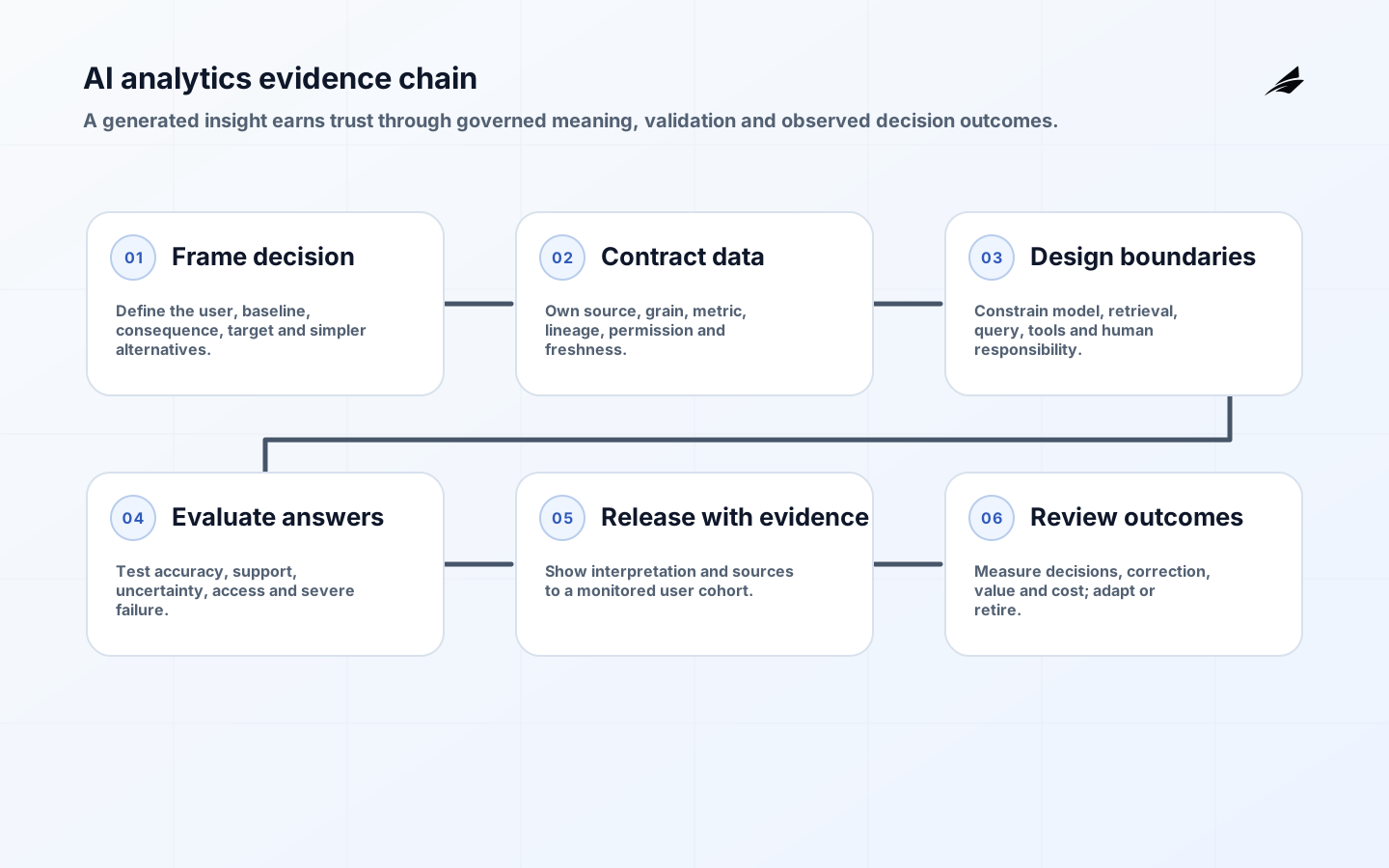
Build an evidence chain in six stages
- Frame one recurring decision, user, baseline, consequence and measurable target.
- Contract the source data, metric definitions, lineage, permissions and freshness rules.
- Design bounded model, retrieval, query and human-review responsibilities.
- Evaluate real questions, severe failures, access boundaries and workflow cost.
- Release to a controlled cohort with source visibility, monitoring and support.
- Review decisions and outcomes; improve, expand, restrict or retire the capability.
The same chain applies to predictive and generative analytics even though their tests differ. Teams building a wider data-and-AI operating model can use Data and Artificial: Practical Guide for Business Teams to align ownership and portfolio decisions.
Who operates and approves AI analytics?
Assign a product owner for decision value, a data owner for meaning and permitted use, technical owners for pipelines and models, and a risk owner for consequential boundaries. Analysts should curate evaluation cases and investigate corrections; platform teams should operate identity, cost, telemetry and release controls. Define who may approve a new dataset, metric, model or autonomous action. A conversational interface must not become an informal route around data governance because its output looks easier to consume.
Create a change policy. Low-risk wording changes may need sampled regression; metric logic, source, permission, model family or decision role can require full re-evaluation. Version the semantic model, prompt, tools and model identifier with each release. Announce material changes to users and preserve the ability to reproduce important answers. Review unresolved corrections and abstentions as product demand rather than training every query into a larger scope.
Prepare for analytical incidents
Define an incident as more than downtime. A leaked field, wrong metric applied across reports, fabricated citation, corrupted feature, unauthorized query or silent model change can require containment and stakeholder notice. Preserve query, source versions, model and output where permitted. Disable the affected tool or dataset, identify decisions that may have relied on it and issue a clear correction. Post-incident work should repair the source or control and add a regression case, not merely edit one generated answer.
Key takeaways
- Anchor AI analytics to a repeated decision with a measurable baseline.
- Govern metric meaning, lineage and permissions before adding conversation.
- Validate source support and severe errors, not just plausible presentation.
- Include privacy, security, human checking and warehouse cost in the operating model.
- Measure changed decisions and outcomes rather than generated analysis volume.
Frequently asked questions
Will AI analytics replace analysts?
It can automate query preparation, classification and first-pass explanation, but analysts remain essential for problem framing, semantic governance, causal reasoning, validation and decision communication. The strongest design removes repetitive work while making expert review more focused and visible.
What accuracy is good enough?
There is no universal percentage. Set thresholds from the cost and reversibility of each error, the baseline and the human review design. Track severe failure, calibration and subgroup behavior separately. A low-impact exploratory feature can tolerate more abstention and correction than an automated allocation decision.
Conclusion
AI data analytics is trustworthy when every insight has a governed meaning, permitted data path, tested method and accountable decision owner. Begin narrowly, make source evidence visible, test realistic failure and measure the changed outcome. Fluency is useful; traceability and decision quality are what make the capability durable.