How a company makes data useful depends on preserving context and control through the entire lifecycle. Data needs a purpose, accountable owner, understood source, stable meaning, quality appropriate to use, protected access, traceable transformations and a retirement decision. Without those elements, more collection and faster analytics can amplify ambiguity, privacy exposure and confident but wrong decisions.
This FAQ focuses on lifecycle governance and trustworthy analytics. The company data scope and delivery plan and company data implementation checklist cover implementation. For organization, funding and product ownership, see how a company makes data work.
What makes company data useful rather than merely available?
Useful data is fit for a named purpose and understandable to its user. Define the decision, required grain, population, time period, freshness, acceptable error and consequences of misuse. A finance close and a campaign trend can use different tolerances. Publish limitations and examples. Availability without semantic and quality context transfers hidden reconciliation work to every consumer.
The Federal Data Strategy practices cover governance, privacy, integrity, authenticity, inventory, documentation, standards, quality aligned with intended use and responsible access. Companies can apply the same lifecycle logic: create only what has purpose, protect it, make it interpretable, and maintain accountability for reuse.
How should the data lifecycle be governed?
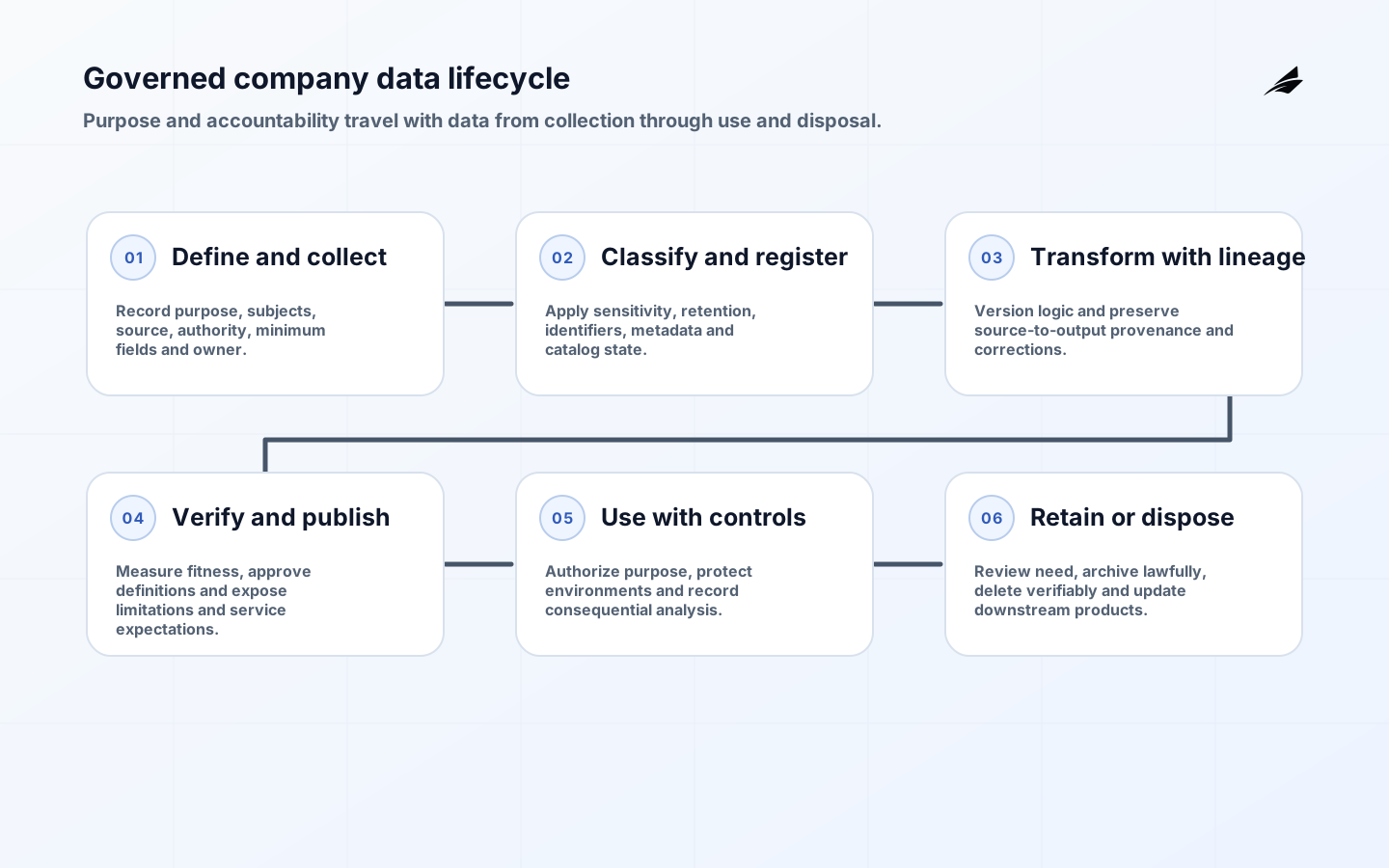
At collection, record purpose, source, authority, notice, owner and minimum necessary fields. At registration, assign classification, retention, identifiers and metadata. During transformation, version logic and preserve lineage. Before publication, verify quality and access. During use, enforce purpose and environment controls. At retirement, archive or delete according to obligation and propagate the change to copies and products.

| Lifecycle stage | Owner decision | Required record |
|---|---|---|
| Collect | Is this data necessary and permitted? | Purpose, source, notice and minimization |
| Store | Where and how long may it live? | Classification, location, retention and access |
| Transform | What meaning changes? | Code version, inputs, rules and lineage |
| Publish | Who may rely on it and for what? | Definition, quality, limits and service owner |
| Dispose | Has purpose or obligation ended? | Deletion scope, verification and downstream notice |
Who owns definitions and authoritative records?
Business domain owners approve meaning and permitted use; stewards maintain definitions and quality coordination; system owners operate source controls; data product owners support consumers; security and privacy roles set safeguards. Name one authority for each critical entity and measure. Authority can be distributed by domain, but competing definitions must be labeled for different purposes rather than presented as one truth.
Catalog governed products, not only physical tables. The W3C Data Catalog Vocabulary supports interoperable descriptions of datasets and services. Include title, purpose, owner, coverage, update cadence, access, distribution, quality, lineage, retention and lifecycle state. Search success should lead to an accountable, usable asset.
How is data quality measured?
Set dimensions and thresholds by use: completeness for required entities, validity against rules, consistency across authorities, timeliness for the decision, uniqueness at the business grain and accuracy against trusted evidence. Segment checks because an overall pass can hide a failing region or product. Record observation time and method, and distinguish measured quality from user annotation.
The W3C Data Quality Vocabulary provides terms for quality measurements, policies and annotations. Use it as a semantic reference, not a demand to produce one universal score. A failed critical check needs quarantine, notification, correction and backfill rules. Review recurring failures for source-process and ownership causes.
| Quality issue | Risk | Control and response |
|---|---|---|
| Late records | Decision uses incomplete period | Watermark, freshness objective and delayed mode |
| Duplicate entity | Overcount or conflicting service | Stable key, match review and merge history |
| Definition drift | Trend changes without business change | Versioned metric and impact notice |
| Silent schema change | Transformation misreads fields | Contract test, quarantine and owner alert |
| Biased coverage | Group outcome is misrepresented | Coverage analysis, limitation and collection remedy |
How much lineage is necessary?
Prioritize lineage for regulated reports, critical decisions, sensitive data and widely reused metrics. Capture source, transformation, responsible agent, time, version and output, plus manual adjustments. The W3C PROV-O Recommendation provides a model for representing entities, activities and agents. Automate technical lineage, then add business context where it affects interpretation.
Test lineage by impact analysis: when a source field changes, can owners identify affected products and users? When a metric is challenged, can an analyst reproduce the version and explain adjustments? Lineage that only draws a graph but cannot support those tasks is incomplete. Protect it because topology and sensitive names can aid attackers.
How should privacy and access be designed?
Minimize collection, separate identifiers, apply least privilege, use approved analysis environments and review high-risk linkage or export. Access decisions should include purpose, data class, role, duration and conditions, with recertification. Masking in a dashboard does not secure unrestricted underlying extracts. Use synthetic or de-identified data only after assessing re-identification and utility.
The NIST Privacy Framework helps organizations identify and manage privacy risk while building products and services. Connect privacy outcomes to data inventories, processing, communication and controls. Maintain processes for correction, objection, retention and incident response where applicable. Vendor access and analytics tools belong in the same inventory.
What controls make analytics trustworthy?
Version queries, models, metric definitions and material assumptions. Separate exploration from published production outputs. Require peer review for consequential analysis and preserve data snapshot, code, parameters and approvals. Visualizations should state population, period, units, denominator, uncertainty and known exclusions. Provide drill-through only within authorization.
Challenge causality claims. A correlation or forecast can support a decision without proving cause, but the limitation must be clear. Compare with a baseline, test sensitivity and monitor outcome after action. For AI uses, apply additional evaluation and human oversight described in the data and AI implementation checklist.
When should data be archived or deleted?
Create retention schedules by record and purpose, resolving legal, contractual, operational and research needs. Trigger review when products close, consent changes, contracts end or data becomes obsolete. Deletion must cover replicas, caches, exports, feature stores and provider copies, with documented exceptions for protected backups. Restore processes should not silently resurrect expired live data.
Measure deletion completion, orphaned assets, overdue retention reviews and unsupported products. Archive when continued access is required but active processing is not; apply access and format preservation. Disposal reduces cost and attack surface while respecting people and obligations. It is a positive control outcome.
Establish a data issue and correction process visible to consumers. Users should be able to report a suspect value or definition, receive an owner and status, and learn which published products are affected. For material corrections, preserve the original, reason, approver, effective time and downstream backfill. Notify users who may have made consequential decisions. Quietly overwriting history makes audit and learning impossible.
Govern external data with the same rigor as internal collection. Record supplier, license, permitted uses, geographic and sharing restrictions, refresh, quality commitments and termination rights. Test how the provider corrects records and how dependent products respond. Procurement should secure export and deletion evidence. Publicly available data can still have license, privacy, representation and fitness limitations.
Use separate zones or workspaces for raw restricted data, controlled transformation, approved analytics and public or broad distribution. Movement between them should be authorized, logged and tested for disclosure. Analysts need safe ways to collaborate without downloading uncontrolled copies. Monitor unusual exports and query patterns while avoiding surveillance measures that lack purpose or transparency.
Create a review path for data linkage. Combining individually low-risk datasets can reveal sensitive relationships or change the population represented. Document the question, fields, matching method, false-link risk, affected people, access, retention and review. Test linkage quality by relevant segments and preserve unmatched records appropriately. Do not allow a convenient shared identifier to become blanket permission for reuse.
Measure trust through behaviour and outcomes, not a survey alone. Track repeated reconciliation, disputed definitions, quality incidents reaching decisions, unsupported extracts, access turnaround, product reuse, correction time and retirement completion. Pair these with interviews to understand why users bypass governed products. High usage can reflect genuine value or lack of alternatives, while low usage can reveal poor relevance rather than poor communication.
Key takeaways
- Define usefulness by a purpose, user, quality tolerance and consequence.
- Carry ownership, classification, lineage and retention through every lifecycle stage.
- Govern definitions and publish limitations alongside data products.
- Measure quality by intended use and design quarantine and correction paths.
- Treat controlled use, reproducible analysis and verified disposal as core capabilities.
Frequently asked questions
Does a company need one source of truth?
It needs an explicit authority for each entity or measure in a purpose and time context. Different governed views can serve different purposes. Problems arise when differences are undocumented or consumers cannot tell which authority applies.
Should data be cleaned centrally?
Fix defects as close to the source process as possible and standardize reusable transformations. Central teams can provide tooling and cross-domain rules, but they should not repeatedly mask source failures without accountable remediation.
Can data be retained because it may be useful later?
A vague future possibility rarely justifies unlimited retention. Document a permitted purpose, value, risk and review date. Aggregate, minimize or delete when detailed records are not necessary, subject to applicable obligations.
Conclusion
A company makes data useful by governing meaning, quality and responsibility from collection to disposal. Catalogs and pipelines help, but trust comes from explicit purpose, authoritative definitions, traceable transformation, proportionate access, reproducible analysis and verified lifecycle decisions. Apply the model first to data supporting a consequential decision, then expand with evidence and ownership intact.