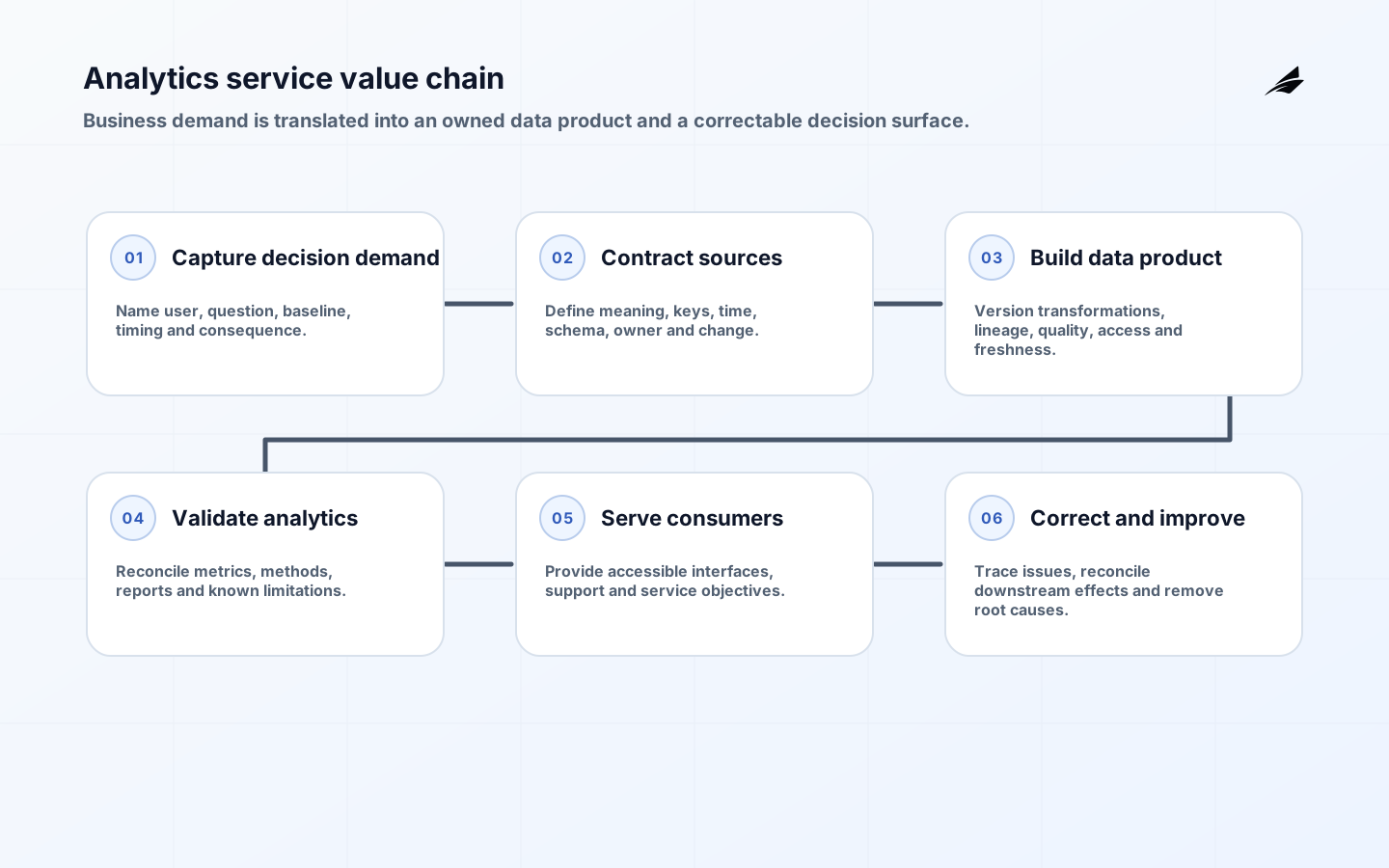
Data and analytics services design, build and operate the path from source records to trusted data products, metrics, analysis and decision support. They may include strategy, governance, engineering, business intelligence, experimentation, data science and managed operations. The useful boundary is not a tool category; it is a set of business questions with defined evidence, quality, access, freshness and ownership.
This FAQ complements the data and analytics services scope guide, the implementation checklist, the data and AI services checklist and the data and AI services FAQ. Use it to compare internal teams and providers on operating outcomes rather than a list of platform features.
What should data and analytics services deliver?
A service should deliver reusable, documented products: a source-aligned dataset, governed metric, analytical model, dashboard, experiment or decision interface. Each product needs users, owner, source contracts, schema, quality rules, lineage, access policy, refresh and support objective. One-off extracts can be necessary, but repeated extracts without ownership become shadow interfaces and conflicting definitions.
Separate data platform capability from data product responsibility. A platform team may provide storage, processing, catalog, orchestration and policy. Domain owners still define meaning and correct source behavior. Analytics specialists formulate measures and interpretations with business owners. The NIST Big Data Reference Architecture offers vendor-neutral roles and functional components; use architecture to clarify responsibilities without assuming one technology stack.
| Deliverable | Contract | Owner evidence |
|---|---|---|
| Source-aligned data | Schema, event time, keys and change behavior | Source and data product owners |
| Governed metric | Definition, grain, filters and reconciliation | Business metric owner |
| Dashboard | Audience, decisions, freshness and accessibility | Decision and support owners |
| Analytical model | Population, method, validation and limits | Analytical and business owners |
| Data API or share | Purpose, access, version and service objective | Producer and consumer owners |
How should data quality be defined?
Quality is fitness for a named use, not cleanliness in the abstract. The Government Data Quality Framework emphasizes users, lifecycle assessment, communication and anticipation of change. Define rules on fields and relationships that affect the decision. A missing optional contact note and a missing payment amount should not receive equal priority.
Measure completeness, uniqueness, consistency, timeliness, validity and accuracy where relevant, and add domain-specific rules. Show numerator, denominator, exclusions, time and owner. The accompanying data quality guidance recommends action plans, root-cause analysis and metadata. Route failures to source process owners and publish limitations to consumers; silently repairing downstream data can preserve the cause.
Which architecture choices matter most?
Prioritize identity, metadata, lineage, interoperability and reliable change over fashionable labels. Capture data with source and event time, preserve immutable raw evidence where justified, and transform through versioned tested code. Use workload isolation and cost controls. Define batch and streaming semantics, late data, duplicate handling, deletion propagation and recovery. Keep production data out of unmanaged notebooks and development copies.

A catalog is useful only when ownership and metadata stay current. W3C PROV-O provides interoperable concepts for entities, activities and agents. The W3C Data Quality Vocabulary allows quality observations and policies to be represented without declaring one universal definition of quality. Teams can borrow these concepts even when their implementation uses a commercial catalog.
| Architecture decision | Option question | Evidence |
|---|---|---|
| Batch or stream | How quickly does the decision need changed data? | Latency need, late-event test and cost |
| Central or domain product | Where does meaning and ownership live? | Named producer, consumer and governance |
| Warehouse, lake or hybrid | Which workloads and interfaces must coexist? | Performance, security, portability and TCO |
| Copy or query in place | What are residency, freshness and load effects? | Access path, deletion and outage behavior |
| Managed or self-operated | Which skills and control are strategic? | Support, exit, evidence and lifecycle model |
How should legacy data be migrated?
Inventory datasets, reports, jobs, interfaces and real consumers before moving storage. Classify what to retain, rebuild, archive or retire. Profile data and resolve business keys, definitions and quality ownership. Migrate in bounded domains, preserve source identifiers and transformation versions, and reconcile counts, totals, relationships and business reports. Test historical periods and corrections, not only a recent sample.
Run old and new outputs in parallel long enough to explain differences. Some differences are fixes, others are defects or definition changes. Have the metric owner approve intentional changes and communicate them. Plan freeze, delta capture, rollback and retirement. A migration is incomplete while critical users continue extracting from the legacy system because the new product lacks freshness, detail or trust.
How are access, privacy and sharing controlled?
Classify data and purposes, minimize collection and retention, and grant access by role and approved use. Enforce policy at source, storage, query, export and downstream shares. Masking a display does not protect a bulk extract or model-training copy. Review service accounts, cross-border movement, vendor use, derived sensitive attributes and deletion propagation. Log consequential access while limiting logs themselves.
The NIST Privacy Framework connects privacy risk with enterprise risk management. Use it to identify data-processing roles, effects on individuals and controls, then apply applicable law with qualified privacy and legal professionals. A provider contract should address purpose, confidentiality, security, subprocessors, incident notice, return, deletion, model training and audit evidence.
What drives cost and pricing?
Cost comes from source count and change, data volume, compute pattern, latency, history, quality remediation, migration, security, licensing, support and user enablement. Project pricing fits a bounded assessment or migration; capacity or product-team pricing fits evolving work; managed service pricing may use pipelines, data volume or service levels. Normalize proposals around deliverables, coverage and expected growth.
Track cost per useful product, query workload, refreshed critical dataset or decision served, alongside adoption and quality. Attribute shared costs with a transparent rule. Optimize storage tiers, inefficient queries and idle compute, but do not reduce lineage, backups or tests without a risk decision. Include provider exit, data export and legacy retirement in the economic model.
How are analytics services operated?
Set objectives for freshness, completeness, availability, query performance and support response by criticality. Monitor from source event through consumer availability. Alert owners on contract failure, schema change, unusual volume, stale partitions and reconciliation variance. Provide incident, correction and communication paths. Consumers need to know when data is incomplete and when a corrected result is available.
Version metrics and communicate material definition changes. Review access, costs, dormant products, quality trends and user outcomes. Measure time to detect and resolve data incidents, recurring root causes, certified-product adoption and report retirement. The service succeeds when users can make a decision with understood evidence; platform uptime alone is insufficient.
Design a visible data correction workflow
Give consumers a way to report a questionable value from the metric, dashboard or data product they are using. Capture the product version, filters, record or aggregate, expected behavior and business impact without requiring the user to know the pipeline. A data support owner triages whether the issue is source data, transformation, definition, access, freshness, presentation or interpretation, then routes it to the accountable owner with a severity and response objective.
Preserve the original and corrected value, reason, effective time and affected outputs. Decide whether history should be restated or a correction applied prospectively, and have the metric or data owner approve that policy. Identify downstream extracts, models and reports that consumed the incorrect result. Notify affected users in language that explains consequence and action, not only that a pipeline was rerun. A correction is incomplete until dependent decisions are considered.
Review recurring issues for root causes and preventive controls. A repeated invalid country code may require source-form validation; a recurring late partition may require a producer contract or schedule change; disputed revenue may expose an unresolved definition. Publish correction rate, time to contain, time to reconcile and repeat causes alongside platform availability. This makes trust repair part of the analytics service instead of an informal conversation between individual analysts.
Prioritize correction by decision impact and time sensitivity, not only record count. One wrong bank balance used in a covenant report may matter more than thousands of optional profile fields. Maintain a contact path for critical consumers and a public status within the organization for material data incidents. If a corrected dataset feeds AI or regulatory reporting, involve the model or reporting owner to determine whether reevaluation, resubmission or notification is required.
Test the workflow with a seeded error before launch. Confirm a consumer can report it, support can locate the producing job and source record, owners can approve a correction, and affected products can be enumerated. Time the exercise and inspect the communication. Seeded tests reveal missing lineage and contacts without waiting for a month-end or regulatory deadline to expose them. Retest after material pipeline, catalog or ownership changes.
Key takeaways
- Contract for owned data products and decisions, not only platform activity.
- Define quality by use and route root causes to source and domain owners.
- Preserve lineage, time semantics, access and deletion through every transformation.
- Reconcile migrations with business measures and retire legacy dependencies deliberately.
- Operate freshness, quality, support, cost and correction as service outcomes.
Frequently asked questions
Should a provider choose the analytics platform?
The provider can recommend options, but the customer should approve against workloads, skills, security, integration, cost, portability and exit. Run a representative proof for uncertain performance or economics. Architecture should remain explainable independently of vendor terminology.
Can there be one source of truth for every metric?
Aim for one governed definition per decision context, not one giant table. Similar labels may legitimately differ by grain, time or policy. Make context explicit, assign an owner, link definitions and prevent accidental reuse. Reconciliation is more useful than pretending semantic differences do not exist.
Conclusion
Data and analytics services create trust by joining business meaning with reliable engineering and operation. Fit-for-purpose quality, visible lineage, controlled access, reconciled change and named ownership make analytical outputs reusable. Those capabilities matter more than where the data is stored or which dashboard brand displays it.