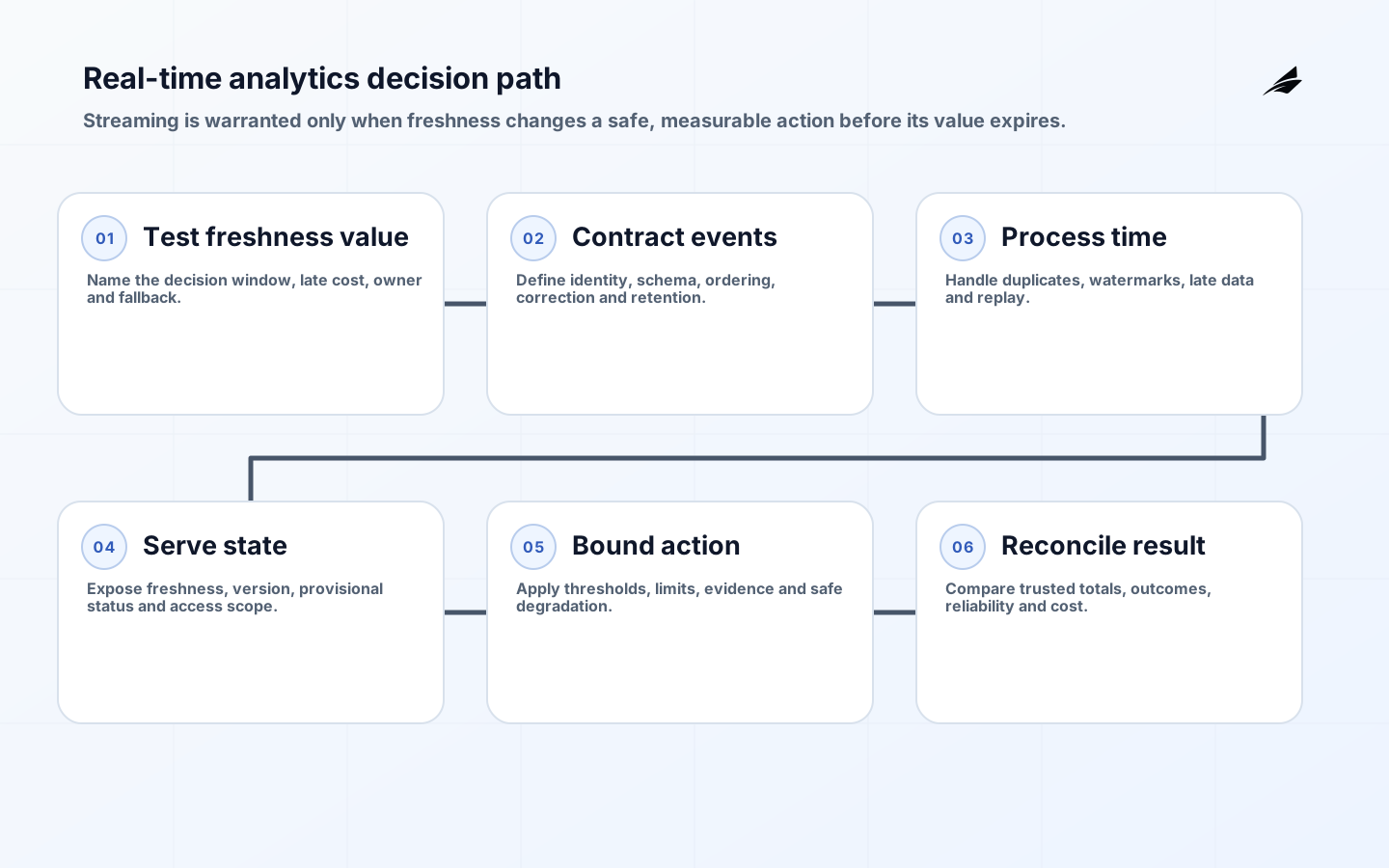
Real-time analytics when it matters means fresher evidence changes an action before the opportunity or risk expires. Fraud intervention, equipment protection, inventory reservation and live service routing can justify seconds or milliseconds. A monthly management review usually cannot. The architectural question is not whether streaming is modern; it is whether end-to-end decision latency, including human or automated response, creates enough value to pay for continuous operation and correction.
This guide provides that decision test and an implementation path. It works with data contracts between systems and teams, dashboard adoption for managers and master data ownership. “Real time” must be a measured service objective, not a label attached to a dashboard.
Test whether a decision truly needs real-time analytics
Write the event, decision, latest useful action time and cost of acting too late. Then map source delay, transport, processing, serving, notification and response. If a five-minute pipeline feeds a queue reviewed tomorrow, faster computation does not improve the outcome. Compare alternatives such as operational rules inside the transaction, micro-batches every few minutes, change-data capture or an hourly incremental model.
Quantify the freshness-value curve. Some actions lose value sharply after seconds; others decline gradually. Include false-positive cost, operator capacity and reversibility. A live alert that nobody can safely investigate is negative value. A batch result may be better when completeness, reconciliation and explainability matter more than immediacy, especially for billing, statutory reporting and decisions requiring several late-arriving sources.
| Decision pattern | Suitable latency | Architecture starting point |
|---|---|---|
| Stop unsafe machine state | Milliseconds to seconds | Local or edge rule with asynchronous analytical record |
| Detect payment or account abuse | Seconds to minutes | Event stream, stateful features and bounded decision service |
| Route live workload | Seconds to minutes | Streaming aggregates with capacity and fallback rules |
| Refresh operational queue | Five to thirty minutes | Incremental micro-batch or change-data capture |
| Reconcile revenue and margin | Daily or period close | Batch model with ledger controls and restatement |
| Review strategy and trends | Weekly to quarterly | Curated batch snapshots and governed metrics |
Design an event contract that survives replay
An event should state what happened, not issue a vague instruction. Include stable event ID, event type and schema version; event and production timestamps; source and entity identifiers; tenant or partition context; and the minimum payload required by legitimate consumers. Define ordering scope, privacy classification, retention, compatibility and owner. Avoid copying an entire mutable database row when a bounded domain fact is sufficient.
Producers must document when an event becomes valid and how corrections appear. Consumers must tolerate duplicates, unknown optional fields and controlled reordering. Contract tests should run before deployment, and incompatible changes should create a new version or migration. Shared naming helps correlation: OpenTelemetry semantic conventions demonstrate how stable attributes give telemetry consistent meaning across components.
Choose event time, windows and late-data policy explicitly
Processing time tells when the system handled a record; event time tells when the business event occurred. Network delay, offline devices and retries make them diverge. Apache Flink’s time attributes guidance explains that event time enables consistent results despite out-of-order records, while watermarks indicate progress and distinguish on-time from late data. Every windowed metric needs a declared time basis.
Set allowed lateness from observed source behavior and decision cost, not convenience. Decide whether late events update a previous result, enter a correction stream, wait for reconciliation or are rejected with evidence. Display provisional status when a live aggregate can change. Prevent idle partitions from freezing progress, monitor watermark lag and keep a batch reconciliation path for business totals that must become final.
| Failure or ambiguity | Design response | Signal to monitor |
|---|---|---|
| Duplicate delivery | Idempotent consumer or deduplication by stable event ID | Duplicate and conflict rate |
| Out-of-order arrival | Event-time windows, watermarks and late-data route | Watermark lag and late percentage |
| Consumer outage | Durable retention, checkpoints and tested replay | Consumer lag and recovery duration |
| Poison record | Schema validation and quarantined dead-letter workflow | Quarantine age and repeated cause |
| External side effect | Idempotency key and transactional outbox or compensating action | Uncertain and repeated effects |
| Definition change | Versioned transform plus controlled backfill | Old-version traffic and reconciliation delta |
Make delivery and side-effect guarantees precise
At-most-once can lose records; at-least-once can redeliver them; exactly-once claims are bounded by the participating systems. Apache Kafka’s design documentation warns that the fine print matters. A streaming engine may commit state and offsets atomically while an email, payment API or legacy database remains outside that transaction. Document guarantees for each boundary rather than advertising one pipeline-wide phrase.
Prefer at-least-once delivery with idempotent processing when it meets the outcome. Use a transactional outbox to publish committed database changes, stable keys to suppress repeats and compensating actions where reversal is possible. Rehearse replay from a known offset into a clean target. The replay test must prove deterministic transformations, versioned dependencies and safe external effects, not just that consumers restart.
Design the serving layer and response path together
A live aggregate needs a query model appropriate to its access pattern, freshness and cardinality. Separate the durable event log from state stores and serving caches; define rebuild behavior. Attach calculated-at time, source watermark, definition version and provisional status to results. Protect multi-tenant queries and avoid unbounded dimensions that turn a useful stream into an expensive cardinality problem.
For automated action, set thresholds, confidence, maximum effect, cooldown and fallback. For human action, design a queue with reason, evidence, priority, expiry and disposition. Capture whether the action occurred and its result. This closes the learning loop and reveals alert fatigue. A streaming model should degrade to a safe rule, last known state or manual review when features are stale or the serving layer is unavailable.
Implement real-time analytics as a bounded slice
- Define one expiring decision, value of freshness, action owner and safe fallback.
- Measure current end-to-end latency and select the least complex architecture that meets it.
- Approve the event contract, partition key, time semantics, retention and privacy controls.
- Build idempotent ingestion, stateful processing, serving and an auditable response path.
- Test duplicates, disorder, late data, poison records, dependency failure and replay.
- Run shadow mode and compare live results with a trusted batch reconciliation.
- Release to a bounded population with limits, rollback and operator runbooks.
- Review decision outcomes, reliability and cost; retain streaming only where freshness proves value.

Operate for lag, correctness and cost
Measure ingestion delay, consumer lag, event-time watermark lag, throughput, duplicate rate, late-event rate, state growth, checkpoint duration, quarantine age, serving freshness and decision completion. Use separate objectives for pipeline availability and result correctness. Page on conditions requiring immediate response, such as a safety feed stalled beyond its decision window; route reconciliation drift and contract debt to owned work queues.
Track cost per million events and per successful decision, including retention, network transfer, state, observability and on-call labor. Control partition count, payload size, high-cardinality labels and duplicate fan-out. Periodically compare the streaming path with a micro-batch alternative. Architecture should be allowed to become simpler when the value-of-freshness assumption does not survive production evidence.
Example: choose latency for inventory reservation
An online seller preventing oversell may need reservation updates within seconds during checkout, but not a streaming dashboard for every product report. Publish a stable reservation event with order, item, location, quantity and event time; partition by inventory key; and maintain bounded available-to-promise state. Use idempotency for repeated checkout requests and expire abandoned reservations through an explicit event.
Reconcile streaming reservations with the authoritative inventory and order systems, routing differences to an owned queue. If the stream is stale, the checkout can reduce available quantity, switch to confirmation-pending or stop accepting the affected item according to risk. Measure prevented oversells, false rejections, event lag and cost. Historical merchandising analysis can remain batch, keeping the real-time boundary aligned to the expiring decision.
Key takeaways
- Justify streaming with a measured decision window and an owned response.
- Define event contracts, ordering scope and corrections so replay remains possible.
- Treat event time, watermarks and late data as business semantics, not engine details.
- State delivery guarantees per boundary and make external effects idempotent.
- Reconcile live results, monitor outcome latency and simplify when batch is sufficient.
Frequently asked questions
How fast is real time?
There is no universal threshold. Define maximum event-to-decision and decision-to-action latency for the use case. A subsecond safety loop, a two-minute fraud review and a fifteen-minute operations queue can all be real time if each meets its expiring opportunity and service objective.
Is change-data capture enough for real-time analytics?
It can provide low-latency source changes, but database rows may lack domain intent, stable event semantics or permitted payload boundaries. CDC also does not supply processing, serving, correction or action design. Use it deliberately, protect schema evolution and translate changes into governed domain facts where consumers need meaning.
Do we need exactly-once processing?
Often no. At-least-once with idempotent consumers is simpler and robust. Stronger transactional guarantees help when supported across the relevant state and output, but do not automatically cover external side effects. Start from the unacceptable business effect, then select the smallest guarantee that prevents it.
Conclusion
Document the maximum acceptable stale period and test it during release; a fast pipeline without an explicit stale-data response remains an unsafe dependency.
Real-time analytics is justified by action, not motion. Define when evidence stops being useful, design events and time semantics for disorder and replay, and connect the live result to a safe response. When freshness produces measurable value, streaming is powerful. When it does not, a well-controlled batch pipeline is the more reliable engineering decision.