Data Contracts Between Systems and Teams: A Practical Design Guide requires more than selecting tools or assembling a feature list. The implementation must connect a defined business outcome to data, authority, failure behavior and permanent ownership. This guide explains the decisions a buyer, product leader and delivery team should settle before committing the full build. It uses current primary standards where they define a useful control, while keeping the architecture proportional to the actual workflow and consequence.
The practical goal is an operable service: people can complete the intended work, understand state and exceptions, and recover when a dependency or decision fails. Scope therefore includes discovery, design, integration, security, delivery, rollout and support. The sections below can be used for proposal review, architecture workshops and acceptance planning. Related reading includes Data Contract Compatibility Testing Before Producer Merge, CDC Schema Evolution Without Breaking Downstream Consumers, How Founders Should Think About Data Contracts.
Define the consumer promise
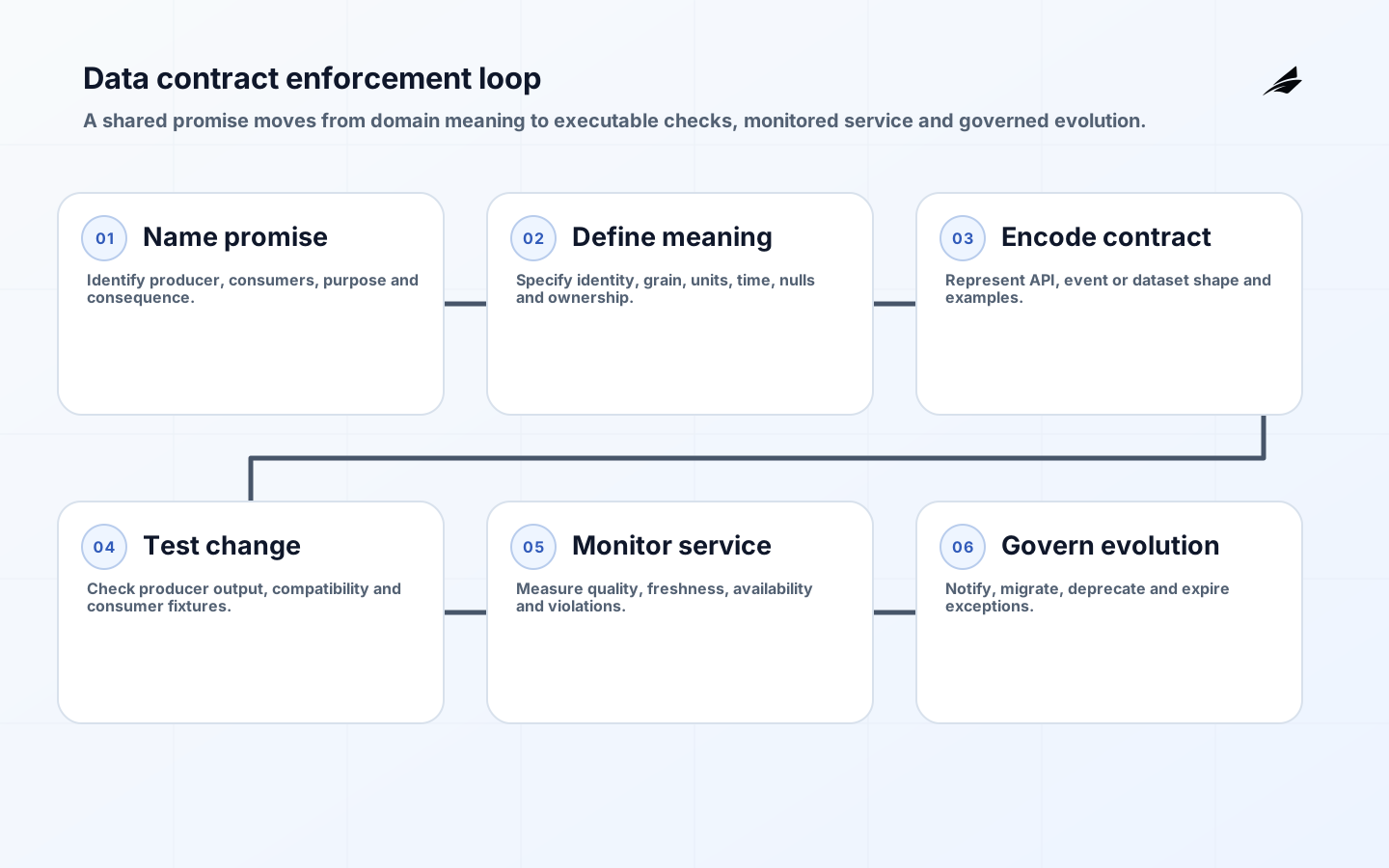
A data contract is an explicit promise a producer can test and a consumer can plan against. Start with the decisions or behavior the data supports, the producer, known consumers and consequence of failure. Distinguish interface shape from business meaning and service behavior. A schema can say that amount is numeric but not whether it is gross, net, signed, converted or provisional. Record grain, identity, units, timezone, null semantics, classification, freshness, completeness and support path. Avoid contracts for every transient table; apply them at boundaries where independent teams or systems depend on stability.
Write separate producer and consumer responsibilities. Producers publish conforming data and incident state; consumers follow documented tolerance, identify material use and migrate within notice. Record prohibited uses when the data is not fit for regulatory or individual decisions. A contract should not promise business outcomes outside producer control, but it should identify dependencies. Review the promise with examples of correct, invalid, late and corrected records.
Choose the contract form for the interface
Use a machine-readable specification aligned to the exchange. OpenAPI describes HTTP interfaces and incorporates JSON Schema concepts; AsyncAPI describes event-driven interfaces; JSON Schema validates JSON instances; analytical tools can enforce model columns and types. None alone captures every operational or semantic promise. Keep a concise human-readable section for purpose, ownership, examples and change policy next to the executable definition. Store the contract with version control, review and generated documentation. The deployed producer and consumer tests must reference the same version, not copied files that drift.
Generate documentation and fixtures from the executable source to reduce drift. Pin specification dialects because OpenAPI and JSON Schema version fields describe tooling behavior. Validate references and examples in continuous integration. For binary or tabular formats, include schema and encoding precisely. Store policy metadata in a form tools can read, but avoid a proprietary wrapper that prevents teams from using standard validators. Sign or protect released contract artifacts where tampering matters.
| Area | Decision | Evidence |
|---|---|---|
| Contract dimension | Example statement | Machine check |
| Shape | order_id is a nonempty string | Schema validation |
| Semantics | amount is net invoice value in currency | Examples plus domain review |
| Quality | 99.5% of events arrive within 15 minutes | Production monitor |
| Security | customer email is restricted personal data | Policy and access test |
| Change | enum additions require tolerant consumers | Compatibility test and notice |
Specify identity, grain and meaning
Name what one record represents and which fields identify it across time. Define whether updates replace, append or correct prior state. State event occurrence time separately from publication time. Enumerations need definitions and an unknown strategy. Quantities require units and currencies; percentages need denominators; booleans need the meaning of false and missing. Include representative and boundary examples. For analytical datasets, document history behavior and late-arriving records. A contract should make it difficult for two reasonable teams to implement incompatible interpretations while both passing syntax validation.
Use domain vocabulary and code lists with stable references. Define how personal data and confidential fields are classified and whether derived values inherit classification. Clarify precision and rounding. For events, distinguish the entity state before and after the event where consumers reconstruct history. For snapshots, define completeness and effective time. Include invalid examples because they reveal boundaries that a happy-path sample cannot. Review semantic changes with people who operate the process.
Classify changes by consumer impact
Define compatibility for the actual technology and consumer behavior. Adding an optional JSON field is often backward compatible, but a strict deserializer may still fail. Renaming, narrowing values, changing units or altering default behavior is breaking even when the wire type remains. Event consumers may be unable to replay a coordinated cutover. Maintain a change taxonomy, deprecation window and consumer inventory. Run compatibility checks before producer merge and execute consumer-driven examples for material interfaces. Publish change notice with migration instructions and observable adoption.

Maintain a registry of consumers with contact, interface version, retention horizon and compatibility behavior. Discovery from lineage is helpful but may miss extracts and external partners. For breaking changes, choose dual write, translation or coordinated cutover based on state and volume. Observe usage of deprecated fields when possible. Do not remove a field merely because no current dashboard queries it; delayed replay or recovery jobs may still depend on historical shape.
Attach service and quality expectations
Specify timeliness, completeness, uniqueness, ordering, duplication, retention and availability where they matter. Define measurement source, window and response when a target is missed. A freshness objective should state the relevant event and percentile, not simply daily. Separate invalid records, late records and unavailable data because consumers need different behavior. Decide whether publication stops, a quality flag is attached or an incident opens. Avoid claiming perfect data. Contracts should make degradation visible and give consumers a safe rule for waiting, using prior state or escalating.
Publish quality indicators alongside the data where consumers can enforce their own risk policy. A provider may continue a degraded dataset for low-risk analysis while a financial process waits. State whether service targets exclude planned backfills or source outages. Use event-time windows and business calendars appropriately. Quality incidents need affected partitions, earliest impact, mitigation and correction state. Consumers should be able to identify which outputs used invalid data.
| Area | Question | Control |
|---|---|---|
| Change | Typical risk | Migration pattern |
| Add optional field | Strict consumer rejects unknown data | Contract test against real consumers |
| Rename field | Existing readers lose value | Dual publish, measure adoption, remove later |
| Change unit | Values remain valid but meaning changes | New field or version with explicit conversion |
| Narrow enum | Stored or delayed events become invalid | Support old values through retention horizon |
| Change grain | Counts and joins silently change | New dataset or major contract version |
Assign ownership and approval without a bottleneck
The producer owns implementation and operational evidence; a domain owner approves business meaning; consumers provide impact evidence. Use automated checks for schema and known compatibility rules, with human review for semantics and risk. Maintain contacts, escalation and support hours. OpenLineage can help identify jobs and datasets affected by change, but inventory must include external and manual consumers too. Establish an exception process with owner, reason, expiry and migration plan. Central governance should provide templates and policy while domain teams retain timely decisions.
Review contracts on ownership change and at a proportionate interval. Keep domain approval lightweight by supplying reusable terminology and examples. Exceptions should never exist only in chat; store scope, risk, compensating control and expiry next to the contract. Provide a dispute path when producer and consumer interpret meaning differently. Governance succeeds when it shortens resolution and prevents recurrence, not when it adds an approval meeting to every compatible field addition.
Adopt contracts at high-value boundaries first
Select an interface with repeated incidents, several consumers and an accountable producer. Baseline current schema, examples, freshness and known exceptions. Introduce contract tests in observation mode, fix false assumptions, then block changes that violate the approved policy. Add consumer fixtures and production conformance monitoring. Test rollback and dual publication for a breaking migration. Measure prevented incidents, change lead time, adoption and expired exceptions. Expand to other boundaries only after ownership and tooling are easy enough that teams maintain contracts as part of normal delivery.
Choose tooling that fits delivery workflows. A contract portal no one checks is weaker than tests in the producer repository and clear alerts in the operational queue. Begin with warning mode to discover undocumented behavior, but set a date for enforcement. Run game days for invalid schema, late data and breaking proposal. Capture the time from proposed change to consumer migration; contracts should improve safe change, not freeze useful evolution.
Key takeaways
- A contract covers meaning and service behavior, not only schema.
- Define compatibility from observed consumer behavior and retention.
- Make quality degradation and change adoption measurable.
- Adopt contracts where independent ownership creates material risk.
Frequently asked questions
Is a schema registry a data contract platform?
It can store and validate interface schemas, but a complete contract also needs semantics, ownership, quality, security and change policy. Treat the registry as one enforcement component.
Who owns a data contract?
The producing team should own technical conformance and operation, while a domain owner approves business meaning. Material consumers should be identified and consulted for breaking change.
Should every data change create a new version?
No. Compatible changes can follow the existing contract policy. Use a new version or interface when consumer migration is required, and keep both available for a defined window.
Conclusion
Data contracts between systems and teams make independent change safer by turning assumptions into reviewed, testable promises. The strongest contracts combine machine-readable shape with business semantics, quality expectations, ownership and a credible migration process. Starting at consequential boundaries and measuring real consumer behavior prevents contracts from becoming static documentation while reducing silent data failures.