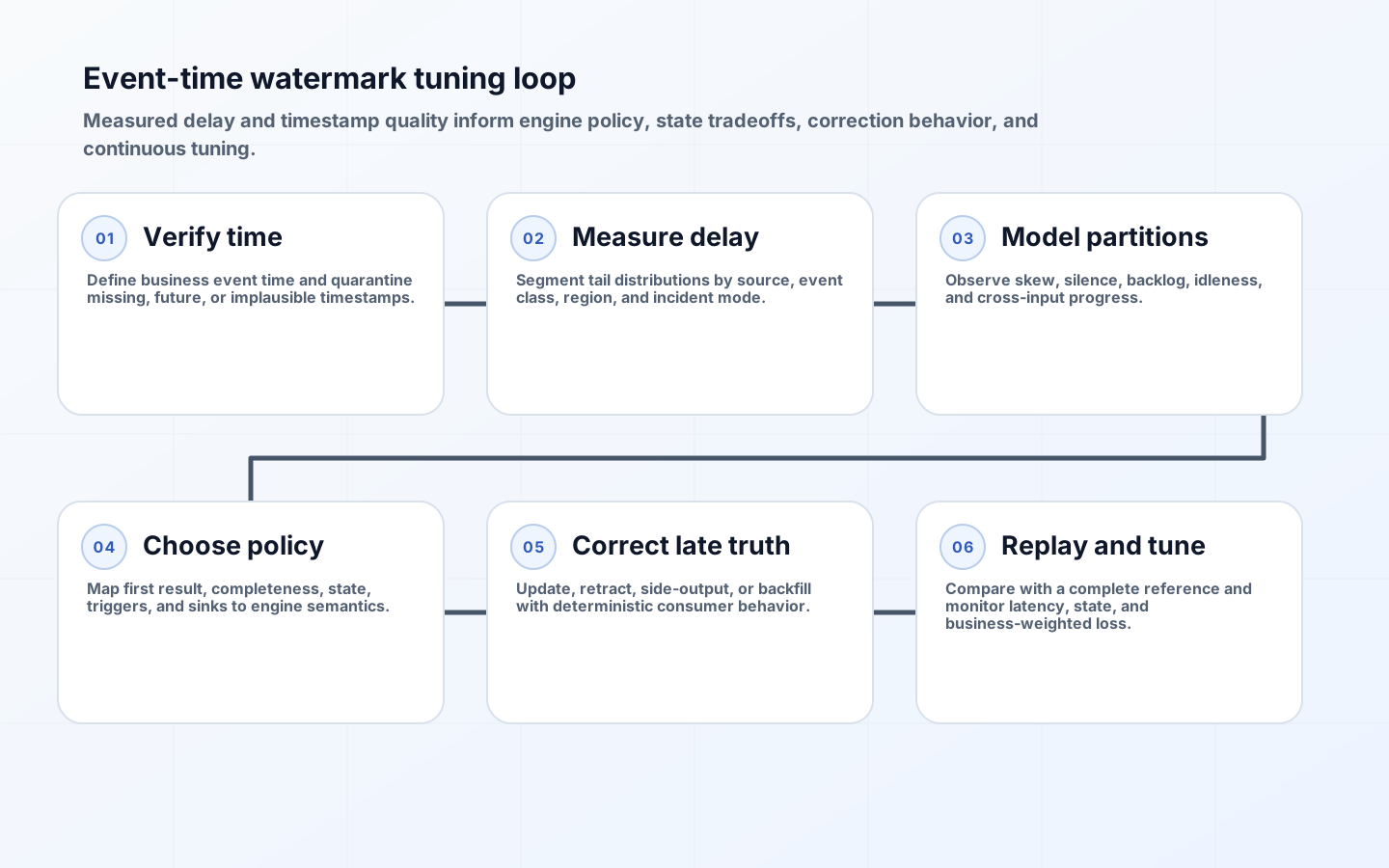
Event-time processing asks when an event occurred in the business domain, not when a streaming engine happened to receive it. Network outages, mobile clients, batch gateways, retries, and uneven partitions make arrival disorder normal. A watermark is the engine's progress estimate used to decide when event-time operations can advance. Event time watermark tuning therefore balances answer latency, retained state, update churn, and the risk that a late event misses the normal computation path.
There is no universally correct delay such as five or ten minutes. Delay distributions differ by source, geography, event class, incident mode, and hour. Framework semantics also differ: Flink watermarks flow through operators and can account for idleness and alignment; Beam couples watermarks with triggers and allowed lateness; Spark uses watermarks to bound state and determine treatment of late records under supported operations. Tune within the chosen engine's exact contract rather than copying one configuration value.
Measure event delay before choosing a watermark
Define delay as observed processing or ingestion time minus trusted event time, then measure it by source partition, event type, region, application version, and operating condition. Report percentiles and tail counts at several thresholds. A median hides the events a watermark is likely to exclude. Separate ordinary disorder from outage recovery: a mobile fleet may deliver most events within seconds and a large backlog hours after connectivity returns. Both patterns need policy, but one threshold may not serve both efficiently.
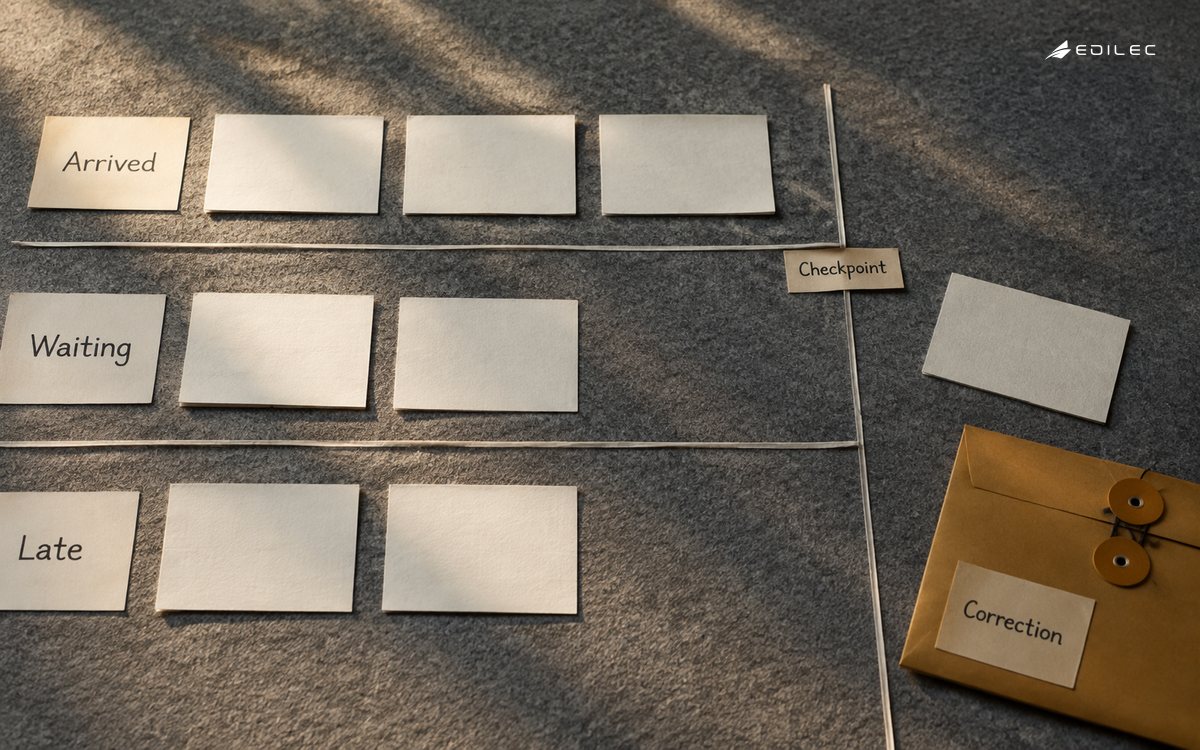
Audit timestamp quality first. Client clocks can be wrong, timezone conversion can shift values, producers can reuse creation time after retries, and future-dated events can push progress unexpectedly. Establish which timestamp represents business occurrence, how it is generated, and allowable bounds. Quarantine invalid time separately from legitimate lateness. Monitor missing, future, and implausibly old timestamps because watermark changes cannot correct a broken clock contract.
| Signal | Segment | Decision it informs | Caution |
|---|---|---|---|
| Delay percentiles | Source and event class | Base out-of-order allowance | Percentiles hide absolute volume |
| Events past thresholds | 1m, 5m, 1h, 1d | Late-data route capacity | Use business-weighted impact too |
| Partition activity | Partition or shard | Idle detection | Silence may be valid |
| State bytes and keys | Operator and window | Cost of longer retention | Backends compress differently |
| Result revisions | Metric and consumer | Trigger/update tolerance | Not every revision has equal impact |
Translate business completeness into engine semantics
Ask when a result must first be available, how complete it should be then, whether it may be revised, and when it becomes final for the business. Fraud alerts may favor seconds and route late evidence to correction; financial settlement may wait longer and still require later adjustment. Map those requirements to windows, watermark generation, triggers, accumulation mode, state timeout, output mode, and sink update behavior supported by the framework.
A watermark is not proof that no earlier event will ever arrive. It is an operational estimate that lets computation progress. Define late in relation to a specific operator and watermark, not as a moral property of the event. In multi-stage pipelines, a record can be on time upstream and late downstream after buffering or repartitioning. Preserve event time and useful source metadata so later stages and correction paths can reason about it.
Handle idle and skewed partitions
Parallel sources commonly combine watermark progress conservatively, so one quiet or delayed partition can hold back the whole operator. That protects completeness but grows state and result latency. Configure idleness only when the engine can distinguish a partition with no expected records from one whose connection has failed. If the timeout is too short, a temporarily slow partition is excluded and its next events may appear late; if too long, genuinely idle partitions stall progress.
Monitor watermark by partition, last event arrival, source lag, and idle-state transitions. Reassignments and restarts deserve special tests because partition state can change. For sources with legitimately different delay profiles, consider separate streams and policies before union, or attach source-aware correction. A single global watermark based on the slowest source can make a real-time path unusable, while a fastest-source policy can silently discard the truth from remote or intermittent producers.
| Condition | Symptom | Possible control | Tradeoff |
|---|---|---|---|
| Idle partition | Watermark stops despite no data | Idleness detection | Returning data may be late |
| Slow partition | Growing cross-partition skew | Investigate source or isolate class | More topology complexity |
| Fast partition | Excess buffered state downstream | Watermark alignment where supported | Throttles fast input |
| Backlog recovery | Burst of old event times | Dedicated replay/correction path | Two result paths to reconcile |
| Future timestamp | Unexpected progress or validation error | Timestamp bounds and quarantine | Requires producer remediation |
Use alignment only for the problem it solves
When one input advances much faster than another, downstream operators can buffer substantial state while waiting for the slow input's watermark. Flink watermark alignment can constrain how far sources in a group drift by slowing faster sources under supported connectors. This is a state-protection mechanism, not a way to manufacture missing data. It can reduce throughput and increase source lag, so monitor both state and backpressure after enabling it.
Before alignment, verify that the streams truly participate in the same event-time decision and that slow progress is not an incident. Separate independent workloads rather than coupling them for convenience. Choose drift and update intervals from measured state growth and recovery behavior. Test connector support because source splitting and watermark alignment have implementation constraints. A configuration accepted by the job is not enough; inspect task-level progress under skew.
Create an explicit late-data policy
For every windowed output, decide what happens to records beyond normal progress: update the result, emit a retraction or upsert, send to a side output, write a correction table, trigger a bounded backfill, or reject with evidence. The sink must support the chosen semantics. Appending a second aggregate to a table that consumers assume is final can double-count. Include result version, window identity, and correction reason so consumers can apply revisions deterministically.
Keep the late path observable and owned. Measure count, business value, delay distribution, source, and repair age. Sample payload only under privacy controls. Set an objective for correction completion and alert on accumulating backlog. Do not quietly drop data merely because it arrived beyond an engine threshold; a deliberate discard policy needs business approval, documented impact, and a way to quantify what was excluded.
Quantify state and latency tradeoffs
Longer lateness generally retains more window or join state and postpones cleanup. Cost depends on key cardinality, window type, aggregation, join range, backend, checkpointing, and data rate. Measure state bytes, checkpoint duration, recovery time, processing latency, and sink revision load at candidate thresholds. A small gain in event completeness can be costly if it multiplies high-cardinality join state. Conversely, an overly aggressive threshold can create an expensive correction system.
Evaluate business-weighted error, not only event count. One late settlement record may matter more than thousands of late telemetry points. Build a frontier showing first-result latency, percentage and value captured, state size, and correction volume. Choose a point with stakeholders and record accepted residual risk. Revisit it when source behavior, topology, state backend, or business finality changes.
Tune with replay and controlled canaries
Replay a representative event-time trace through candidate configurations in an isolated environment. Include normal days, skew, idle partitions, outages, future timestamps, restart, and backlog recovery. Compare results to a batch-complete reference. Then canary the chosen policy on production traffic with shadow outputs, ensuring it cannot affect decisions. Validate engine upgrades because watermark and state behavior can change with APIs and connectors.
Change one policy at a time and retain the previous configuration, state compatibility plan, and rollback criteria. Dashboards should show event-time lag, processing lag, per-partition watermark, late volume, state, checkpoint health, backpressure, and correction age. Review after material incidents and on a stable cadence. Tuning is an operating practice because the delay distribution belongs to a changing distributed system.
Key takeaways
- Measure delay by source and incident mode, and validate timestamp quality before tuning.
- Map business first-result and finality needs to the exact framework semantics.
- Treat idleness, skew, and alignment as distinct operational problems.
- Give every beyond-watermark record a visible correction or approved discard path.
- Choose thresholds using completeness, value, state, latency, and recovery evidence together.
Frequently asked questions
Does a watermark mean all earlier events arrived?
No. It is an engine progress estimate. Earlier events can still arrive and must follow the configured late-data behavior. Business finality may require reconciliation beyond streaming progress.
Why not set an extremely long delay?
Long retention can delay cleanup, increase state, slow checkpoints and recovery, and postpone final results. A separate correction path is often more economical for rare extreme lateness.
Should all sources share one watermark policy?
Only when their delay profiles and business decisions genuinely align. Separating source classes can protect real-time latency while preserving a slower completeness route, provided outputs are reconciled clearly.
Conclusion
Event time watermark tuning is a measured agreement about when computation progresses and how later truth is repaired. Delay percentiles alone are insufficient; partitions, timestamp quality, state, sinks, correction obligations, and business value shape the choice. A replay-tested policy with per-source observability and owned late-data handling delivers timely answers without pretending distributed events arrive neatly.