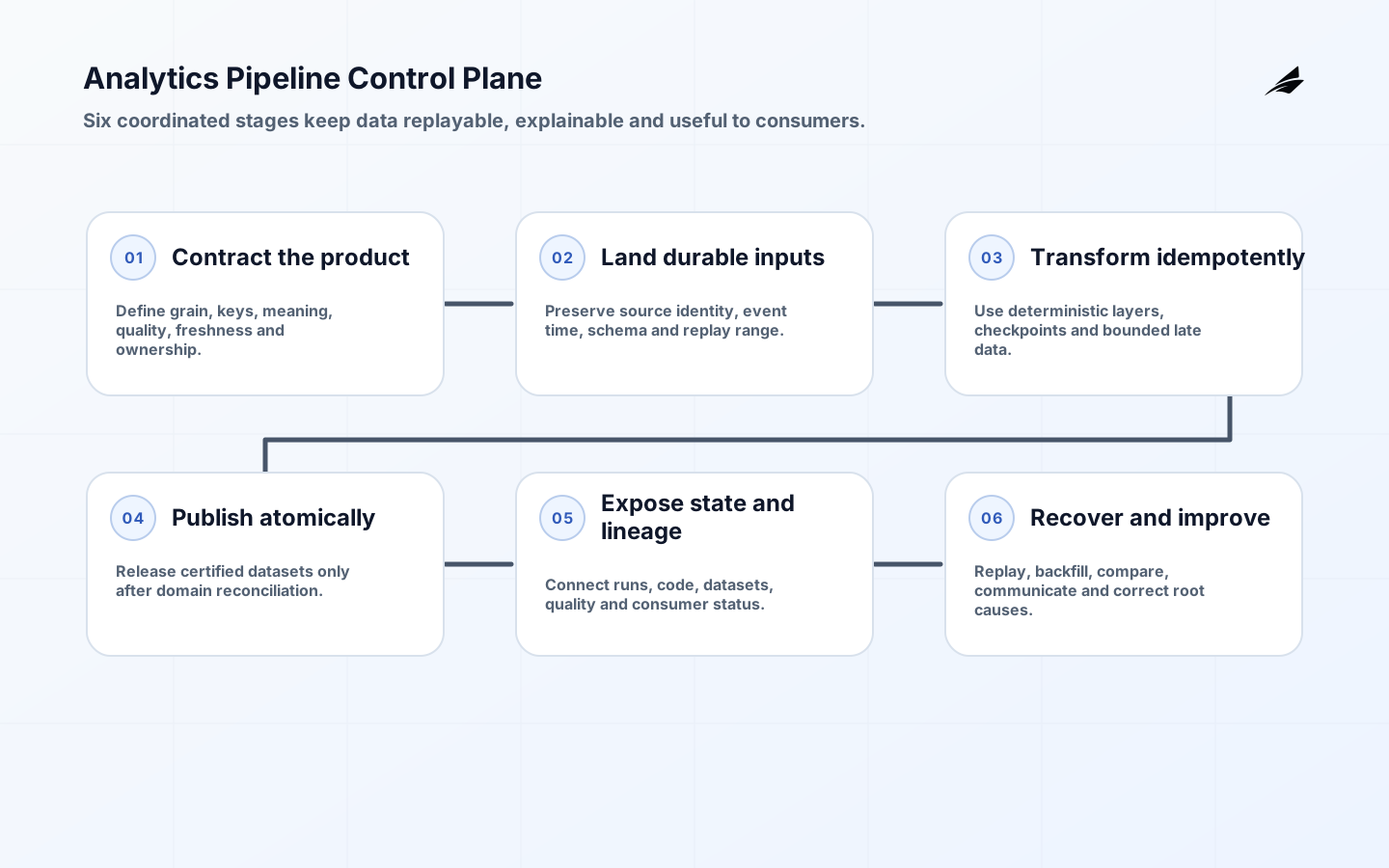
Data pipelines for data analytics turn changing operational records into trustworthy, timely data products. Their quality depends less on drawing boxes between sources and warehouses than on defining contracts, preserving replay, handling partial failure and assigning ownership. A pipeline is production-ready when consumers can understand freshness and meaning and operators can recover without silently changing results.
Use this guide with Edilec's data contracts engineering notes, real-time analytics buyer guide, ELT workflow guide and data lineage guide. Start from a consumer decision and the source change that supports it.
Define the data product and service objectives
Name consumers, decisions, data owner, steward, producing system, grain, keys, freshness, completeness, accuracy, retention and access. Specify what happens when the source is late or corrected. The Google SRE guidance on service level objectives recommends indicators tied to user-relevant behavior. For a daily revenue table, useful indicators include completed business-date partitions, reconciliation difference and availability before finance review.
Distinguish event time, source commit time, ingestion time and publication time. Decide which time drives analysis and late-arrival windows. Record business calendars and time zones. A pipeline that is technically fresh but has not received the final settlement file is not complete. Publish status and limitations with the dataset instead of forcing analysts to infer reliability from row counts.
| Requirement | Example definition | Owner |
|---|---|---|
| Grain | One row per order line and version | Domain owner |
| Freshness | Complete through prior hour by 10 minutes past | Pipeline owner |
| Quality | Order totals reconcile within stated tolerance | Data steward |
| Change | Additive fields announced; breaking changes versioned | Producer |
| Recovery | Seven-day replay without duplicate facts | Platform owner |
Choose batch, streaming or change capture deliberately
Batch is appropriate when decisions tolerate scheduled latency and source extracts are reliable. Change data capture can reduce source load and preserve row-level change but requires log retention, schema handling and snapshot bootstrap. Streaming supports low-latency decisions but introduces ordering, watermark, state and replay questions. A hybrid design is common: stream operational events, then publish reconciled analytical tables on a schedule.
The Apache Kafka design documentation explains partitions, consumer position, replication and log compaction concepts that shape event-pipeline behavior. Do not translate broker delivery guarantees directly into business correctness. Define idempotency keys, ordering scope, duplicate policy and transaction boundaries at the application level. Test consumer restart and replay from a known position.
Establish source and event contracts
A contract should specify schema, semantic definitions, nullable fields, keys, units, accepted values, classification, update behavior, quality expectations, ownership and notice period. Validate at ingestion but provide a quarantine path and impact-aware response. Hard rejection protects consumers from incompatible data; uncontrolled rejection can also create a hidden outage. Publish rejected counts and samples to the responsible producer.
For event-driven ingestion, the CloudEvents specification defines common context attributes such as ID, source, type and specification version. Use a stable envelope and keep domain payload separate. Require source plus ID uniqueness for deduplication, define schema references, and avoid sensitive data in routable metadata because infrastructure and logs may expose context attributes.
Design layers for replay and idempotency
Land immutable source data with ingestion metadata before business transformation where feasible. Build normalized staging models, conformed domain models and published products. Preserve source keys and record provenance across layers. Partition for common recovery and query patterns, not only ingestion convenience. A daily partition is useful when corrections and backfills are managed by business date; high-cardinality partitions create operational overhead.

Make every stage safe to rerun. Use deterministic transformations, merge on stable keys, track source version or sequence, and commit outputs atomically. Keep checkpoints separate from business data and advance them only after durable publication. Backfills should declare range, code version, expected impact and consumer notification, then validate against control totals before replacing trusted output.
| Failure | Detection | Recovery |
|---|---|---|
| Late source | Freshness and expected-file check | Publish delayed status; ingest on arrival |
| Duplicate delivery | Stable source ID and uniqueness test | Idempotent merge |
| Breaking schema | Contract validation | Quarantine and versioned adapter |
| Partial transform | Atomic publication and run state | Retry from durable input |
| Bad historical logic | Reconciliation or consumer report | Scoped, versioned backfill |
Make quality and lineage operational
Test structural validity, key uniqueness, referential integrity, accepted values, freshness, volume and domain reconciliation. Put tests at the earliest layer that can assign ownership. A null check can block immediately; revenue reconciliation may require all sources and belongs near publication. Assign warning and blocking severity by consequence and define who can accept a temporary exception.
Emit lineage as part of execution rather than maintaining a separate manual diagram. The OpenLineage schema documentation describes JSON-schema-based events and extensible facets for runs, jobs and datasets. Capture job and dataset identities, inputs, outputs, run state, schema and source-code context. Use lineage to identify affected consumers before a contract change or backfill.
Observe pipeline and data behavior together
Collect run duration and outcome, queue and processing lag, input and output counts, rejected records, checkpoint position, freshness, reconciliation difference, warehouse cost and consumer availability. The OpenTelemetry signals overview separates traces, metrics and logs. Correlate a pipeline run ID across orchestration, compute, quality and publication events so an operator can follow one failed delivery end to end.
Alert on consumer impact or imminent objective breach. A failed retry that recovered before publication may need a ticket, while a successful job with stale source data may need an urgent page. Dashboard medians and percentiles because growing tail latency often appears before missed deadlines. Keep high-cardinality values such as customer IDs out of metrics and sensitive payloads out of logs.
Release and operate changes safely
Version pipeline code, configuration, schema and infrastructure. Test transformations on representative fixtures and a recent production-shaped sample, then compare candidate and current outputs by key aggregates and changed rows. Deploy to a shadow table or limited partition before switching consumers. Coordinate breaking semantic changes through a new dataset or versioned field rather than silently redefining an existing metric.
Runbooks should cover source delay, schema break, quality failure, partial publication, credential expiry, warehouse saturation and backfill. Record on-call ownership and escalation to source and consumer teams. Review recurring manual fixes as product debt. A pipeline that needs daily spreadsheet patching is part of the critical data path whether or not orchestration reports green.
Worked example: an orders analytics pipeline
An ecommerce team needs hourly order and refund reporting plus a reconciled daily finance table. Order events enter a partitioned log with source and event IDs; payment settlements arrive as daily files. The pipeline lands both immutably, normalizes currencies and timestamps, builds order-line state, and publishes an hourly operational fact. A later daily job joins final settlement and emits a finance-certified partition only after record counts and amount totals pass agreed tolerances.
The event contract permits additive fields and versions breaking payload changes. Consumers deduplicate on source and event ID and order changes within an order key. A twenty-four-hour late window updates operational facts; later corrections enter a controlled backfill. Tests replay a duplicate event, restart a consumer before checkpoint commit, deliver a future timestamp and omit the settlement file. Each case produces an observable state rather than a silently plausible table.
Lineage connects source topics and files to staging, order state, hourly fact, certified daily fact and three dashboards. A deploy compares candidate and current totals for seven recent dates in an isolated schema. When a refund-rule correction requires ninety days of history, the owner publishes scope and expected changes, rebuilds partitions, validates against payment controls and switches them atomically. Consumers receive the lineage-based impact list before the corrected data becomes authoritative.
Pipeline production acceptance
- Published contract for grain, keys, semantics, classification, freshness and correction behavior.
- Durable source landing with replay range, encryption, access and retention controls.
- Idempotency and ordering tests under duplicate, restart, late and out-of-order delivery.
- Atomic publication and checkpoint behavior proven during an interrupted run.
- Structural, domain and reconciliation tests with owners and blocking severity.
- Lineage events linking source, run, code, schema, datasets and downstream exposures.
- Alerts for source delay, processing lag, quality failure and consumer deadline risk.
- Backfill procedure with scope, comparison, communication, switch and rollback evidence.
Key takeaways
- Define a data product with owners, grain, freshness, quality and recovery objectives.
- Choose batch or streaming from decision latency and failure cost.
- Preserve immutable inputs and make every transformation safe to replay.
- Test domain reconciliation and emit execution lineage.
- Operate source freshness, pipeline health and consumer availability as one service.
Frequently asked questions
Do analytics pipelines need exactly-once processing?
They need correct business outcomes under retries. Broker and engine guarantees help, but stable event identity, idempotent writes, ordering rules and reconciliation remain necessary. Design and test replay explicitly instead of relying on a label.
Should raw data be kept forever?
No. Retain it according to recovery, audit, privacy, legal and cost needs. Classify sensitive fields, restrict access and apply deletion. Preserve enough durable history to meet the agreed replay window and explain published results.
Who owns a data pipeline?
The producing domain owns meaning and source commitments, the pipeline team owns transformation and delivery, the platform team owns shared runtime, and the data-product owner owns consumer outcomes. Escalation must connect those responsibilities rather than assigning every failure to data engineering.
Conclusion
Reliable analytics pipelines are contracts and recovery systems as much as movement systems. Build around durable inputs, explicit meaning, idempotent publication, lineage and consumer objectives. That foundation supports both scheduled reporting and low-latency products without making correctness depend on a perfect run.