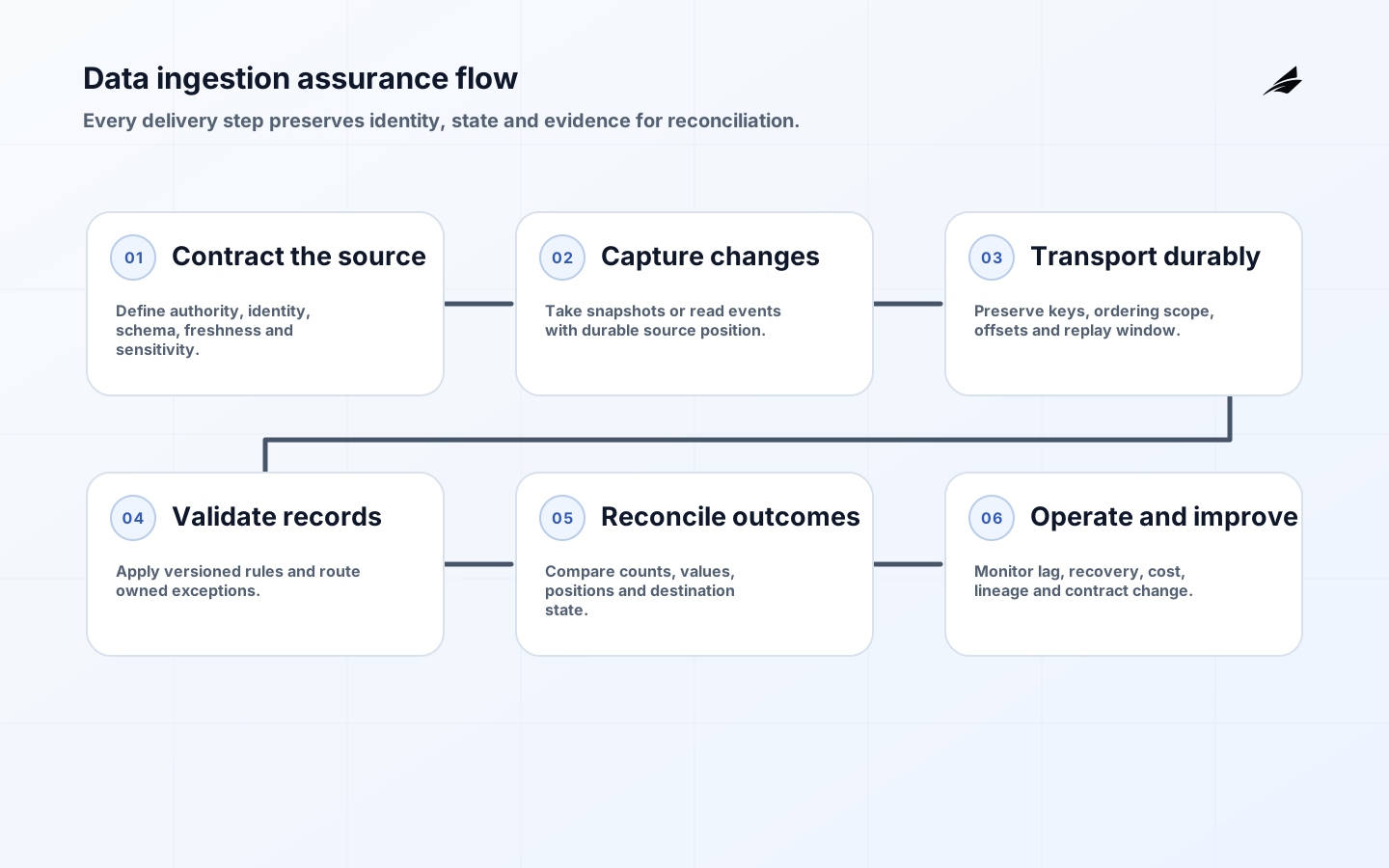
Data ingestion solutions move records and events from operational sources into destinations where they can be analyzed, shared or used by applications. The hard part is not copying bytes. It is preserving meaning, detecting loss, controlling replay and proving which source state produced a downstream result. This FAQ helps teams choose an ingestion pattern and define the evidence needed to run it reliably.
Use it alongside the data ingestion architecture and delivery plan and the data ingestion implementation checklist. If the pipeline will feed models or automated decisions, the broader data and AI solutions checklist adds use-case governance beyond transport.
What is a data ingestion solution?
An ingestion solution is the operated path from a named source boundary to an accepted destination boundary. It includes extraction or event capture, transport, serialization, validation, transformation where permitted, delivery, state management, observability and recovery. A connector alone is one component. A production solution also needs contracts, credentials, capacity, deployment ownership, alerts, runbooks and a correction path when source and destination disagree.
Define the unit of delivery before choosing technology. It may be a file, database row change, business event, API page or telemetry record. Give that unit a stable identity, source timestamp, ingestion timestamp, schema version and sensitivity class. The CloudEvents specification provides a standard event envelope with identity, source, type and time attributes; even when CloudEvents is not adopted, those concepts expose missing contract decisions.
When should teams use batch, streaming or change data capture?
| Pattern | Best fit | Main engineering concern | Acceptance evidence |
|---|---|---|---|
| Scheduled batch | Bounded files or queries with hourly, daily or period-close needs | Late files, partial loads and rerun boundaries | Manifest counts, checksums, watermark and reconciled totals |
| Event streaming | Business events that consumers need continuously | Ordering, partitioning, back pressure and replay | Consumer lag, durable offsets, event contract and replay test |
| Change data capture | Committed database changes needed with low delay | Snapshots, log retention, duplicates and schema changes | Source position, snapshot record, duplicate handling and reconciliation |
| API extraction | A provider exposes paginated or incremental reads | Rate limits, cursor validity and historical corrections | Cursor state, request audit, completeness check and retry policy |
Choose according to business freshness and correction needs, not fashion. Batch is often simpler and more auditable when a report can tolerate delay. Streaming helps when delayed state has a real operational cost, but it adds continuous capacity and state concerns. Change data capture reads database change mechanisms rather than inventing application dual writes. Debezium's documentation describes row-level change event streams and connector-specific constraints; source database privileges, retained logs and snapshot behavior must still be tested.
Hybrid designs are normal. A team may take a consistent snapshot, continue with change events, and run a nightly reconciliation. Another may stream order events but batch-load reference data. Write down which path is authoritative for inserts, updates and deletes. If two paths can update the same destination record, specify precedence and how operators detect a split-brain result.
Do exactly-once claims eliminate duplicates?
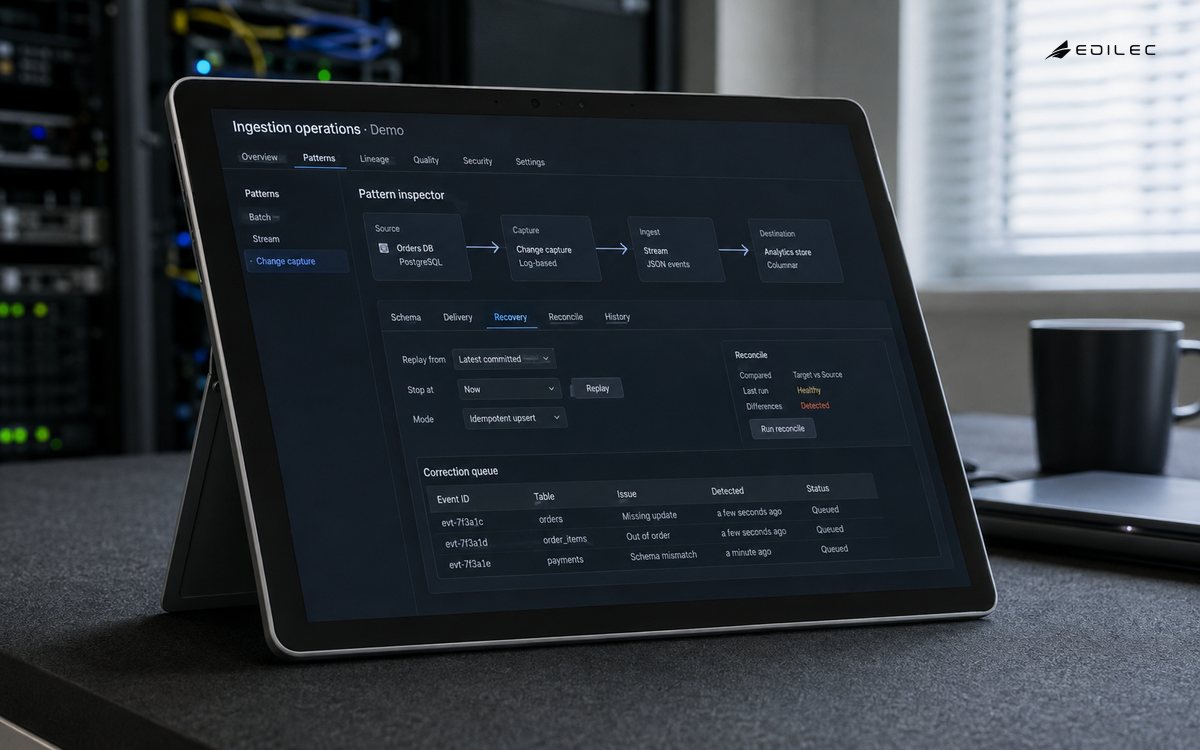
No end-to-end guarantee follows from a broker label alone. Producers, transport, processors and sinks each have failure boundaries. The Apache Kafka design documentation distinguishes delivery semantics and explains how producer, broker and consumer behavior interact. A sink outside the transaction boundary may still receive a duplicate after a crash between writing data and recording progress.
Design consumers to be idempotent where practical. Use a source event identifier or a compound key such as source, partition and position. Upsert against a business key when overwriting is correct; keep an append-only ledger when history matters. Store processing state durably and make replay a supported operation. Never call deduplication complete without defining the retention window: a duplicate older than the key store may be accepted again.
Ordering also has a scope. A partitioned stream may preserve order for one entity key while events across keys interleave. State the entity whose changes require order and route it consistently. Add a source sequence or version where consumers must reject stale updates. Wall-clock timestamps alone are unsafe ordering keys because clocks skew and two changes can share a timestamp.
How should schema evolution be controlled?
Treat schemas as versioned interfaces. Name field meaning, type, nullability, units, identifiers, allowed values and privacy classification. Producers should announce changes and consumers should declare compatibility. Additive fields are not automatically safe: a new enum value can break a switch, increased precision can overflow a sink, and a newly populated field can violate a privacy assumption.
Test changes with representative old and new records. Preserve the raw source payload or a governed landing representation when policy allows, because it supports replay after transformation defects. Quarantine records that violate a contract; do not silently coerce them into plausible values. A quarantine needs an owner, a reason code, searchable evidence and a route to correct either producer or consumer.
| Control | Implementation detail | Operational measure |
|---|---|---|
| Completeness | Compare source manifests, positions or control totals with accepted records | Missing units and unreconciled variance |
| Freshness | Track source event time and destination availability time separately | Age percentiles by source and priority |
| Validity | Apply versioned structural and domain rules before publication | Rejected records by rule and producer |
| Uniqueness | Use stable event keys and a defined deduplication window | Duplicate attempts and duplicates accepted |
| Lineage | Record job, run, input, output, code and schema versions | Datasets and runs with complete lineage |
What lineage and observability are useful?
Pipeline health must answer business questions. A green process that delivered zero orders is not healthy if the source had 10,000. Monitor source progress, throughput, lag, retries, rejects, destination commits and reconciliation. Keep dimensions bounded; exposing customer identifiers as metric labels creates cost and privacy risk. Logs can carry detailed identifiers under controlled access, while metrics summarize rates and age.
The OpenLineage facet model associates context with runs, jobs, inputs and outputs. The W3C PROV overview provides broader concepts for entities, activities and agents. Tools differ, but the operational requirement is stable: a steward should be able to trace a published dataset to source objects, pipeline run, code release, schema and correction history.
How should failure and replay be tested?
Exercise failures at each boundary: source unavailable, token expired, malformed record, broker partition, full destination, throttled API, worker restart and schema rejection. Verify what is retried, what is parked and what requires human approval. Confirm that retries use bounded backoff and do not overload a recovering dependency. The runbook should state the durable restart point and how an operator detects gaps or duplicates after recovery.
Stateful stream processors need tested checkpoints. Apache Flink's guidance on checkpointing under back pressure shows why checkpoint duration and in-flight data behavior matter when a pipeline is constrained. Whatever engine is used, measure recovery point, restart time and catch-up capacity with realistic state size, not a tiny development fixture.
What security and cost questions belong in the design?
Give connectors narrowly scoped identities and separate source-read, transport-write and destination-write privileges. Store secrets in an approved manager, rotate them and test revocation. Encrypt transport and storage, classify landing zones, mask or tokenize where required, and set retention by purpose. Debug payload access is sensitive access; restrict it and audit exports. Document data residency for every hop, including dead-letter and backup stores.
Model cost by source count, data volume, record rate, retained history, egress, connector runtime, compute, storage operations, cataloging and support. Streaming often has a high fixed operational floor; batch may create peak compute and repeated full-scan cost. Include replay and backfill scenarios. A design that is cheap only while nothing fails is not a useful estimate.
What should be accepted before production?
- Approve source and destination contracts, record authority, freshness objective and privacy classification.
- Reconcile an initial load and at least one incremental cycle with known inserts, updates and deletes.
- Restart every stateful component and prove offsets, checkpoints and destination writes remain coherent.
- Introduce duplicates, late records, malformed data and a schema change; verify expected handling.
- Demonstrate alert ownership, replay approval, quarantine resolution and a source-to-report lineage trace.
- Measure steady load, catch-up load and cost, then record capacity and retention assumptions.
Example: ingesting orders from an operational database
Suppose analytics needs order changes within five minutes. Take a consistent initial snapshot, record its source position, then continue from database logs through CDC. Partition events by order identifier, land the unchanged envelope, validate the schema and upsert a curated table by order version. Reconcile daily counts and values against the source. Test update, delete, connector restart, duplicate delivery, stale event and a destination outage. Acceptance requires the snapshot and stream to join without a gap, the sink to remain idempotent and the backlog to catch up within the agreed recovery window.
Key takeaways
- Select batch, streaming, CDC or API ingestion from freshness, correction and operational requirements.
- Define delivery and ordering across the complete path; broker guarantees do not settle sink behavior.
- Make schemas, lineage, reconciliation, replay and quarantine part of the product contract.
- Measure business completeness and freshness as well as process uptime.
- Accept the pipeline only after representative failure, recovery and cost tests.
Frequently asked questions
Should raw data always be retained?
Retain a replayable source representation when it has a defined purpose and lawful retention basis. Do not create an indefinite raw-data archive by default. Sensitive fields, deletion obligations and storage cost still apply. Where raw retention is prohibited, keep control totals, lineage and enough transformation evidence to investigate.
Is a dead-letter queue sufficient error handling?
No. It prevents one bad record from blocking all work, but it can quietly become permanent data loss. Define which errors may be parked, preserve reason and source position, alert an owner, set an age target and provide a tested correction and replay path.
Conclusion
Reliable data ingestion solutions make every movement explainable: what was read, what was accepted, what changed, what failed and how the destination was reconciled. Start with a precise contract and the simplest pattern that meets freshness. Add durable state, bounded replay, lineage and operational ownership before scale turns a hidden gap into a trusted but wrong result.