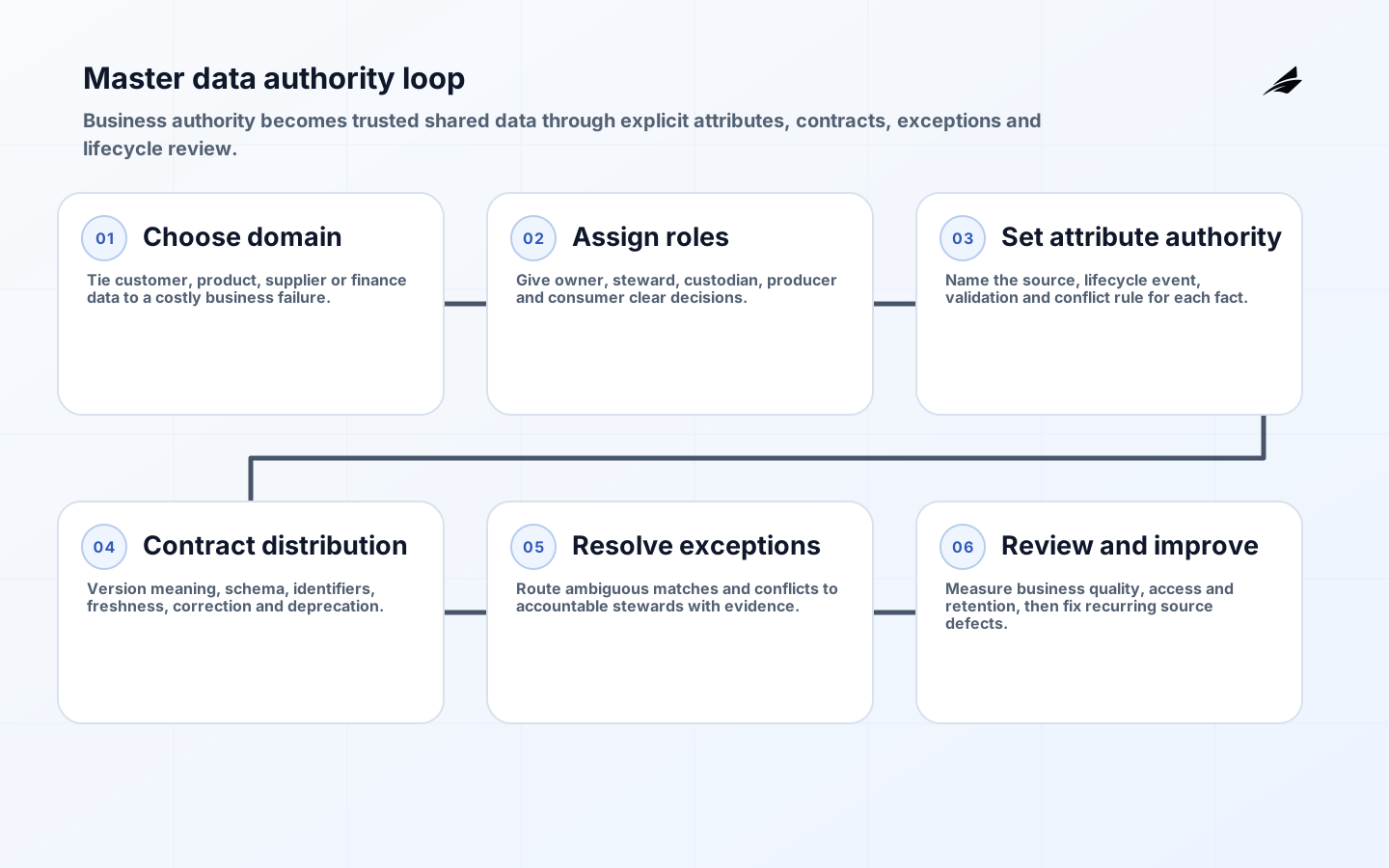
Master data ownership for growing businesses answers a practical question: who has authority to define, create, correct, share and retire the core records on which operations depend? Customer, product, supplier, location, employee and chart-of-account data often appear in several systems, but duplication does not create equal authority. Without an explicit model, integrations amplify conflicts, reports stop reconciling and teams repair records through private spreadsheets. Ownership makes decisions possible; stewardship makes them work every day; architecture enforces them.
Current guidance reinforces that data governance is an operating discipline. The Federal Data Strategy playbook describes governance as setting and enforcing priorities for data as a strategic asset, supported by authority, policy, inventory and lifecycle oversight. NIST's Data Governance and Management Profile is still under development in 2026, so it should not be treated as a final standard; its stated areas—roles, provenance, lineage, quality, sharing and disposition—nevertheless identify the decisions businesses need. ISO 8000 standards add useful concepts for master-data quality, provenance, accuracy, completeness and responsibilities.
Start with a data domain and business outcome
Do not launch an enterprise-wide ownership program first. Choose one domain causing a visible outcome: duplicate customers delay service, mismatched product identifiers break fulfillment, supplier bank changes create fraud risk, or inconsistent account codes prevent close. Map the business processes that create and consume the data. Collect real records and conflicts. Define the target outcome, such as fewer duplicate customer creations, faster product activation or no unverified payment-detail changes.
Draw a domain boundary. “Customer” may include prospect, account, legal entity, contact, billing relationship and service user, each with different authority. Define key terms with business examples and lifecycle states. Identify affected teams, systems, reports, integrations and external sources. A glossary is useful only when it changes behavior: validation, permissions, mappings and reports should use the agreed meaning. Connect the result to the client portal architecture guide where customer records appear across an operational experience.
Separate owner, steward, custodian and consumer
The business data owner is accountable for definition, acceptable quality, access principles, lifecycle and resolution of cross-team conflicts. The data steward maintains definitions, monitors quality, investigates exceptions and coordinates changes. A technical custodian operates platforms, pipelines, protection and recovery. Data producers create or update records, while consumers use them under agreed meaning. Privacy, security, records, finance and legal teams set applicable requirements. One person can hold several roles in a small company, but the decisions must remain distinct.
Give roles authority and time. An owner who can be overruled by any application project is only a label. Define which changes require owner approval, which corrections a steward may make, and when a conflict reaches a governance group. Name deputies and response targets. Use a simple charter listing domains, decisions, members, cadence and escalation. The Federal Data Strategy playbook's governance-body model is designed for agencies, but the underlying lesson applies: governance needs formal authority and integration with normal investment and operational decisions.
| Role | Accountable action | Evidence |
|---|---|---|
| Business owner | Approve definition, quality target, access principle and lifecycle | Decision record and domain policy |
| Steward | Monitor, resolve and prevent quality exceptions | Queue, rule and trend review |
| Custodian | Operate storage, integration, security and recovery | Configuration and restore evidence |
| Producer | Create data under required validation | Source, actor and timestamp |
| Consumer | Use fields according to contract and report defects | Usage purpose and issue route |
Assign authority at the attribute and lifecycle level
A single “system of record” for an entire entity is often unrealistic. CRM may own sales status, ERP may own billing account, an identity platform may own login email, and a verified external registry may supply legal name. Create an attribute authority matrix that lists system, owner, source method, validation, update direction and conflict rule. Distinguish source of entry, authoritative source, golden representation and analytical copy. These terms are not interchangeable.

Model lifecycle events: create, verify, approve, merge, split, suspend, reactivate and retire. Define which system initiates each event and which systems acknowledge it. Preserve stable internal identifiers even when names or external keys change. Never use email, product name or supplier number as the only durable identity unless its lifecycle guarantees uniqueness and immutability. When records merge, maintain redirects and lineage so history, references and audit remain intact.
Turn ownership into data contracts and controls
For every shared dataset or event, specify field name, meaning, type, required status, units, allowed values, identifier, sensitivity, owner, freshness, version and deprecation. Define whether consumers receive snapshots, events or APIs and how they detect correction. Include examples and error behavior. A schema validates shape, not business meaning; “status: active” still needs an agreed definition. Version contracts and notify consumers before incompatible change.
Enforce decisions near creation. Use reference data, uniqueness checks, required provenance, approval for sensitive changes and server-side permissions. Supplier payment details, customer consent and legal identifiers need stronger verification than a marketing label. Route uncertain matches to a steward instead of auto-merging. Record who changed what, why, source evidence and prior value. The NIST Research Data Framework emphasizes provenance as an attributed history of origin and alteration; the same evidence makes operational master-data corrections trustworthy.
| Control point | Decision | Failure handling |
|---|---|---|
| Create | Required fields, identifier and verification | Reject or route incomplete record |
| Match | Deterministic and probabilistic rules | Steward reviews ambiguous candidates |
| Change | Attribute authority and approval | Return conflict to owning source |
| Distribute | Version, freshness and permitted consumers | Replay or quarantine failed delivery |
| Retire | Retention, legal hold, anonymization and deletion | Preserve required lineage and evidence |
Integrate without creating circular truth
Choose one direction for each authoritative attribute. Bidirectional synchronization is safe only when field authority and conflict behavior are explicit; otherwise values bounce between systems. Use stable identifiers and idempotent events. Store integration state separately from business state and make failed deliveries visible. Reconcile counts, keys and high-value attributes, not merely successful API responses. A 200 status does not prove that the downstream system applied the intended meaning.
Avoid a central hub that becomes another unowned copy. A master-data platform can match, govern and distribute golden records, but business domains still own meaning and correction. Start with simpler patterns when volume and complexity allow: authoritative APIs, event publication and steward queues. Introduce specialized tooling when duplicate scale, matching complexity, hierarchy or distribution needs justify its operating burden. Document exit and export so governance does not depend on one vendor's proprietary matching rules.
Measure quality in relation to use
Quality is fitness for a defined purpose. Select dimensions such as completeness, validity, uniqueness, accuracy, consistency, timeliness and provenance, then connect them to business consequence. A missing customer phone number may not matter for digital delivery but is critical for emergency service. Define the population, calculation, threshold, owner and response for each rule. ISO 8000's catalogue includes standards addressing master-data provenance, accuracy, completeness and quality-management responsibilities, which can inform precise specifications.
Operate a transparent exception queue with record, rule, consequence, age, suggested source and owner. Track recurrence and fix upstream design, training or integration rather than cleaning the same defect repeatedly. Sample accuracy against trustworthy evidence because automated rules often measure format, not truth. Report business effect alongside quality percentage: blocked orders, delayed invoices, returned shipments or manual corrections. High average quality can conceal a critical defect in a small, high-value population.
Apply privacy, security and retention to the domain
Inventory why personal and sensitive data is processed, who receives it, where it travels and how long it remains. The NIST Privacy Framework helps organizations identify, govern, control, communicate and protect data processing to manage privacy risk. Apply least privilege by purpose and role, not broad department access. Mask sensitive fields in support and nonproduction. Control exports and derived datasets. Ensure the owner, privacy and records roles agree on retention and lawful exceptions.
Secure high-impact changes with stronger authentication, dual control or verified source evidence. Monitor bulk access, privilege changes and unusual correction patterns. Encrypt transmission and storage, manage keys and test recovery. Deletion requires lineage: removing a primary customer record while leaving unrestricted analytical copies defeats the decision. Define how deletion, anonymization, legal hold and backup expiry propagate. Communicate limits honestly; a retained invoice can coexist with deletion of unrelated marketing attributes.
Roll out ownership as a working control loop
- Choose one domain and baseline a costly business failure.
- Define terms, lifecycle, owner, steward, custodian and escalation authority.
- Create the attribute authority and system interaction matrix.
- Implement creation controls, contracts, lineage and an exception queue.
- Reconcile authoritative systems and migrate one consumer at a time.
- Review quality, access, retention and business outcome with domain owners.
- Retire duplicate fields, circular syncs and private correction spreadsheets.
Hold a monthly domain review initially. Examine quality trends, old exceptions, contract changes, unauthorized copies, new consumers and upcoming system projects. Require architecture work to identify affected data owners before build. Use the workflow exception queue guide to keep judgment work visible. Scale governance by adding domains, not by multiplying committees. A small company can maintain a concise owner register, matrix and queue if leaders honor the decisions.
Key takeaways
- Assign business decision authority separately from technical custody.
- Define authority by attribute and lifecycle event, not only by entity.
- Use versioned contracts, stable identifiers, provenance and visible exceptions.
- Measure data quality against a named use and business consequence.
- Scale ownership one domain at a time through an operating review loop.
Frequently asked questions
Is the data owner the person who runs the database?
Usually not. The business owner is accountable for meaning, quality, access principles and lifecycle. The database or platform operator is a custodian responsible for implementing and operating technical controls.
Must one system own every customer field?
No. Authority can be assigned by attribute and event. The important requirement is one clear authoritative path and conflict rule for each shared fact, with stable identity across systems.
When is master data management software necessary?
Consider it when matching, hierarchy, stewardship and distribution complexity exceed simpler APIs, events and controls. Establish ownership and definitions first; software cannot decide contested business meaning on its own.
Conclusion
Master data becomes dependable when authority, stewardship and system behavior agree. A growing business does not need an elaborate council before acting; it needs one named owner, one precise domain, one attribute authority matrix and one visible correction loop tied to a business outcome. Repeat that pattern as systems and teams grow, and integration will distribute trusted decisions instead of distributing ambiguity.