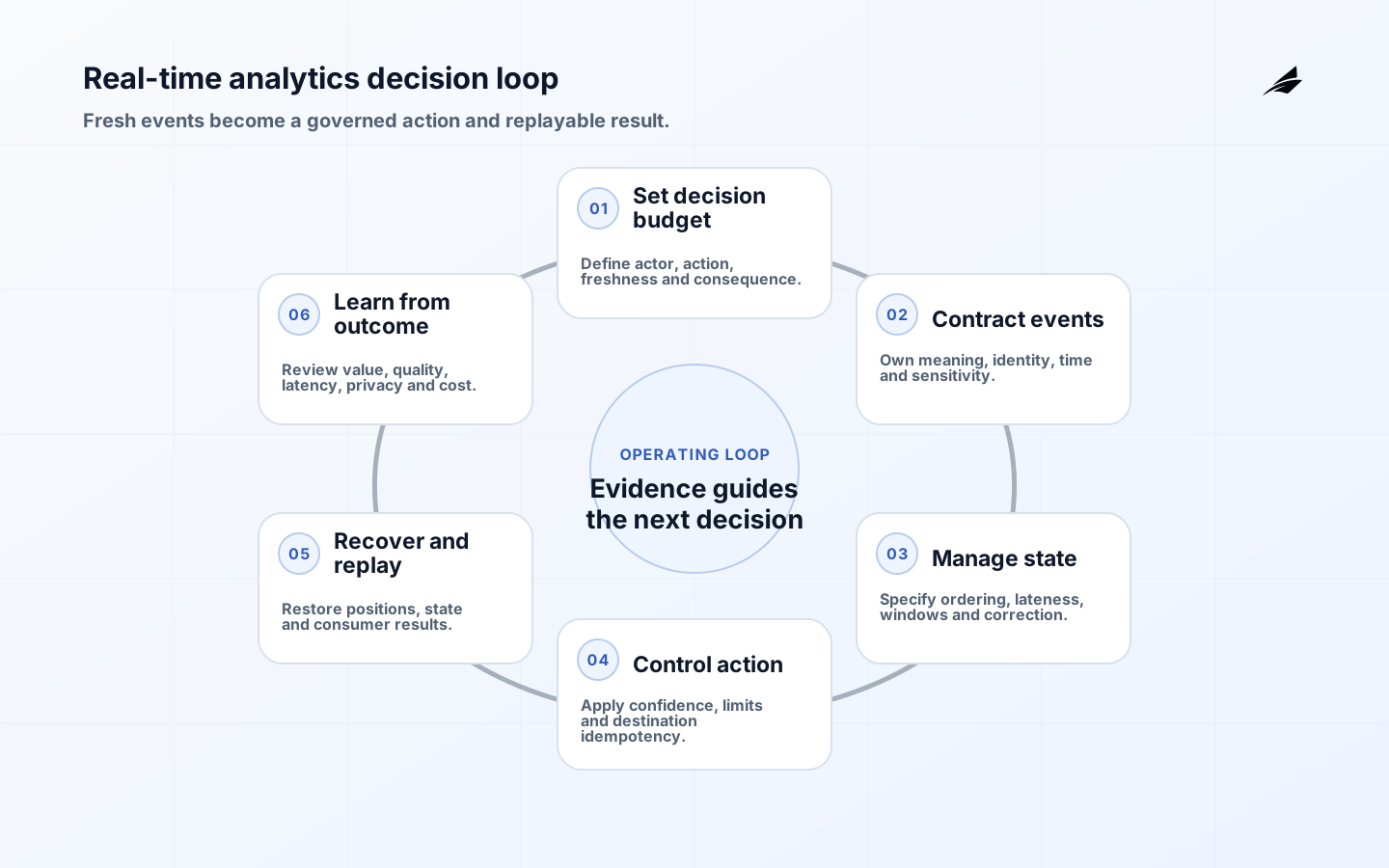
Real-time analytics is an operating capability that turns continuously arriving events into a decision within a defined freshness budget. The architecture is justified when delay has a measurable consequence: fraud exposure, operational interruption, missed intervention, stale inventory or degraded customer experience. It is not simply a dashboard that refreshes often. Correctness, event time, replay, privacy and response ownership matter as much as low processing latency.
Buyers and CTOs need to determine whether streaming is necessary, which capabilities belong in scope and how to compare platforms without confusing benchmark speed with business fitness. This guide complements real-time analytics in production and the pre-build decision guide.
Start with decision time, not data speed
Define the actor or automated system, the decision, the event that informs it, the last useful response time and the consequence of an incorrect or late result. Break the budget into source capture, transport, processing, model or rule evaluation, destination update and action. Many requests described as real time tolerate minutes. A simpler micro-batch may provide better recovery and lower cost while still meeting the decision window.
Measure source-to-action latency, not only broker or query latency. Include device buffering, API retries, clock error, downstream cache and human response. Set freshness and completeness objectives together; a fast result based on half the expected sources can be worse than a clearly marked delay. Define degraded behavior when the objective is missed: suppress the action, show stale status, use a bounded fallback or route to review.
| Decision class | Typical tolerance | Correctness concern | Suitable starting pattern |
|---|---|---|---|
| Immediate protection | Seconds or less | False action and missed threat | Event stream with bounded rule and fallback |
| Operational intervention | Seconds to minutes | Late, duplicate or out-of-order state | Stateful processing with event-time policy |
| Customer personalization | Subsecond to minutes | Consent, relevance and feedback bias | Online features with controlled exposure |
| Inventory visibility | Minutes | Cross-source reconciliation | Incremental events plus periodic truth check |
| Executive monitoring | Minutes to hours | Stable definitions and comparability | Micro-batch semantic model |
| Regulatory reporting | Hours to days | Completeness, lineage and reproducibility | Governed batch or reconciled stream output |
Contract events and source ownership
Define event type, business meaning, source, key, identifier, event time, units, optionality, sensitivity, schema version and ownership. Distinguish an occurrence from a current-state snapshot. State whether deletion, correction and replay events exist. Give producers compatibility rules and consumers representative examples. Apache Kafka's event-streaming introduction describes durable capture, processing and routing, but application teams still own the semantic contract carried by records.
Use stable keys for partitioning and state, while watching skew caused by a few high-volume customers or assets. Protect sensitive fields and avoid placing them in broadly visible headers or keys. Maintain a consumer inventory and change-notification process. A schema that parses can still break meaning when units, default values or lifecycle semantics change. Contract tests should exercise the behavior consumers depend on, including absent, corrected and future fields.
Make time, ordering and state explicit
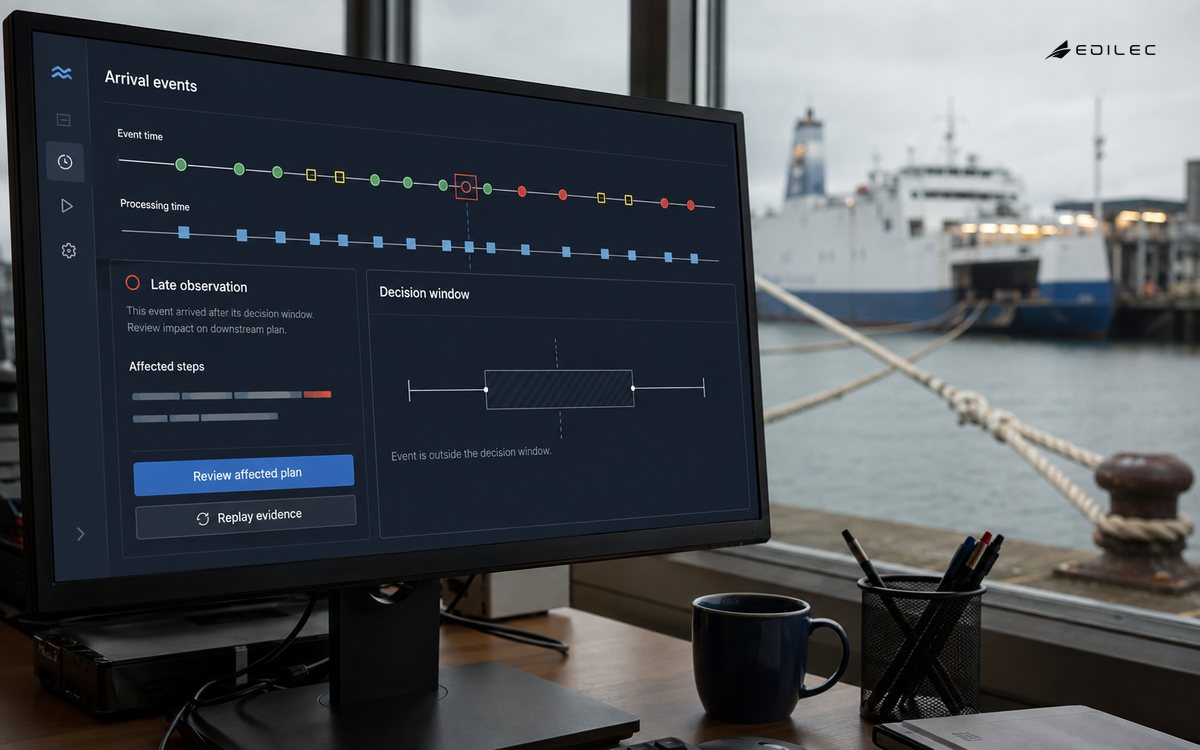
Record event time and processing time separately. Define allowed lateness, watermark or closure policy, window boundaries and how corrected results are published. Global ordering is expensive and often unnecessary; order by a business key where the decision requires it. A late event may update a current view, revise a historical aggregate or be quarantined. The choice must be visible to consumers and consistent during replay.
Stateful analytics needs a clear state model, retention, checkpoint and migration policy. Define deduplication identity and duration. Use idempotent destinations for effects such as alerts or case creation. Exactly-once is a scoped guarantee: Apache Flink's fault-tolerance documentation explains that end-to-end exactly-once requires replayable sources and transactional or idempotent sinks. Verify the entire path rather than repeating a platform label.
Select an architecture from guarantees
A production design may include change capture or event producers, durable transport, schema services, stream processing, state and checkpoints, serving stores, alerts and analytical sinks. Keep the source of truth explicit. A streaming view can be authoritative for a bounded decision while a transactional system remains authoritative for settlement. Avoid maintaining separate batch and streaming logic for the same metric unless the reconciliation and ownership burden is justified.
Evaluate platforms through supported connectors, processing semantics, state scale, event-time behavior, multi-tenancy, security, observability, upgrade compatibility, ecosystem maturity and operator skill. Run a representative proof with skew, late data, schema change, backpressure and failure. Managed services reduce infrastructure work but do not remove contract, correctness, privacy or cost ownership. Document portability for event data, state, code and checkpoints before deep adoption.
| Failure | Expected behavior | Acceptance exercise | Signal |
|---|---|---|---|
| Producer retry | Duplicate does not duplicate business effect | Replay same event identifier | Deduplication conflicts |
| Out-of-order input | Policy produces defined correction | Deliver reversed sequence | Late-event and revision counts |
| Processor crash | State and source position recover consistently | Terminate worker under load | Recovery and catch-up time |
| Sink unavailable | Backpressure or buffer remains bounded | Block destination writes | Oldest pending event |
| Schema change | Compatible consumers continue; break is stopped | Publish old and proposed examples | Rejected contract versions |
| Regional outage | Recovery meets decision objective | Restore processing and serving state | Data loss and action gap |
Reconcile quality and lineage
Validate transport, schema, business rules and aggregate totals at meaningful boundaries. Monitor missing sources, duplicate identifiers, impossible values, event-time lag and reconciliation differences. Periodically compare streaming outputs with an authoritative snapshot or ledger where one exists. Do not silently discard malformed data; quarantine it with owner, reason and retrievable evidence. Publish freshness and quality status beside the analytical result.
Capture source, contract version, transformation revision, run or deployment, state version, output and quality status. The W3C PROV-O recommendation models provenance through entities, activities and agents. Teams can apply those concepts without adopting the full ontology. The practical goal is to explain why an alert or metric had a value at a time and reproduce or correct it safely.
Control privacy, access and automated action
Classify event data and define purpose, access, retention, regional movement and deletion propagation. Streams can expose detailed behavioral patterns and make harmful inferences quickly. The NIST Privacy Framework provides a voluntary approach for identifying and managing privacy risk. Apply data minimization before collection and processing, not only through later access controls. Separate operational telemetry from broadly accessible analytics where appropriate.
Use distinct producer, processor and consumer identities with narrow topic, state and destination rights. Encrypt transport and stores, protect schema and pipeline changes, rotate credentials and audit administrative access. Put high-consequence automated actions behind limits, confidence requirements, human review or a kill switch according to risk. An anomaly score should not directly suspend a customer or stop equipment without an explicitly accepted decision policy.
Operate and price the complete service
Observe input rate, end-to-end lag, watermark delay, backpressure, skew, checkpoint duration, state growth, retries, rejects, sink latency and action outcomes. OpenTelemetry signals can correlate services through traces, metrics and logs, but data-pipeline quality needs domain measures too. Define on-call ownership and a consumer communication path when results are stale or being corrected.
Model cost by events, bytes, partitions, processing, state, checkpoints, retention, network transfer, serving queries, observability, support and duplicated transition systems. Test peak and catch-up rates, not only average traffic. Set per-decision or per-event unit economics and retention budgets. The older buyer and CTO guide offers a useful comparison point, while the operations checklist supports ongoing reviews.
Capacity planning must include recovery. If normal operation consumes nearly all available throughput, a service cannot catch up after a two-hour outage while new events continue to arrive. Measure sustainable input, peak input, replay rate, state restore time and downstream write capacity together. Decide which event classes receive priority and when old low-value work expires. Rehearse recovery with representative state and backlog because empty-cluster benchmarks omit the most expensive production condition.
Manage analytical rule and model releases like application changes. Version features, thresholds, reference data and model artifacts; expose the active version in outputs; and compare a candidate on recorded or shadow traffic before action. Set rollback or roll-forward criteria and preserve the ability to reproduce a consequential decision. Streaming infrastructure can deliver an updated rule instantly, which makes controlled exposure and outcome monitoring more important rather than less. Keep shadow outputs access controlled and delete them under the same purpose and retention rules.
Key takeaways
- Define the decision and last useful response time before selecting streaming technology.
- Contract event meaning, time, identity, sensitivity and compatibility.
- Specify ordering, lateness, state, replay and destination idempotency together.
- Prove platform guarantees across sources, processors and sinks under failure.
- Publish freshness, quality and lineage beside analytical outputs.
- Measure decision outcomes and full operating cost, not only processing latency.
Real-time analytics FAQ
Is real time the same as low latency? No. It is an end-to-end decision objective that includes freshness, completeness, correctness and action. A fast processor cannot compensate for delayed sources or stale destinations.
When is micro-batch better? When the decision tolerates its interval and simpler recovery, reconciliation or cost is valuable. Choose the least complex pattern that meets the decision budget.
Does exactly-once eliminate duplicates? Only within its defined boundary. External effects still require transactional coordination or idempotent design, and source identifiers must represent the business event correctly.
How should a platform proof be run? Use representative volume, key skew, state, late events, schema evolution, destination slowdown, worker failure and recovery, then measure end-to-end decision behavior.
Conclusion: buy a decision service
Real-time analytics earns its complexity when a fresh, trustworthy result changes a valuable decision before the opportunity expires. Begin with that budget, govern event meaning, engineer time and state, prove recovery, protect privacy and operate from action outcomes. The best architecture is not the fastest benchmark; it is the simplest service that consistently meets the business decision under real failure.