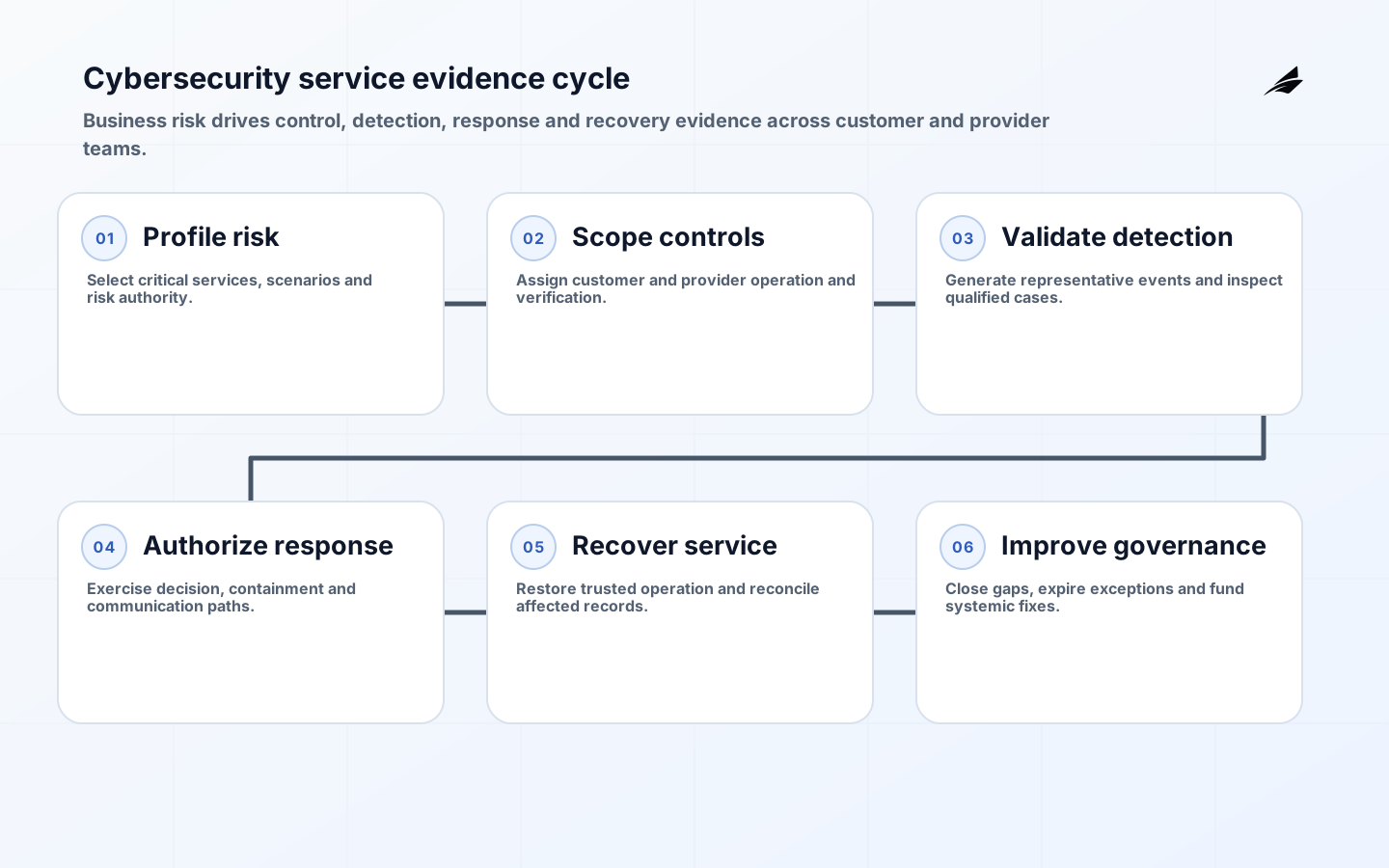
A cybersecurity services implementation checklist should begin with risk outcomes and operating authority, not a list of tools. A provider can monitor alerts, test applications, manage vulnerabilities or operate identity controls, but the organization still owns business priorities, legal duties, risk acceptance and recovery decisions. The implementation succeeds when both parties can trace a material scenario from preventive control through detection, authorized response, verified recovery and improvement using evidence that leaders and engineers understand.
Use NIST CSF 2.0 to define a current and target profile across Govern, Identify, Protect, Detect, Respond and Recover. The framework describes outcomes rather than prescribing products, which makes it suitable for comparing internal and provider responsibilities. Select a small set of scenarios tied to critical services: account takeover, ransomware, cloud credential theft, exposed application, supplier compromise or data exfiltration. These scenarios should drive service scope, telemetry, response authority and acceptance exercises.
Define service outcomes and retained accountability
Name the business services, data and identities in scope. Set risk appetite, recovery needs and notification obligations. For each offered service, describe eligible assets, hours, request path, target, exclusions and customer dependencies. “Managed detection” is incomplete unless it states which logs are collected, how coverage is validated, who triages, what counts as an incident and what containment may occur without approval. “Vulnerability management” must cover discovery, ownership, exploitation context, remediation evidence and accepted exceptions.
Assign design, implementation, operation, verification and decision authority separately. A provider may operate endpoint policy while an internal security owner approves it and an application team resolves compatibility. Identify deputies and out-of-hours authority. Retain access to alerts, cases, asset context and control evidence; a service that can only be understood through quarterly slides is not governable. Include supplier and subcontractor dependencies in the risk model and contract.
| Service area | Provider responsibility | Customer responsibility | Acceptance evidence |
|---|---|---|---|
| Detection | Operate agreed analytics and triage | Provide assets, context and escalation | Scenario produces timely, useful case |
| Vulnerability | Prioritize and track findings | Own remediation and risk acceptance | Affected assets close or have expiring exception |
| Identity | Operate bounded controls | Approve roles and emergency authority | Access reviews and misuse drill |
| Incident response | Coordinate and preserve evidence | Direct business decisions and notification | Tabletop plus technical exercise |
| Recovery | Support clean restoration | Set service and data objectives | Measured restore and reconciliation |
Build an evidence-based onboarding baseline
Reconcile assets, identities, data stores, internet exposure, cloud accounts, suppliers and service owners. Do not import an unreliable inventory and call onboarding complete. Sample critical systems against authoritative cloud, directory and deployment sources. Record unsupported technology and blind spots as risks with owners. Establish secure administrative access using individual, strong, time-bound identities. Provider activity should be attributable to a person or constrained automation, never a shared support account.
Map and test telemetry. Confirm time synchronization, source identity, parsing, retention, access and detection use. Event volume is not coverage. CISA’s logging guidance emphasizes selecting useful event data and operationalizing detection; verify representative security events from endpoint, identity, cloud, network and application layers. Protect logs from unauthorized change and document degraded mode when a source stops. Alert on collection gaps with the same seriousness as detection failures.
Prioritize exposure and exploitability instead of raw severity
Combine vulnerability severity with internet reachability, active exploitation, asset criticality, available mitigation and attack path. CISA’s Known Exploited Vulnerabilities Catalog is one useful signal for vulnerabilities exploited in the wild; it should inform, not replace, organization-specific decisions. Define remediation targets and an exception process with accountable approval, compensating controls and expiry. Verify closure through rescanning, configuration evidence or deployment records rather than ticket status alone.
Test whether findings can reach the team that owns the change. A provider report without repository, platform or endpoint integration creates queue delay. Normalize asset IDs and preserve discovery source. Track recurring root causes such as unsupported bases, missing deployment paths or broad permissions. Fund platform improvements that remove classes of exposure. The service should reduce risk and future workload, not maximize finding counts.
Agree incident authority and communication before go-live
NIST SP 800-61 Rev. 3 integrates incident response with broader CSF risk management. Define declaration thresholds, roles, secure communications, evidence handling, containment options, legal and privacy escalation, customer notification and recovery acceptance. Specify what the provider may do when internal approval is unavailable. Bounded actions such as disabling a known-compromised account may be pre-authorized; shutting down a revenue service may require an incident commander with business context.

Exercise one scenario across organizational boundaries. Make the provider detect and escalate using production-like telemetry; require internal teams to decide and execute; then restore and reconcile. Measure time lost at each handoff. Preserve a shared incident chronology and decision log. Afterward, update detections, access, runbooks and architecture, and verify that actions close. A tabletop that never touches tools or identities cannot prove operational readiness.
| Go-live gate | Proof | Stop condition |
|---|---|---|
| Scope | Critical services and exclusions are signed off | Unknown ownership for material assets |
| Access | Least-privilege and emergency paths tested | Shared or unreviewed administrator access |
| Telemetry | Representative events reach usable detections | Critical source gaps are unowned |
| Response | Cross-party exercise meets authority and timing needs | Containment waits on an unreachable approver |
| Exit | Cases, evidence and configuration can be exported | Customer cannot operate or transition |
Measure control and response quality
Use measures tied to scenarios: coverage of critical assets, detection validation, time to qualified triage, time to authorized containment, exception age, restore success, repeat incidents and evidence completeness. Mean-time averages can hide severe outliers, so inspect distributions and critical events. Sample closed alerts and findings for correctness. Report known blind spots and overdue dependencies alongside positive metrics. A low alert count may mean good prevention, poor collection or narrow detection; context decides.
Run operational, service and executive reviews at different cadences using one evidence set. Operational review resolves cases and gaps. Service review addresses recurring failure, roadmap and capacity. Executive review connects residual risk and investment to business priorities. Maintain a funded improvement backlog. Test provider exit periodically by exporting case history, analytics, inventories and runbooks and by confirming customer-owned access remains usable.
Turn procurement claims into testable commitments
Ask bidders to map their offer to the target profile and representative scenarios. Require sample evidence with sensitive details removed: a detection case, vulnerability decision, incident chronology, access report and improvement plan. Confirm which staff and locations deliver the service, how subcontractors are controlled, which tools hold customer data and how platform changes are communicated. Certifications and attestations can support due diligence, but they do not prove that the proposed service covers the organization’s assets or can execute its response authority.
Price onboarding, steady operation, surge response, improvement and exit separately enough to expose assumptions. Define data ownership, retention, secure deletion, audit support and export formats. State how volume changes affect service and cost. Tie payment or acceptance milestones to reconciled inventory, telemetry validation, exercised runbooks and knowledge transfer rather than document delivery. This keeps the engagement focused on operational capability.
Use the first 90 days to prove the service
In the first month, reconcile scope, access, telemetry and escalation and publish known blind spots. In the second, validate high-priority detections, vulnerability routing and one incident scenario. In the third, review metrics, close major handoff gaps, exercise recovery and confirm exit evidence. Sequence depends on risk, but every phase should end with observable proof. Do not spend the whole transition importing old alert rules while critical services remain unidentified.
Create a single acceptance ledger for commitments, evidence, exceptions and owners. Link each service requirement to the asset population and test result, and distinguish provider dependency from customer dependency. Review overdue entries jointly. This prevents a transition issue from vanishing when it is moved between procurement, security and operations queues and gives governance a defensible view of residual risk.
Keep service documentation executable. Contacts should be checked, queries should run, identities should work and runbooks should contain current decision authority. Sample them during ordinary reviews instead of waiting for a severe event. When a tool, tenant, supplier or key owner changes, update both the technical integration and the incident path. Documentation quality is an operating control when it shortens a real decision.
Agree how urgent threat intelligence changes the service. A newly exploited vulnerability or provider advisory should trigger an impact query against the reconciled estate, a named decision path and evidence of action. Avoid forwarding undifferentiated feeds to customers. The useful product is a time-bounded answer about affected services, exposure, mitigation and residual uncertainty.
Key takeaways
- Scope services around material scenarios and business assets.
- Separate operating work from risk and incident decision authority.
- Validate telemetry and detections with representative events.
- Prioritize exploitability and exposure, and expire exceptions.
- Prove response, recovery and exit through exercises.
Frequently asked questions
Does a managed security provider replace an internal security leader?
No. The organization still needs authority over business risk, policy, architecture, legal obligations, incident decisions and supplier governance. A provider can supply expertise and operations, but retained ownership must be named and capable.
Which service levels matter most?
Acknowledgement matters, but qualified triage, escalation, authorized containment, restoration and evidence quality are more meaningful. Define measurement source, severity rules and customer dependencies, and inspect critical-event performance rather than averages alone.
Is annual penetration testing enough?
No. Penetration tests provide point-in-time evidence within a scope. They should complement secure engineering, exposure management, configuration assurance, detection validation and incident exercises. Re-test after material changes and verify remediation.
Conclusion
Cybersecurity services create value when they make risk reduction and response more dependable, not when they add dashboards. Before go-live, require a provider and internal owners to detect, decide, contain and recover from a representative scenario with current tools and access. The unresolved handoffs from that exercise are the real implementation backlog. Close them, preserve evidence and govern continuing improvement as part of the service.