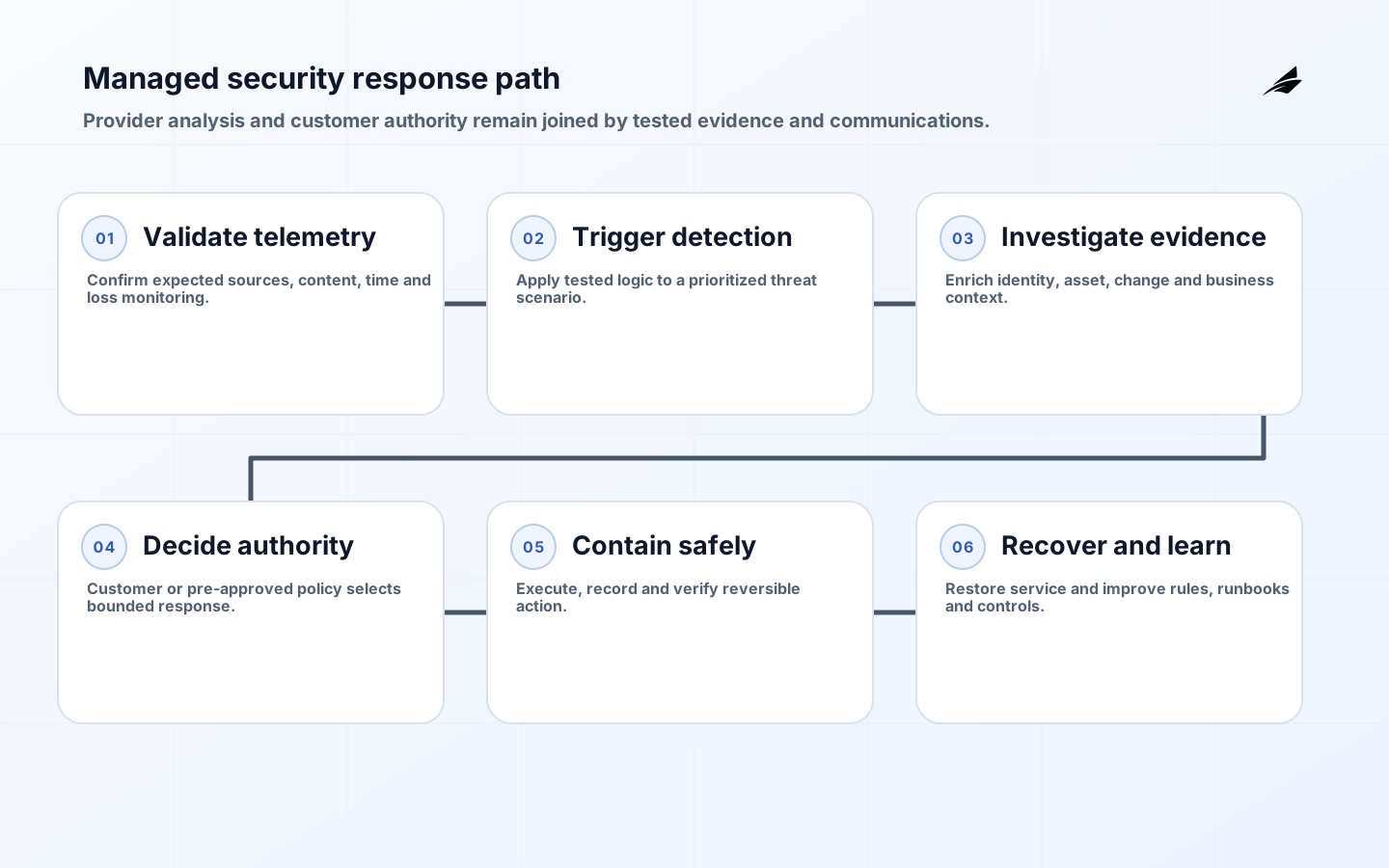
Managed security services can supply monitoring, detection engineering, investigation, vulnerability work, incident support and security-platform operation. They do not transfer the organization's accountability for risk, business decisions or legal duties. Implementation succeeds when customer and provider share a precise operating boundary, trustworthy telemetry, rehearsed response authority and evidence that detections reduce material risk rather than merely produce tickets.
Use this managed security services implementation checklist with Edilec's scope, cost and delivery plan, buyer and operating FAQ and managed cloud security checklist. NIST CSF 2.0 organizes outcomes across Govern, Identify, Protect, Detect, Respond and Recover; the service contract should show which outcomes it supports and which customer dependencies remain.
1. Define risk outcomes and the service boundary
Identify critical services, data, identities, likely threat scenarios, business hours, jurisdictions and current response capability. Define the provider's functions by asset and environment: collect, monitor, hunt, tune, investigate, advise, contain or recover. List exclusions such as operational technology, acquired companies or unsupported cloud accounts. For each scenario, name customer and provider decisions, evidence, notification route and maximum tolerated delay. Align the boundary to an approved target profile rather than purchasing a generic bundle.
| Service decision | Customer owns | Provider owns | Joint evidence |
|---|---|---|---|
| Telemetry | Authority, source access and retention | Collection health and parsing | Coverage and loss dashboard |
| Detection | Risk priority and acceptance | Rule engineering and tuning | Test result and change history |
| Investigation | Business and identity context | Technical triage and evidence | Case timeline and confidence |
| Containment | Impact authority and exceptions | Approved action execution | Command, result and reversal |
| Recovery | Business priority and validation | Technical assistance if scoped | Restoration and recurrence review |
2. Inventory assets and onboard telemetry
Reconcile identity, endpoint, server, network, cloud, email, application and critical SaaS inventories against log sources. For each source record owner, event types, time synchronization, transport, expected volume, parsing, sensitive fields, retention, residency and failure alert. CISA recommends centralizing useful logs and protecting them from unauthorized access or deletion. Prioritize evidence needed for high-risk scenarios instead of ingesting everything and discovering later that a decisive identity or application event is absent.
Validate content, not just connection status. Generate known events and confirm timestamp, actor, source, action, target and outcome survive the pipeline. Detect sudden silence, parse failure, clock drift and volume change. Keep raw or replayable evidence where requirements justify it. Mask unnecessary secrets and personal data, and control provider access to both telemetry and search tools.
3. Build and test a detection catalog
Map detections to prioritized scenarios and relevant ATT&CK techniques, but do not treat framework coverage as proof of effectiveness. Each detection needs purpose, required data, logic, severity, threshold, known limitations, owner, runbook and test. Establish a controlled change path for rules and suppression. Replay representative events or run safe simulations to verify collection, alert, enrichment, analyst decision and customer notification end to end.
Measure precision in context. A low-volume high-consequence signal may tolerate more investigation; a noisy low-value rule can consume the team and hide serious work. Review false positives, false negatives found through incidents or exercises, duplicate cases, stale rules and unmonitored assets. Provider intellectual property can remain protected while the customer still receives enough logic, data dependency and performance evidence to govern the service.
4. Approve response authority and communications
NIST SP 800-61r3 integrates incident response across CSF 2.0 rather than treating it as a separate late-stage function. Define severity using business impact and confidence. Create a contact tree with primary, alternate and out-of-band routes. Specify who may isolate a host, disable an identity, block traffic, preserve evidence, engage legal counsel, notify authorities or communicate externally. Pre-authorize bounded low-regret actions only after testing their effect and reversal.

5. Secure provider access and service dependencies
Use named, federated identities, phishing-resistant multifactor authentication where feasible, least privilege, just-in-time elevation and customer-controlled logging. Separate administration from investigation. Inventory service accounts, API keys, collectors, remote tools and support channels; rotate and revoke them through a tested process. Restrict data export and subcontractor access. Review the provider's own incident, continuity, vulnerability and personnel controls and contract for prompt notification of events affecting the service.
Avoid a shared emergency account with an unknown user. Where a break-glass path is unavoidable, store it under customer control, require approval or immediate notice, limit duration and review every use. Test what happens when federation, the SIEM, the provider portal or the provider itself is unavailable. The customer must retain a minimum independent path to declare and coordinate a major incident.
6. Run onboarding as a controlled transition
- Approve scope, critical scenarios, responsibilities, service levels and exclusions.
- Connect prioritized sources and validate event content and loss monitoring.
- Migrate or create detections with tests, owners and runbooks.
- Shadow existing operations and compare triage and escalation decisions.
- Exercise a high-impact scenario, including out-of-band communication.
- Accept each capability separately and track remaining gaps with owners and dates.
Do not declare completion because agents are installed or logs arrive. Run parallel review long enough to expose differences in asset context, severity and escalation. Train customer responders to use the case portal and retrieve evidence. Give help desk, infrastructure, identity, legal and communications teams their specific actions. Establish change freezes or heightened monitoring around critical business periods.
7. Measure security and operating quality
| Measure | What it reveals | Caution |
|---|---|---|
| Telemetry coverage | Expected sources sending usable events | Asset inventory may be incomplete |
| Detection test pass rate | End-to-end control still works | Test set must evolve |
| Time to qualified triage | Delay to an evidence-based decision | Do not reward premature closure |
| Escalation acceptance | Cases are useful to responders | Customer delay also needs ownership |
| Containment completion | Approved action reached affected scope | Measure reversal and collateral effect |
| Repeat incident pattern | Learning changed the environment | Classification consistency matters |
Report distributions and severe exceptions, not averages alone. Review missed incidents, aged cases, source outages, tuning backlog, privileged access, contractual dependencies and improvement actions. Alert count is a workload measure, not a security outcome. The governance forum should decide changes to coverage, risk acceptance, automation and investment and preserve those decisions.
8. Prepare continuity and exit before go-live
Define ownership and export format for raw logs, normalized data, cases, detection content, threat intelligence, dashboards and runbooks. Contract retention and deletion after termination. Maintain an inventory of deployed agents and credentials. Rehearse transfer to the customer or another provider, including API limits and history. Exit acceptance should confirm data receipt, rule migration, access revocation, collector change and uninterrupted escalation.
Exercise and assure the live service
Run recurring exercises beginning with realistic evidence rather than a known answer. Include compromised identity, control-plane change, ransomware precursor, exfiltration and provider unavailability according to risk. Test nights, weekends and stale contacts. Capture detection, analyst reasoning, customer decision, containment, communication and recovery; improve the rule, runbook or authority gap that caused delay.
Sample closed cases for evidence quality and correct disposition. Review provider quality controls, analyst continuity, subcontractors, platform changes and vulnerability handling. Independent assurance reports inform due diligence but do not prove the customer's scoped service works. Combine them with telemetry tests, case samples, access records and exercises from the actual environment.
Keep a joint improvement backlog prioritized by risk and friction. Put each action on the correct side of the contract: a provider cannot fix missing asset ownership, and a customer cannot tune proprietary logic. Review overdue actions and accepted residual risks with leadership, especially where repeated incidents show the original boundary is insufficient.
Key takeaways
- Contract a measurable operating boundary, not an undefined promise of protection.
- Validate telemetry content and loss detection against prioritized scenarios.
- Test detections and response handoffs end to end before acceptance.
- Keep business-impact authority and independent incident coordination with the customer.
- Measure useful decisions, control health and learning, and preserve a workable exit.
Frequently asked questions
What is the difference between MSSP and MDR?
Labels vary. MSSP often covers operation of security controls and monitoring; MDR usually emphasizes detection, investigation and response. Compare the actual telemetry, analyst work, response authority, hours, evidence and exclusions rather than relying on the name.
Does every organization need 24/7 monitoring?
The requirement follows threat exposure, criticality and tolerated response delay. A service can monitor continuously while customer escalation remains limited, which creates a gap. Define who can decide and act at every hour, and test that path.
Can a provider guarantee that breaches will not occur?
No credible service can eliminate all cyber risk. It can commit to defined coverage, control operation, response behavior and evidence. Governance should focus on reducing likelihood and impact and improving detection, response and recovery.
Control service and platform change
Require notice for material changes to collection, analytics, case workflow, storage location, subcontractors and response process. Assess effects on detections, privacy, integration and evidence before adoption. Keep rule and runbook history, test important changes with known events and maintain a rollback or continuity path. Provider innovation is useful only when the customer can understand how the live control changed.
Review scope after acquisitions, new cloud regions, identity changes and major incidents. Update asset and telemetry expectations before signing an annual renewal. Price expansion transparently and remove sources or licenses that no longer serve an approved scenario. Contract governance should keep technical reality, risk profile and invoice aligned.
Conclusion
A managed security service becomes useful when provider capability and customer authority operate as one tested system. Start from risk scenarios, prove telemetry and detections, rehearse consequential response and govern service evidence. Clear access, continuity and exit controls keep outsourcing from creating a new concentration of unmeasured security risk.