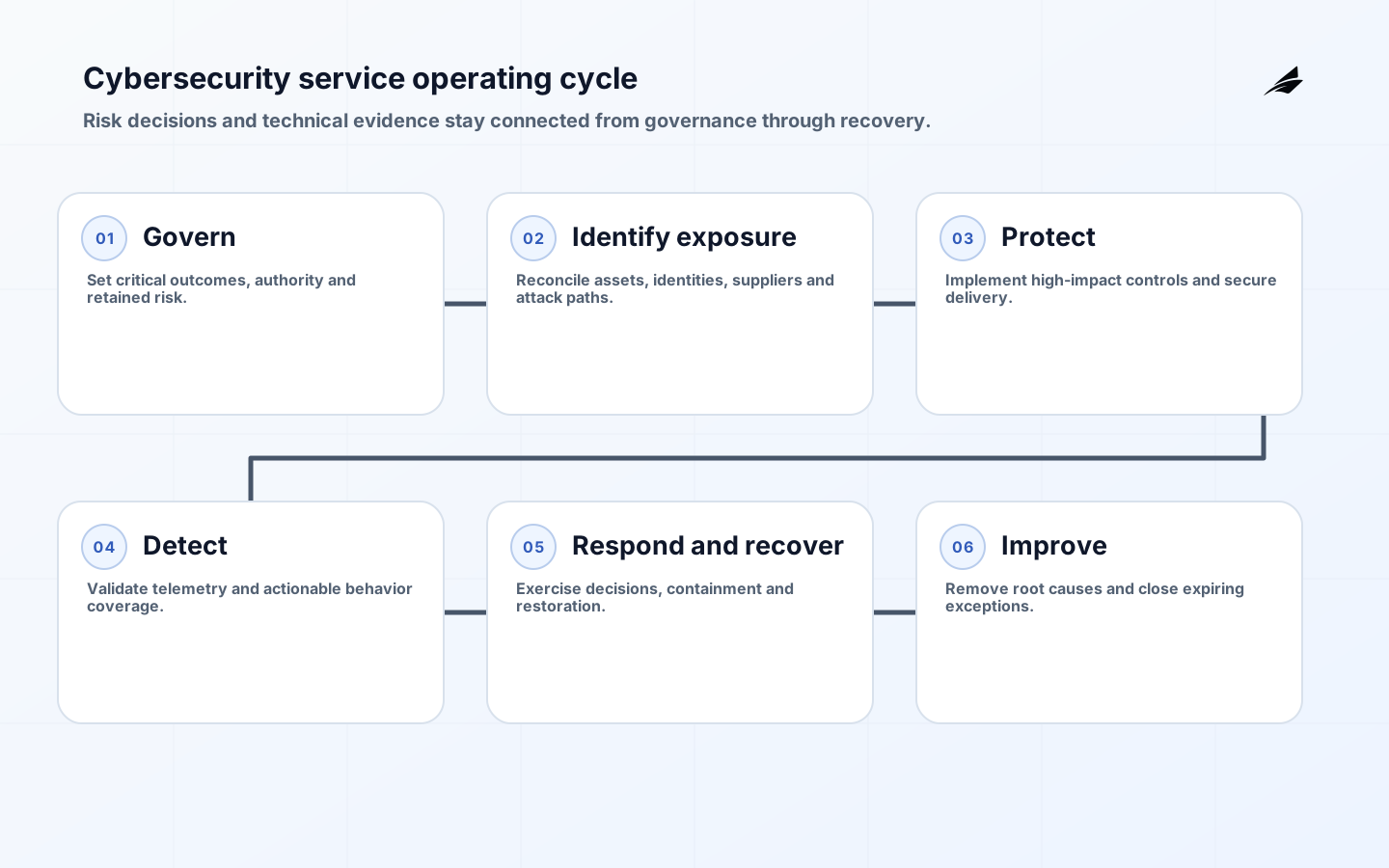
Cybersecurity services are most effective when they improve a defined risk outcome and leave responsibilities visible. A penetration test, monitoring platform or policy set can be useful, but none is a complete security program. The organization still owns business priorities, legal and contractual obligations, risk acceptance and safe operation. A provider can supply specialist capability and continuous work when the service boundary, authority, evidence and escalation path are explicit.
NIST Cybersecurity Framework 2.0 organizes outcomes through Govern, Identify, Protect, Detect, Respond and Recover. CISA's performance goals offer a prioritized baseline of high-impact practices, while NIST SP 800-61 Revision 3 integrates incident response across the framework. These resources help buyers move beyond tool lists. The questions below explain how to scope advisory, implementation, assessment and managed services and how to verify that they reduce exposure rather than produce reports.
Which cybersecurity services does an organization need?
Begin with critical services, data, obligations and plausible threats. Advisory work can establish governance, target profiles and roadmap. Engineering can implement identity, hardening, logging, segmentation, secure development and recovery controls. Assurance can test design and operation through architecture review, vulnerability assessment, penetration testing or control evidence. Managed services can operate monitoring, vulnerability workflows, cloud posture or incident support. Select the missing capability, not the most familiar product category.
A small organization may first need asset ownership, multifactor authentication, protected backups, patching, logging and a practiced response plan. A software producer may prioritize NIST SSDF, build integrity, dependency management and vulnerability disclosure. An enterprise with those foundations may need detection engineering, identity threat monitoring and coordinated exercises. Use a current and target CSF profile to record outcomes and priorities, then assign work to internal teams or providers based on capability and consequence.
| Service | Useful scope | Acceptance evidence |
|---|---|---|
| Risk and architecture | Critical services, threats and target outcomes | Approved profile, decisions and owned roadmap |
| Control engineering | Identity, hardening, logging, backup or secure delivery | Tested configuration and operating evidence |
| Assessment | Defined systems, methods and limitations | Reproducible findings with consequence and retest |
| Managed detection | Named telemetry, use cases and response boundary | Alert exercises and investigation records |
| Incident readiness | Roles, contacts, playbooks and evidence handling | Tabletop and technical recovery exercise |
| Program governance | Metrics, exceptions, suppliers and improvement | Decisions linked to current risk |
How should scope and shared responsibility be documented?
Describe business services and technology boundaries, not only IP ranges. Include cloud accounts, SaaS, identity providers, endpoints, applications, data, operational technology, subsidiaries and third parties where relevant. Record exclusions and the risk they create. For each activity, name who designs, approves, operates, verifies and responds. These may be different parties. A provider may triage an alert while the client authorizes containment and legal communication.

Document access, tools, hours, severity, notification, evidence, data location, subcontractors and exit. Define who may isolate a host, disable an account or block traffic when client approval is unavailable. Specify which systems remain unsupported because telemetry or access is missing. Test handoffs before go-live. A responsibility matrix without runbooks, data paths and exercised authority will not resolve a time-critical incident.
How should security work be prioritized?
Prioritize by business consequence, exposure, exploitability and control weakness. Start with pathways that lead to critical services or high-impact data. CISA performance goals can identify high-value baseline actions, but tailor them to the estate. Fix systemic issues such as unmanaged internet assets, shared administration, unprotected recovery and unsupported software before optimizing low-consequence scanner findings. Use threat intelligence to adjust decisions, not to replace asset and business context.
Maintain a remediation register with affected service, evidence, consequence, owner, due date, planned control and exception. Vulnerability severity is one input. An internet-facing identity bypass and an internal library finding with no reachable path need different urgency. Group recurring findings by root cause: insecure defaults, missing deployment control, ownership gap or unsupported component. Fund improvements that prevent recurrence as well as closing individual tickets.
What makes an assessment or penetration test useful?
Define the question, target, accounts, data handling, test window, prohibited actions and incident coordination. Provide architecture and business context so testers can examine meaningful trust boundaries. Use authenticated review where it improves depth; an external scan alone cannot assess authorization, business logic or administrative workflow. Require reproducible evidence, affected conditions, realistic consequence and remediation guidance. Protect reports because they contain sensitive attack paths.
Retesting should verify the changed condition and look for alternative paths. Closing a finding because a single payload no longer works can leave the design weakness intact. Connect application findings to secure development practices in NIST SSDF: requirements, design review, protected build, dependency provenance, testing and vulnerability response. Track time to remove root cause and recurrence across products. Do not advertise a test as certification unless a recognized scheme actually supports that claim.
How should managed detection and response operate?
Start with telemetry quality. Inventory identity, endpoint, network, cloud, application and data sources; define owner, coverage, time synchronization, retention and parsing health. Map detection use cases to plausible attack paths and critical services. For each alert, specify evidence, severity, triage steps, enrichment, escalation and containment authority. Measure whether representative behavior is detected, not only whether logs arrive. Monitor source silence and schema change.
Tune through exercises and real investigations. Reduce alerts that cannot lead to action, but preserve low-frequency high-consequence signals. A provider should expose investigation reasoning and allow export of alerts, cases and detection logic according to contract. The client needs an on-call decision path and current asset contacts. Service-level promises for acknowledgement have limited value when the provider lacks authority or the client cannot answer at night.
What incident response capability should be included?
NIST SP 800-61 Revision 3 treats response as part of ongoing risk management. Prepare roles, contacts, communications, evidence sources, legal and regulatory decisions, supplier coordination and recovery priorities before an event. Playbooks should guide common scenarios without replacing judgment. Preserve volatile and durable evidence proportionally. Define how an incident is declared, who leads, how business decisions are recorded and when external specialists join.
Exercise both decisions and technology. Run tabletop scenarios for executives and a technical simulation that uses actual access, alerts, isolation and restoration. Include a failed communication channel or unavailable decision-maker. Recovery must validate data and business service, not merely rebuild hosts. After an incident or exercise, assign changes to controls, architecture, detection and plans. Improvement work requires capacity; otherwise lessons become presentation slides.
| Measure | Good interpretation | Avoid |
|---|---|---|
| Control coverage | Critical assets meeting tested outcome | Licenses purchased |
| Detection coverage | Relevant behaviors observable and exercised | Number of alert rules |
| Response time | Decision and containment time by scenario | Average ticket closure |
| Remediation | Risk removed and root cause prevented | Raw vulnerability count |
| Recovery | Measured restore and reconciliation result | Backup job success |
| Exception aging | Residual risk with owner and expiry | Permanent accepted findings |
How should a cybersecurity provider be selected?
Evaluate the assigned people, delivery method and evidence. Ask candidates to walk through a representative finding, investigation or incident with decisions and handoffs. Review sample reports and runbooks. Confirm competence in the actual cloud, application, identity or operational environment. Certifications can support due diligence but do not prove service fit. Check conflicts, insurance, breach history where available, subcontractors, secure development and how provider access is controlled.
Contract terms should cover scope, assumptions, acceptance, access, confidentiality, data residency, retention, breach notification, evidence ownership, vulnerability disclosure, subcontractors, service levels, liability, termination and transition. Ensure the organization can retrieve configuration, findings, cases and logs needed for continuity. Use individual, time-bound provider access and review it. A provider should reduce dependency by documenting the environment and transferring knowledge, even when the service is ongoing.
What affects cost and how is value measured?
Cost depends on asset and identity count, telemetry volume, application complexity, coverage hours, response authority, retention, compliance evidence, environment change and specialist access. Separate setup, recurring operation, incident surge and remediation engineering. A low monitoring fee can exclude log ingestion, tuning or response. Ask for unit assumptions and change rules. Retain budget for fixing issues; assessment without remediation capacity creates an expensive inventory of known risk.
Measure value through risk and operating outcomes: fewer unmanaged critical assets, stronger authentication, faster removal, tested recovery, higher detection coverage, lower repeat findings and better response decisions. Link metrics to business services and trends. Absence of incidents is not proof of effectiveness, and a rising alert count is not necessarily improvement. Use exercises and control tests to create evidence before an adversary does.
Key takeaways
- Select services from critical business outcomes and capability gaps.
- Document design, operation, verification and response ownership separately.
- Prioritize systemic attack paths and high-impact baseline controls.
- Exercise telemetry, handoffs, containment and recovery before relying on service levels.
- Measure tested risk reduction and retain access to authoritative evidence.
Frequently asked questions
Does a small business need a 24-hour security operations center?
Not always. It needs a response appropriate to exposure and consequence. Continuous managed monitoring may be valuable for internet-facing critical services, but foundational identity, patching, backup and ownership may reduce more risk first.
How often should penetration testing occur?
Use risk, material change and obligations rather than a universal interval. Test after consequential architecture or authorization change and periodically where exposure justifies it. Continuous secure development remains necessary between tests.
Can cybersecurity be fully outsourced?
Specialist work and operation can be outsourced, but the organization retains business ownership, risk acceptance, legal duties and service decisions. Maintain informed internal owners and an exit capability.
Conclusion
Cybersecurity services create durable value when they make risk ownership and control evidence clearer. Use CSF 2.0 to define target outcomes, CISA guidance to prioritize meaningful baseline actions, and current NIST incident and secure-development guidance to connect prevention, response and learning. Test the provider at the seams: missing telemetry, urgent containment, restoration and handover. A service that works there is more valuable than one measured mainly by reports and alert volume.