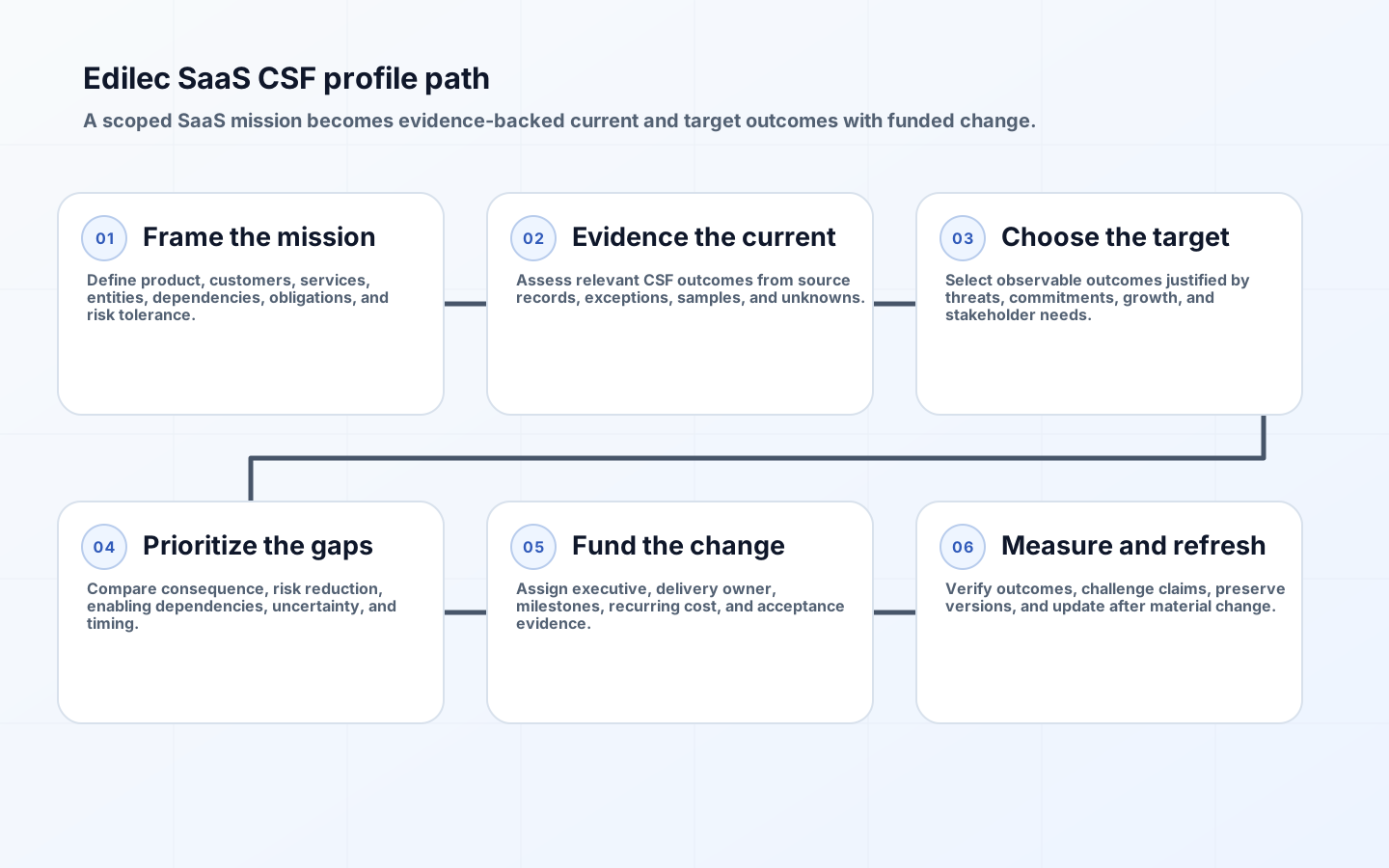
A NIST CSF 2.0 SaaS profile describes cybersecurity outcomes for a defined part of a software company in terms of the CSF Core. A Current Profile records outcomes the organization is achieving now; a Target Profile records prioritized outcomes it intends to achieve. The difference becomes a risk-informed roadmap. This is more useful than assigning a maturity score to every subcategory, because a SaaS company can explain what evidence exists, what target matters to customers and the business, why a gap has priority, and who will fund the change.
The NIST CSF 2.0 publication organizes outcomes under Govern, Identify, Protect, Detect, Respond, and Recover. It is not a control catalogue and does not prescribe implementation. Profiles tailor that common language to context. For SaaS, context includes multi-tenant data, cloud dependencies, software delivery, administrative access, customer contractual promises, availability, privacy, support, and a changing supplier stack. Keep implementation evidence beside the profile so statements can be verified rather than negotiated in workshops.
Scope the NIST CSF 2.0 SaaS profile
Name the organizational unit, product, customer population, environments, legal entities, cloud accounts, corporate systems, and third parties covered. Define mission objectives such as protecting customer records, maintaining transaction integrity, meeting availability commitments, and shipping changes safely. Identify stakeholders and decision rights: board or executive sponsor, security, engineering, product, support, legal, privacy, finance, people operations, and service owners. A whole-company profile can work for a small team, but separate product and corporate scopes may reveal different risks and owners.

Document assumptions and exclusions. If a payment provider stores card data, the SaaS company still owns integration, access, monitoring, incident, and continuity outcomes. If the cloud provider manages physical facilities, the company retains architecture, configuration, identity, data, and recovery responsibilities. The SaaS architecture guide helps expose service and tenant boundaries. Record profile date, business stage, customer commitments, applicable requirements, risk tolerance, and the events that require rescoping.
Build the Current Profile from operating evidence
Assess relevant CSF subcategories using concise implementation statements and proof. For asset management, show cloud, endpoint, application, data, and supplier inventories plus reconciliation. For identity, show authentication, lifecycle, privileged paths, service accounts, and access reviews. For detection, show telemetry coverage, use cases, triage, and measured response. Use achieved, partially achieved, not achieved, not applicable, and unknown only with defined criteria. Unknown is a legitimate finding that needs an owner; it should not be converted to partial to improve appearance.
Interview process owners, then sample records from source systems. Policies describe intended behavior; tickets, configurations, logs, incidents, exercises, metrics, and approvals show actual behavior. Select ordinary and exceptional cases such as emergency changes, departed administrators, failed backups, and supplier incidents. The audit-log guide supports evidence design. Record evidence date, population, limitations, and reviewer so the next assessment can distinguish a changed control from a changed opinion.
| CSF area | SaaS outcome | Useful evidence | Misleading shortcut |
|---|---|---|---|
| Govern | Cyber risk informs business decisions | Risk owners, accepted tolerances, funded treatments and oversight | Security policy exists |
| Identify | Assets and dependencies are understood | Reconciled inventories and data flows | Cloud billing export alone |
| Protect | Access and delivery safeguards operate | Lifecycle samples, CI gates and configuration tests | Tool enabled |
| Detect | Material events are discovered and analyzed | Coverage map, alert cases and detection tests | Log volume |
| Respond | Incidents are managed and communicated | Timed case, decisions, notices and lessons | Template playbook |
| Recover | Service and trust are restored | End-to-end exercise and measured objectives | Backup success indicator |
Set a risk-informed SaaS Target Profile
Select target outcomes from business objectives, threat scenarios, legal and contractual requirements, customer expectations, incidents, and growth plans. State the target in observable terms. Instead of improve supplier security, require that critical providers are identified, assessed before use, contractually bound to notify incidents, monitored, and tested in continuity plans. Specify target evidence and time horizon. Not every CSF outcome needs the same urgency or implementation depth, and selecting everything as immediate priority makes the profile useless for investment.
Use CSF Tiers carefully to characterize rigor of governance and risk-management practices, not as certification levels or simplistic maturity grades. A small SaaS company may choose repeatable processes for privileged access and incident response while accepting more informal treatment for low-risk internal tooling. Document why that posture fits risk and when it must change. The compliance-ready delivery guide helps translate target outcomes into release controls, ownership, and retained evidence.
Prioritize gaps by risk reduction and dependency
For each Current-to-Target difference, describe the affected service or asset, threat or failure scenario, business consequence, existing safeguards, proposed change, dependency, cost range, owner, and deadline. Prioritize material risk reduction, customer or legal commitments, and enabling foundations. A reliable asset and identity inventory may unlock vulnerability, access, incident, and supplier outcomes. A high-visibility dashboard may be less valuable than fixing incomplete tenant authorization tests. Preserve dissent and uncertainty so leadership sees the real tradeoff.
| Gap | Business consequence | Dependency | Decision |
|---|---|---|---|
| Privileged access is not attributable | Unauthorized production change cannot be contained or reconstructed | Central identity and administrative path | Fund before expanding operations |
| Backups restore data but not full service | Recovery objective may be missed | Identity, secrets, DNS, queues and runbooks | Run end-to-end recovery work |
| Supplier inventory is incomplete | Critical dependency incidents arrive without context | Procurement and architecture reconciliation | Establish inventory before deeper assessments |
| Detection misses tenant-boundary abuse | Customer data exposure can persist | Application events and threat scenarios | Add telemetry and abuse tests |
| Low-risk policy review is overdue | Limited immediate exposure | Policy owner availability | Schedule after material control gaps |
Turn the profile into a funded roadmap
Group gap treatments into initiatives with outcomes, milestones, accountable executive, delivery owner, budget, staffing, and acceptance evidence. Separate one-time remediation from recurring capability. Implementing endpoint management has a rollout cost and continuing licensing, operations, exception, and support costs. Include engineering capacity and customer-impact constraints, not only security-tool spend. Sequence foundational data and identity work before controls that depend on them. Leadership should explicitly accept deferred outcomes with rationale and review dates.
Integrate initiatives with product and platform planning rather than maintaining a parallel security roadmap. Define release criteria and demonstrations: privileged sessions attributable, recovery exercise within objective, critical suppliers mapped, or incident notification drill completed. Metrics should measure outcome and coverage, not activity alone. Percent of critical services with verified recovery is useful; number of backup jobs is not. Report both progress and residual exposure in language that finance, product, and customers can understand.
Govern profile refresh and independent challenge
Refresh the profile on a planned cadence and after material product, architecture, regulatory, supplier, acquisition, or threat changes. Do not reassess every row from scratch. Update changed evidence, aged samples, outstanding gaps, and target assumptions. Service owners should attest only after reviewing source records. Security coordinates the profile but cannot self-certify every outcome. Internal audit, an external assessor, or independent peers can challenge high-risk claims, sampling methods, exclusions, and accepted gaps.
Keep prior profile versions so trends are explainable. A lower score may reflect better evidence or expanded scope rather than deteriorating security; a higher score may hide looser criteria. Track unknowns resolved, target gaps closed, overdue actions, residual risks, incidents tied to gaps, and outcome durability after personnel or technology change. The incident-playbook guide helps test whether Respond and Recover claims remain executable under pressure.
Use threat scenarios to check profile coherence across Functions. A compromised support administrator, for example, tests governance of authority, identification of sensitive workflows, protective access and approval controls, detection of unusual customer-data access, response containment and notification, and recovery of account trust. If the profile rates these outcomes independently, it may miss a broken end-to-end path. Select several material scenarios and trace current evidence and target changes across all six Functions. This also exposes duplicated initiatives and sequencing needs. A new alert cannot help if identity records are not attributable; a recovery procedure cannot restore trust if the organization cannot identify which customer records were viewed.
Translate customer assurance requests into profile inputs without letting the questionnaire become the strategy. Map recurring contract and due-diligence questions to CSF outcomes and authoritative evidence, then identify genuinely new commitments. Product and sales teams should not promise a Target Profile outcome as if it were currently achieved. Maintain approved language that distinguishes current capability, funded improvement, and unsupported request. This reduces contradictory responses and gives leadership evidence about market expectations. It also keeps the profile tied to real commercial decisions while preserving risk ownership: a large prospect can influence priority, but cannot make an ineffective control the right technical answer.
Keep the profile usable for technical teams by linking target outcomes to implementation references and internal standards without turning those references into the profile itself. A subcategory may map to several controls across cloud configuration, application code, identity, process, and supplier management. Record the chosen implementation, local standard, exception path, and test method. When technology changes, teams can replace the control while preserving the outcome and rationale. This separation prevents tool replacement from appearing as a new cybersecurity strategy and lets reviewers distinguish an outcome gap from one control that needs modernization.
Key takeaways
- Define the SaaS mission, product boundary, dependencies, requirements, and decision owners before assessment.
- Write Current Profile statements from sampled operating evidence, including exceptions and unknowns.
- Choose Target Profile outcomes from risk and business context rather than treating every subcategory equally.
- Prioritize gaps by consequence, risk reduction, enabling dependency, and commitment.
- Fund recurring operating capability as well as one-time remediation.
- Refresh and independently challenge the profile when evidence or business context changes.
NIST CSF 2.0 SaaS profile FAQ
Is a CSF profile a certification?
No. CSF 2.0 provides outcome language for managing risk. A profile is an organization's contextual description, and its credibility depends on evidence and governance rather than a NIST certificate.
Must a SaaS company implement every CSF outcome?
The company should consider the Core comprehensively, then tailor applicability and priority to its mission, risks, obligations, and stakeholders. Not-applicable judgments need a defensible rationale.
Should the goal always be Tier 4?
No. Tiers characterize rigor and context; they are not universal maturity targets. Choose practices proportionate to risk and explain where greater rigor produces meaningful value.
Conclusion
A good SaaS profile makes cybersecurity choices legible. It connects present evidence to desired outcomes, translates gaps into business risk, and funds work that can be verified. Used this way, CSF 2.0 becomes a shared decision language for engineering and leadership rather than another assessment spreadsheet.