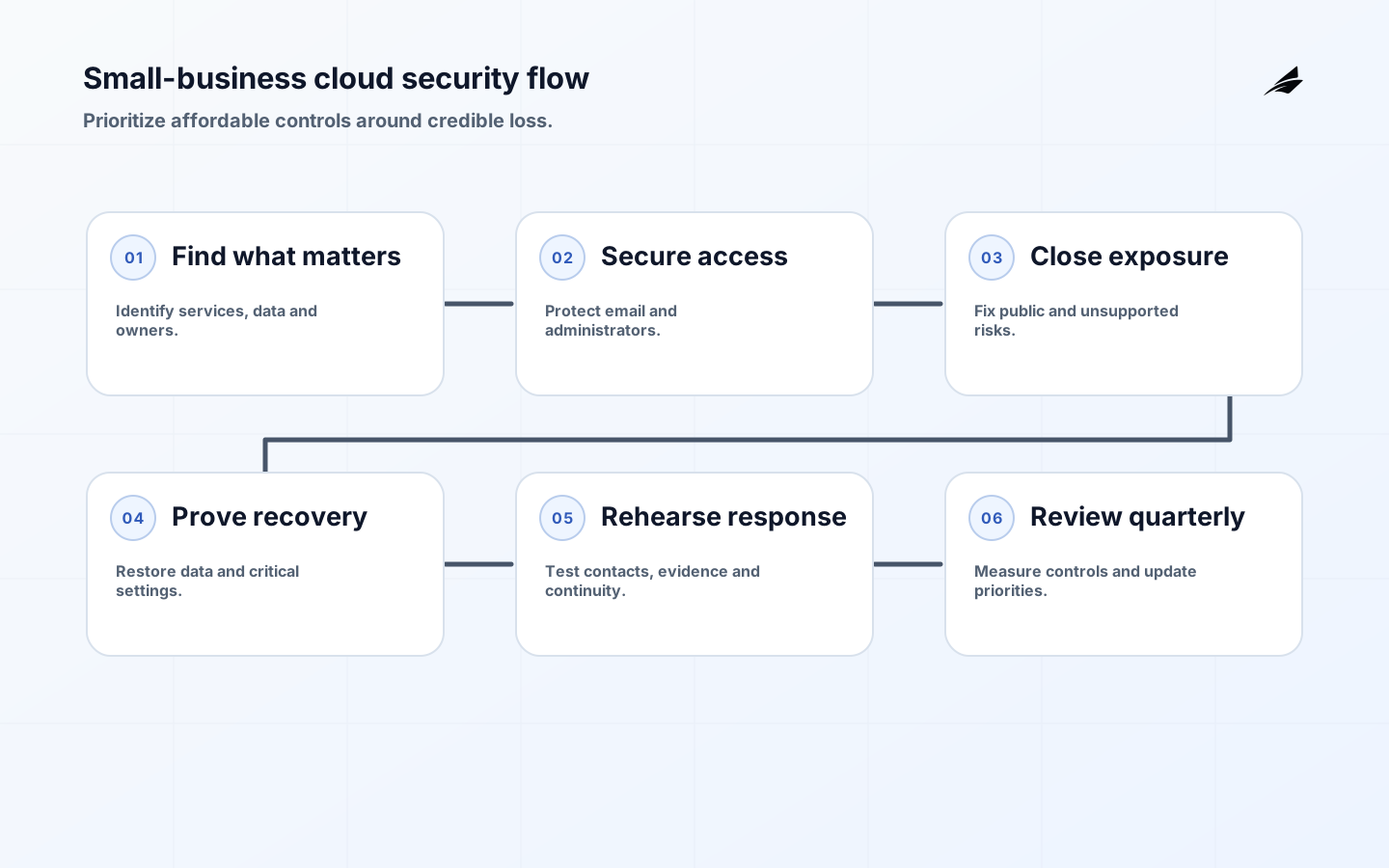
Cloud cybersecurity consulting for small business should produce a short list of owned risk reductions, not a thick assessment that requires another consultant to interpret. The engagement begins with what could stop the business: account takeover, ransomware, payment fraud, data exposure, loss of a key SaaS service or an unrecoverable configuration. It then connects affordable controls to those scenarios, assigns owners and tests the response. Small organizations rarely need every enterprise security product. They do need a truthful asset picture, strong identity, secure defaults, recoverable data, useful logging and a plan that works when the usual IT contact is unavailable.
This guide covers scope, cost, supplier selection and a staged delivery plan. The companion small-business cloud security checklist turns it into implementation tasks, while the small-business cloud security FAQ addresses common buying questions. Laws and notification duties vary by location, sector, contract and data, so a consultant should identify where qualified legal or privacy advice is needed rather than promise universal compliance.
1. Scope the business and cloud baseline
Identify essential services, data and identities first. Include cloud accounts, email, file sharing, finance, payroll, customer systems, code repositories, domain and DNS, endpoints, backups and outsourced IT. Record the owner, administrator, data class, recovery need and supplier for each. NIST SP 800-145 distinguishes cloud service and deployment models, which helps clarify responsibility. NIST's small-business quick-start resources then adapt CSF 2.0 for organizations with modest programs without pretending every business needs identical controls.

Review how staff and suppliers actually access systems, including shared accounts, personal devices, former workers, emergency credentials and integrations. Sample configuration and logs rather than relying only on interviews. Ask how an invoice change is verified, how a deleted file is restored and who can change domain records. The wider cloud security consulting roadmap is useful when the estate includes complex engineering workloads; a small-business engagement should remain proportional and actionable.
| Discovery area | Evidence | Risk decision |
|---|---|---|
| Critical services | Owner, outage consequence and busy period | Recovery and protection priority |
| Identity | Account inventory, MFA method and privileged roles | Access remediation |
| Data | Location, sensitivity, sharing and retention | Protection and legal review |
| Cloud configuration | Tenant settings, public exposure and logging | Secure-baseline work |
| Recovery | Backup scope, isolation and restore result | Continuity investment |
| Suppliers | Access, contract, incident route and exit | Third-party treatment |
2. Prioritize controls that reduce likely loss
The CISA small-business resources emphasize phishing resistance, passwords, multifactor authentication, updates, logging, backups and encryption. Translate those themes into the actual estate: phishing-resistant MFA for administrators and email where supported, a password manager, removal of unused accounts, supported software, protected backups and alerts for consequential account changes. Protect the domain registrar and email tenant early because compromise there can reset or impersonate many other services.
Apply least privilege to people and integrations. Separate routine work from administration, restrict external sharing, rotate exposed secrets and use managed identities instead of embedded credentials where available. Configure cloud-native security controls before buying overlapping tools. Prioritize by probable loss, exploitability, current safeguard and recovery difficulty. A red finding should describe a scenario and next action, not merely a severity label copied from a scanner.
3. Prepare detection, response and recovery
Enable logs that answer who changed access, sharing, forwarding, billing, security settings and critical resources. Retain them long enough for the likely discovery delay and restrict deletion. Route a small number of high-value alerts to a monitored destination: new privileged role, disabled MFA, suspicious mailbox rule, public data exposure, backup failure or unusual sign-in. Test the route. An alert sent only to the compromised mailbox or an unstaffed console is not a detection capability.
The FTC's small-business cybersecurity guidance recommends incident, disaster recovery and continuity plans and regular testing. Write a one-page first-hour guide: contacts, insurer and legal route, how to isolate access without destroying evidence, how to keep the business operating and who approves communications. The FTC breach-response guide stresses mobilizing the right team, containing additional loss and determining notification obligations. Test a plausible account-takeover scenario before closing the engagement.
| Control | Low-complexity proof | Failure to avoid |
|---|---|---|
| Administrator MFA | New session requires approved strong factor | SMS-only recovery bypass is ignored |
| Account lifecycle | Leaver loses all access on a timed exercise | Only the main application account is removed |
| Backups | Sample data and configuration restore successfully | Backup exists in the same compromised account only |
| Logging | Owner receives and investigates a test alert | Logs exist but retention or access is unknown |
| Payment change | Independent callback verifies a request | Email alone authorizes bank-detail changes |
| Incident plan | Tabletop reaches insurer, legal and technical contacts | Outdated contacts block the first hour |
4. Estimate cost by stage and recurring obligation
Separate assessment, remediation and continuing operation. Assessment cost follows the number of tenants, critical services, users, integrations, data classes and evidence gaps. Remediation may include identity licenses, device management, backup, logging, configuration work, supplier changes and staff time. Recurring cost includes monitoring, patching, access reviews, exercises, insurance requirements and support. Ask for a range with assumptions and optional stages rather than one fixed number built on an unknown estate.
A practical sequence is a bounded baseline, urgent identity and exposure fixes, recovery proof, logging and response, then a ninety-day improvement backlog. Reserve funds for remediation before buying an assessment. The cheapest proposal is poor value if it excludes implementation support or leaves findings without owners. Conversely, a large managed security package can overwhelm a small team if alerts, escalation and authority are not integrated into daily operations.
5. Evaluate the consultant and statement of work
Ask candidates to explain how they would investigate one relevant scenario and what evidence the business receives. The statement of work should name systems, sample depth, cloud configuration review, identity, data, backup, incident exercise, reporting, remediation validation and exclusions. Require findings to include business consequence, evidence, affected assets, recommended action, owner and priority rationale. Confirm treatment of credentials and data, subcontractors, retention, professional insurance and conflicts from reselling products.
A consultant should work in customer-controlled accounts, use time-limited access and remove it at completion. The client should receive current configuration decisions, scripts or infrastructure definitions, risk register, incident contacts and evidence of fixes. Product recommendations should include a lower-complexity option and recurring operating effort. For a SaaS-heavy company with development pipelines, the SaaS cloud cybersecurity scope guide covers additional software supply-chain concerns.
6. Deliver a measurable ninety-day plan
In the first two weeks, confirm owners, inventory critical services, secure administrator and email access, close obvious public exposure and verify backup status. In the next month, standardize onboarding and offboarding, patch unsupported assets, configure high-value logging, test restore and write the incident guide. In the following month, run the tabletop, validate remediations, review suppliers and define a quarterly rhythm. Time frames should follow risk and capacity, but each stage must produce operational evidence.
Track a few measures: percentage of privileged accounts using the approved MFA method, time to remove leaver access, critical assets with a tested restore, age of high-priority findings, alert-route test success and incident action completion. NIST CSF 2.0 organizes outcomes across Govern, Identify, Protect, Detect, Respond and Recover; review progress across all six so the business does not spend its whole budget on prevention while remaining unable to detect or recover.
Close the engagement with a plain-language owner briefing. It should name the five most credible loss scenarios, safeguards now in place, remaining decisions, first-hour contacts and the next review date. Give administrators a technical appendix, but do not make the owner search a scanner export to understand accepted risk. Recheck a sample of corrected settings from a different account and verify consultant access removal. That final validation distinguishes an implemented improvement from a report whose recommendations were marked complete without testing.
Keep a minimal evidence register after the consultant leaves: date of the last restore, privileged-access review, alert test, tabletop and critical finding review. Link each item to its result and owner. This makes recurring work visible without purchasing a large governance platform and gives the next advisor a reliable starting point instead of repeating discovery.
Key takeaways
- Start from critical business services, identities, data and plausible loss scenarios.
- Prioritize strong administration, email protection, updates, backups and useful logging.
- Test restore and the first-hour incident route before accepting the engagement.
- Budget separately for assessment, remediation and continuing operation.
- Demand evidence-rich findings, customer-controlled artifacts and removable consultant access.
- Use a short, owned roadmap with measures that show whether risk treatment works.
Cloud cybersecurity consulting FAQ
Does a small business need a penetration test? Sometimes, especially for an exposed custom application or contractual requirement. It does not replace identity, configuration, backup and incident work. Scope it to the threat and ensure remediation is funded.
Can the cloud provider secure everything? No. Providers secure portions of infrastructure and service operation, while customers and their suppliers still control identities, configuration, data, endpoints and application behavior. The boundary varies by service model.
What should be fixed first? Active compromise and public exposure come first, followed by privileged and email access, unsupported internet-facing systems, recoverability and high-consequence supplier access. Priorities should reflect the specific business.
How often should the plan be reviewed? Review critical access, findings and backup evidence at least on a defined recurring cadence and after material change or incident. Tabletop exercises and supplier contact checks should also recur, not remain one-time consulting artifacts.
Conclusion
Good cloud cybersecurity consulting for small business leaves the company able to make the next security decision itself. The engagement should reveal what matters, fix urgent exposure, establish a proportional control baseline, prove recovery and rehearse response. Buy a staged outcome with accessible evidence, not fear or a product bundle. Ninety days later, owners should know what remains open, why it matters, how current controls are tested and where the next dollar reduces the most credible loss.