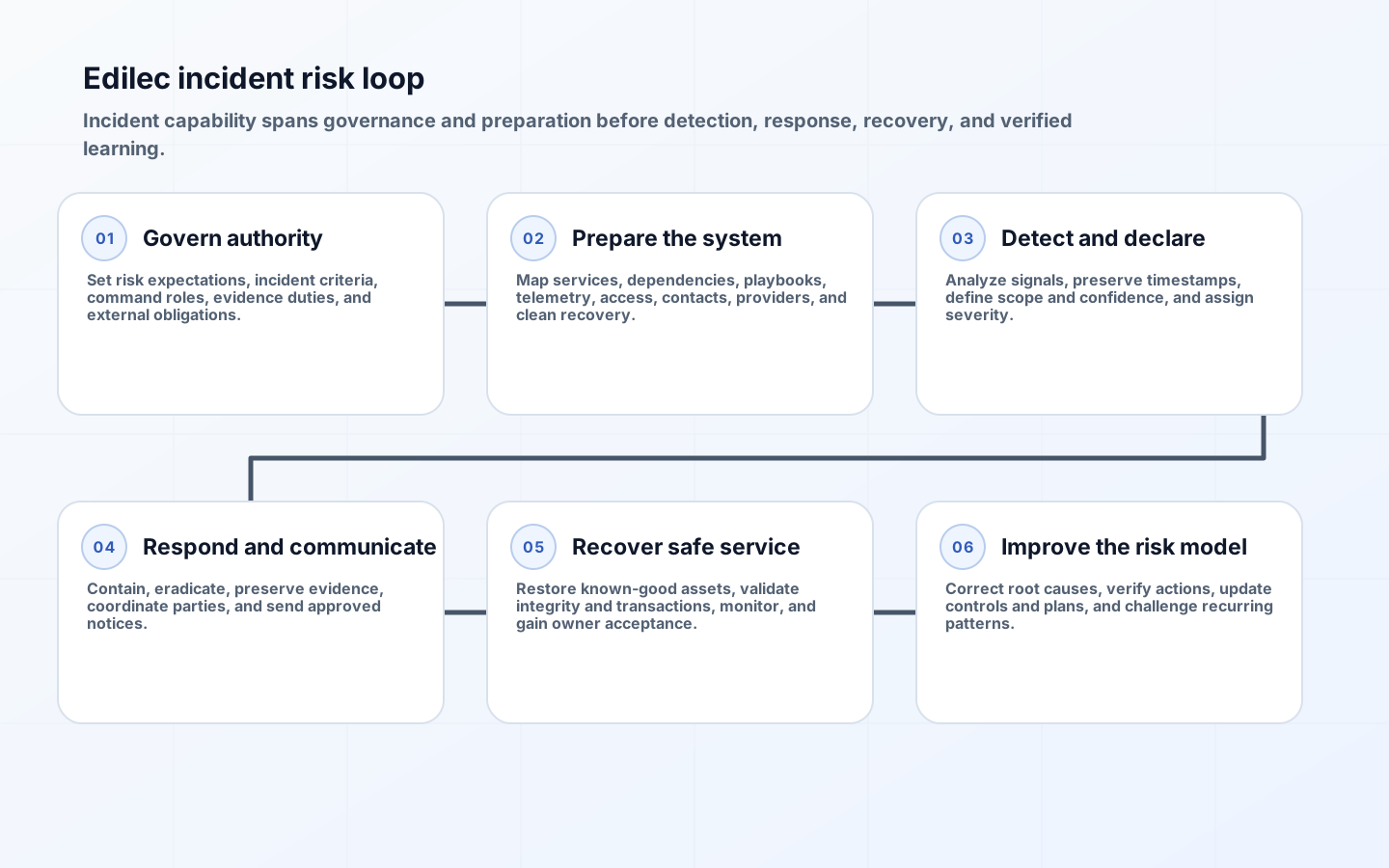
NIST SP 800-61 Rev. 3 reframes incident response as part of cybersecurity risk management across the entire organization. Govern, Identify, and Protect help prevent incidents, prepare people and systems, reduce likely impact, and incorporate lessons. Detect, Respond, and Recover discover, manage, contain, eradicate, communicate, and restore. This does not prohibit an operational lifecycle or incident phases. It changes the governing model: the response team cannot compensate for unclear risk ownership, missing inventories, weak architecture, untested recovery, or supplier ambiguity only after an alert fires.
NIST finalized Revision 3 in April 2025 and states that it supersedes Revision 2. The final publication is a CSF 2.0 Community Profile, with recommended outcomes and considerations rather than a prescriptive procedure. Rebuilding means mapping existing policy, playbooks, tooling, roles, metrics, and evidence to those outcomes, preserving effective operational detail, and closing organization-wide gaps. Do not merely rename preparation, detection, containment, eradication, recovery, and post-incident activity with six CSF labels.
Assess what Revision 3 changes in your program
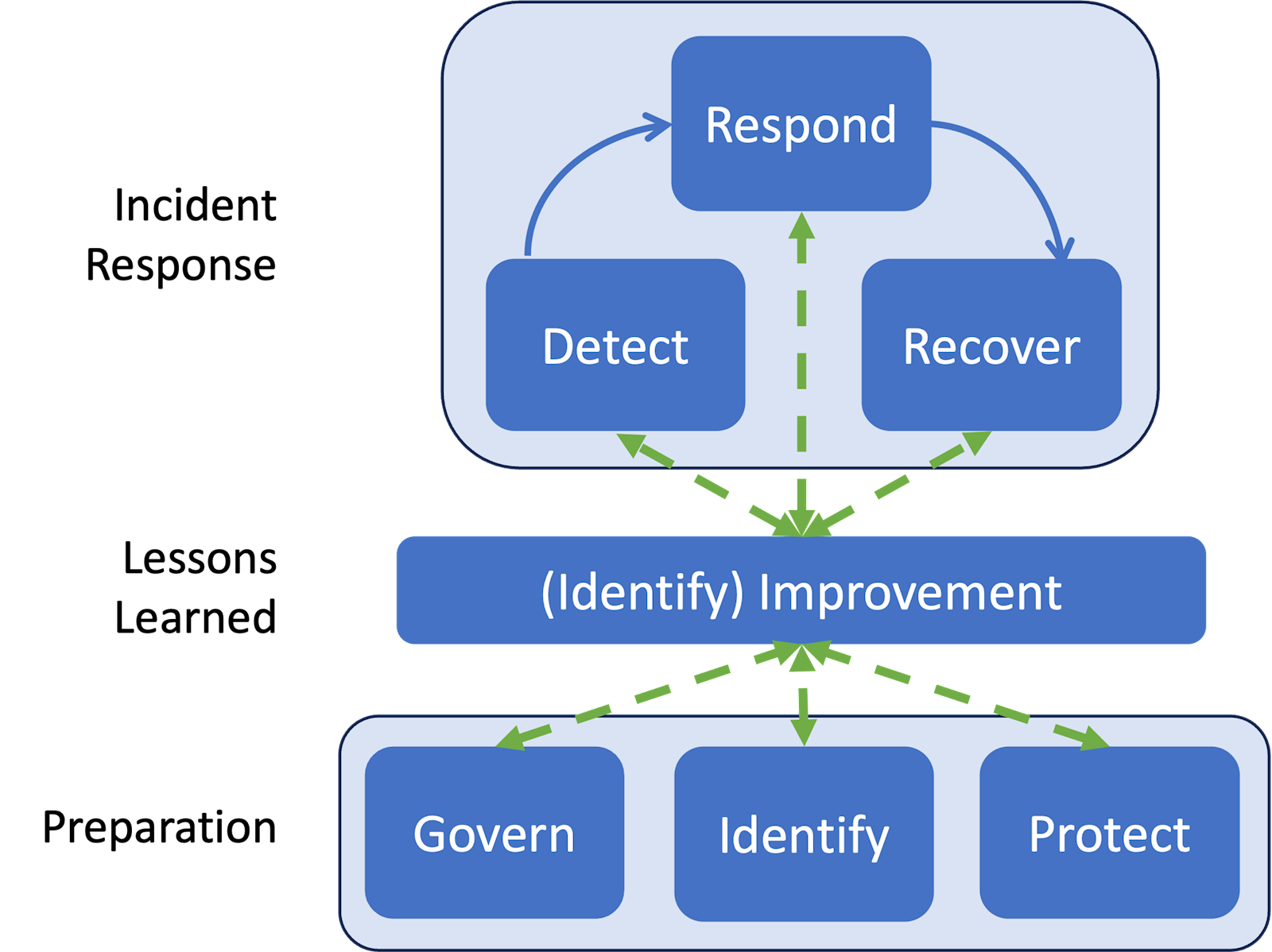
Inventory the present incident framework: policy authority, definitions, severity, team structures, on-call coverage, service and data inventories, monitoring, playbooks, evidence handling, communications, legal and regulatory duties, third parties, recovery, exercises, lessons, and risk acceptance. Map each element to the SP 800-61r3 Community Profile. Mark outcomes achieved, partial, absent, or outside scope with evidence. Pay particular attention to preparation and lessons now distributed through Govern, Identify, and Protect instead of isolated around the response team.
Identify ownership outside security. Executives set risk expectations and crisis authority; service owners understand business impact and restoration; legal and privacy advise notification; communications manages stakeholders; HR handles insider and personnel issues; procurement governs providers; finance may authorize emergency spending; engineering contains and corrects product paths. The web-application incident guide supplies operational mechanics. Revision 3 asks whether the surrounding risk system makes those mechanics effective and continuously better.
Design an incident risk operating model
Approve an incident policy that defines purpose, scope, incident criteria, authority, roles, evidence duties, communication, external coordination, exception, and oversight. Separate governance from case command. A senior risk owner sets tolerance and accepts residual program risk; the incident commander coordinates a specific event; technical leads make bounded containment and recovery changes; legal specialists advise applicable duties; business owners validate service effect. Define alternates and out-of-hours authority. During a crisis, an organization should not discover that nobody can isolate a revenue system or contact a critical provider.
| Role | Before an incident | During an incident | Required evidence |
|---|---|---|---|
| Executive risk owner | Approves strategy, authority and resources | Resolves major business tradeoffs | Risk decisions and accepted residual exposure |
| Incident commander | Maintains process and exercises | Coordinates objectives, timeline and handoffs | Command log and decision record |
| Service owner | Defines impact and recovery needs | Validates containment and restoration | Service dependency and business acceptance |
| Technical lead | Builds telemetry and playbooks | Investigates, contains, eradicates and restores | Actions, artifacts, tests and rollback |
| Legal and communications | Maps duties and audiences | Coordinates notices and stakeholder messages | Decision rationale, approvals and copies |
| Third-party owner | Contracts and tests escalation | Obtains provider action and evidence | Contacts, notices and service commitments |
Strengthen Govern, Identify, and Protect for preparation
Govern establishes strategy, policy, roles, oversight, and supply-chain expectations. Identify maintains assets, services, data, dependencies, threats, vulnerabilities, and improvement opportunities. Protect limits impact through identity, awareness, data, platform, and infrastructure safeguards. Convert these into incident readiness: critical-service maps, telemetry requirements, forensic access, secure administrative paths, emergency accounts, contact rosters, evidence retention, clean recovery resources, decision thresholds, and trained alternates. A response plan without these capabilities describes work that responders may be unable to perform.
Build playbooks from credible scenarios and service facts. Ransomware, cloud-account takeover, exposed customer data, software-supply-chain compromise, insider misuse, payment fraud, and provider outage require different evidence and containment. The incident-playbook guide helps make triggers and actions executable. Keep playbooks short enough to use, link deeper technical procedures, define prohibited improvisations, and test them after architecture or provider changes. Preparation evidence includes exercises and corrected failures, not document approval alone.
Operate Detect, Respond, and Recover as one evidence path
Detection should establish what happened, where, to whom, and with what confidence. Define event sources, coverage, analysis, correlation, triage, incident declaration, severity, and escalation. Preserve the original signal and decision timestamps. Response then manages, prioritizes, contains, eradicates, reports, and communicates. Recovery restores assets and operations, validates integrity, monitors recurrence, and communicates status. Use shared case identifiers and a timeline so alerts, technical actions, business decisions, provider events, and messages can be reconstructed.
Containment choices should balance ongoing harm, evidence, safety, continuity, and attacker awareness. Pre-authorize common actions but require explicit approval for destructive or high-impact changes. Eradication must address persistence and root cause, not only delete a file. Recovery should restore from a known state, rotate compromised trust, validate business transactions, monitor for re-entry, and gain service-owner acceptance. NIST's recovery guide emphasizes planning, testing, and improvement around mission priorities. A green infrastructure dashboard is not proof that customers can safely resume work.
Integrate third parties and communications
Map providers that host, monitor, authenticate, distribute, support, insure, or investigate critical services. Contracts should define security contacts, notification timing, evidence access, cooperation, containment authority, preservation, subcontractor communication, and recovery. Test contact routes and portal access before an event. When a provider declares an incident, independently assess your services, data, customers, and duties. Provider status language rarely answers the financial, privacy, or operational questions your organization must decide.
Create audience-specific communication plans for workforce, customers, partners, regulators, law enforcement, insurers, and media. Define approval and update cadence without making counsel the only person who can release an urgent safety instruction. Preserve what was known at each message time and correct material errors. Coordinate regulatory notices with facts from the same case. The audit-log guide helps capture attributable actions; communication records add audience, channel, approval, delivery, and feedback.
| Checkpoint | Decision | Evidence | Failure to avoid |
|---|---|---|---|
| Declaration | Does the event meet incident criteria? | Signal, scope, confidence, severity and timestamp | Waiting for complete certainty |
| Containment | Which action reduces harm acceptably? | Options, tradeoffs, authority and result | Unlogged destructive change |
| Notification | Who must know what and when? | Known facts, obligation, approval and receipt | Contradictory messages |
| Recovery | Is service safe for business use? | Integrity checks, objective measurement and owner acceptance | Technical uptime only |
| Closure | Are actions and residual risks governed? | Root cause, lessons, owners, due dates and acceptance | Closing when alerts stop |
Turn lessons into cybersecurity improvement
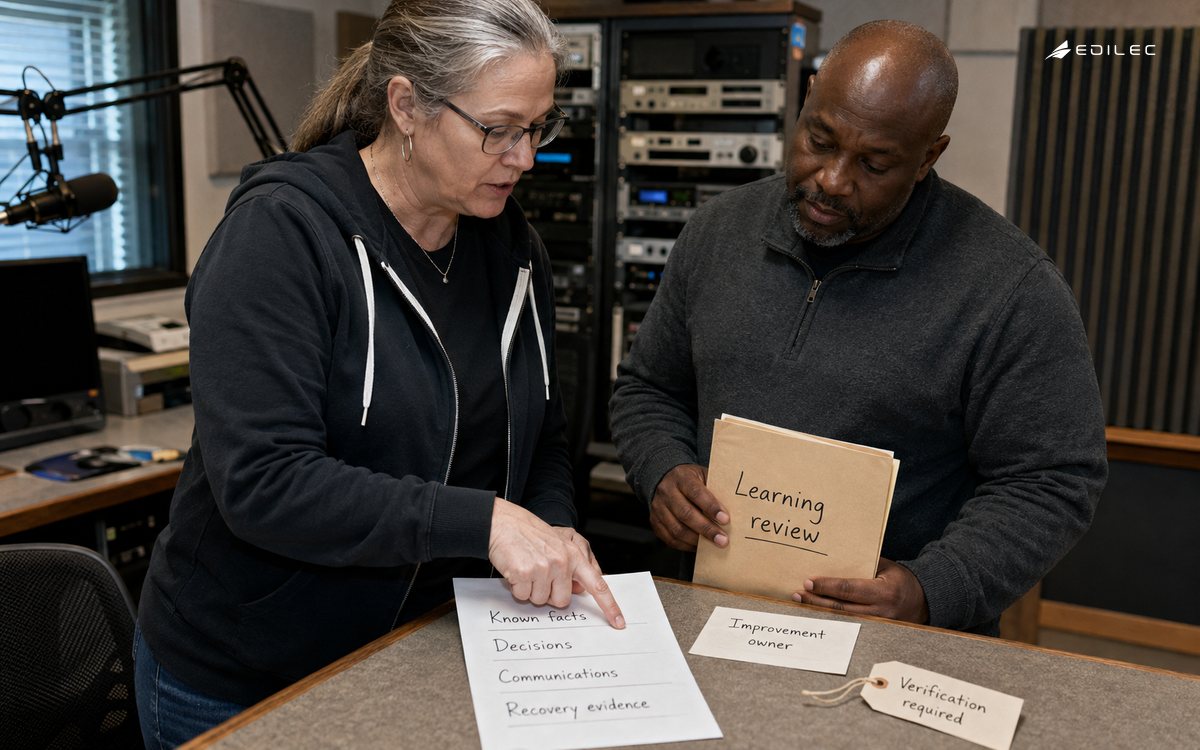
Hold learning reviews after incidents and meaningful exercises with psychological safety and factual rigor. Reconstruct detection, decisions, technical paths, communications, recovery, and business effects. Identify conditions and system causes, not a single operator to blame. Convert lessons into changes to risk assessments, architecture, monitoring, playbooks, contracts, training, staffing, and objectives. Each action needs an owner, due date, expected risk reduction, and verification. Track recurring themes across cases because repeated dependency or authority failures indicate program-level risk.
Measure outcomes that support decisions: time to credible detection, declaration, containment, stakeholder notice, safe restoration, and corrective closure; coverage of critical services; exercise performance; recurrence; evidence completeness; and overdue lessons. Segment by severity and scenario rather than averaging incomparable cases. The vulnerability-management guide can connect root-cause flaws to prioritized correction. Report where management action or investment is needed, not only whether response met a service-level target.
Exercise and assure the Revision 3 profile
Build an exercise program spanning executive decisions, technical containment, provider coordination, notification, and end-to-end recovery. Use realistic ambiguity, unavailable people, conflicting objectives, and incomplete evidence. Run focused drills as well as integrated simulations. Observers should record timestamps, decisions, workarounds, and control failures. Retest material corrections. An annual tabletop with the same ransomware script cannot validate changing cloud, software-delivery, identity, customer, and supplier risks.
Independent assurance should sample profile claims against operating evidence and follow a case from alert through closed improvements. Review authority, staffing, access, data handling, retention, privacy, and legal constraints. Compare incidents with the risk register and control testing to find blind spots. Preserve effective local procedures even if they use different terminology; Revision 3's value is integration and common outcomes, not cosmetic conformity. The program is rebuilt when risk decisions before and after incidents change, not when headings change.
Define incident data handling before responders collect broadly. Classify case records, forensic images, packet captures, credentials, employee information, customer data, legal advice, and threat intelligence; set approved repositories, access, transfer, retention, and destruction. Give investigators a fast path to preserve volatile evidence without distributing it through chat or personal storage. Record chain of custody when legal, disciplinary, insurance, or law-enforcement use is plausible. Minimize unrelated personal data and coordinate privacy requirements. After closure, remove temporary access and duplicate working copies while retaining the authoritative record. Evidence that cannot be trusted, located, or lawfully used weakens technical conclusions and external reporting.
Review emergency tooling as part of readiness: secure conferencing, alternate identity, status communication, forensic collection, clean devices, and offline contact data. Confirm licenses, access, capacity, and ownership before a crisis. A tool that responders cannot authenticate to during an identity outage is not a recovery capability.
Key takeaways
- Treat incident response as organization-wide cybersecurity risk management across all six CSF Functions.
- Map existing capabilities to the Revision 3 Community Profile before replacing useful procedures.
- Define authority and evidence duties across executives, service owners, responders, legal, communications, and providers.
- Connect detection, response, recovery, and communication through one reconstructable case record.
- Convert incidents and exercises into verified risk, architecture, process, and investment improvements.
- Assure outcomes with realistic cross-functional exercises and independent evidence sampling.
NIST SP 800-61 Rev. 3 FAQ
Did Revision 3 eliminate the incident response lifecycle?
No. Organizations may use a suitable lifecycle. Revision 3 organizes recommendations through CSF 2.0 to integrate incident response with broader risk governance and preparation.
Does Revision 3 supersede Revision 2?
Yes. NIST states that SP 800-61r3 supersedes SP 800-61r2. Existing playbooks may remain useful but should be assessed against the new profile and context.
Is incident response owned only by the security team?
No. Security often coordinates technical response, but executives, service owners, engineering, legal, communications, HR, procurement, and third parties hold necessary decisions and capabilities.
Conclusion
Revision 3 makes incident response a property of the risk-management system around the responders. Clear authority, service knowledge, safeguards, detection, coordinated action, safe recovery, and verified learning all matter. Organizations that rebuild those connections will reduce impact more effectively than organizations that merely update a plan template.