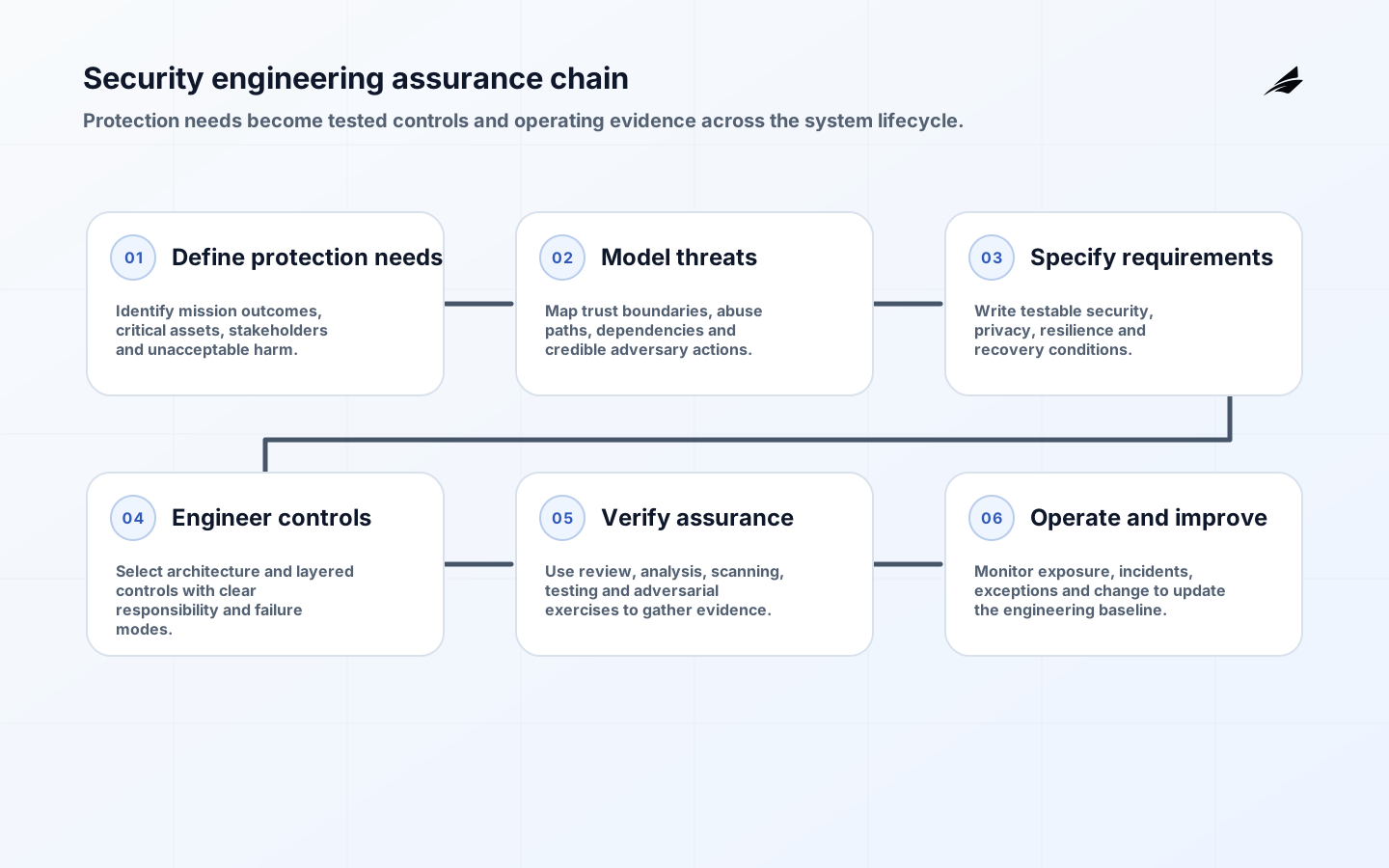
Security engineering services apply engineering discipline to the protection of systems throughout their lifecycle. The work translates business harm, adversary behaviour and regulatory duties into requirements, architecture, controls, verification evidence and operating feedback. It is broader than a penetration test and more concrete than a policy review. The central question is not whether a tool found issues; it is whether the system can deliver its mission while resisting, detecting, responding to and recovering from credible threats.
This security engineering services FAQ helps buyers and technical leaders define useful scope and evaluate evidence. Use it with the security engineering delivery plan and implementation checklist. Teams commissioning software should also align the work with the software build checklist.
What outcomes should security engineering services deliver?
Start with protection needs stated in operational language: prevent unauthorized release of patient records, preserve the integrity of settlement instructions, keep a safety function available, or recover a customer service within its tolerance. Identify stakeholders and consequences, including physical, financial, privacy and societal harm. The NIST systems security engineering guidance treats security as part of systems engineering for trustworthy systems, applicable across system types and lifecycle stages.
A useful engagement leaves a maintained assurance baseline, not a static report. It should show assets and trust boundaries, threat assumptions, testable requirements, selected controls, residual risk, verification results, exceptions, evidence owners and review triggers. Findings need an affected outcome, plausible path, remediation option and accountable owner. Severity without context encourages teams to clear scanner counts while important architectural risk remains.
| Engagement type | Best used when | Expected evidence |
|---|---|---|
| Architecture and threat review | A new system or material change is still designable | Threat model, requirements, options and decisions |
| Secure delivery enablement | Teams need repeatable controls in build and release | Pipeline rules, protected artifacts and remediation workflow |
| Verification assessment | A release or control claim needs independent challenge | Test plan, reproducible results, limitations and retest |
| Cloud or platform hardening | Shared foundations affect many workloads | Baseline, policy-as-code, drift findings and exception register |
| Resilience engineering | Service interruption or destructive attack is material | Failure scenarios, recovery design and exercise evidence |
Where does security engineering fit in the lifecycle?
Begin during problem framing, when data collection, system boundaries and failure consequences can still change. Refine threats and requirements as architecture becomes concrete. During build, protect repositories, identities, dependencies, pipelines and test data. Before release, verify the highest-risk claims and rehearse response. In operation, monitor exposure, control health, incidents and changes. Retirement also needs engineering: revoke identities, preserve required records, erase data, close integrations and dispose of keys.

Use the six functions in the NIST Cybersecurity Framework 2.0 to connect engineering work with enterprise governance: Govern, Identify, Protect, Detect, Respond and Recover. The framework describes outcomes rather than prescribing one implementation. A current profile and target profile can expose where a product design, platform service or operating process needs stronger evidence.
How should threats become engineering requirements?
Model the system that will actually exist: people, workloads, devices, data, third parties, administration paths and recovery facilities. Mark trust boundaries and high-value operations. For each plausible abuse path, record adversary goal, preconditions, affected asset, control opportunities and detection. Include misuse by authorized users, compromised suppliers, automation failure and accidental disclosure; an exclusively internet-attacker model misses many material scenarios.
Write requirements that can be verified. Replace “use strong access control” with conditions such as “production administration requires phishing-resistant authentication from managed devices; emergency elevation expires, records approval and alerts the security team.” State what must happen when a dependency or control fails. Requirements should trace back to protection needs and forward to a design element, test and operational owner.
| Weak statement | Engineering requirement | Verification evidence |
|---|---|---|
| Encrypt data | Classified fields use approved encryption in transit and storage with separated key administration | Configuration inspection, key-access test and rotation record |
| Log important events | Privileged and sensitive-data actions emit tamper-resistant events with actor, object, result and correlation ID | Scenario replay, event query and retention check |
| Validate input | Untrusted input is constrained at every trust boundary and dangerous interpreter paths are excluded | Code review, negative tests and targeted fuzzing |
| Have backups | The service restores required data within stated recovery objectives after credential compromise | Isolated restoration exercise and reconciled records |
What belongs in a secure delivery baseline?
The NIST Secure Software Development Framework groups practices around preparing the organization, protecting software, producing well-secured releases and responding to vulnerabilities. In practice, use separate human and workload identities, least privilege, reviewed changes, isolated build workers, pinned dependencies, protected artifacts, secret management, provenance, automated checks and a vulnerability intake process. Apply the same scrutiny to infrastructure definitions and pipeline code as to application code.
Set risk-based release rules. A critical authentication bypass should stop release; a low-impact issue with a compensating control may enter a time-bound exception. Exceptions need rationale, owner, expiry, affected assets and monitoring. Avoid treating every automated result as confirmed: tune tools, suppress false positives with reviewed justification and make remediation feedback fast enough for developers to act while context is fresh.
How much testing is enough?
Verification should match threats, novelty and consequence. The NIST minimum software verification guidance includes techniques such as threat modeling, automated testing, static scanning, hardcoded-secret detection, black-box testing, structural testing, fuzzing, web scanning and review of included code. Select a complementary set; no single test provides assurance about architecture, implementation and operation.
For web applications, the OWASP Application Security Verification Standard can turn broad expectations into versioned verification requirements. Agree the applicable level and requirement set before procurement or testing. Preserve tool versions, environment, credentials, test data and limitations so results can be reproduced. Retest fixes and examine whether the root cause affects sibling components.
How should a security engineering provider be governed?
Give the provider enough access to understand context, while enforcing scoped identities, approved data handling and monitored environments. Name an internal risk owner and technical counterpart. Contracts should cover personnel assurance, subcontractors, evidence ownership, vulnerability disclosure, incident notification, secure deletion and conflicts of interest. A provider can recommend treatment and validate controls; business risk acceptance remains with the accountable organization.
Review progress through evidence demonstrations rather than slide counts. Ask engineers to trace one serious scenario from protection need through threat, requirement, implementation, test and monitoring. Require raw, safely shareable findings and machine-readable outputs where practical. Ensure internal teams can update the models and controls after the engagement, because an assurance artifact that cannot follow system change decays quickly.
Which measures show the service is working?
Measure risk reduction and control performance, not only finding volume. Useful indicators include critical threat paths without treatment, age of time-bound exceptions, percentage of high-risk requirements with passing evidence, exposure time for exploited vulnerabilities, privileged-access review completion, recovery exercise success and recurrence of root causes. Segment by service criticality and report uncertainty. A falling finding count can mean improvement, narrower testing or poorer visibility.
Connect technical measures to business outcomes: protected transactions, reduced blast radius, faster safe recovery and fewer customer-impacting control failures. Use incident and near-miss reviews to update requirements and test cases. For cloud-specific operational coverage, the managed cloud security delivery plan shows how shared responsibility and configuration drift change the service model.
Plan engagement sequencing around decision windows. Architecture review must occur before boundaries harden; delivery controls should land before teams scale releases; independent verification needs a stable candidate and enough time for remediation; recovery exercises require business participants. A single assessment at the end compresses every treatment into a launch dispute. Use short assurance cycles with explicit entry evidence, findings triage, retest and residual-risk acceptance so security evidence stays synchronized with delivery.
Price the service by capability and uncertainty. Include discovery access, specialist testing, cloud or lab environments, tooling, evidence preparation, retesting, remediation support and internal participation. Compare providers on scope clarity, practitioner competence, methods, deliverables, limitations and knowledge transfer, not on the promised number of findings. Extremely broad fixed-price testing can reward shallow coverage; staged work lets both parties refine depth after the most consequential threat paths are understood.
Key takeaways
- Scope security engineering around mission harm and protection needs.
- Trace credible threats into testable requirements, design decisions, verification and monitoring.
- Protect the development and delivery system as part of the product attack surface.
- Use complementary verification methods selected by risk and preserve reproducible evidence.
- Retain risk acceptance and lifecycle ownership internally, with time-bound exceptions and clear measures.
Frequently asked questions
Is security engineering the same as penetration testing?
No. Penetration testing is one verification technique at a point in time. Security engineering shapes requirements, architecture, implementation, delivery, resilience and operation. A penetration test can challenge selected attack paths but cannot compensate for missing ownership, unsafe defaults or an untested recovery model.
Can a provider guarantee zero vulnerabilities?
No credible provider can. Complex systems and threats change, and every assessment has limits. Require transparent scope, methods, limitations and evidence instead. The goal is proportionate risk reduction, rapid exposure management and resilient operation, not an absolute claim that prevents honest reporting.
Should the same team build and assess the controls?
Builders must verify their own work continuously, but high-consequence claims benefit from independent challenge. Independence can come from another internal team or a separate provider. Define who designed, operated and assessed each control so readers can judge the assurance and avoid hidden conflicts.
Conclusion
Security engineering services are valuable when they make protection claims traceable and maintainable. A threat-led scope, explicit requirements, secure delivery baseline, risk-based verification and operational feedback produce stronger assurance than a collection of disconnected tools. Begin with the most consequential service and one credible threat path, prove the evidence chain, then standardize the parts that genuinely repeat.