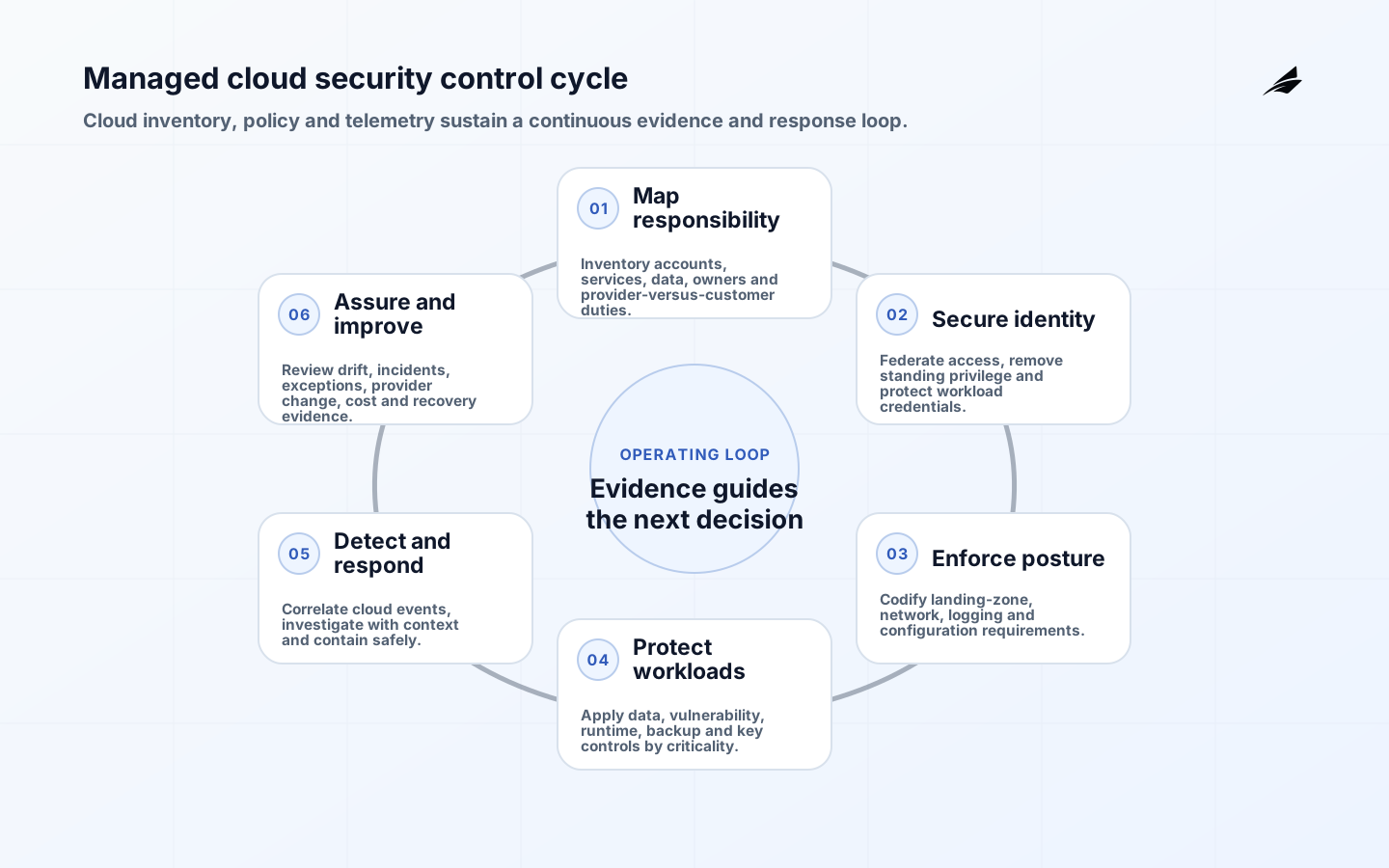
Managed cloud security is an operating capability that keeps identities, accounts, configurations, workloads, data and provider relationships within an agreed risk posture as the environment changes. A useful service does more than deploy posture tools or forward alerts. It establishes responsibility, prevents unsafe changes, detects material exposure, coordinates response, preserves evidence and proves recovery across infrastructure, platforms and software services.
This delivery plan helps leaders define scope, cost and acceptance. Use the managed cloud security checklist and managed cloud security FAQ for detailed readiness and buying questions. Multi-region teams can compare the worldwide managed cloud security plan.
Define scope through responsibility and critical services
Inventory organizations, tenants, accounts, subscriptions, projects, regions, services, workloads, data classes, internet exposure and owners. Map business criticality and recovery needs. Then document shared responsibility for each service model and control: provider, customer, managed provider or another supplier. “The cloud provider secures it” is incomplete; customers still configure identities, data access, networks, workloads and many logs.
The CISA Cloud Security Technical Reference Architecture covers shared services, secure migration, DevSecOps and cloud security posture management. Use its concepts to shape a target, then tailor by architecture. SaaS needs tenant configuration, identity, data and supplier assurance; IaaS adds operating system, network and workload responsibilities.
| Service component | Managed scope | Acceptance evidence |
|---|---|---|
| Governance | Inventory, owners, policy, exceptions and provider review | Coverage report and current responsibility matrix |
| Identity | Federation, MFA, privilege, service identities and keys | Access tests, review and emergency-elevation record |
| Posture | Landing zones, network, storage, logging and drift | Policy evaluation and remediated baseline |
| Workloads | Images, dependencies, secrets, runtime and vulnerability response | Deployment and exposure evidence by criticality |
| Response | Detection, investigation, containment, forensics and recovery | Scenario exercise with timestamps and decisions |
Choose the managed service and responsibility model
Decide who owns policy, engineering, monitoring, triage, containment, recovery, risk acceptance and regulator or customer communication. A provider may run tools and recommend actions, but the organization needs named service and risk owners. Define hours, severity, response targets, escalation, authorized actions and emergency authority. For destructive actions, specify approval; for stolen credentials or public storage, pre-authorized containment may be safer.

Use the Cloud Security Alliance Cloud Controls Matrix to structure control and actor discussions across cloud domains. Map only applicable controls and name evidence, frequency and owner. A broad mapping without implementation proof is not assurance. Require subcontractor and cross-cloud responsibilities to be visible.
Build identity and secure configuration foundations first
Federate workforce access, require strong authentication, eliminate shared administrators, separate production duties and replace standing privilege with approved time-bound elevation. Inventory service identities, remove long-lived keys where workload federation is available, constrain permissions and monitor use. The NIST cloud access-control guidance explains that access-control considerations vary across IaaS, PaaS and SaaS.
Create versioned landing-zone and service policies for logging, regions, networks, encryption, public exposure, backup and tagging. Enforce preventive rules where safe and detective rules where legacy needs transition. CIS Benchmarks provide consensus secure-configuration recommendations for cloud platforms and other technologies. Tailor them, document exceptions and test automation before bulk remediation.
| Cost driver | What increases it | How to control it |
|---|---|---|
| Environment coverage | Accounts, clouds, SaaS tenants and ephemeral assets | Automated discovery and risk-tiered service |
| Telemetry | High-volume logs, long retention and duplicate routing | Purpose-based sources, tiers and filtering |
| Operations | 24/7 coverage, alert noise and unclear ownership | Actionable detections, automation and runbooks |
| Remediation | Legacy drift and manual account-by-account work | Policy as code and platform patterns |
| Assurance | Framework mappings and bespoke customer evidence | Reusable evidence with scoped control mappings |
Protect workloads, data and recovery paths
Classify workloads and data, then apply controls proportionately: approved images, dependency management, secret stores, encryption and key separation, egress restrictions, vulnerability targets and runtime protection. Connect findings to deployed assets and owners; a vulnerable package not present in production differs from an internet-exposed exploitable service. Protect pipelines and infrastructure code because they can change many resources at once.
Design recovery against credential compromise and destructive action, not only hardware failure. Separate backup administration, use protected copies, test restoration and reconcile business records. Define key-loss and provider-region scenarios. Recovery evidence should include achieved time, data point, dependencies, access path and business validation.
Engineer cloud detection and response
Collect organization, identity, control-plane, network, workload, data-access and security-service events needed for defined scenarios. Preserve cloud-native context such as account, region, principal, resource, API action and policy result. Route alerts to an owner who can act, enrich them with inventory and recent changes, and suppress duplicates without hiding separate affected assets.
Rehearse compromised administrator, exposed storage, stolen workload credential, malicious deployment, cryptomining and destructive deletion. Validate provider support and evidence acquisition. Prebuild containment actions such as disabling a principal, isolating a workload or blocking a policy, with safeguards and rollback. Record command receipts and timeline for investigation.
Deliver managed cloud security in stages
Stage one establishes scope, access, inventory and critical risk triage. Stage two implements identity and landing-zone baselines. Stage three onboards telemetry and rehearses response for selected critical services. Stage four automates posture, workload and evidence controls. Stage five expands coverage by risk and optimizes operations. Each stage needs exit evidence and a transition plan; tool installation is not an outcome.
Transition alert rules, integrations and emergency paths in parallel before retiring incumbents. Test access revocation and data return at exit. The NIST Cybersecurity Framework 2.0 can align Govern, Identify, Protect, Detect, Respond and Recover outcomes across the managed service and enterprise risk process.
Measure coverage, response, recovery and cost
Track owned-resource coverage, high-risk drift age, privileged-access exposure, log-source health, actionable alert rate, time to contain, vulnerability exposure by service criticality, exception age, recovery-test success and cost per protected workload or account. Report blind spots and confidence. Mean values can hide one abandoned account with severe exposure.
Review provider changes, incidents, capacity, data processing, subcontractors and roadmap. Link cost to risk and operational outcomes. Excess telemetry with no detection purpose wastes money; aggressive filtering without scenario coverage creates false economy. Revisit scope whenever architecture, acquisition or regulation changes.
Create an exception process that supports migration without normalizing drift. Every exception should identify the resource scope, failed policy, business reason, compensating control, owner, approval, expiry and remediation plan. Re-evaluate automatically when the resource or policy changes. Report exception age and concentration by team. Permanent exceptions should become an explicit alternative baseline or be removed; repeatedly extending temporary records hides risk and consumes review effort.
Provider due diligence should cover architecture, personnel access, support locations, subcontractors, data handling, evidence retention, service continuity and secure exit. Ask for examples of actual containment collaboration and how actions are authorized across time zones. Test ticket and emergency contacts before launch. Contractual response targets matter only when both parties can exchange the identity, resource and event context needed to act.
Integrate security into cloud platform delivery. Offer approved account vending, identity patterns, network connections, logging, secrets, images and deployment modules that satisfy policy by default. Give teams fast feedback in infrastructure pull requests and a clear route for justified deviations. This reduces remediation cost and lets the managed service focus on unusual risk rather than rediscovering the same configuration error in every account.
Plan coexistence with application and enterprise incident teams. Define which queue is authoritative, how cloud findings become incidents, who communicates customer impact and how evidence is preserved for legal or forensic needs. Map cloud severity to business service criticality. A technically severe event in an unused sandbox and a modest-looking identity anomaly in production should not be prioritized by the same raw score.
Build a current provider and service risk register. Cloud platforms introduce new services, retire features and change defaults faster than annual assurance cycles. Subscribe to security and deprecation notices, assign owners to assess impact, and test policy coverage before teams adopt a new service. Record unsupported regions, preview features and provider dependencies. Procurement and architecture review should prevent unowned tenants from appearing through expense cards or acquisitions.
For merger, acquisition or divestiture, use a separate transition profile. Discover unknown accounts and domain trust, isolate administration, preserve logs, rotate credentials and classify data before connecting environments. Decide which controls and monitoring remain during separation. Business deadlines do not remove the need for custody and access evidence; they increase the value of a short, risk-ranked transition baseline.
Key takeaways
- Map every cloud service and control to a named responsibility.
- Prioritize federated identity, least privilege and secure landing-zone policies.
- Connect posture and vulnerability findings to real workload context and owners.
- Rehearse cloud-specific containment and protected recovery paths.
- Price telemetry, operations, remediation and assurance, then measure coverage and risk reduction.
Frequently asked questions
Is a general SOC enough for cloud security?
Only if it has cloud inventory, identity, control-plane, workload and response context plus authority to coordinate remediation. Forwarding cloud alerts to a queue without engineering ownership leaves configuration and recovery gaps.
Should one provider cover every cloud?
One provider can simplify coordination, but verify depth for each platform and SaaS category. Keep platform-native expertise and name control differences. A single dashboard does not make responsibilities or response actions uniform.
What is the biggest hidden cost?
Remediating accumulated drift and operating noisy telemetry often exceed the license estimate. Inventory uncertainty, weak ownership and manual exceptions compound both. Fund platform engineering and control tuning, not just monitoring seats.
Conclusion
Managed cloud security works when continuous discovery, explicit responsibility, identity control, policy enforcement, workload protection, detection and recovery form one service. Stage delivery around critical workloads, prove response and restoration, and expand with reusable guardrails. The result should be measurable control over a changing environment, not a monthly export of findings.