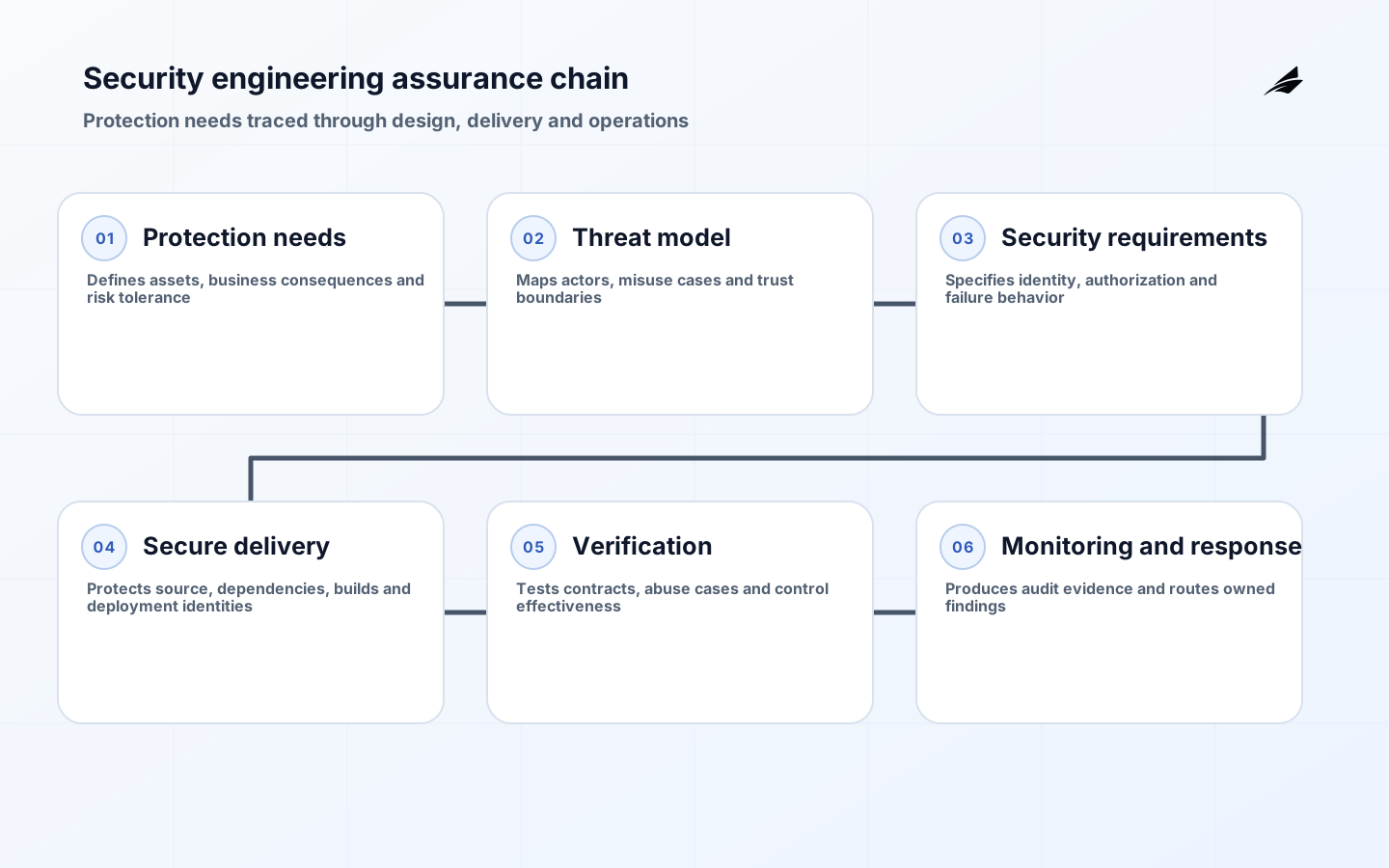
Security engineering services should be planned as an operating capability, not a procurement label. The objective is trustworthy systems that satisfy business needs within an explicit risk tolerance. A credible initiative connects business ownership, design, controls, people, transition and measures before broad rollout. It also states what will not change, because a clear boundary protects teams from uncontrolled scope and makes acceptance possible.
Define the service and its boundary
Map the end-to-end scope across protection needs, requirements, threat modeling, architecture, identity, data, secure development, verification, supply chain, monitoring, response and retirement. Start with priority journeys and name the accountable outcome owner. Describe demand, current failure modes, manual work, dependencies and obligations. Validate the inventory with people who perform and support the work; repositories and contracts rarely capture exceptions or informal handoffs.

For each system boundary, trace business protection needs to security requirements, architecture decisions, implementation controls and verification evidence. Identify assets, actors, privileged operations, trust transitions and suppliers. Limit the first engineering slice to a meaningful workflow where misuse cases, requirements and residual risk can be reviewed by the accountable system owner.
| Scope area | Decision | Evidence |
|---|---|---|
| Outcome | What result must improve? | Baseline, owner and acceptance measure |
| Workflow | Which normal and exception paths are included? | Journey and exception map |
| Information | Which records are authoritative and sensitive? | Classification, lineage and retention |
| Technology | Which components and providers participate? | Dependency and interface inventory |
| Controls | Which requirements must remain effective? | Control owner, test and evidence |
| Operation | Who supports, recovers and improves it? | Runbook, roles and service objectives |
Turn requirements into an operable design
Trace protection needs to requirements, design decisions, implementation and verification. Define trust boundaries, assets, actors, misuse cases and failure behavior. Prefer secure defaults and elimination of vulnerability classes. Include build systems, dependencies, deployment identities and operational tooling.
Security mechanisms must fail in ways that preserve protection and recovery. Define behavior when identity, policy, key, logging or dependency services are unavailable. Prevent uncontrolled retries and fail-open authorization, protect administrative paths, and retain useful evidence without logging secrets. Test emergency access and restoration from trusted artifacts before an incident.
Build a cost model from measurable drivers
A universal price would be misleading. Material cost drivers include criticality, attack surface, legacy constraints, assurance depth, regulation, supplier evidence, environments, remediation and vulnerability response. Estimate a range from observed scope and expose assumptions. Discovery should reduce the largest uncertainties before a fixed commitment. Compare options across transition and useful operation, not only the implementation quote.
| Cost group | Include | Control question |
|---|---|---|
| Discovery | Observation, inventory and design | Which unknowns change the approach? |
| Delivery | Build, integration and environments | What is reusable or custom? |
| Assurance | Security, testing and remediation | What evidence is required? |
| Transition | Migration, training and parallel work | How long will coexistence last? |
| Operation | Consumption, licenses, people and suppliers | Who owns demand and unit economics? |
| Exit | Export, replacement and decommission | Can continuity survive departure? |
Separate initial threat modeling, architecture and control implementation from recurring vulnerability management, telemetry, access review, incident readiness and supplier assurance. Include remediation and retesting, secure build maintenance, specialist review and system retirement. Reforecast after the first engineering slice reveals legacy constraints, control ownership gaps and the depth of evidence required.
A bounded example
For a new partner API, map assets and trust boundaries, then define workload identity, scoped authorization, schema and size limits, replay protection, rate policy, audit events and key rotation. Contract, abuse and security tests run in delivery; a limited partner pilot validates operations and revocation.
Baseline current attack surface, privileged access, vulnerability age, control coverage, incident findings and recovery evidence before claiming improvement. For the partner API, measure authorization and abuse-test results, key-rotation success, anomalous-request detection and revocation time. Tool counts are secondary to whether defined protection needs are satisfied and verified.
Manage risks as delivery inputs
| Risk | Early signal | Practical treatment |
|---|---|---|
| Late review | Architecture is fixed first | Embed security in discovery |
| Control theater | Tools run without coverage | Tie checks to risk requirements |
| Privilege growth | Access accumulates | Use expiry and review |
| Supply chain | Build paths lack provenance | Protect source and verify components |
| Unowned findings | Reports age | Assign owners and escalation |
| Blind operations | Misuse cannot be investigated | Engineer telemetry and response |
Assign threats and control failures to owners who can alter design, operation or risk acceptance. Use triggers such as exposed credentials, missing build provenance, overdue critical remediation, privilege-review failure or absent detection. Stop release when a protection need lacks an effective treatment unless the authorized business owner explicitly accepts the documented consequence.
A staged implementation plan
- Frame: confirm owner, outcome, boundaries, obligations, risk tolerance and funding.
- Discover: observe work; inventory data, systems, providers, controls, demand and failures.
- Design: select architecture, roles, security, recovery, migration and acceptance together.
- Prove: build a representative slice and test the hardest dependency, control and failure.
- Pilot: limit exposure while increasing monitoring, support and feedback.
- Expand: add waves only while quality, risk, operations and cost remain within thresholds.
- Retire: remove obsolete access, jobs, copies, contracts and procedures after verification.
Security gates should follow system risk. Before pilot, review threats, requirements, architecture, supplier evidence, test results, monitoring and incident procedures. Expand only after material findings are treated and operations can revoke, detect and recover. At retirement, remove identities, secrets, endpoints, data and supplier access while retaining required records and vulnerability obligations.
Threat modeling should map assets, entry points, identities, data flows and misuse, record assumptions, assign mitigations and change real design decisions.
Combine design review, automated checks, code and dependency analysis, configuration review, penetration testing and exercises according to risk; retest fixes.
Include safe failure, denial of service, dependency loss, key or identity outage, compromised administration and recovery from trusted artifacts in architecture.
Ask suppliers about secure development, disclosure, support periods, components, defaults, incidents, data, evidence and exit; procurement is part of engineering.
Threat models should be living engineering records. Update assets, entry points, trust boundaries and misuse cases when interfaces, identities, deployment or suppliers change. Link mitigations to backlog and tests. Review assumptions after incidents and near misses so the model reflects observed behavior rather than an idealized architecture.
Secure development includes the environment that produces software. Protect source, review changes, isolate and authenticate builds, control dependencies, preserve artifact provenance and restrict deployment authority. Define how a compromised component or credential is found, revoked and replaced. Release assurance is weak when the production binary cannot be tied to reviewed inputs.
Authorization deserves resource-level and action-level design. Describe who may read, create, approve, export, administer and recover each sensitive capability, including service identities. Test cross-tenant and object-reference abuse, role changes and revocation. Authentication alone does not prevent an authenticated actor from reaching the wrong data or operation.
Detection requirements should originate in threat and response needs. Specify security events, context, retention, time synchronization, access and alert ownership. Exercise an investigation to verify analysts can connect identity, application, infrastructure and supplier evidence. Logging everything without purpose increases exposure and can make decisive signals harder to find.
Vulnerability response needs intake, validation, severity, ownership, remediation, disclosure and learning. Include supplier and researcher reports as well as automated findings. Set treatment expectations by exploitability and consequence, retest fixes, and examine recurring weakness classes so teams remove causes instead of repeatedly patching symptoms.
Make governance, acceptance and adoption practical
Security engineering governance should include the system owner, architects, developers, operations, security specialists, privacy and relevant risk or compliance owners. The group decides protection priorities, design exceptions and residual risk. It should preserve engineering speed by defining approved patterns and escalation thresholds rather than reviewing every routine implementation choice.
Acceptance combines requirement traceability with evidence from design review, code and dependency analysis, configuration checks, abuse testing, targeted penetration testing and operational exercises. The mix depends on system risk. Confirm that findings are owned and fixes retested, and that responders can use the resulting telemetry to investigate a realistic event.
Make secure behavior the easiest path for engineers and operators. Provide maintained identity, secret, logging, build and deployment patterns with clear support. Train teams through their actual architecture and misuse cases. Repeated exceptions often indicate an unusable control or missing platform capability and should trigger engineering improvement, not permanent policy waivers.
Key takeaways
- Anchor security engineering services in an accountable outcome and bounded first service.
- Map authoritative records, decisions, dependencies and failure behavior first.
- Estimate assurance, transition, operation and exit with implementation.
- Use a representative proof and limited pilot to turn assumptions into evidence.
- Scale through explicit gates while retaining ownership of risk, quality and economics.
Frequently asked questions
Where should planning start?
Start with the system's mission, assets and unacceptable consequences. Map trust boundaries and plausible misuse for one critical workflow, then translate them into testable security requirements. Select a slice that exercises identity, data protection, logging and recovery together so the team proves a security architecture rather than collecting disconnected scanner results.
How should cost be estimated?
Estimate security engineering from system criticality, attack surface, legacy constraints, architecture change, assurance depth, supplier evidence, test environments, remediation and ongoing response. Include time from product and operations teams, not only specialists. Reforecast after threat modeling and early verification reveal control gaps and expensive design assumptions.
What should be checked when using a provider?
Check whether a security provider can connect findings to your architecture and risk, protect assessment data, supply qualified reviewers, explain methods, retest fixes and transfer usable evidence. Clarify tool ownership, subcontractors, disclosure handling and conflicts. A long generic report is less valuable than reproducible findings and engineering-ready treatment guidance.
How long should implementation take?
Timing depends on system complexity, existing design debt, assurance depth and remediation. Threat modeling a bounded change may fit within delivery, while improving identity or build architecture can span releases. Schedule verification early enough to change design and reserve time for retest; a penetration test immediately before launch leaves only acceptance or delay.
What proves success?
Success means the system's important protection needs are demonstrably met within accepted residual risk. Track requirement and threat-treatment coverage, material finding age, privileged-access review, dependency health, detection and response exercises, recovery from trusted state and recurrence of root causes. More alerts or scans do not by themselves indicate stronger security.
Conclusion
A professional plan for security engineering services makes ownership, boundaries, design, controls, economics and transition visible. It replaces broad promises with a representative proof, measurable acceptance and reversible rollout. This exposes uncertainty early enough to make informed decisions while changing direction is still manageable.