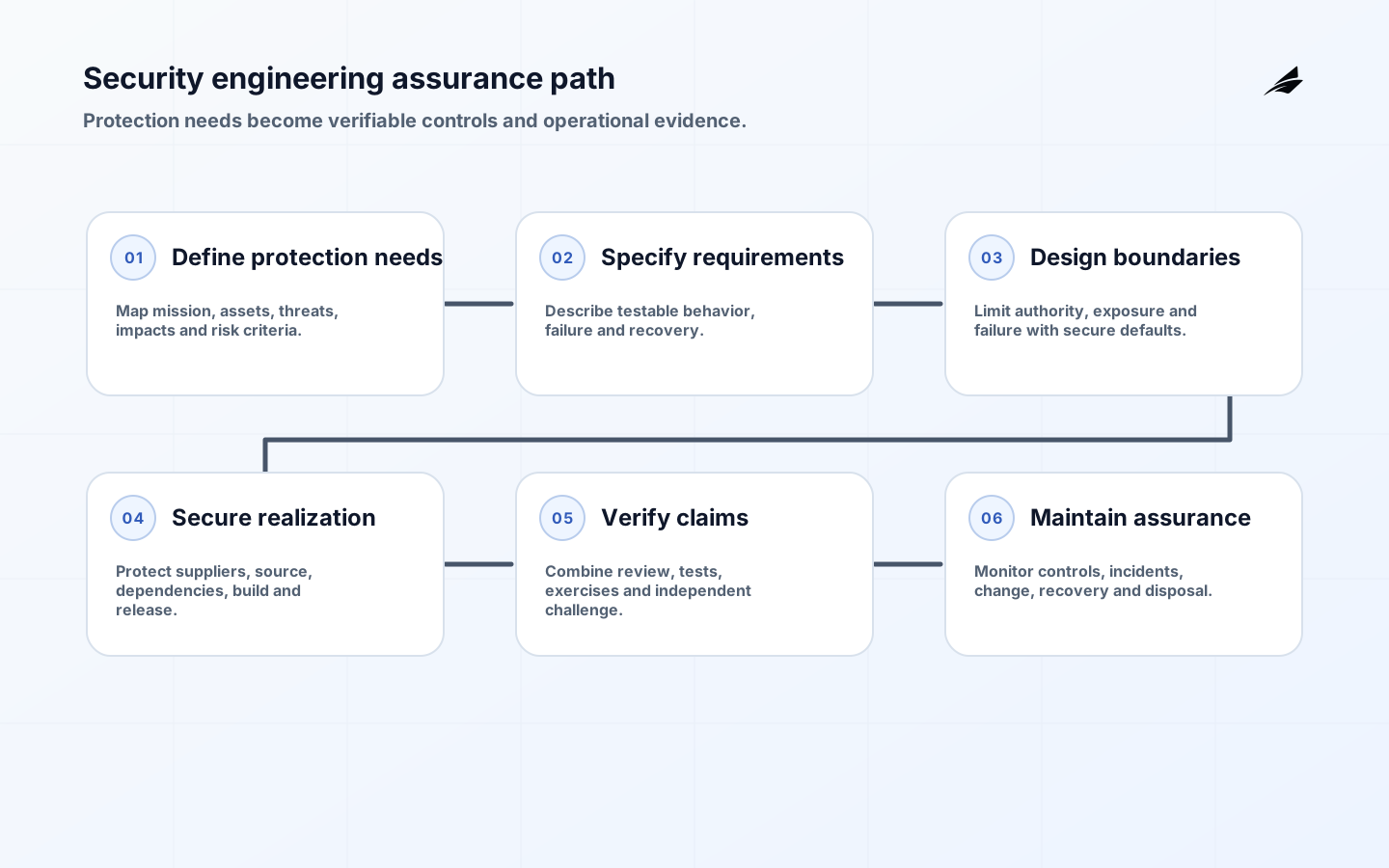
Security engineering services integrate protection into system requirements, architecture, implementation, verification and operation. They differ from a one-time penetration test or a collection of security tools. The service should help a system continue its mission under credible threat and failure while producing evidence decision-makers can understand. This security engineering services implementation checklist provides accountable gates from protection needs to continuous assurance.
Use it beside the security engineering scope and delivery plan, security engineering FAQ and automation testing checklist. Assign a system owner who can make tradeoffs and accept residual risk. Security specialists analyze and recommend; they should not become accidental owners of the business service.
1. Define mission, system and protection needs
Describe the mission or business service, users, critical assets, physical and digital environment, dependencies, expected lifetime and unacceptable outcomes. Include safety, privacy, fraud, availability and supply-chain concerns where they intersect. Map trust boundaries and administrative paths, including support and recovery. Agree risk criteria and escalation authority before listing controls, because the same vulnerability has very different consequence in a public brochure and an emergency dispatch workflow.
The current NIST SP 800-160 Volume 1 Revision 1 applies systems security engineering across the lifecycle of trustworthy secure systems. Use that systems view to include people, procedures, enabling systems and external services. Document assumptions such as trusted identity sources, network isolation or physical protections and assign an owner to validate each. An untested assumption remains part of the attack surface.
| Foundation artifact | Content | Acceptance test |
|---|---|---|
| System context | Mission, boundary, users, environment and dependencies | Owners agree what is inside and inherited |
| Protection needs | Assets, loss scenarios, impacts and priorities | Business owner ranks unacceptable outcomes |
| Threat model | Actors, capabilities, paths, trust boundaries and abuse cases | Representative scenarios reach design decisions |
| Risk criteria | Severity, likelihood, tolerance and escalation | Teams apply criteria consistently to sample risks |
| Assurance plan | Claims, evidence, independence and lifecycle reviews | Each important claim has feasible evidence |
2. Turn risk into verifiable security requirements
Write requirements as required system behavior under stated conditions. Name subject, object, action, constraint and evidence. “Use strong encryption” is vague; specifying protected data, approved mechanism, key authority, lifecycle, failure behavior and verification is actionable. Trace each requirement to a protection need and design element. Include negative and recovery behavior such as denial, rate limiting, revocation, degraded mode, evidence preservation and restoration.
Tailor requirements to risk and applicable obligations. The NIST Cybersecurity Framework 2.0 organizes outcomes across Govern, Identify, Protect, Detect, Respond and Recover, while the OWASP ASVS supplies application verification requirements. Neither should be copied wholesale. Record why controls apply, how inherited controls are verified, and who approves exceptions with an expiry and compensating action.
3. Design defensible architecture and trust boundaries
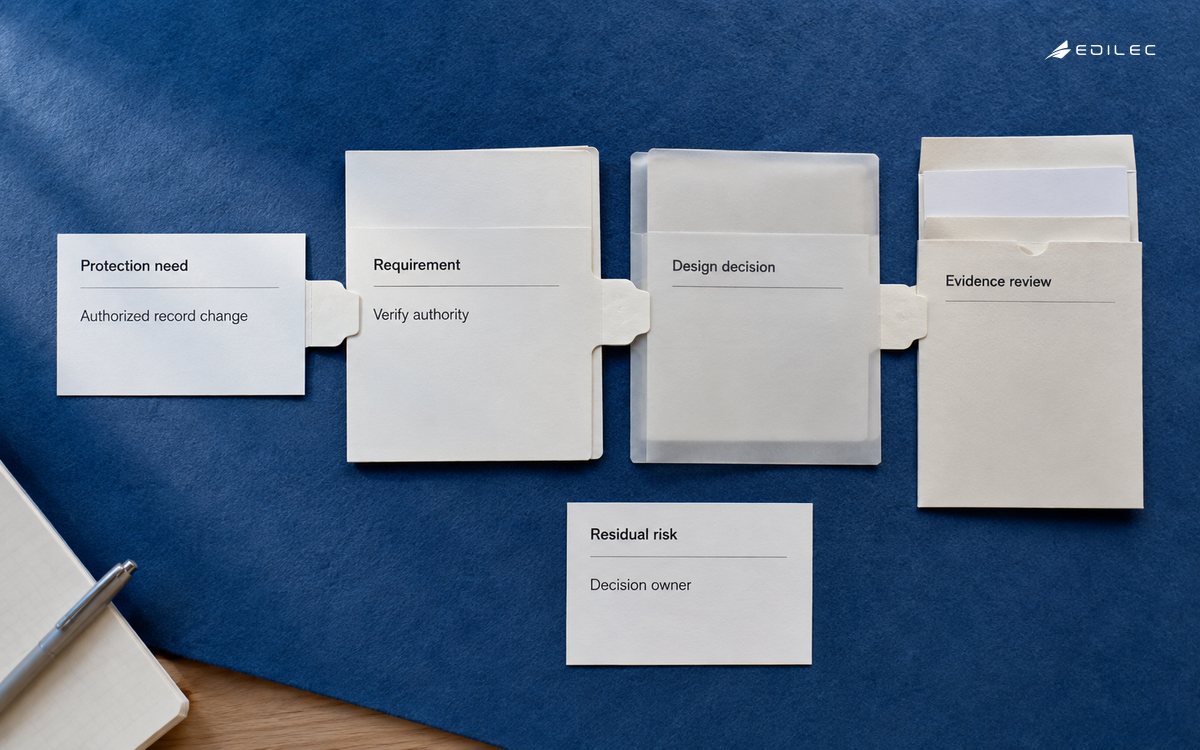
Decompose the system into zones, identities, data flows, privilege paths and failure domains. Apply least privilege, explicit authorization, secure defaults, minimized exposed functionality, protected administration and independent recovery. Make sensitive transitions visible and auditable. Reduce the components that can make a high-impact decision. Where a control depends on a platform or supplier, capture its configuration, evidence, limitations and behavior when that dependency fails.
CISA’s Secure by Design initiative asks technology providers to make customer security a core business requirement and reduce burdens placed on users. Apply that principle to custom systems: safe configurations should be default, common protections should not require expert assembly, and dangerous capabilities should be hard to enable accidentally. Review usability because controls that operators routinely bypass are not dependable architecture.
4. Secure development and supplier realization
Protect the engineering environment as part of the product. Use attributable identities, minimal pipeline privileges, reviewed changes, managed secrets, dependency inventory, approved artifact sources, isolated signing or release authority and retained provenance. Integrate checks at the layer where they give timely feedback, but require expert analysis for business logic and architecture. The NIST SSDF gives producers and purchasers a common secure-development vocabulary.
Flow requirements into supplier agreements. Ask for secure-development practices, vulnerability disclosure and response, component and subprocessor visibility, update support, incident notification, evidence access and exit. OWASP SAMM supports risk-driven improvement across governance, design, implementation, verification and operations. Set a target matched to the system instead of requiring every supplier to claim maximum maturity.
- Protect source, build and deployment systems with stronger controls than ordinary collaboration tools.
- Maintain component, license, support and vulnerability records for first- and third-party software.
- Threat-model significant changes and update requirements when trust boundaries or authority move.
- Use coding standards and review focused on the languages, frameworks and defect history in use.
- Require release evidence identifying source revision, dependencies, checks, artifact and approver.
- Track exceptions and defects to owner, severity, due date, release decision and root-cause action.
5. Verify claims with layered and adversarial evidence
Create an assurance case linking important claims to evidence and residual uncertainty. Use design review, code analysis, configuration inspection, automated tests, manual security testing, penetration testing, fault injection and operational exercises according to risk. Validate both the requirement and implementation; a scanner result cannot show that an authorization model matches business relationships. Preserve reproducible inputs, versions, findings, dispositions and retest results.
Test abuse and recovery scenarios across interfaces and roles. Include compromised credentials, cross-tenant access, disabled telemetry, stale caches, replayed transactions, dependency failure, malicious files, secret exposure and excessive privilege. Independence should increase with consequence: engineers test continuously, while high-impact claims may need a separate assessor. Resolve critical uncertainty before release or obtain a documented, time-bounded risk decision.
| Security claim | Suitable evidence | Common false assurance |
|---|---|---|
| Only authorized actors change records | Policy model, server-side negative tests and audit reconstruction | Hidden buttons or role names |
| Release artifact matches reviewed source | Protected pipeline, provenance and integrity verification | A successful build badge |
| Detection covers critical paths | Telemetry map, simulated events and observed triage | Tool installed with default rules |
| Service can recover securely | Isolated restore plus identity and integrity validation | Backup job completion |
| Supplier risk is controlled | Contract, component visibility, notifications and exercised exit | Questionnaire accepted once |
| Residual risk is owned | Dated decision, rationale, action and review trigger | Finding marked accepted without authority |
6. Accept operation and maintain assurance
Before go-live, exercise incident authority, containment, evidence capture, communication, restore and return to service. Verify monitoring coverage against the reconciled inventory. Assign runbooks to roles, not individuals, and test break-glass access and revocation. Establish vulnerability intake and remediation targets that consider exploitability and business consequence. The system owner should sign operational acceptance with known exceptions visible.
Continue threat, requirement and assurance review after material change or incident. Monitor control coverage, privileged access, security defects, telemetry loss, supplier notices, recovery tests and exception age. Feed production lessons into architecture and engineering practices. Plan disposal: revoke identities, remove secrets and integrations, preserve required evidence, sanitize data and verify supplier deletion. A secure lifecycle includes a controlled end.
Key takeaways
Practical example: a dispatch system identifies unauthorized route changes and loss of service during an incident as unacceptable outcomes. Engineers trace those needs to separate operator and administrator roles, server-side authorization, protected audit events, offline read access and an independently managed restore path. The team then compromises an operator account, disables central telemetry and interrupts a mapping supplier during an exercise. Evidence shows the account cannot change protected configuration, local alerts remain visible and dispatch continues in a degraded mode. A slow supplier fallback becomes a dated exception accepted by the service owner, with a performance fix and retest required before the next expansion.
- Begin with mission, boundary, protection needs and unacceptable outcomes.
- Translate risk into testable behavior and trace requirements to architecture and evidence.
- Design secure defaults, narrow authority, observable transitions and independent recovery.
- Treat engineering systems, dependencies and suppliers as part of the security boundary.
- Use layered evidence and increase assessment independence with consequence.
- Reassess controls through operation, change, incident learning and disposal.
Frequently asked questions
Is a penetration test sufficient for security acceptance?
No. It samples weaknesses at a point in time and is useful within a wider assurance plan. Acceptance also needs requirements traceability, architecture review, secure build evidence, configuration, identity, detection, recovery and owned residual risks. Penetration findings should improve engineering controls, not remain an isolated report.
Does security engineering require zero trust architecture?
Use zero trust concepts where they address system risk, especially explicit authorization and reduced implicit network trust. The label does not replace analysis. Physical processes, safety constraints, disconnected operation and legacy dependencies may require additional patterns. Define behavior and evidence rather than procuring a branded outcome.
Who can accept a security exception?
An accountable owner with authority over the affected business risk, informed by security, legal and operational expertise. The record should state scope, rationale, consequence, compensating measures, expiry and review trigger. A delivery team or supplier should not accept customer enterprise risk merely to meet a date.
Conclusion
The operational authorization pack should remain small enough to use during change. Include the current system boundary, protection priorities, important claims and evidence, open defects and exceptions, dependency owners, incident authority, recovery result and next review triggers. Link to detailed artifacts rather than freezing screenshots in a presentation. When a supplier, data flow, privileged role or deployment process changes, assess which claim and test are affected. This traceability lets teams update assurance proportionately and avoids repeating a full assessment while also avoiding the opposite mistake of treating an old approval as permanent.
Security engineering makes protection part of how a system is conceived, built, verified and sustained. Define protection needs, write verifiable requirements, design defensible boundaries, protect realization, challenge claims and maintain evidence in operation. That produces a service whose residual risks are visible and whose security can improve with change.
Measure improvement through reduced exposure, reliable control operation, faster containment and verified recovery, not the volume of findings or tools. Security evidence should support a risk decision and guide the next engineering change.