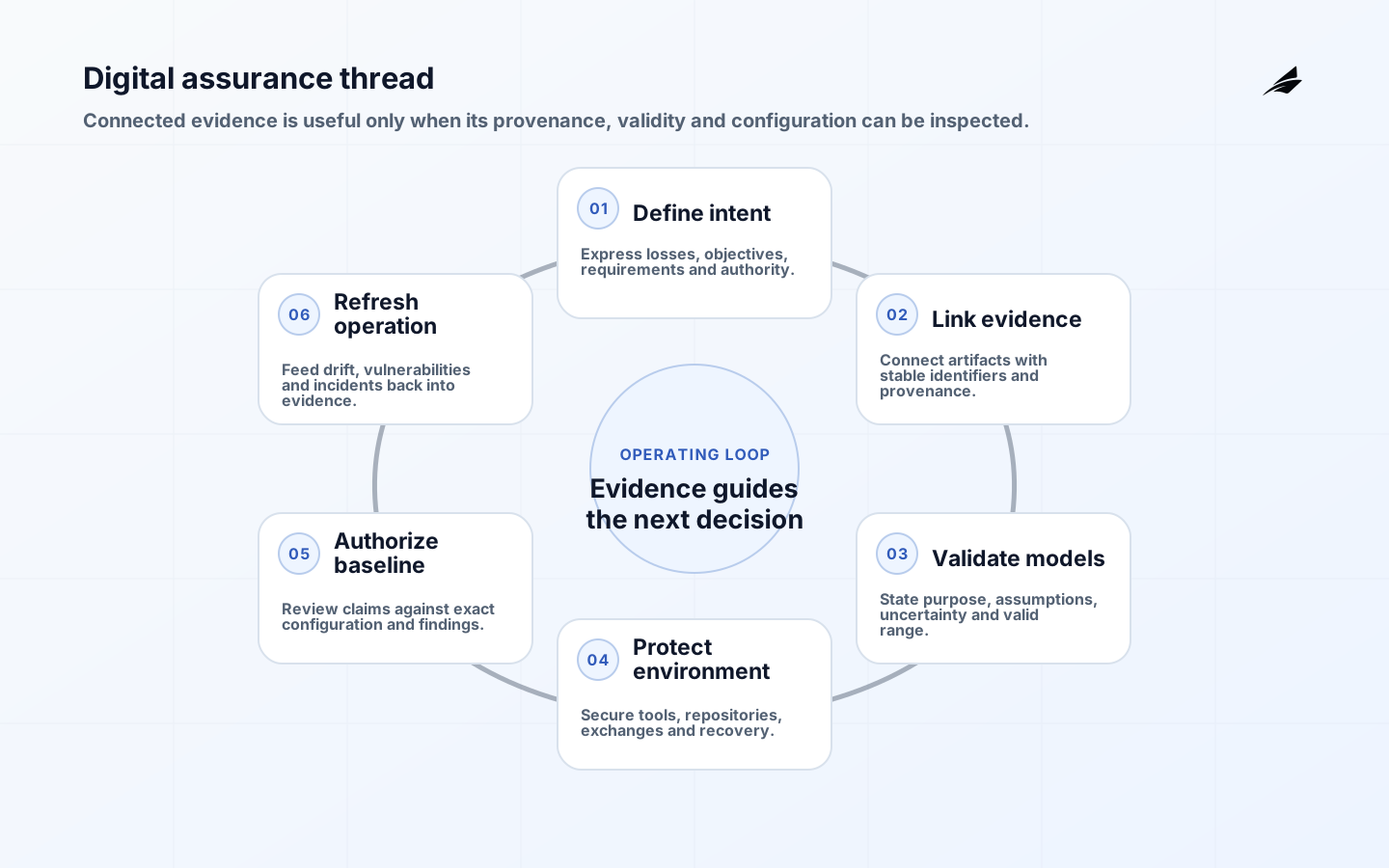
Cybersecurity digital engineering uses connected models, requirements, code, test results, configurations and operational evidence to make security decisions throughout a system lifecycle. The promise is earlier insight and faster change analysis. The risk is a persuasive but incomplete digital thread whose sources, assumptions or versions cannot be trusted. This FAQ explains the controls needed to make digital evidence decision-ready.
For implementation detail, pair this FAQ with the cybersecurity digital engineering guide, the implementation checklist and the OpenID Connect operations checklist. NIST SP 800-160 treats security as a systems engineering concern, which is the right foundation: the digital environment supports engineering judgment but does not replace accountable judgment.
What does cybersecurity digital engineering include?
It includes the engineering methods, repositories, models, automation and governance that connect security objectives to system architecture and evidence. Typical elements are mission and loss scenarios, requirements, threat models, interface definitions, source and build provenance, verification results, risk decisions, bills of material, deployed configuration and incident learning. It also includes protection of the engineering environment itself.
A useful digital thread answers a decision question: which control addresses this threat, what evidence supports it, which configuration was tested and what changes if this interface moves? Link objects with stable identifiers and explicit relationship types. Preserve author, time, version, approval and source. A folder of PDFs is digital storage; it is not necessarily a navigable or trustworthy engineering thread.
| Thread object | Security question | Minimum provenance | Decision use |
|---|---|---|---|
| Requirement | What outcome is required and why? | Source, owner, version and rationale | Architecture and acceptance |
| Model | What behavior or exposure is represented? | Assumptions, fidelity and valid range | Analysis and simulation |
| Test result | What configuration produced the result? | Inputs, tool chain, environment and time | Release and authorization |
| Field evidence | What happened in operation? | Asset, software, event and confidence | Response and redesign |
How can teams trust models and simulations?
Define the model's intended decision, fidelity, assumptions, inputs, uncertainty and valid operating range. Verify implementation against its specification and validate that representation against observed reality for the intended use. Control model and data versions, review sensitive changes and retain the run configuration. A model valid for architecture comparison may not be valid for quantitative risk acceptance.
Treat model exchange and generated artifacts as supply-chain boundaries. Validate schemas, constrain active content, scan imports and separate untrusted conversion. Protect authoritative libraries and reusable components from unauthorized change. Sign or otherwise attest important baselines where needed. Reproduce a sample of consequential analyses independently and investigate unexplained divergence between tools.
How should the digital engineering environment be secured?
Inventory repositories, modeling tools, plugins, build services, test equipment, data stores and external exchanges. Segment by sensitivity and trust, use phishing-resistant authentication where appropriate, enforce least privilege and protect administrative paths. Restrict export and bulk retrieval of sensitive designs. Log reads and changes to high-value artifacts while avoiding unnecessary secrets or personal data in telemetry.
Apply NIST SSDF practices to software and automation that produce engineering evidence. Review dependencies and plugins, protect source and build integrity, generate reproducible or attributable outputs, and maintain vulnerability response. CISA's secure-by-design principle matters here: tool and platform owners should reduce unsafe defaults and make strong security capabilities available without relying on every engineer to harden each workspace manually.
Back up and restore the connected evidence graph, not only individual files. Test whether relationships, permissions, identifiers and audit history survive recovery. Define offline or degraded engineering procedures for platform outages. Continuity plans should also cover vendor failure, license interruption, unsupported file formats and cryptographic key loss.
How does the digital thread support assurance and authorization?
Map claims to evidence and evidence to exact configurations. Reviewers should be able to see requirement coverage, unresolved findings, model limitations, test independence and accepted residual risk. Automate completeness checks and change-impact candidates, but keep risk acceptance with authorized people. A green dashboard may show that fields are populated; it cannot prove that assumptions are sound or harm is acceptable.

Use incremental assurance at architecture, integration and release milestones. Baseline only evidence that has passed defined review. When an interface, dependency, threat or operational assumption changes, traverse affected relationships and require targeted reevaluation. Preserve superseded evidence for history while making the current approved baseline unmistakable. Time-bound exceptions and monitor their conditions in operation.
| Control point | Automated check | Human judgment | Retained evidence |
|---|---|---|---|
| Commit | Schema, signature and policy | Is rationale adequate? | Change and review |
| Integration | Trace and interface coverage | Are assumptions compatible? | Baseline comparison |
| Release | Test, finding and configuration completeness | Is residual risk acceptable? | Approval package |
| Operation | Configuration drift and alert correlation | Does evidence change the risk? | Incident and update decision |
What changes after deployment?
The thread expands from design intent to observed behavior. Reconcile deployed hardware, software, configuration and keys with approved baselines. Connect vulnerability notices, incidents, threat intelligence, control performance and maintenance actions to affected assets and assurance claims. NIST CSF 2.0's Govern, Identify, Protect, Detect, Respond and Recover functions provide a common structure for these lifecycle outcomes.
Set freshness rules. Threat models, inventories and recovery evidence decay when systems and adversaries change. Trigger review on material changes and schedule review for assumptions that can age silently. Measure stale evidence, unowned findings, time to assess exposure, unauthorized configuration drift and time from incident lesson to verified engineering change. Do not reward artifact volume.
Measure digital evidence quality
- Define mandatory requirement, interface, risk and configuration relationships by decision. Measure stale evidence, orphaned artifacts, failed imports, conflicting authority and reconstruction time. Sample semantic correctness because an automatic relationship can be syntactically valid and substantively wrong.
- Quarterly, ask an independent team to reconstruct one release: applicable requirements, models, findings, tests, acceptances and supplier evidence. Introduce a vulnerability or interface change and time impact analysis. Record every use of tribal knowledge or uncontrolled exports.
- Review the human system. Engineers need time and training to challenge models and a fast route to correct links. Treat local copies and bypasses as design feedback. A secure platform that makes legitimate work impractical moves risk outside controls.
- Define when evidence age triggers review and when a configuration change invalidates a test. Route triggers to accountable owners. A threat update need not invalidate every authorization, while an unreviewed component change may invalidate one claim immediately.
- Restore a baseline and prove identifiers, relationships, permissions, signatures and history remain usable. Test long-lived export and supplier exit. Evidence that cannot survive a platform outage, license failure or contract termination is not durable engineering evidence.
- Measure decision usefulness, not artifact volume. Reviewers should find the current approved baseline quickly, understand uncertainty and see unresolved findings. If dashboards encourage teams to maximize link counts, adjust incentives before low-quality automation obscures real gaps.
Set role-specific views without fragmenting authority. Developers, assessors and operators need different detail, but all views should resolve to the same controlled objects. Test that markings, restrictions and redaction survive reports and exchange.
Govern impact analysis as a recommendation. Record traversal rules, confidence and exclusions; compare suggestions with expert review; and monitor missed effects. A tool must not close an action because a link exists. Closure requires evidence that the claim remains valid for the exact baseline.
Use incidents to test the thread's honesty. Ask whether pre-release evidence contained a weak signal, unsupported assumption or missing relationship. Update product and process while preserving what reviewers actually knew at authorization time.
Key takeaways
- Build the digital thread around explicit security decisions and typed evidence relationships.
- Record model purpose, assumptions, uncertainty, configuration and validity range.
- Secure tools, plugins, repositories, build paths and exchanges as a high-value system.
- Use automation to test completeness and impact, while people retain risk authority.
- Connect field configuration and incidents back to claims, requirements and verification.
Frequently asked questions
Does digital engineering require one tool platform?
No. A federated environment can work when identifiers, semantics, interfaces, authority and synchronization are governed. One platform may reduce integration burden but can still contain inconsistent evidence. Evaluate portability, access control, audit, versioning, APIs, recovery and supplier exit as well as modeling features.
How does zero trust apply to engineering data?
Authorize access from identity, role, device, resource sensitivity and context rather than network location alone. Minimize standing privilege and verify important actions. The design must still support collaboration and emergency work; measure denied legitimate work and build governed elevation rather than encouraging uncontrolled copies.
Can AI review the digital thread?
AI can help classify artifacts, suggest links, summarize changes and identify inconsistencies. Treat outputs as proposals with citations and confidence, protect sensitive inputs, test representative failure modes and record the model version. It should not silently create approved evidence or accept risk.
Plan portability before dependence. Export a representative baseline with identifiers, relationships, model metadata, approvals and audit history, then reconstruct it using documented methods. Include proprietary tool formats, license loss and supplier failure in continuity. A digital thread that cannot leave its platform may weaken long-term acquisition and investigation even when daily collaboration is excellent.
Define evidence retention from legal, contractual, mission and learning needs. Protect sensitive designs while keeping the minimum material required to explain decisions. Apply defensible deletion to temporary workspaces and redundant exports. Uncontrolled accumulation increases both cyber exposure and the chance that reviewers select a superseded artifact.
Conclusion
Cybersecurity digital engineering is valuable when it makes consequential evidence easier to inspect and update. Define decision-focused relationships, validate models, secure the environment, preserve configuration context and keep the thread alive in operation. The result is not automatic assurance; it is a stronger basis for accountable engineering decisions.
Define retention from mission, legal, contractual and learning needs. Protect sensitive designs while retaining enough to explain decisions, and delete redundant exports defensibly. Uncontrolled accumulation increases exposure and the chance that a reviewer relies on a superseded artifact.