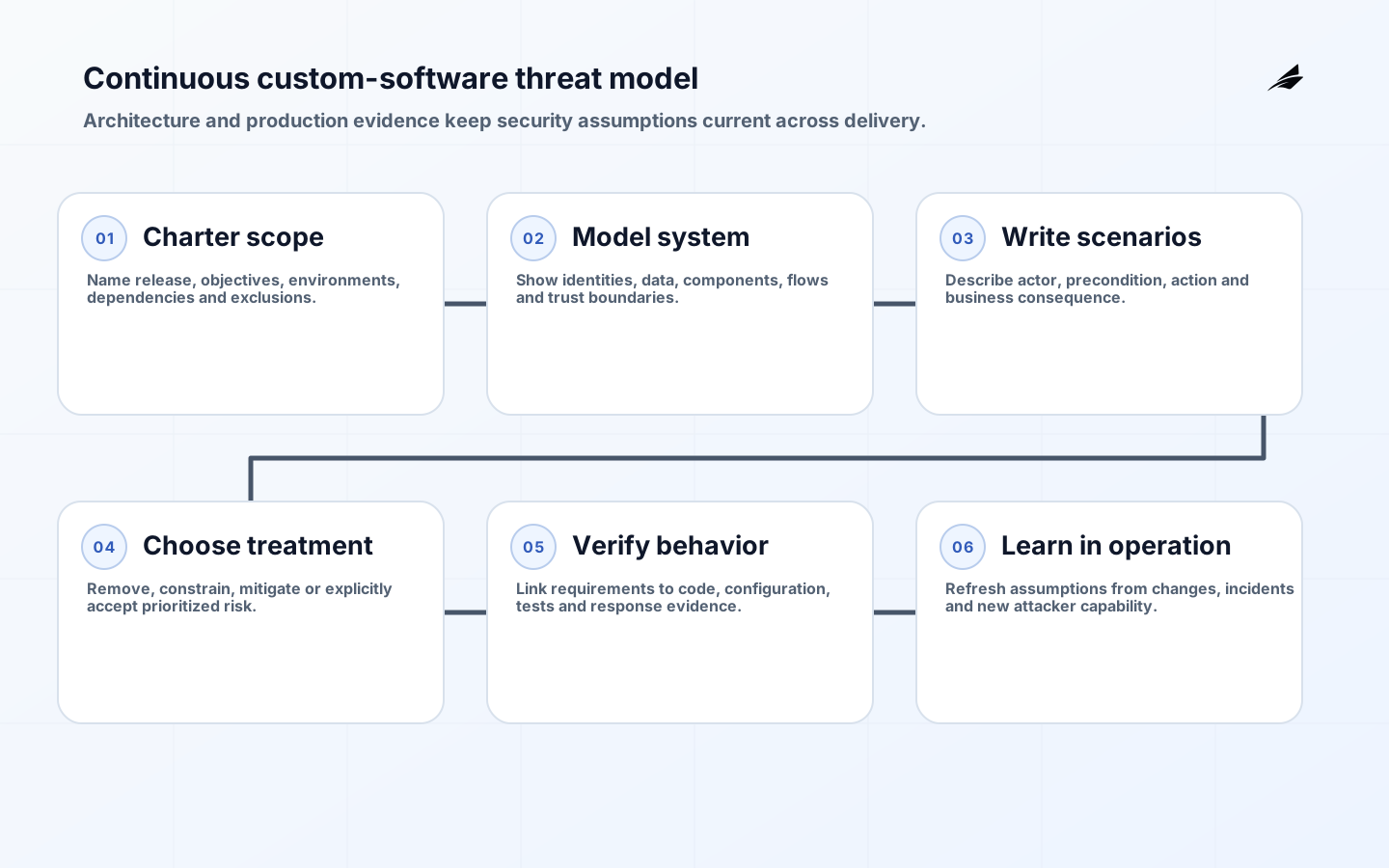
Threat modeling for custom software projects is a structured way to understand what is being built, what can go wrong, what the team will do and whether the response is sufficient. It is most valuable before design choices harden, but it should continue as architecture, integrations and deployment change. The output is not merely a diagram; it is prioritized security work, explicit assumptions and evidence that important threats were addressed.
This guide uses the methodology-neutral four-question frame maintained by the OWASP Threat Modeling Project. It is for product, engineering, security and operations teams. The aim is a living model that informs requirements, code, tests and monitoring. It avoids false precision: risk scoring supports decisions, but business impact, exposure and control evidence matter more than a decorative matrix.
Charter the model around a decision and scope
Define the release, feature, workflow or architecture decision the model will support. Name in-scope components, users, data, environments and dependencies, plus explicit exclusions. Record security and privacy objectives such as preventing unauthorized payment, protecting a health record or maintaining service availability. Acceptance evidence should identify the responsible owner, the source record, the expected result and the decision required when the result is missing.
Select participants who understand product intent, architecture, implementation, operations and likely abuse. Keep workshops small enough to reason. Use prework to collect diagrams and decisions, then capture unanswered questions as owned actions rather than letting missing detail end the exercise. Test the normal path, boundary conditions and a realistic failure path; a successful demonstration alone does not prove the software threat model is ready.
| Artifact | Question answered | Minimum content |
|---|---|---|
| Scope statement | What are we modeling? | Release, assets, environments, dependencies and exclusions |
| System model | How does it work? | Components, flows, identities, stores and boundaries |
| Threat record | What can go wrong? | Scenario, precondition, consequence and affected objective |
| Treatment | What will we do? | Design change, control, test, owner and due date |
| Review evidence | Did we do enough? | Validation result, residual risk and approval |
Model the system and its trust boundaries
Draw users, services, data stores, queues, external systems and administrative paths. Label protocols, identities, sensitive data and deployment zones. Show where data crosses a trust boundary or changes authority. Include build, support and recovery paths when they can alter production. Keep the definition and its effective date with the implementation so later teams can explain why historical and current behavior differ.
Keep diagrams at a level the team can reason about. A model with hundreds of infrastructure nodes hides important flows; one generic cloud box hides identity and dependency boundaries. Link to deeper diagrams when a threat requires detail. Record assumptions such as provider guarantees or network isolation. Make exceptions visible in the same operating workflow instead of routing them to private spreadsheets or undocumented support messages.
Identify concrete threat and abuse scenarios
Use structured prompts such as STRIDE, attack trees, misuse cases, CAPEC or relevant incident history. Methods are aids, not checklists that prove completeness. Phrase a scenario with actor, precondition, action and consequence so the team can design a response. Use progressive exposure and explicit stop conditions so the team can learn from production without placing the entire estate at risk.

Consider authentication, authorization, data disclosure, tampering, replay, denial of service, tenant isolation, dependency compromise, unsafe automation and administrative misuse. Include accidental failure where its consequence resembles an attack. Ask how an adversary chains ordinary capabilities rather than reviewing each component in isolation. Measure the business completion time and error consequence, not only component uptime or the number of tasks closed.
Prioritize by consequence, feasibility and exposure
Estimate affected business service, data, people, financial loss, safety, legal obligation and recoverability. Consider attacker access, prerequisite capability, reachable surface and existing controls. Use ranges or categories where evidence is weak and record uncertainty rather than inventing precision. Preserve identifiers, timestamps and version information across handoffs so reconciliation can distinguish delay, duplication and correction.
Prioritize scenarios that could cross a critical boundary, scale across tenants, evade detection or prevent recovery. A common weakness with broad exposure may outrank an exotic severe scenario. Name who can accept residual risk and when that decision expires. Document the recovery sequence and exercise it with representative state before relying on it during a live incident.
Translate threats into design and verification work
Prefer design changes that remove or constrain a threat: reduce exposed functionality, centralize authorization, isolate tenants, make operations idempotent or eliminate a sensitive copy. Then add preventive, detective and recovery controls. Do not treat logging as mitigation when nobody can respond. Apply least privilege to people and services, and record material administrative actions with enough context for later review.
Write security requirements as observable behavior. For example, a service must reject a cross-tenant identifier before data access, emit an attributable denial and resist enumeration. Map requirements to code changes, configuration, tests and telemetry. Review this control when scope, integrations, users or obligations change; a launch-time decision should not become a permanent assumption.
| Scenario | Design response | Verification |
|---|---|---|
| Cross-tenant object access | Server-side tenant-scoped authorization | Negative tests across roles and identifiers |
| Replay of a financial request | Signed idempotency key and state guard | Repeated and reordered request tests |
| Compromised dependency | Inventory, verification and constrained runtime | Build provenance and containment exercise |
| Privileged support misuse | Just-in-time named access and approval | Access log review and revocation test |
| Destructive automation | Bounded tools, limits and human gate | Adversarial workflow and recovery test |
Integrate threat modeling into normal delivery
Create a lightweight trigger for new data types, external integrations, authentication changes, privileged tools, major dependencies and architecture moves. Review affected parts of the model during design and pull requests rather than repeating the whole workshop every sprint. Separate a commercial promise from the operational mechanism and evidence that will make the promise dependable.
NIST SSDF calls for identifying and addressing security requirements throughout development. Put threat treatments in the same backlog and release gates as functional work. Link architecture decisions, tests and incidents back to scenarios so the model remains useful instead of becoming a stale PDF. Give users a clear degraded state and next action instead of allowing partial data or failed automation to appear complete.
Validate controls and challenge assumptions
Review whether the implemented architecture still matches the model. Run unit, integration, abuse and authorization tests, then use code review, configuration review or penetration testing where appropriate. Test detection and response for scenarios that cannot be fully prevented. Automate repeatable verification where it shortens feedback, while retaining accountable human judgment for consequential ambiguity.
Ask a person who did not design the system to challenge boundaries and assumptions. Confirm that supplier controls apply to the deployed configuration. Record unresolved threats, compensating controls and residual-risk approval. Security acceptance should be repeatable after significant change. Version configuration with code and deployment records so a defect can be reproduced, contained and corrected without guesswork.
Use production evidence to evolve the model
Monitor authentication anomalies, authorization denials, sensitive workflow failures, dependency alerts and abuse signals tied to modeled scenarios. Keep enough context to investigate without collecting unnecessary sensitive data. Exercise containment and restoration for high-consequence threats. Define a small set of leading and lagging measures, then remove metrics that have no owner or operating response.
Update the model after incidents, near misses, new attacker techniques, capability growth or changed exposure. CISA secure-by-design principles place responsibility on software producers to reduce customer burden; recurring customer hardening failures may indicate a product design problem, not a documentation problem. Model supplier and platform assumptions explicitly so a changed guarantee or configuration reopens the affected scenarios.
Keep a small set of maintainable threat-model deliverables
The durable record should include scope and assumptions, the current system model, prioritized scenarios, treatments, verification links and residual-risk decisions. Store it near architecture and delivery artifacts where engineers can update it. Avoid a proprietary format that only a security specialist can open. Version control and clear ownership matter more than visual sophistication, provided sensitive attack detail is protected appropriately.
- A scope statement with release, environments, dependencies and exclusions.
- A readable flow model showing identities, data stores and trust boundaries.
- Scenario records with preconditions, consequence, priority and affected objective.
- Treatments linked to requirements, code, configuration, tests and telemetry.
- Residual-risk approvals with owner, rationale, compensating control and review trigger.
Close each review by checking whether the model changed a decision. If it produced only generic recommendations, narrow the scope or make scenarios more concrete. If the same threat appears repeatedly, create a reusable platform control or secure default and verify adoption. Threat modeling scales when its lessons become engineering capability, while exceptions remain visible for product-specific judgment.
Key takeaways
- Scope the model around a real release or architecture decision.
- Show data flows, identities, stores, dependencies and trust boundaries.
- Write concrete abuse scenarios and prioritize consequence with uncertainty.
- Turn threats into design changes, tests, telemetry and owned residual risk.
- Refresh the model through delivery triggers and production evidence.
Frequently asked questions
Is STRIDE required for threat modeling?
No. STRIDE is one useful prompt set, but OWASP does not prescribe one universal method. Select an approach that fits the system, team and risk. The essential work is understanding the system, identifying credible failure or abuse, choosing responses and validating them.
How often should a threat model be updated?
Update it when a change affects trust, data, identity, exposure, authority, dependencies or recovery. Use lightweight review triggers during normal delivery and a deeper review for major architecture changes or incidents. A calendar review can catch drift but should not be the only trigger.
Does penetration testing replace threat modeling?
No. Penetration testing examines an implemented system during a period and scope. Threat modeling can change requirements before code exists and covers assumptions, business misuse and recovery. The two complement each other, and threat scenarios can make testing more targeted.
Conclusion
Threat modeling for custom software is a repeatable design and assurance practice. It makes trust boundaries, assumptions and abuse scenarios visible early enough to change the architecture, then follows those decisions into tests, monitoring and response. Its quality is measured by better decisions and verified controls, not document size.
Begin with one consequential workflow and the OWASP four questions. Draw the real system, write concrete scenarios, assign treatments and validate the resulting behavior. Keep the model connected to delivery and incidents so it remains an operating asset rather than a launch artifact.