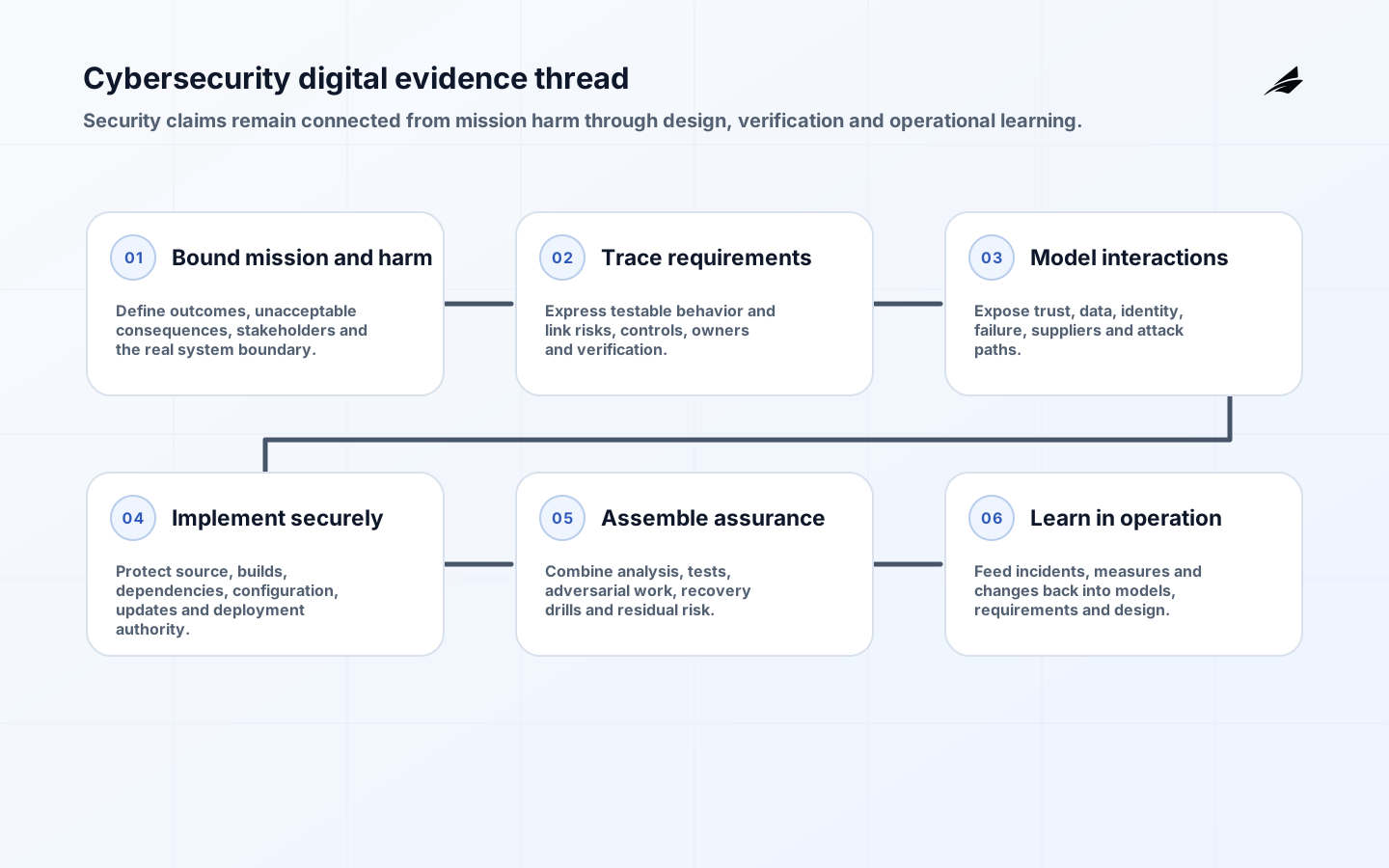
Cybersecurity digital engineering integrates security reasoning and evidence into the digital representations used to design, build, verify and operate a system. Requirements, models, interfaces, threat assumptions, code, tests, configurations and operational signals should tell a coherent story. The goal is not a larger document set. It is earlier discovery of unsafe interactions, traceable decisions and faster reassessment when the system changes. This approach is especially valuable when software, cloud, hardware, suppliers and operational processes form one consequential system.
Use this lifecycle guide with the cybersecurity digital engineering checklist and cybersecurity digital engineering FAQ. Identity teams can deepen interface controls with the OpenID Connect checklist, while data owners can use the encryption at rest checklist. Tailor rigor to consequence and lifecycle length.
Start with mission, harm and system boundary
Describe the system’s purpose, stakeholders, operating environment, critical services and unacceptable harms. Map people, software, devices, data, networks, facilities, suppliers and external services that influence the outcome. Record assumptions about connectivity, trust, maintenance and degraded operation. Security requirements become distorted when the boundary is drawn only around components the engineering team controls. Include support tools, build systems and recovery dependencies.
NIST SP 800-160 Volume 1 applies systems security engineering principles across the lifecycle and frames security in terms of trustworthy secure systems. Use that systems view to define protection needs and assurance claims before selecting controls. Connect each claim to harm, stakeholder and verification method. Revisit the boundary when architecture, mission or threat changes.
| Engineering artifact | Security content | Evidence link | Change trigger |
|---|---|---|---|
| Mission model | Critical outcomes and unacceptable harms | Hazard and threat analysis | New user, use or environment |
| System context | Trust boundaries and external dependencies | Interface owner and contract | Supplier or topology change |
| Requirement | Testable security behavior and conditions | Verification case | Threat or policy change |
| Architecture model | Control placement and failure behavior | Analysis, prototype or test | Design decision |
| Operational model | Detection, recovery and degraded mode | Exercise and live measure | Incident or objective breach |
Write traceable security and resilience requirements
Express requirements as observable behavior with actor, condition, protected asset, response and threshold. Include confidentiality, integrity, availability, authenticity, accountability, privacy, safety and recoverability as relevant. Distinguish design constraints from outcomes. “Use encryption” is a solution statement; the engineering requirement should identify data, states, authorized access, key lifecycle and failure behavior. Assign an owner and verification method to every material requirement.
Use the NIST Cybersecurity Framework 2.0 to organize governance outcomes and communicate risk, then select detailed controls appropriate to the environment. NIST SP 800-53 offers a broad control catalog, but adopting identifiers is not evidence of implementation. Trace selected controls to system behavior, responsible elements and tests. Record tailoring and residual risk.
Use models to expose interactions and attack paths
Maintain context, data-flow, identity, privilege, deployment and recovery views at a level the team can keep current. Mark trust boundaries, authoritative records, secrets, management paths and cross-domain flows. Threat modeling should examine abuse, misuse, dependency compromise, unsafe defaults and operator error. Link threats to mitigations and verification. Model uncertainty explicitly; an assumed provider guarantee deserves a contract reference or test, not a comforting diagram label.
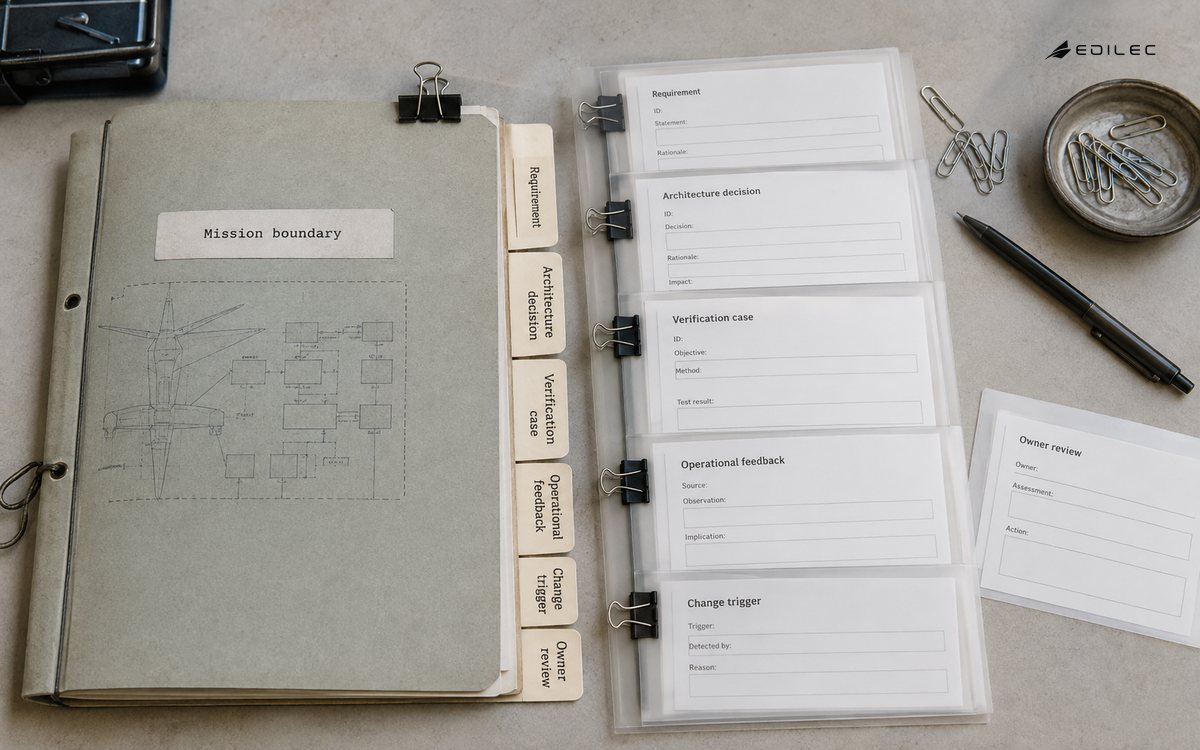
Automate consistency checks where models have structured data, but preserve engineering review. A generated inventory can reveal an unmodeled interface; it cannot decide whether a fallback creates unacceptable harm. Review models with product, operations, safety, privacy and supplier owners. The most valuable finding is often a mismatched assumption between teams, such as one service retrying while another treats duplicate requests as new transactions.
Allocate controls and design for compromise
Place controls at boundaries where decisions can be made with reliable context. Minimize privilege, isolate critical functions, constrain management planes and make safe states explicit. Use strong identities for people, workloads and devices. Protect integrity of configuration and updates. Design observability so security-relevant decisions can be reconstructed. Avoid single controls whose failure defeats the whole claim; identify independent prevention, detection and recovery paths according to consequence.
CISA’s Secure by Design guidance places greater responsibility on technology manufacturers to make products secure by default and reduce customer burden. Apply that principle internally: eliminate default credentials, unnecessary exposure and insecure optional modes. Make the approved path the easiest path. Security features that require every deployment team to rediscover expert configuration are system design debt.
Protect implementation and the engineering environment
Translate architecture decisions into code, infrastructure definitions, policies and testable interface contracts. Protect repositories, developer endpoints, build services, artifact stores, signing keys and deployment identities. Review dependencies and generate inventories. NIST’s SSDF structures practices for preparing the organization, protecting software, producing well-secured releases and responding to vulnerabilities. Map practices to evidence in the actual engineering toolchain.
Use continuous integration to check formatting, tests, secrets, dependencies, static analysis, infrastructure policy and artifact provenance. Risk-based human review should examine intent, authorization, failure, observability and rollback. Keep production changes reproducible and separate build from deployment authority. Generated code and models receive the same assurance as human-authored work; provenance does not replace verification.
Build an assurance case from diverse evidence
Verify requirements through analysis, inspection, demonstration and test. Include normal function, abuse, load, concurrency, degraded operation, dependency failure, update, rollback and recovery. Security tests should challenge enforcement at the correct boundary. Combine component tests with end-to-end scenarios because individually correct controls can interact unsafely. Track evidence versions against the requirement and system configuration they support.
Use an assurance case to state important claims, reasoning, evidence and remaining uncertainty. Keep it concise and reviewable. A passing scanner supports only limited claims; a recovery exercise supports different ones. Independent assessment may be needed for high-consequence systems, but the delivery team still owns correction. When evidence fails, change design or explicitly accept residual risk rather than lowering a threshold silently.
| Evidence type | Supports | Limitation | Useful cadence |
|---|---|---|---|
| Model analysis | Boundary and interaction reasoning | Depends on model fidelity | At consequential design change |
| Automated test | Repeatable behavior | May miss environment and unknown paths | Every relevant change |
| Adversarial exercise | Resistance and detection | Sample of possible attacks | Before release and periodically |
| Recovery drill | Restore and operational coordination | Can use simplified conditions | Risk-based schedule |
| Production signal | Behavior in real context | Observes after exposure | Continuous with service review |
Feed operational evidence back into engineering
Deploy progressively with protected telemetry, clear ownership, rollback and support. Monitor security outcomes, not just control status: suspicious access, policy bypass, data integrity, detection coverage, recovery and exception age. Connect incidents and near misses to requirements, models, architecture and tests. Update the digital thread so future teams see why a control exists and what evidence changed the decision.
Plan maintenance, vulnerability response, cryptographic change, supplier replacement and retirement during design. Long-lived systems need secure update and inventory capability before deployment. At retirement, revoke identities, sanitize or transfer data, remove routes and preserve required records. A system that cannot be safely changed or decommissioned is not fully engineered.
Example: engineer a remotely managed device service
A remotely managed device system includes manufacturing credentials, enrollment, cloud commands, local control, updates, technician tools and retirement. The mission analysis identifies unacceptable harms such as unauthorized actuation, loss of safe local behavior and inability to revoke a stolen device. Context and identity models show that a valid cloud account alone cannot prove physical authorization. Requirements therefore bind command privilege to role, device, site and state, with expiration and local safety checks.
The architecture allocates protected device identity, signed updates, short-lived technician elevation, command audit and an offline-safe mode. Verification includes replayed commands, expired credentials, interrupted update, compromised support account and cloud outage. Each result links back to the requirement and software or hardware configuration. A recovery exercise tests credential revocation, device quarantine and reconciliation when connectivity returns.
Months later, an incident reveals that retired devices can still request a bootstrap certificate. The team updates the lifecycle model, retirement requirement, provisioning service and automated test, then searches the fleet for affected state. That traceable correction is the practical advantage of cybersecurity digital engineering: operational evidence changes the connected system description and prevents a local fix from leaving the same assumption elsewhere.
Configuration management keeps the assurance evidence meaningful. Each released device profile identifies hardware revision, boot policy, firmware, cloud API and approved cryptography. When a supplier changes a component, impact analysis can locate requirements and tests that depend on it. The program does not rerun every activity blindly; it selects evidence affected by the change and records why unaffected claims remain credible. Reviewers can reproduce that selection from versioned artifacts and require broader regression whenever an interface assumption or threat boundary moved. Independent reviewers should be able to challenge the stated rationale directly. That precision makes rigorous assurance sustainable across a long lifecycle.
Key takeaways
- Define security from mission outcomes and unacceptable harm.
- Connect requirements, models, controls and tests through traceable identifiers.
- Model trust, failure and supplier assumptions across the real system boundary.
- Protect the engineering environment and verify implementation continuously.
- Use incidents, exercises and live measures to revise design and assurance.
Frequently asked questions
Does cybersecurity digital engineering require model-based systems engineering?
No. Structured models can improve consistency and automation, but the essential practice is a maintained evidence thread across lifecycle artifacts. Teams can begin with versioned context, data-flow and requirement models appropriate to their complexity.
Is this the same as DevSecOps?
DevSecOps strengthens automated software delivery and operational feedback. Cybersecurity digital engineering also covers mission, system interactions, hardware, suppliers, assurance and retirement. They overlap and should share evidence rather than operate as separate programs.
Conclusion
Cybersecurity digital engineering makes security a connected engineering property. Start from harm, trace requirements, model interactions, allocate resilient controls, protect implementation, assemble diverse evidence and learn from operation. The result is a system whose security reasoning can survive change instead of a compliance snapshot that expires at release.