Cloud and infrastructure decisions shape how reliably a business can serve customers, protect information, launch changes and respond to disruption. They also change who performs day-to-day work and how spending behaves. Business teams do not need to select network protocols or instance types, but they should understand workload fit, responsibility, recovery, cost and exit. Those questions turn a cloud proposal from a technology destination into an accountable service decision.
What cloud means in practical terms
NIST defines cloud computing through characteristics including on-demand self-service, broad network access, shared resource pools, rapid elasticity and measured service. That model can provide faster access to capacity and managed capabilities, but it is not automatically cheaper, safer or more reliable. Outcomes depend on workload architecture, configuration, operational skill and commercial discipline. An old application moved unchanged may gain a new hosting location without gaining meaningful resilience or agility.
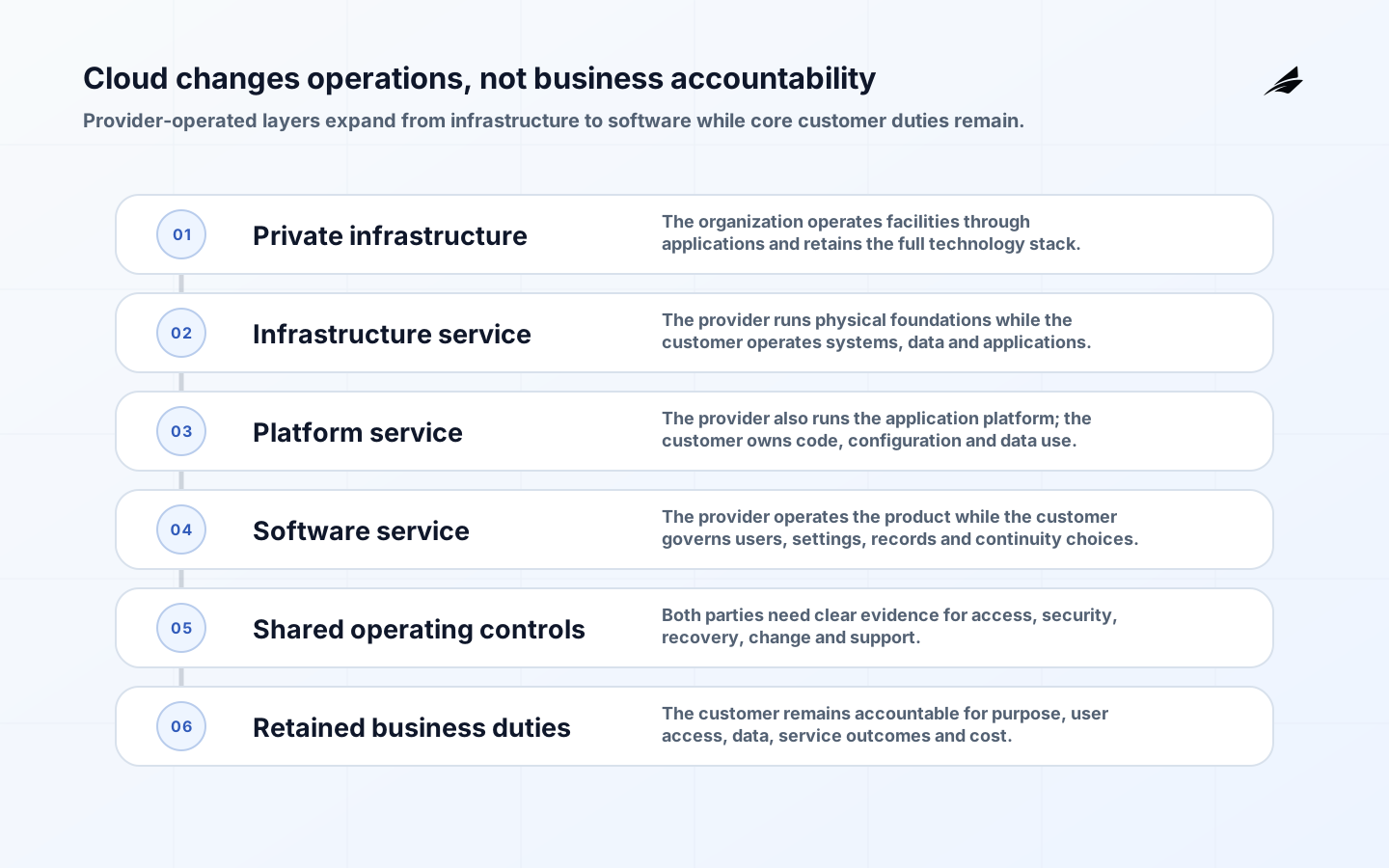
Service models mainly describe the division of work. In software as a service, the provider runs the application while the customer manages users, configuration and appropriate data use. In platform as a service, the customer deploys applications onto provider-managed runtime capabilities. In infrastructure as a service, the customer controls more of the operating system, network and workload stack. Greater control brings greater operating responsibility; a lower-level service is not inherently more capable for the business need.
| Model | Business example | Customer still decides |
|---|---|---|
| SaaS | Subscription-based collaboration or finance application | Users, configuration, data use, integrations and continuity |
| PaaS | Custom application on a managed runtime and database | Application, data, access, releases and service design |
| IaaS | Virtual machines, networks and storage | Operating systems, workload controls, patching and recovery |
| Private infrastructure | Dedicated environment under organizational or supplier operation | Capacity, lifecycle, controls and investment |
| Hybrid | Connected mix chosen per workload | Authority, data movement, end-to-end support and cost |
Choose placement workload by workload
Begin with the business service, its users, dependencies and constraints. Record demand patterns, change frequency, data sensitivity, latency, location requirements, supported technology, recovery needs and current pain. A seasonal digital service may benefit from elasticity; a stable system tied to local equipment may not. Consider retain, retire, replace with SaaS, rehost, replatform or redesign. A portfolio can reasonably use different answers.
| Decision factor | Business question | Evidence |
|---|---|---|
| Value | What customer or operational outcome improves? | Baseline and target |
| Change | How often must the service adapt? | Release and roadmap history |
| Demand | Is usage steady, seasonal, bursty or growing? | Measured traffic and forecast |
| Dependency | What systems, devices and partners must remain connected? | Validated dependency map |
| Data | What sensitivity, retention and location rules apply? | Classification and obligation review |
| Continuity | How much outage and data loss can the process tolerate? | Impact assessment |
| Exit | How could data and service move or close later? | Portability and retirement plan |
Make responsibility visible
Cloud providers operate substantial parts of the stack, but the customer retains responsibilities that vary by service. Name owners for business service, data, architecture, access, security risk, cost and incident decisions. For each critical control, record who configures it, who monitors it, who responds and who supplies evidence. This is more useful than a generic responsibility diagram that does not match the purchased service and actual organization.
Governance should enable bounded choices. Define approved account structures, identity, data locations, network patterns, logging, backup, deployment and cost allocation. Provide standard paths that product teams can use without waiting for repeated design. Exceptions need a reason, risk owner and review date. The Govern function in NIST's Cybersecurity Framework 2.0 reinforces that cyber risk decisions belong in organizational leadership and policy, not only technical implementation.
Ask how security works day to day
Security begins with identity: federate workforce access where appropriate, avoid shared accounts, minimize standing privilege and protect emergency access. Understand which systems face the internet, how data is encrypted, where keys and secrets are held, and how configuration changes are reviewed. Central logging helps only when important sources are included, retention is suitable and alerts reach people who can act.
Leaders should ask how assets are inventoried, vulnerabilities are prioritized, supplier changes are assessed and incidents are coordinated across company and provider. Review actual evidence: access reviews, high-risk findings, incident exercises and restoration results. Certifications and provider reports can support assurance, but they do not prove that the customer's workload is correctly configured or that its operating process works.
Translate resilience into business choices
Define recovery time as how quickly the service must return and recovery point as how much recent data may be lost. Different workflows may need different targets. Architecture can use multiple zones, regions or providers, but every additional failure domain adds cost and operational complexity. Select redundancy according to impact, then test the complete path. A plan that excludes identity, data, third parties or the people who invoke it is incomplete.
Backups must be protected from the event they are intended to address and restored in exercises. High availability, backup and disaster recovery solve related but different problems. Ask when the last representative restoration occurred, what was recovered, how correctness was checked and which manual decisions were required. A successful backup notification is not the same as a usable service.
Connect cloud cost to value and demand
Cloud changes capital purchases into a larger set of metered services and commitments. Bills can include compute, storage, database, network transfer, security, logs, support and marketplace products. Migration adds discovery, remediation, testing and temporary parallel operation. People still design, govern and support the service. Compare total cost over a useful period and state demand, growth, support and retirement assumptions.
The FinOps Framework describes collaboration among engineering, finance, product, procurement and leadership to maximize technology value. Business owners should see spending for their service, the demand that drives it and relevant unit measures such as cost per completed transaction. Teams need timely feedback and authority to act. Blanket cost cutting can damage reliability, while unused capacity and ownerless resources should not survive because bills are technically complex.
| Cost question | Useful measure | Decision it supports |
|---|---|---|
| Who owns the spend? | Allocated and unallocated cost | Accountability and cleanup |
| What drives it? | Cost by users, transactions or data volume | Forecast and product tradeoffs |
| Is demand efficient? | Utilization and idle resource cost | Rightsizing and scheduling |
| What is committed? | Coverage, utilization and expiry of commitments | Purchase timing |
| What remains old? | Duplicate hosting and license cost | Migration retirement |
| What changed unexpectedly? | Anomaly amount and responsible service | Investigation and control |
Migrate in waves with a return path
Discovery should verify dependencies through configuration, traffic and owner knowledge. Build the common foundation for identity, network, policy, logging, recovery and deployment before moving critical workloads. Prove it with a representative, lower-impact service that exercises real dependencies. Then group migrations into waves small enough to support and reverse, with clear readiness and stop conditions.
A migration is complete only when the new service is stable and the old one is safely closed. Confirm data reconciliation, user access, monitoring, support, recovery and cost. Remove obsolete routes, credentials, scheduled jobs, backups, hardware and licenses according to retention and change controls. Without funded retirement, organizations pay for two estates and leave forgotten access paths behind.
Example: a seasonal customer portal
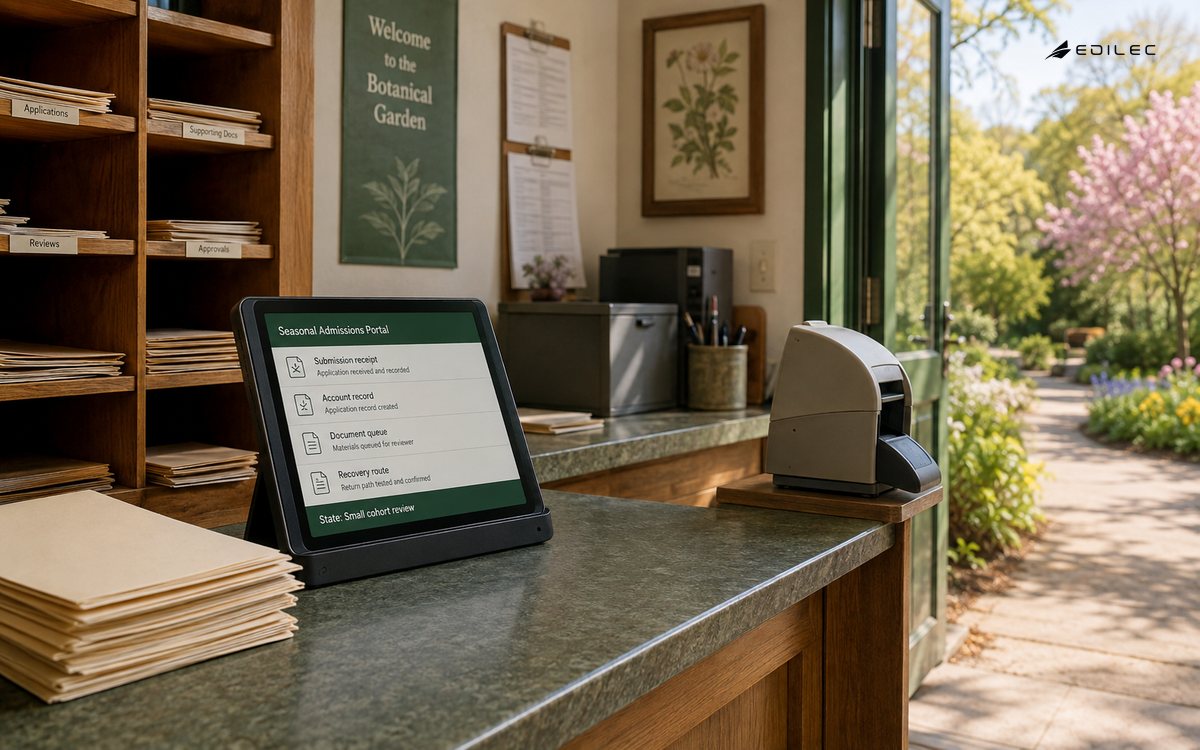
Consider a customer portal with short annual demand peaks, a stable account database and a document service. The business goal is to handle peak submissions and recover predictably, not simply to 'move to cloud.' The portal can use an elastic application platform, while the account system remains authoritative. Load tests use realistic submission and document patterns. Capacity limits, queueing and a user-visible receipt prevent overload from turning into duplicate requests.
A small customer cohort enters first, with old and new transaction totals reconciled. Traffic increases only when completion, error, latency and support thresholds hold. A return route remains until the peak path and recovery process are proven. After migration, the team removes old public access and hosting but retains records according to policy. The following review compares service outcome and total cost with the original baseline.
Questions that expose cloud risk early
| Risk | Question to ask | Required evidence |
|---|---|---|
| Unclear value | Which measured outcome improves? | Baseline and accountable owner |
| Shared-responsibility gap | Who configures, monitors and responds for this control? | Workload-specific responsibility map |
| Unexpected outage | Which dependencies can stop the journey? | Failure test and recovery runbook |
| Data exposure | Where does data flow and who can access it? | Data map and access review |
| Cost surprise | What demand and architecture drive the forecast? | Sensitivity model and anomaly process |
| Lock-in | What would replacement or exit require? | Data export, interface and transition plan |
| Old estate remains | What proves retirement is complete? | Closure checklist and cost removal |
A business checklist for cloud decisions
- Name the business service, owner, current baseline and desired outcome.
- Confirm workload dependencies, data obligations, demand and continuity needs.
- Compare placement and modernization options rather than assuming migration.
- Approve a workload-specific responsibility, security, recovery and cost model.
- Require a representative proof and production-readiness evidence before critical waves.
- Release progressively with user, service, reconciliation and spend thresholds.
- Fund stabilization and retirement, then review actual value against the baseline.
Provider well-architected frameworks from AWS, Microsoft and Google Cloud organize design reviews around related quality areas such as security, reliability, operations, performance and cost. They are useful prompts, but the decision belongs to the workload team and business owner. Ask which tradeoffs were made and which risks remain, not only whether a review checklist was completed.
Key takeaways
- Cloud service models change the division of work; they do not remove customer responsibility.
- Choose placement per workload from value, demand, dependencies, data and continuity needs.
- Require named owners and evidence for access, security, recovery, cost and incidents.
- Connect spending to service demand and include migration, people and old-estate retirement.
- Move in bounded waves with measurable stop conditions and verified closure of the prior environment.
Frequently asked questions
Is public cloud less secure than private infrastructure?
Security depends on the workload, controls, configuration and operation. Public providers offer strong capabilities, while customers can still misconfigure them. Private environments also require disciplined identity, patching, monitoring and recovery. Compare evidence against the actual risk.
Do we need a multi-cloud strategy?
Use multiple providers when a defined business, regulatory, supplier or capability need justifies the added skills, integration and governance. Using two clouds does not automatically make one workload portable or resilient; that requires deliberate design and testing.
How should we evaluate promised cloud savings?
Ask for the current baseline, demand assumptions, architecture, rates, migration cost, parallel operation, people and retirement timing. Test sensitivity to growth and commitments, then compare actual service cost and value after release.
Keep cloud decisions tied to service outcomes
Business teams add the most value by keeping technology proposals connected to customer outcomes, accountability and evidence. A sound cloud decision states why a workload should change, who owns the remaining work, how service recovers, what demand costs and how the old path ends. With those answers, cloud becomes a governed tool for the business rather than an abstract destination.