This cloud transformation consulting FAQ answers the questions leaders should settle before funding a migration or modernization program. Transformation is not a target percentage of workloads in public cloud. It is a coordinated change to business services, architecture, delivery, security, finance, skills and operations that should produce measurable value. Consulting is useful when it improves decisions and transfers capability, not when it leaves a slide deck and a larger supplier dependency.
Use the cloud transformation scope and delivery plan to frame the program and the implementation checklist to verify progress. The customer should name an executive sponsor, business service owners and accountable technology, security, finance and operating roles before consultants begin. External expertise can accelerate discovery and patterns; internal owners must make tradeoffs and accept outcomes.
What is cloud transformation consulting?
Cloud transformation consulting helps an organization connect business drivers to a target operating model, portfolio decisions, governed platform, delivery roadmap and measurable adoption. Work may include readiness, architecture, security, migration, application modernization, data, FinOps, organizational design and supplier selection. The engagement should state which decisions it supports and which implementation or operating work it includes. Advisory recommendations without accountable execution can be appropriate, but their boundary must be clear.
Provider frameworks offer useful lenses. The AWS Cloud Adoption Framework uses business, people, governance, platform, security and operations perspectives. The Microsoft Cloud Adoption Framework connects strategy, plan, ready and adopt with ongoing govern, secure and manage methods. Consultants should adapt frameworks to evidence and context, not treat completion of a template as transformation.
How should the business case be built?
Start with problems and opportunities that cloud capabilities can influence: release delays, fragile capacity, data-center renewal, geographic expansion, recovery weakness, product experimentation or access to managed services. Baseline service outcomes and current fully loaded cost. State hypotheses such as reducing environment lead time from weeks to hours or restoring a priority service within an approved objective. Avoid generic promises of agility or a list-price comparison between servers and instances.
Model migration and operating scenarios, including discovery, remediation, connectivity, landing zone, licenses, data transfer, training, consultants, dual running, commitments, support and decommissioning. Benefits need owners and measurement methods. Some value is option value or risk reduction rather than immediate cash; label it honestly. Approve funding by waves and learning gates so weak assumptions can be corrected before the whole portfolio is committed.
| Business driver | Evidence baseline | Transformation measure |
|---|---|---|
| Faster product change | Lead time, deployment frequency and rework | Low-risk release performance |
| Reliability | Incident impact and tested recovery | User SLO and exercise results |
| Cost transparency | Owned current spend and demand | Unit cost and forecast accuracy |
| Market expansion | Region lead time and constraints | Compliant launch time and service quality |
| Data capability | Access delay, quality and duplication | Trusted product use and outcome |
| Estate exit | Facilities, contracts and unsupported systems | Verified obligations closed by date |
Should every workload move or modernize?
No. Build a portfolio register and classify each workload to retain, retire, replace, rehost, replatform or refactor based on evidence. Consider business criticality, dependencies, data, latency, licensing, hardware, release needs, support horizon, compliance, recovery, skills and economics. A system near retirement may remain temporarily; a differentiating product constrained by slow releases may justify modernization; a commodity capability may be replaced by SaaS. The categories are decisions, not fixed badges.
Trace representative transactions and reconcile technical discovery with interviews, incident records, contracts and bills. Tools find hosts and network flows but may miss manual controls, authoritative records and critical calendar periods. Record confidence, blockers and the event that could change each disposition. Reassess after a representative wave, because actual platform and operating evidence often changes the portfolio case.
What should a landing zone and cloud platform provide?
A landing zone should provide consumable, governed foundations: organization and account structure, identity, network, policy, logging, keys, secrets, approved regions, billing, delivery integration, backup and incident routes. The exact design depends on provider and scale. Acceptance is behavioral: a product team can create a compliant environment, deploy through a standard path, obtain narrowly scoped identities, emit usable telemetry, allocate cost and recover protected data.
Use architecture guidance as review questions. The Google Cloud Well-Architected Framework covers operations, security, reliability, cost, performance and sustainability. Avoid building every possible control before a workload tests the platform. Establish non-negotiable foundations, onboard a representative service, then improve templates from observed friction. Platform teams should offer safe defaults and support; workload teams own application and data behavior.
How does the operating model need to change?
Cloud changes work from periodic hardware provisioning toward software-defined, continuously changing services. Define responsibilities among central platform, product teams, security, networking, data, finance, service management and suppliers. Decide who creates policy, operates shared services, approves exceptions, responds to incidents, owns SLOs and pays for consumption. Replace long ticket chains with automated controls and bounded team autonomy where risk permits.
Map skills to real operating tasks: deploying infrastructure, reviewing access, diagnosing distributed services, restoring data, investigating cost and responding to cloud incidents. Training is useful, but capability is proven through supervised work and exercises. Plan organizational and role changes transparently. Transformation stalls when teams are accountable for cloud outcomes but lack authority, access or protected time to build skills.
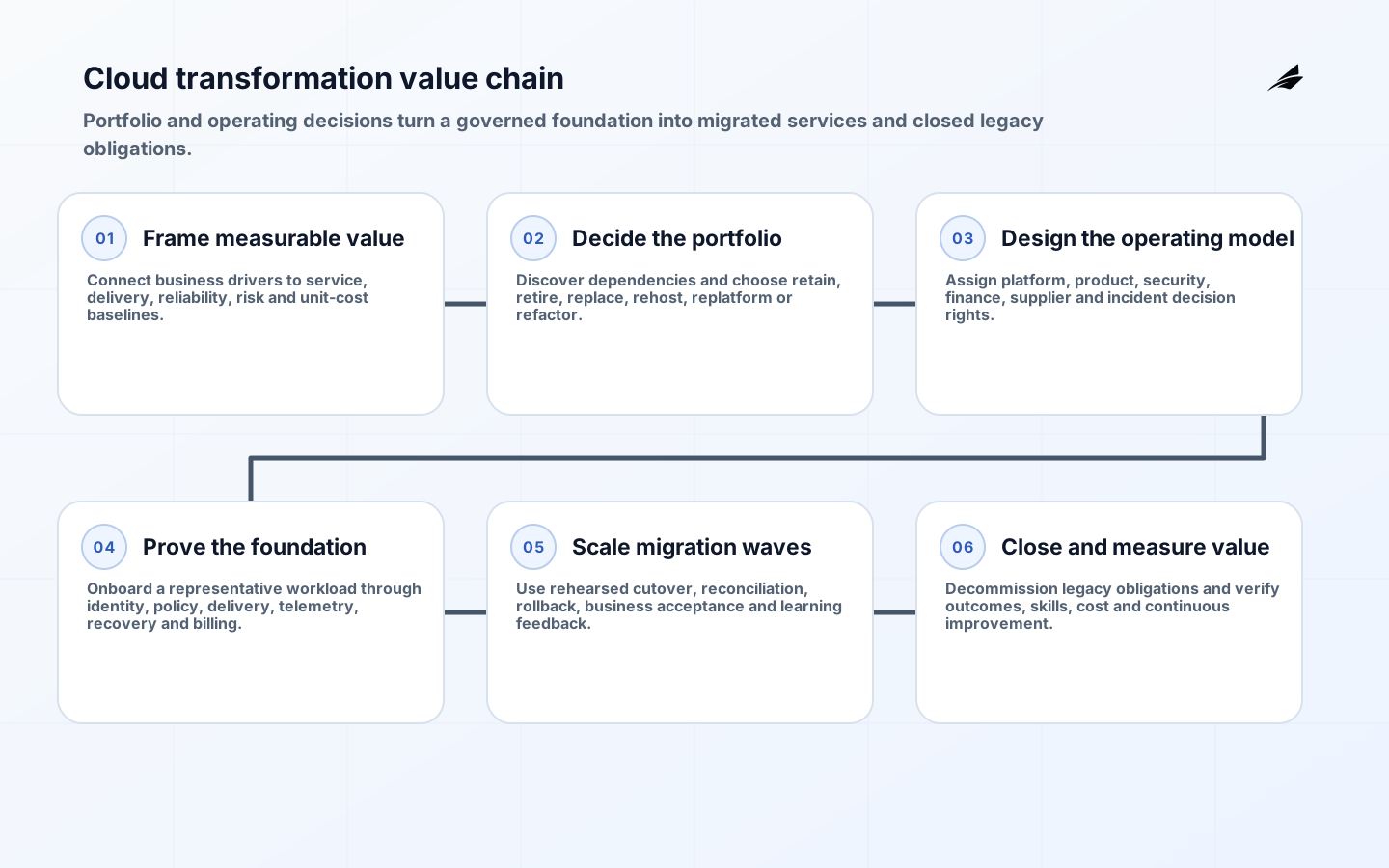
Follow a six-stage cloud transformation value roadmap
Sequence the program through outcome framing, estate discovery, operating-model design, foundation proof, migration waves and value closure. Choose the first workload for representative learning with bounded impact. It should test identity, network, delivery, telemetry, data, cost and support. Feed findings into platform and portfolio decisions. Scale only after the organization can change and recover the service through the new model.
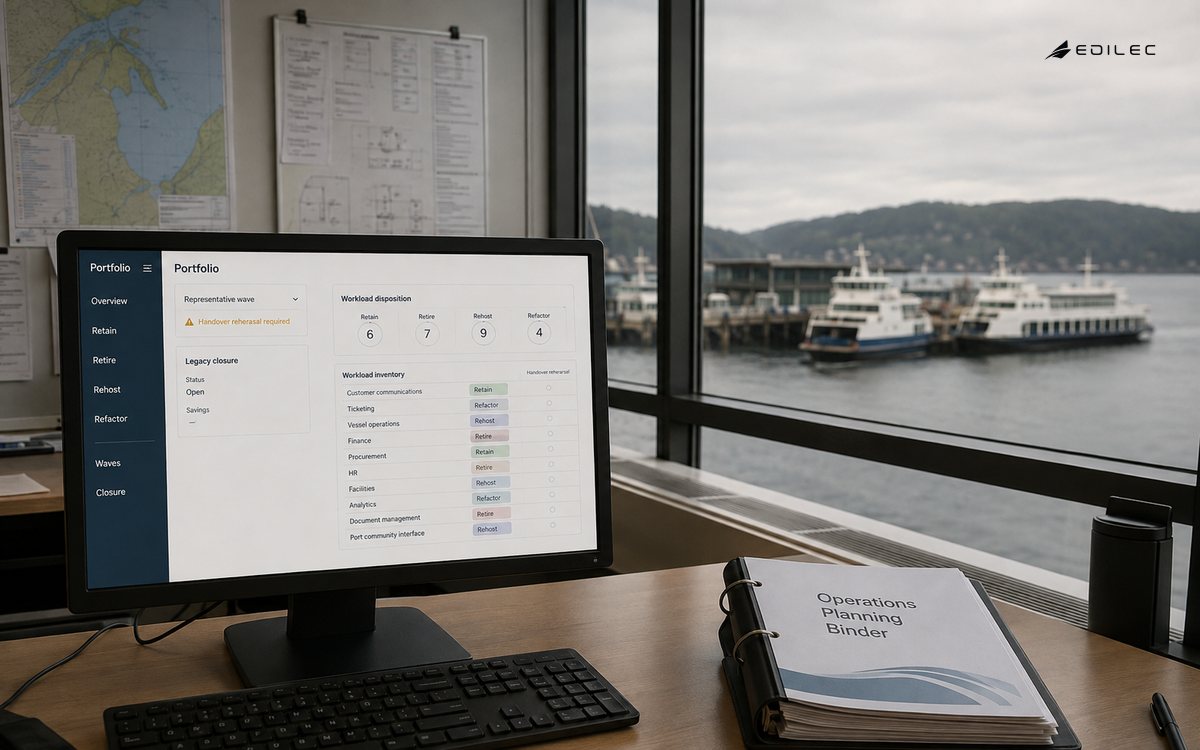
Every wave requires entry criteria, dependency confirmation, rehearsal, data reconciliation, rollback, business validation, hypercare exit and legacy closure. Count a workload as transformed only when the target service is accepted and old obligations have an owner and date. Migration volume can look impressive while duplicate estates, licenses and manual processes preserve cost and risk. Report outcome and closure, not only resources created.
What delivery practices support transformation?
Store infrastructure, policy, application configuration and database changes in version control. Build canonical artifacts, automate tests, promote controlled versions and use progressive release with observable rollback. DORA's continuous-delivery guidance connects test and deployment automation, continuous integration, version control and fast feedback to low-risk releases. Transform governance by embedding evidence in delivery rather than adding manual approvals that cannot evaluate every change.
Measure deployment frequency, lead time, change failure, failed-change recovery and rework in context. High frequency is not the goal for every system; the ability to release safely when the business needs a change is. Add customer reliability, security outcomes and cost. Modernizing architecture without deployment and operating change often leaves the organization with newer components and the same slow, risky release process.
How are cost and FinOps handled?
Implement billing access, allocation rules, budgets, forecasts and anomaly routing before broad migration. Assign costs to products and owners. Model demand, resilience, transfer, storage, managed-service requests, observability, security, support, licenses, commitments and migration overlap. Separate rate optimization from usage and architecture optimization. Commitments can lower unit rates but create risk when workload demand or portfolio plans are uncertain.
The FinOps Framework emphasizes collaboration, business value, ownership and timely data. Use unit economics such as cost per order, policy, learner or environment alongside service quality. Consultants should leave repeatable cost-management practices and internal decision rights, not a one-time savings report. Validate claimed savings against invoices, retired contracts and avoided commitments using an agreed method.
| Transformation cost | Uncertainty to model | Control |
|---|---|---|
| Foundation | Shared-service scope and platform team effort | Roadmap with consumer acceptance |
| Migration | Dependencies, data movement and remediation | Wave ranges and learning updates |
| Operations | Support, telemetry, security and skills | Owned service and unit-cost reporting |
| Resilience | Architecture, backup and exercise expense | Impact-based objectives and tests |
| Parallel estate | Facilities, licenses and duplicate teams | Dated closure ledger |
| Consulting | Deliverables, extensions and knowledge transfer | Outcome gates and capability tests |
How should consultants be selected and governed?
Evaluate experience with comparable constraints and request examples of decision artifacts, implemented patterns, operating handover and measurable outcomes. Clarify provider partnerships and commercial incentives. Define deliverables, acceptance evidence, staffing, subcontractors, intellectual property, access, security, expenses, dependencies, change control and exit. Avoid paying for volume of documents. A useful deliverable changes an approved decision, deployed capability or internal skill.
Keep customer product and risk owners in decision authority. Require joint working, paired implementation, repository access and progressively reduced consultant dependence. Review assumptions and outcomes by wave. Test knowledge transfer by having internal teams deploy, diagnose, restore, review cost and explain architecture. The engagement ends well when the customer can govern and improve the platform without hidden reliance on named consultants.
Cloud transformation consulting takeaways
- Define transformation through measurable service and operating outcomes.
- Choose workload dispositions from evidence rather than migration quotas.
- Prove the landing zone with a representative workload.
- Change ownership, delivery, finance and skills with architecture.
- Fund by waves and close legacy cost and risk explicitly.
- Accept consulting only when decisions, capabilities and knowledge transfer are demonstrated.
Frequently asked questions
How long does cloud transformation take? Estimate by portfolio dependencies, platform readiness, operating change and evidence-backed waves, not server count. Is cloud always cheaper? No. Demand, architecture, rates, transfer, resilience and management determine cost. Do we need a cloud center of excellence? A cross-functional enabling group can help, but its structure should match scale and avoid becoming a permanent approval bottleneck. Is multicloud a requirement? Only when distinct business needs justify its added complexity.
Should consultants choose the cloud provider? They can supply evidence, while the customer should own criteria and decision. Can transformation finish before every workload moves? Yes; success may include retained or retired workloads and an operating model that continues improving. What is the best first migration? A meaningful, representative workload with bounded impact. How is value proven? Compare service, delivery, risk and unit-cost outcomes with a baseline, then verify legacy obligations actually close.
Conclusion
Cloud transformation consulting creates value when it helps an organization make better portfolio decisions and build an operating capability it can own. Anchor the business case to measured services, prove the foundation through real delivery, scale in controlled waves and close duplicate obligations. Consultants should accelerate evidence and transfer knowledge. The durable result is not a migration total; it is an organization able to fund, secure, change and recover its cloud services.