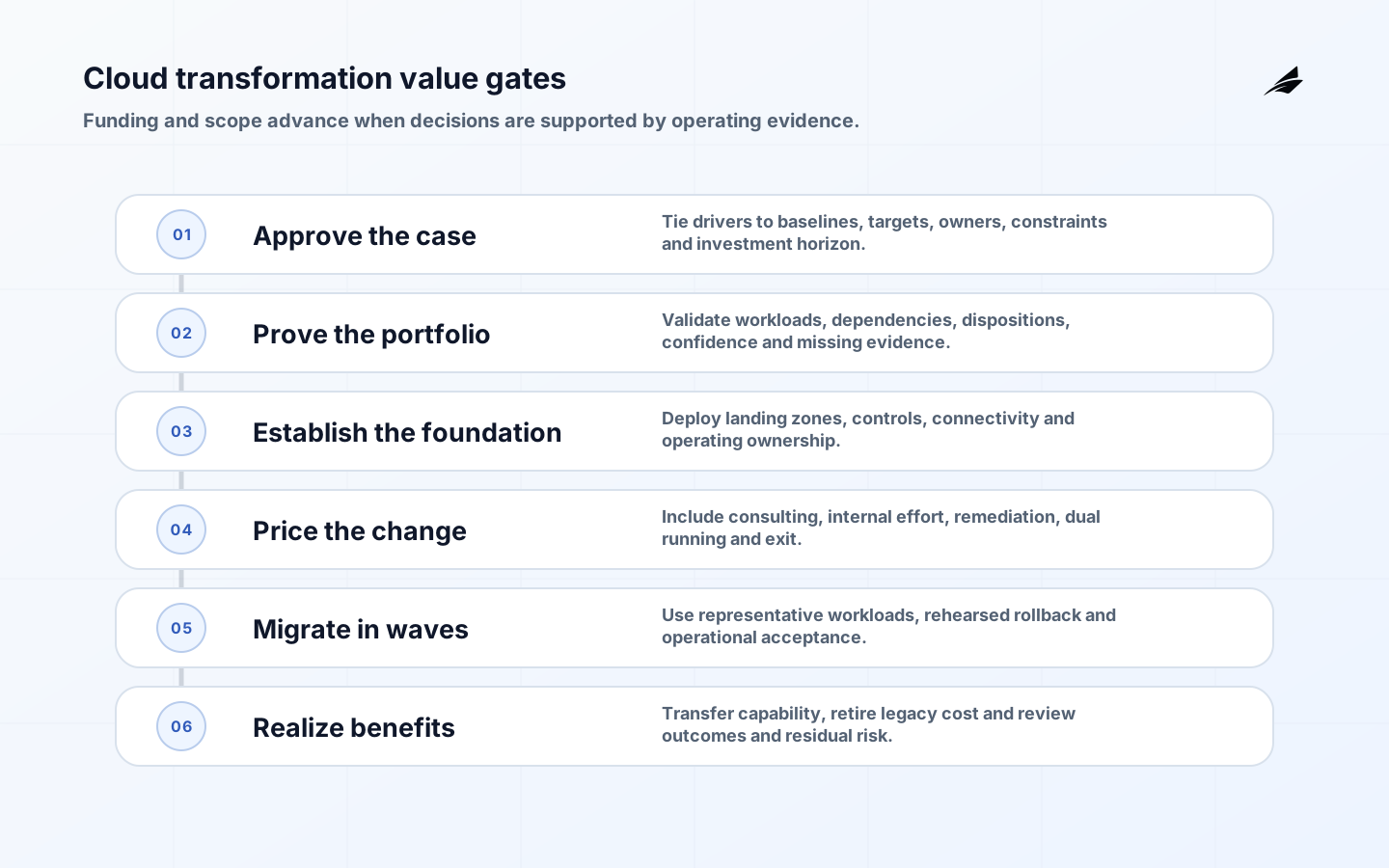
Cloud transformation consulting should help an organization change how it funds, builds, secures and operates digital services. A migration inventory and a target architecture are necessary, but they are not the transformation. The engagement must connect business outcomes to workload decisions, establish an operating model and leave internal teams able to govern the environment. Scope, fees and milestones should therefore be tied to verified decisions and usable capabilities rather than document volume.
Use this guide with Edilec's cloud transformation implementation checklist, cloud transformation consulting FAQ and cloud computing consulting plan. The combination provides a buyer's view of discovery, migration, governance and the evidence required before each wave.
Build a transformation case with measurable outcomes
Define why change is needed now. Drivers may include product lead time, resilience gaps, expiring infrastructure, data-center commitments, security exposure or access to managed capabilities. For each driver, record a baseline, target, deadline, executive owner and constraint. Avoid treating cloud spend reduction as a universal justification; modernization can increase near-term cost while improving delivery speed, recovery or product capability. The business case should show those tradeoffs explicitly.
Agree how benefits will be measured and who owns them after the consultants leave. Separate migration outputs, such as applications moved, from business outcomes, such as reduced provisioning time or verified recovery. The current Microsoft Cloud Adoption Framework overview separates strategy, planning, readiness and adoption from ongoing governance, security and management. That distinction is useful when turning an ambition into funded workstreams.
| Workstream | Required decision | Acceptance evidence |
|---|---|---|
| Strategy | Outcome, constraint and investment horizon | Signed case with baseline and owner |
| Portfolio | Disposition and wave for each workload | Evidence-backed inventory and dependency map |
| Platform | Landing-zone services and responsibility split | Deployed, tested reference environment |
| Adoption | Migration method and cutover authority | Rehearsed runbook and rollback |
| Operations | Service objectives, support and cost ownership | On-call, dashboards, budget and recovery proof |
Scope discovery around the application portfolio
Inventory applications, interfaces, data, infrastructure, users, contracts, support windows and compliance obligations. Validate records with telemetry and owners because configuration databases are often incomplete. Map upstream and downstream dependencies, identity paths, batch schedules, licensing and network latency. Capture business criticality and change calendars. The result should support a disposition decision for every workload: retain, retire, replace, relocate, rehost, replatform, refactor or rebuild.
Apply decision criteria consistently but preserve exceptions. The FinOps Foundation's architecting and workload placement guidance connects placement to operational requirements, skills and financial viability. A mainframe-connected service, latency-sensitive plant workload and stateless web application should not receive the same migration pattern. Require consultants to document assumptions, confidence and missing evidence instead of presenting a false precision score.
Establish landing zones and the operating model
Build the minimum foundation before the first production wave: organization hierarchy, identity federation, privileged access, network connectivity, approved regions, encryption, key management, logging, policy enforcement, backup, incident routing, billing structure and resource metadata. Provision it through version-controlled code. A landing zone is a maintained platform product, not a one-time configuration. Assign owners for upgrades, exceptions, support and capacity as part of acceptance.
Use the CISA cloud security reference architecture to test assumptions about shared services, migration and security posture management. Map accountability between provider, consultant, central platform and workload teams at control level. Align governance and incident responsibilities to the NIST Cybersecurity Framework 2.0, including executive governance and supply-chain considerations. Contracts do not replace technical verification.
Estimate consulting and transformation cost honestly
Separate consulting fees from the total cost of change. Consulting may cover assessment, architecture, engineering, migration factory, program management, security, FinOps, training and managed operations. Transformation costs also include internal staff, provider consumption, connectivity, tools, data transfer, testing, remediation, dual running, contract exits and contingency. Price each wave from evidence about complexity and volume; do not multiply an average application estimate across an unverified portfolio.
Compare commercial models. Fixed price fits bounded deliverables with stable assumptions; time and materials fits uncertain discovery; outcome-linked fees require metrics the supplier can materially influence. Define what constitutes a completed migration, how defects and rework are handled, and when change control applies. Retain enough payment until operational acceptance. Require transparent rate cards and cloud discounts, and prevent incentives that reward workloads moved while ignoring reliability or retirement of old cost.
| Cost category | Often missed item | Control |
|---|---|---|
| People | Internal owners diverted from normal delivery | Capacity plan by role and wave |
| Technology | Logs, backup, security tools and data transfer | Production-shaped cost model |
| Transition | Parallel environments and extended licenses | Exit criteria and maximum overlap |
| Remediation | Unsupported software and data-quality repair | Discovery reserve with approval threshold |
| Operations | 24-hour support, skills and platform upgrades | Target operating budget before migration |
Deliver migration waves through evidence gates
Start with a representative wave, not only the easiest application. It should exercise identity, networking, deployment, monitoring, support and cost allocation without carrying intolerable business risk. Define entry criteria, freeze windows, cutover authority, rollback triggers and post-release observation. Automate repeated assessment and migration tasks, but keep disposition and risk acceptance accountable to named people. Feed every wave's findings back into estimates and platform patterns.
Review migrated workloads against operational excellence, security, reliability, performance, cost and sustainability. The AWS migration lens description of Well-Architected pillars offers a practical checklist of concerns, regardless of target provider. Require load, recovery, security and billing tests. A successful technical cutover is provisional until service owners can operate the workload and the legacy environment has an approved retirement path.
Example: shape a representative migration wave
Imagine a portfolio with a customer portal, scheduled integration jobs and an aging database. A useful first wave includes the portal and one integration, while the database remains connected through a secured temporary path. This combination tests identity, public ingress, private connectivity, deployment, batch scheduling, logs and cost allocation without forcing the riskiest data move first. Discovery documents latency, change windows, licensing and the exact condition for later database migration.
The consultant builds the landing-zone components through client-owned code and pairs with internal engineers. Before cutover, the team runs performance, backup, restore, security and rollback exercises, then records accepted residual risks. During hypercare it measures service objectives, support tickets, provider spend and unexpected manual work. The steering group reviews actual effort against the estimate and changes later wave assumptions rather than protecting the original business case.
Wave completion requires stable operation, internal on-call acceptance, reconciled cost, resolved critical defects and an approved retirement date for replaced infrastructure. If old servers remain because a downstream consumer was missed, the wave is not financially complete. This example illustrates a strong consulting milestone: a business service operates on the target platform, internal teams can support it, new evidence improves the roadmap and legacy obligations are visible.
Control consulting and delivery risks
Major risks include consultant dependency, biased provider selection, incomplete portfolio data, uncontrolled scope, weak security foundations, unrealistic cutovers and failure to retire legacy cost. Protect knowledge transfer through paired delivery, repository ownership, decision records and internal sign-off. Require disclosure of reseller incentives and subcontractors. Keep architectural choices portable where the business case supports it, but do not pay a complexity premium for theoretical multicloud portability without a credible scenario.
Create a steering review that considers outcomes, risk, spend, workforce and operational readiness together. Track forecast variance, wave throughput, escaped defects, policy exceptions, recovery tests, platform support demand, legacy retirement and benefits realized. Independent assurance is appropriate for high-impact security, regulatory or financial claims. Stop or reshape a wave when evidence changes; continuing to protect a published schedule converts uncertainty into avoidable operational risk.
Make capability transfer a contracted deliverable
Define the skills internal teams must demonstrate: provision a compliant environment, deploy a workload, investigate an alert, restore data, review cost, approve an exception and upgrade a platform component. Use observed exercises, not attendance records, as acceptance. Transfer code, pipelines, architecture decisions, inventories, runbooks, credentials, support history and supplier contacts. Assign maintenance owners before warranty or hypercare ends.
Close the engagement with a benefits and residual-risk review. Reconcile promised and realized outcomes, document unresolved dependencies and set review dates. Confirm data and intellectual-property return, account removal and subcontractor offboarding. A consulting engagement succeeds when the client can operate and evolve the transformed estate without the original team present, while retaining a deliberate option to buy specialist help.
Cloud transformation consulting takeaways
- Contract for decisions, working capabilities and operational evidence.
- Validate the portfolio before fixing wave cost and schedule.
- Treat the landing zone as an owned platform product.
- Price internal effort, dual running, remediation and legacy exit.
- Use representative waves with rollback and recovery gates.
- Accept knowledge transfer only when internal teams demonstrate key tasks.
Frequently asked questions
How long does a cloud transformation take?
A bounded foundation and pilot wave may take months; a complex portfolio can take years. Duration depends on application count, dependencies, data movement, change windows, skills and modernization depth. Ask for a range by wave and confidence level, then update it using actual throughput and remediation findings.
Should one partner assess and deliver the migration?
It can reduce handoffs, but it also creates an incentive to recommend more delivery work. Use transparent decision criteria, client-owned evidence and independent review for material choices. Separate approval authority from the supplier and preserve the right to compete later waves.
Conclusion
Cloud transformation consulting creates value when it converts uncertainty into owned, testable decisions and leaves a sustainable operating capability. Anchor scope in business outcomes, validate the portfolio, build the foundation, migrate in evidence-gated waves and measure benefits after cutover. The strongest engagement is designed to make the client capable, not permanently dependent.