Cloud advisory consulting should make consequential decisions clearer and leave the client better able to act. Typical questions include whether to adopt cloud, which workloads fit, how responsibilities change, what platform foundation is needed, how much transition and operation will cost, and what evidence permits migration. A polished strategy deck is not sufficient if assumptions remain hidden or delivery teams cannot use the outputs.
This cloud advisory consulting FAQ complements the cloud advisory scope and delivery plan and the deeper cloud advisory strategy checklist. Advisory work should be proportionate: a focused platform decision may need weeks, while a regulated global portfolio requires broader evidence and stakeholder decisions.
Agree review and acceptance mechanics at the start. Identify which client leaders can validate business facts, architecture, security, finance, records and operating readiness; set response times; and record how unresolved disagreement will be escalated. Advisors should expose partial evidence as it emerges instead of waiting for a polished final document. Early review catches incorrect ownership, missed dependencies and unsuitable assumptions while the team can still change discovery or test another option without disrupting the roadmap.
What should cloud advisory consulting accomplish?
The engagement should define business outcomes and constraints, create a reliable view of workloads and dependencies, compare viable options, identify risk and operating changes, model cost, recommend a sequenced roadmap and transfer decision artifacts. It may also prototype a landing-zone pattern or representative workload. The client should know what was observed, what was inferred, what remains unknown and which leader owns each decision.
Cloud is not one architecture. NIST’s cloud synopsis and recommendations distinguishes characteristics, service models and deployment models. Advice must specify whether the target is IaaS, PaaS, SaaS, private or hybrid and how that changes customer duties. “Cloud first” is an incomplete rule; use cloud when the service outcome, constraints, capability and economics support it.
| Advisory output | Useful content | Acceptance question |
|---|---|---|
| Outcome brief | Baseline, target, sponsor and constraints | Can leadership reject options against it? |
| Estate evidence | Owners, dependencies, data, cost and confidence | Can delivery scope a representative wave? |
| Decision record | Options, assumptions, tradeoffs and authority | Is the recommendation reproducible? |
| Roadmap | Capabilities, waves, funding and gates | Does each stage produce usable evidence? |
| Operating model | Roles, SLOs, security, FinOps and support | Can internal teams run the resulting service? |
What evidence belongs in a cloud assessment?
Reconcile inventories, runtime discovery, network flows, code and release systems, incident history, costs, contracts and interviews. For each business service, identify owner, users, critical periods, data, dependencies, service levels, support, technical lifecycle and manual controls. Scanner data is valuable but incomplete. A connection observed for one week may miss a month-end process; an owner can explain purpose but may overlook an undocumented integration.
Record evidence date and confidence. Classify workloads as retain, retire, replace, rehost, replatform or refactor only after understanding desired outcomes and constraints. Document the event that would change the decision. Avoid estimating migration from server count alone; complexity often sits in data, identity, licensing, release, operational readiness and retirement. Select a representative sample for deeper analysis instead of pretending every inventory field is equally reliable.
How should buyers assess advisor independence?
Ask how the advisor is paid, which provider partnerships and resale incentives apply, whether implementation revenue depends on the recommendation, and who owns resulting credits or discounts. Commercial relationships do not invalidate expertise, but they should be disclosed. Require option criteria before scoring and include retain or SaaS replacement where plausible. Client decision makers should approve assumptions and weights.
Evaluate named personnel, relevant delivery evidence, security practices, subcontractors, location and availability. Interview the team that will do the work. Define ownership of scripts, models, configuration and deliverables. Keep data in client-controlled systems where feasible and restrict advisor access. A generic partner badge says little about the proposed team’s ability to understand this estate or transfer capability.
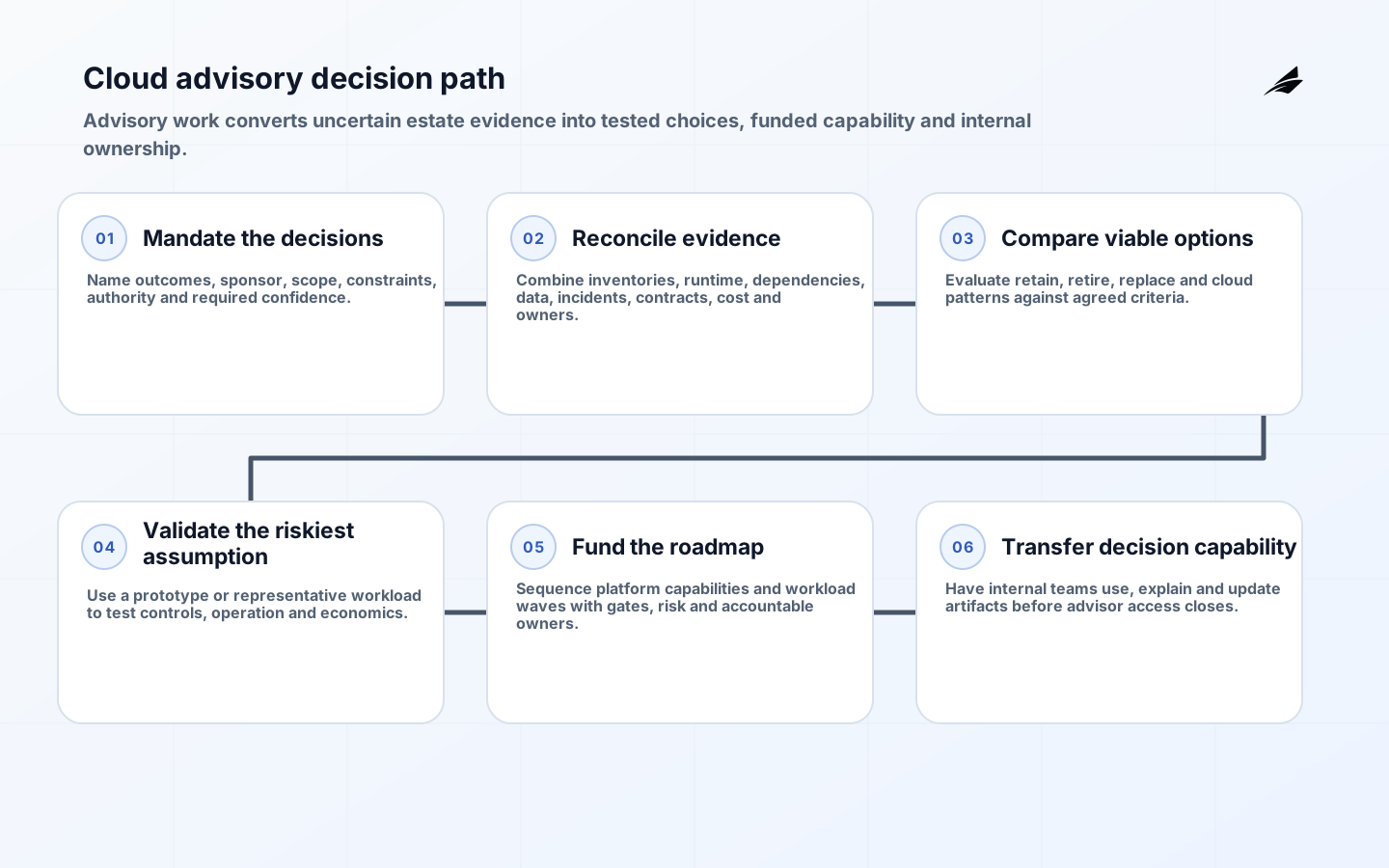
Follow a six-stage cloud advisory decision path
Sequence advisory work through mandate, evidence, options, representative validation, funded roadmap and handover. Gate the work at decisions, not presentation dates. In the mandate, establish sponsor and constraints. During evidence, reconcile facts and uncertainty. Compare options against agreed criteria. Validate the highest-risk assumption with a prototype or workload. Then fund capabilities and waves, and transfer artifacts through internal demonstration.

Keep a decision log that names question, alternatives, evidence, assumptions, approver and review trigger. Pair it with a risk register and benefits map. This prevents later teams from treating recommendations as timeless facts. Schedule architecture and security specialists at the point choices are reversible. The roadmap should identify dependencies such as identity, network, data governance, delivery automation, support and skill, not simply list application migration dates.
What should landing-zone advice include?
Define organization and account boundaries, identity, network, DNS, encryption and keys, secrets, policy, logging, vulnerability response, backup, billing, deployment and exception handling. CISA’s Cloud Security Technical Reference Architecture offers vendor-neutral architecture considerations. Translate applicable controls into platform capabilities and tests rather than pasting a framework catalog into a design.
A foundation must be consumable. Show how a product team obtains an environment, deploys code, gets access, observes a service, recovers data and attributes cost. Recommend a platform product owner and backlog. Design for multiple workload patterns without attempting to anticipate every future need. Make exceptions visible, approved and expiring. Estimate ongoing platform support and upgrades, not only initial build.
How should advisory work address security and resilience?
Use threat scenarios and the NIST Cybersecurity Framework to organize governance, assets, protection, detection, response and recovery. Map provider and customer responsibility by service. Prioritize administrative identity, public exposure, data movement, software delivery, telemetry and protected recovery. Identify regulatory and contract obligations, but route legal interpretations to qualified owners. Provider certification does not prove customer configuration.
Define service-level indicators, recovery objectives and decision authority. Recommend failure exercises for identity, region, data corruption, compromised administration and critical suppliers. Architecture diagrams should show recovery dependencies and degraded modes. Avoid promising resilience from multi-region labels alone. The advisory output should specify tests and acceptance evidence that delivery and operations can execute.
How should cloud cost and business value be modeled?
Build demand-based scenarios for compute, storage, operations, transfer, observability, security, support, licenses, migration overlap, people and retirement. Show range, sensitivity and confidence. Include change in engineering effort and service outcomes. Price calculators help estimate resources but cannot choose architecture or predict behavior. Compare alternatives over a common horizon and identify costs that remain on premises or in the organization.
The FinOps Framework treats technology value as collaboration among engineering, finance and business. Advisory recommendations should include allocation, budgets, forecasting, anomaly response, unit economics and commitment governance. Savings are not automatic. Verify optimization against reliability and product demand. State how benefits will be measured after consultants leave and who can alter spending decisions.
| Cost category | Common omission | Better evidence |
|---|---|---|
| Consumption | Average usage without peaks or growth | Demand profile and architecture scenario |
| Migration | Copy tools but not parallel operation | Wave duration and retirement dependency |
| People | Only provider fees | Platform, security, product and support capacity |
| Risk | No cost for outage or delayed recovery | Business impact and tested objectives |
| Exit | Assumed free portability | Formats, transfer volume, assistance and license terms |
When is advisory work ready for delivery?
A recommendation is delivery-ready when the accountable owner, scope, dependencies, architecture decisions, controls, acceptance tests, cost range, risks and next gate are clear. Validate a representative workload before scaling. Use small, releasable changes and automated evidence consistent with continuous delivery. Treat the roadmap as a product backlog that evolves from real workload feedback rather than a fixed migration promise.
Handover should have internal teams explain the decision model, run discovery updates, provision through the proposed foundation, evaluate a workload, review cost and execute a recovery scenario. Store artifacts in client systems. Close advisor access and record open risks. A steering presentation is useful communication; demonstrated internal use is stronger acceptance evidence.
Cloud advisory consulting takeaways
- Mandate decisions and outcomes, not a generic cloud strategy document.
- Reconcile technical discovery with business ownership and confidence.
- Disclose incentives and compare viable alternatives through agreed criteria.
- Validate the riskiest assumptions with a representative workload.
- Accept advisory outputs when internal teams can use and update them.
Frequently asked questions
How long does a cloud assessment take? Scope it by decisions, estate diversity and evidence quality; a focused assessment can be short, while a global portfolio needs staged discovery. Must the advisor also implement? No. Combined work can preserve context, but the client should retain independent acceptance. Is multi-cloud always safer? No; it can reduce some concentration while adding operational complexity.
Can cloud advisory guarantee savings? It can establish assumptions and controls, but actual cost depends on architecture, demand, pricing and behavior. What is the most useful deliverable? A traceable set of decisions and a roadmap delivery teams can execute. How should success be measured? By improved service outcomes, reduced uncertainty, faster safe decisions and demonstrated client capability.
Conclusion
Good cloud advisory work turns ambiguity into owned, testable decisions. It combines estate evidence, options, security, economics and operating design, then validates the riskiest assumptions before scale. The engagement has durable value when the client understands why choices were made, can revise them as evidence changes and can deliver without hidden consultant dependence.