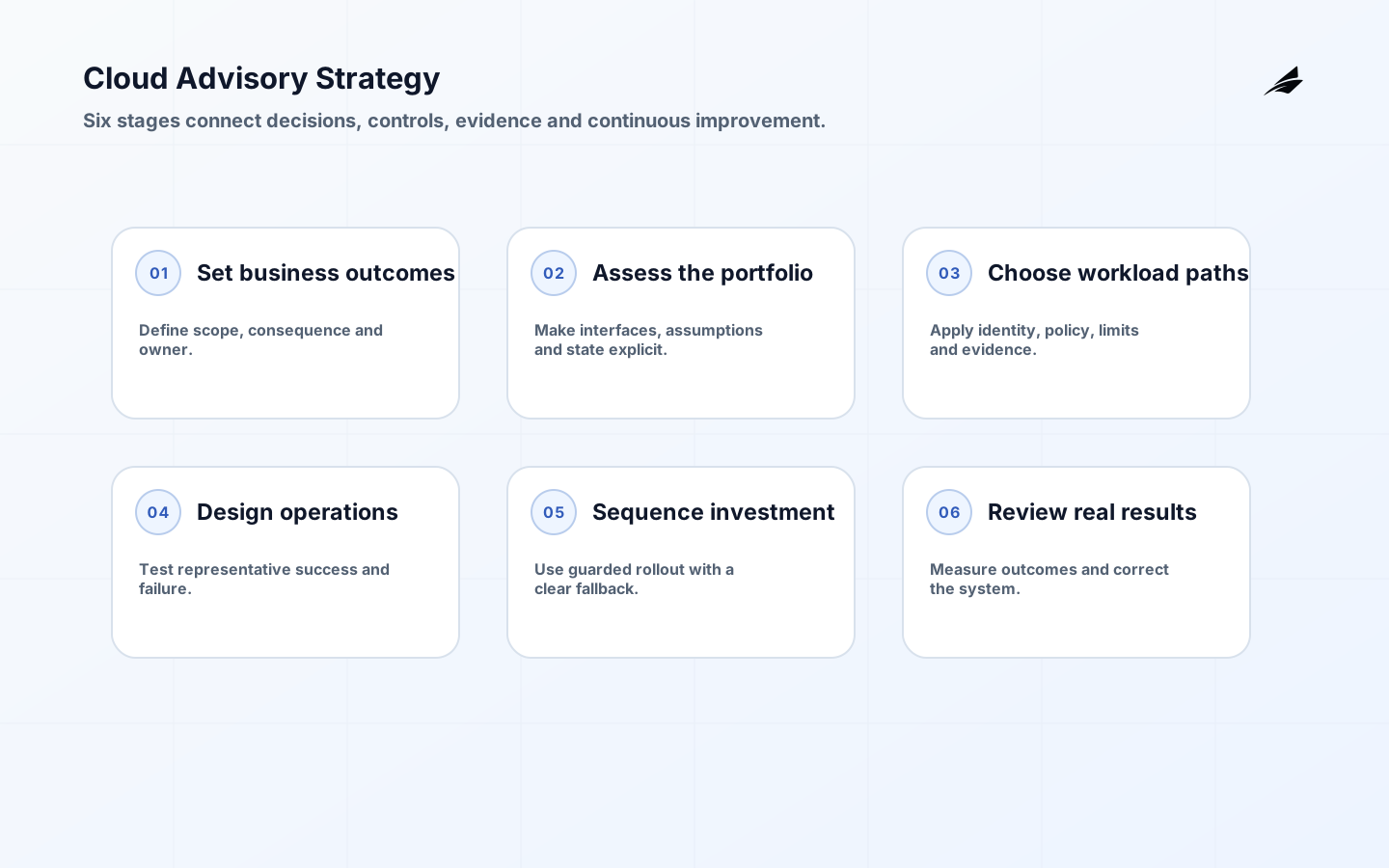
A cloud advisory strategy should help leaders decide where cloud services create value, which workloads should move or change, how teams will govern them and what capabilities must exist before scale. It is not a provider shopping list or a migration target expressed as a percentage. Good advice produces traceable decisions, an executable roadmap and an operating model the organization can sustain.
Use this FAQ alongside the cloud advisory strategy delivery plan, strategy implementation checklist, cloud advisory consulting guide and advisory consulting checklist. Treat each recommendation as a hypothesis with an owner, evidence and review date.
What a cloud advisory strategy should contain
Start with business priorities, constraints and service outcomes. The NIST cloud definition gives a stable baseline for cloud characteristics and service models, helping teams distinguish genuine on-demand measured services from ordinary hosted infrastructure. The strategy should cover portfolio segmentation, workload decisions, platform foundations, organization, security, resilience, financial management, sourcing, skills and execution governance.
Expected deliverables include decision principles, current-state evidence, target operating model, workload disposition criteria, landing-zone requirements, migration waves, capability roadmap, investment case, risk register and measures. Each artifact should name assumptions and data sources. A maturity score without evidence or action is weak advice; a short decision record that changes funding or architecture is more useful.
Translate business outcomes into cloud decisions
Define outcomes in operational terms: launch lead time, geographic reach, recovery capability, cost per transaction, data access, acquisition integration or retirement of unsupported technology. Microsoft’s current Cloud Adoption Framework strategy guidance starts with readiness, motivations, objectives, team and strategic considerations. Use comparable discipline across providers.
Avoid universal claims such as cloud always reduces cost or improves resilience. Outcomes depend on architecture, operating practice, commercial terms and demand. Establish a baseline and target with a measurement owner. If the outcome is faster product change, include environment setup, deployment and approval wait. If it is resilience, define the business service, tolerable impact and tested recovery rather than counting regions.
| Decision layer | Question | Required evidence |
|---|---|---|
| Business | Which measurable outcome justifies change? | Baseline, target, owner and time horizon |
| Portfolio | What disposition fits each workload? | Dependencies, lifecycle, risk, cost and demand |
| Platform | Which shared capabilities unblock teams safely? | Service catalog, standards and support model |
| Execution | Which waves create learning with bounded risk? | Readiness, sequencing, rollback and capacity |
Assess workload placement one workload at a time
Inventory applications, data, dependencies, owners, users, lifecycle, criticality, compliance, cost and change demand. Decide whether to retain, retire, replace, relocate, rehost, replatform or rearchitect, using terms the organization defines consistently. The FinOps workload placement capability connects placement and architecture choices to business value, performance, scalability and operational objectives.

Map hard dependencies before sequencing. A low-risk application may rely on a shared identity or database that is not ready. Evaluate data gravity, latency, licensing, specialized hardware, sovereignty, portability and staff capability. Use confidence ranges where inventory is incomplete. The roadmap should fund discovery for uncertain systems rather than presenting false precision.
Design the cloud operating model before migration scale
Clarify central platform, workload team, security, finance, architecture, service management and supplier responsibilities. A shared model often lets a platform team operate landing zones and guardrails while product teams own workload reliability and cost. The AWS Cloud Adoption Framework organizes capabilities across business, people, governance, platform, security and operations perspectives.
Specify services and decision rights: account vending, identity, connectivity, policy, pipelines, observability, backup, incident response, cost allocation and exceptions. Define support hours and escalation. Do not call a committee an operating model; show how a product team obtains an environment, deploys, requests an exception, responds to an incident and retires a workload.
Make security and resilience architectural inputs
Use resource-focused access, strong workload identity, least privilege, centralized policy and verified telemetry. NIST zero trust guidance makes clear that network location or asset ownership alone should not grant trust. Map cloud shared responsibility to each service and add any managed provider as a separate operator with named evidence and authority.
Tie resilience to important business services and dependency maps. Choose availability and recovery patterns from impact, not prestige. Test backup restore, regional or provider impairment, identity outage, quota exhaustion and loss of a critical third party. Multicloud is not automatically resilient if both implementations share control planes, teams, data pipelines or an untested failover process.
| Advisor output | Acceptance test | Weak substitute |
|---|---|---|
| Workload decision model | Two independent teams reach explainable results | Unweighted maturity heat map |
| Operating model | A real environment and exception journey can be traced | Organization chart alone |
| Investment case | Assumptions, ranges and unit drivers are editable | Single savings percentage |
| Roadmap | Capabilities, workloads, owners and dependencies align | Date-only migration list |
Integrate financial accountability with engineering
The current FinOps Framework treats FinOps as an operational framework and cultural practice for maximizing technology value through engineering, finance and business collaboration. Establish allocation, forecasting, anomaly response, unit economics and commitment governance. Cost dashboards without owners and decisions do not form a practice.
Model migration and steady-state cost, including parallel run, data transfer, support, observability, security tooling, licenses, people and exit. Compare options against demand uncertainty. Set cost ownership at product and platform levels, and define when architecture review considers cost. Optimization should not undermine resilience, delivery or customer outcome; record the tradeoff.
Evaluate advisor independence and usable deliverables
Ask how the advisor handles provider incentives, subcontractors and recommendations that lead to later delivery work. Require access to working papers, assumptions and models. Interview the people who will perform discovery. The Google Cloud Adoption Framework is a useful primary provider perspective, but an advisor should synthesize multiple frameworks against your context rather than copying one.
Acceptance criteria should test decisions: can executives prioritize investments, can teams place a new workload, can finance forecast a wave, and can platform owners sequence capabilities? Transfer models and methods, not only slides. Schedule reviews after the first migration waves so actual cost, lead time, incidents and adoption update the strategy.
Example: sequence an order platform modernization
An order platform supports revenue, warehouse integration and customer service. The strategy team maps transaction peaks, recovery objectives, database dependencies, release pain, licensing and support expiry. It compares retaining, replatforming and staged rearchitecture against outcomes. Rather than moving the whole stack, the first wave establishes the platform foundation and extracts a low-coupling notification capability.
- Baseline order volume, release lead time, incidents and full operating cost.
- Map identity, payment, warehouse, reporting and customer-service dependencies.
- Define non-negotiable data, recovery and audit requirements.
- Estimate each option with uncertainty and parallel-run cost.
- Pilot one reversible component to test platform and team readiness.
- Update later waves from observed lead time, cost and reliability.
The decision record explains why full rehosting was rejected, which assumptions may change and who reviews them. The platform roadmap funds identity, connectivity, deployment, observability and recovery before high-criticality migration. Finance tracks cost per order and temporary duplication. This is advisory value: a defensible sequence tied to business evidence, not a generic cloud destination.
Operate the capability as a managed system
A strategy should include transition governance for the period when old and new operating models coexist. Define who can approve migration, modernization scope, temporary risk and retirement; how duplicated monitoring and incident response work; and when legacy support can be removed. Maintain one dependency and wave view across business, platform and suppliers. After each wave, compare planned and observed cost, lead time, defects, outage, skills and user outcome. Adjust estimates and sequencing openly instead of protecting the original business case. Track decisions that are reversible, costly to reverse or effectively irreversible because of data gravity and contracts. This makes uncertainty manageable and gives leadership meaningful points to pause or redirect investment.
Review evidence before expanding scope
Before expanding cloud advisory strategy, the accountable owner should review representative outcomes, exceptions, access, changes, operating cost, user feedback and recovery evidence. Confirm that metrics still reflect the intended business result, that known limitations are visible to users and that suppliers have not changed material behavior without evaluation. Exercise one realistic failure and reconcile the resulting records. Record the decision to scale, narrow, correct or retire the capability, including assumptions and a review date. This review keeps implementation evidence connected to authority and prevents a successful pilot from becoming an unmanaged dependency.
Key takeaways
- Anchor cloud strategy in measurable service and business outcomes.
- Make workload placement decisions from lifecycle, dependency, risk, economics and change demand.
- Design platform services, responsibilities and support before scaling migrations.
- Integrate security, resilience and FinOps into architecture and funding decisions.
- Accept advisory work only when teams can use and update its models.
Frequently asked questions
Is cloud-first a useful strategy?
It can be a decision preference, but it is not a workload answer. Define when cloud characteristics are valuable and which constraints can override the preference. Require each placement decision to show outcome, risk, cost and reversibility. A slogan should not replace portfolio evidence.
Should an advisor choose one cloud provider?
Only when business, technical, regulatory and commercial evidence supports that choice. A primary provider can reduce complexity, while another platform may fit a specific workload. Evaluate identity, data, skills, operations, contracts and exit. Avoid multicloud by default and lock-in fear without a credible switching scenario.
How often should cloud strategy be reviewed?
Review quarterly during active transformation and after major migrations, incidents, acquisitions or provider changes. Update workload data, assumptions, cost and capability progress. A full rewrite is rarely necessary; maintain decision records and a living roadmap so evidence changes the relevant part.
Conclusion
Cloud advisory strategy is valuable when it converts broad ambition into workload decisions, platform capabilities, responsibilities and investment choices that survive scrutiny. Build the roadmap from outcomes and dependencies, make economics and risk explicit, and update it from delivery evidence. The strategy should become easier to operate with each wave, not more dependent on its original authors.