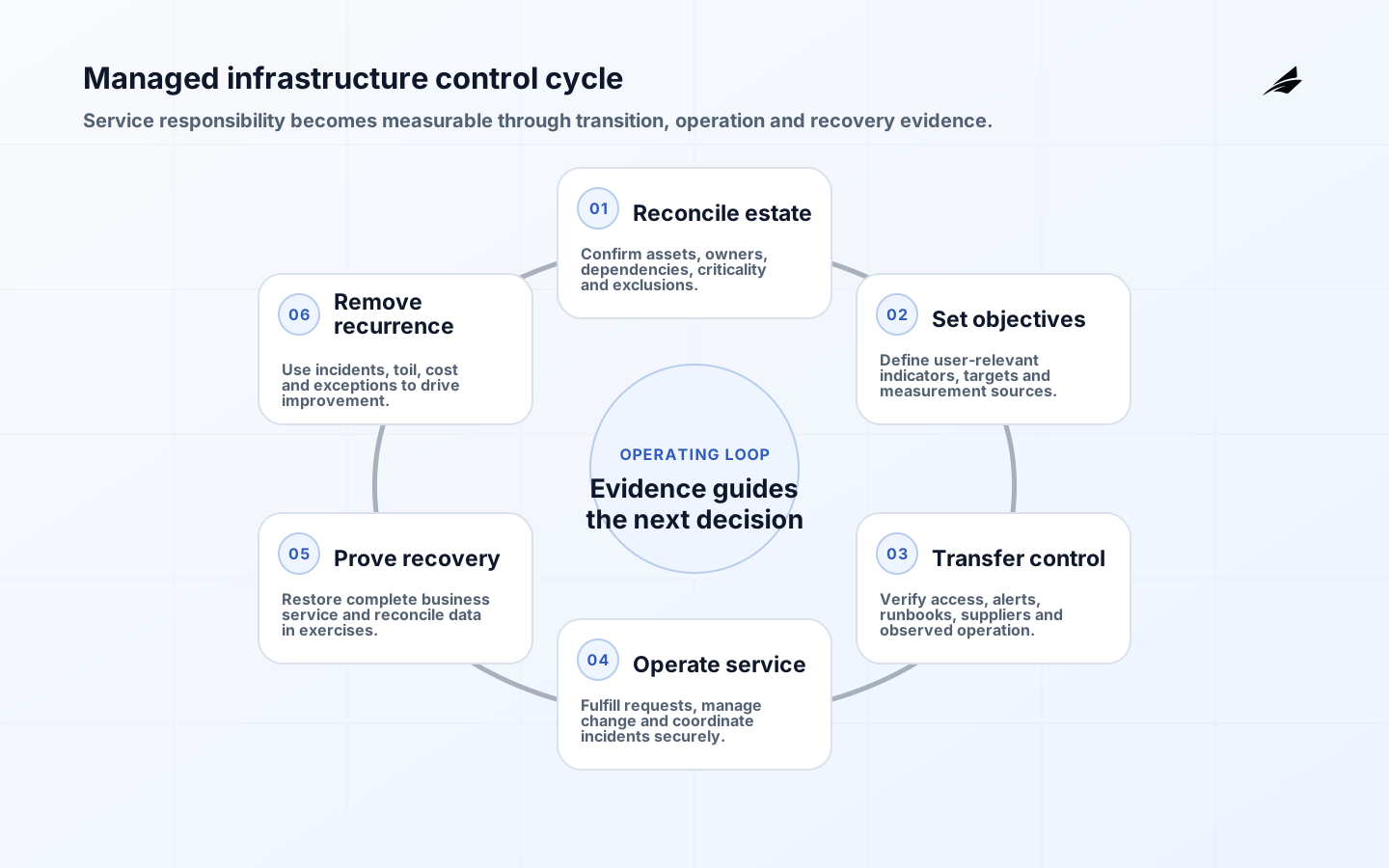
Infrastructure services offerings range from monitoring a defined server estate to operating cloud platforms, networks, identity foundations, databases, endpoints and recovery. The phrase alone does not reveal who approves changes, patches operating systems, pays consumption, restores data or responds at 3 a.m. A useful comparison converts a service catalog into explicit responsibilities, measurable user outcomes and evidence that the provider can take over without losing control.
This FAQ is for technology, procurement, security and finance leaders comparing internal, co-managed and outsourced operation. Use the infrastructure services delivery plan to frame the engagement and the infrastructure services implementation checklist for transition acceptance. Teams adding analytics or automation can compare the cognitive infrastructure services plan.
What should an infrastructure service include?
A service should name the assets, environments, locations, hours, activities, dependencies and exclusions. Inventory covers more than compute instances: include accounts, subscriptions, network routes, certificates, domains, backup stores, monitoring, automation, licenses, support contracts and privileged identities. Classify each workload by business owner, criticality, data sensitivity, recovery need and lifecycle state. Unknown or ownerless assets should enter a discovery queue, not silently become accepted service scope.
| Service tower | Typical included work | Common hidden boundary |
|---|---|---|
| Cloud platform | Accounts, landing zones, policy, network and observability | Application configuration and data correctness |
| Compute and OS | Provisioning, hardening, patching and capacity | Unsupported software or custom agents |
| Database | Engine operation, backup, replication and tuning | Schema, query design and data ownership |
| Network | Connectivity, DNS, firewall and traffic visibility | Carrier last mile and application protocol defects |
| Recovery | Backups, runbooks, exercises and coordination | Business validation after technical restore |
NIST distinguishes software, platform and infrastructure service models partly by what the customer manages. The same discipline applies to a managed service layered over them. Build a responsibility matrix for normal operation, request fulfillment, change, incident, vulnerability, continuity, supplier escalation and decommissioning. Give each row one accountable party, named contributors and a required record. Shared responsibility without task-level clarity becomes disputed responsibility during failure.
How should SLAs and SLOs be written?
Start from a user journey and service-level indicator, not a provider's convenient device metric. Google SRE defines an SLI as a quantitative measure, an SLO as a target for it, and an SLA as an agreement with consequences. An application can be unavailable while every server reports healthy, so infrastructure objectives need to connect component behavior to the service dependency they support. State the population, measurement point, window, exclusions, data source and response when the target is threatened.
| Objective | Useful definition | Avoid |
|---|---|---|
| Availability | Successful eligible requests over all eligible requests | Server ping without user-path coverage |
| Latency | Percentile from a relevant client or boundary | Monthly average that hides the tail |
| Incident response | Time from qualified detection to owned action | Time from ticket creation when detection is delayed |
| Recovery | Restore service and verified data within approved targets | Backup job success alone |
| Request fulfillment | Elapsed business time by request class | One target for access, capacity and architecture changes |
Keep a small number of meaningful objectives and supporting operational indicators. Penalties can create accountability but do not compensate for business disruption; governance should focus on prevention, transparency and improvement. Define maintenance handling, customer-caused delay and force majeure narrowly. Require raw measurement access or agreed reports so both parties can reproduce the calculation.
What proves a safe service transition?
Transition is a controlled transfer of knowledge, access and decision authority. Begin with discovery from configuration sources, billing, network observations and interviews, then reconcile discrepancies. Record known incidents, technical debt, unsupported components and expiring contracts. A provider cannot responsibly commit to outcomes for an estate that neither party can describe. Baseline performance and ticket demand before changing tooling, or later improvements cannot be distinguished from changed measurement.

- Approve the service inventory, owners, criticality, dependencies and explicit exclusions.
- Verify privileged access through individual identities, controlled elevation and emergency procedures.
- Import monitoring and demonstrate that alerts reach the correct on-call role with usable context.
- Shadow operations, then let the incoming team lead while the outgoing team observes.
- Run representative request, incident, patch, restore and supplier-escalation scenarios.
- Accept transition only when evidence gaps have owners, dates and commercial treatment.
Do not transfer shared administrator accounts or undocumented scripts as permanent solutions. Rotate credentials at the agreed point, protect automation in version control, and capture architecture decisions and exception expiry. Plan reverse transition at entry: data exports, configuration formats, tool licenses, knowledge ownership, credential revocation and assistance rates should already be in the contract.
Who owns security in a managed model?
The customer remains accountable for business risk and legal obligations even when tasks are delegated. The provider should operate agreed controls and supply evidence. Define identity federation, privileged access, separation of duties, logging, vulnerability triage, patch windows, configuration baselines, encryption, security monitoring, incident notification and subcontractor access. CISA's cloud reference architecture highlights shared services, cloud security posture and migration considerations that can inform the control design.
| Security event | Provider duty | Customer duty |
|---|---|---|
| Critical vulnerability | Identify affected assets, mitigate and report status | Approve risk exception or outage where required |
| Suspicious privileged access | Contain account, preserve evidence and notify | Coordinate identity, legal and business response |
| Configuration drift | Detect, classify and restore approved state | Own baseline and exception decision |
| Data exposure | Stop exposure and support investigation | Assess affected data, obligations and communication |
| Supplier incident | Invoke supplier process and provide updates | Decide business continuity and regulatory action |
Security reports need asset and control coverage, not only ticket totals. Track critical exposure age, privileged-access review, logging gaps, unsupported assets, baseline drift, incident notification performance and remediation recurrence. Confirm where logs and evidence reside and how the customer receives them during a dispute or provider outage.
How is resilience different from backup?
Backup is one input to recovery. Resilience also depends on architecture, dependencies, people, communication, clean access, documented priorities and validation. Set recovery time and recovery point objectives from business impact, then map the technical sequence. A database restored before identity or DNS may not return the service. NIST describes contingency planning as coordinated plans, procedures and technical measures for recovering systems, operations and data after disruption.
Exercise realistic loss: deleted data, unavailable region, compromised credentials, failed network provider or ransomware suspicion. Measure from declaration to business-verified service, including reconciliation of transactions that arrived during recovery. Record actual recovery point, manual steps and decisions. Close exercise findings through the same governance as incidents; a repeatedly untested runbook is only a claim.
How should cost and commercials work?
Separate provider service fees, cloud or hardware consumption, licenses, projects, out-of-hours work and pass-through support. A fixed fee offers predictability only when volume bands and assumptions are clear. Per-ticket pricing can reward ticket creation; percentage-of-cloud-spend pricing can conflict with optimization. Choose units that reflect work and value, then require transparent rate cards for exceptional activity.
The FinOps Framework emphasizes collaboration and financial accountability for technology value. Keep consumption data accessible to engineering, finance and product owners. Allocate costs by product or business scope, forecast material changes, and agree who can purchase commitments or resize services. Savings should be validated against performance and risk; deleting unused resources is valuable, while reducing recovery copies below policy is not optimization.
What should improve after takeover?
Stabilization is not the end state. Use incident themes, manual effort, repeat requests, cost anomalies, security exceptions and recovery findings to create an improvement backlog. Prioritize by avoided customer impact and toil, with an owner and expected measure. Automation should standardize a understood process; automating an ambiguous approval path makes mistakes faster.
Run monthly service reviews around outcomes, risks, finances and decisions rather than slide volume. Quarterly reviews can revisit architecture, lifecycle and supplier strategy. Ask which alerts were removed, which recurring incidents were eliminated, which unsupported assets were retired and which recovery gaps were closed. Contractual improvement credits or shared savings can help, but ownership and accessible engineering capacity matter more.
Maintain a service decision log alongside the improvement backlog. It should capture accepted risk, architecture exceptions, objective changes and major cost commitments with owners and review dates. This history helps new operators understand why the estate differs from the standard and prevents expired temporary arrangements from becoming invisible permanent scope.
Key takeaways
- Convert a service catalog into asset, activity and decision-level responsibility.
- Measure user-relevant service behavior with reproducible SLIs and SLOs.
- Accept transition through observed operation and recovery evidence, not document delivery alone.
- Retain customer accountability while assigning provider security tasks and evidence precisely.
- Use visible unit cost and an improvement backlog to prevent managed stagnation.
Frequently asked questions
Is a managed service provider responsible for application incidents?
Only as defined. Infrastructure teams may detect, triage and restore dependencies while application teams fix code or data. Define joint incident command, diagnostic access and escalation so ownership boundaries do not delay service restoration.
Does every service need 24/7 support?
No. Coverage should follow business impact and recovery objectives. Some services need around-the-clock response; others can queue until business hours. Dependencies of a critical service may require higher coverage than their direct users suggest.
What is a reasonable availability SLA?
Derive it from user need, architecture and cost. Each additional nine can require substantial redundancy and operating discipline. Define exactly what is measured and pair availability with latency, correctness and recovery.
When should exit planning begin?
Before contract signature. Agree asset and configuration exports, documentation rights, credential transfer, knowledge assistance, subcontractor dependencies and deletion evidence. Exercise selected export and rebuild steps during the term.
Conclusion
A strong infrastructure service is an accountable operating system for technology, not a bundle of monitoring and tickets. Precise scope, outcome-based objectives, controlled transition, joined security, recovery proof and transparent economics make service claims testable. The right offering leaves the estate more understood, resilient and improvable each quarter.