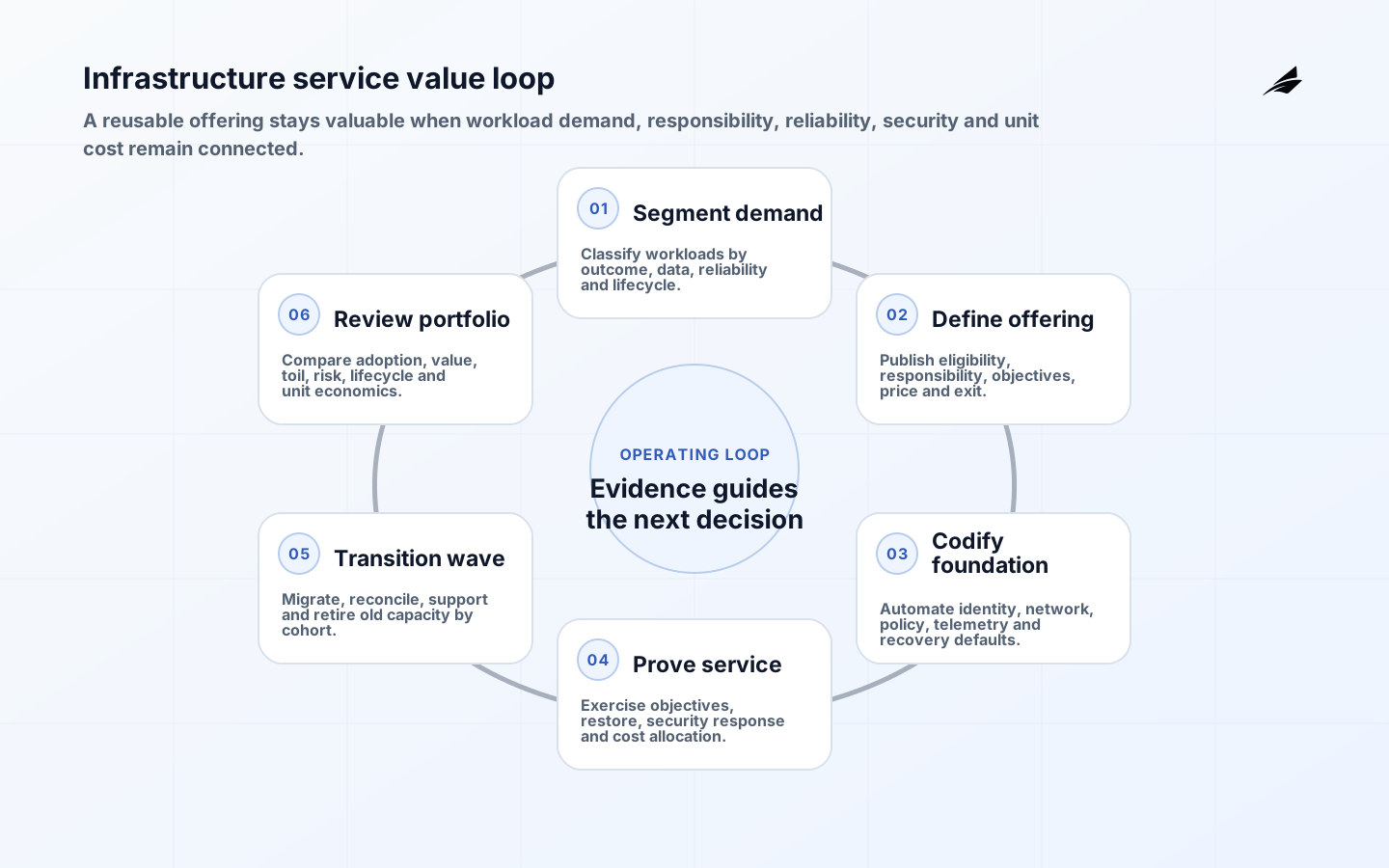
Infrastructure services offerings provide reusable capabilities for hosting, connectivity, identity, storage, databases, backup, observability, security and operations. Buyers often compare lists of technologies, but value depends on the operating contract around them: who provisions, patches, monitors, restores, pays, approves risk and supports an application at 2 a.m. A service catalog without workload outcomes and responsibility boundaries leaves each team to rediscover those answers during an incident.
This guide explains how to scope and govern infrastructure services offerings across cloud, data center and hybrid estates. It complements the infrastructure implementation checklist, the infrastructure offerings FAQ and the infrastructure services delivery plan. The objective is a usable service system, not a procurement taxonomy.
Segment demand before selecting offerings
Inventory workloads by business criticality, user location, data class, latency, availability, recovery, regulatory scope, lifecycle and change rate. Include batch, integration, development, analytics, end-user and operational-technology patterns. Group workloads with similar needs into a small set of placement and support profiles. NIST SP 800-145 distinguishes cloud through essential characteristics and service and deployment models; use those characteristics to test whether a proposed offering actually provides the expected elasticity, pooling and measured use.
For each profile define the consumer outcome, eligibility, standard architecture, included operations, options, exclusions, lead time, service objectives, price basis and exit route. Keep experimental and production paths distinct without making experimentation ungoverned. Identify workloads that should retire or become software as a service rather than being migrated unchanged. The cheapest infrastructure migration is often the one avoided through portfolio decisions.
| Offering | Best fit | Provider responsibility | Consumer responsibility |
|---|---|---|---|
| Managed virtual compute | Legacy or specialized workloads needing OS control | Facility, hardware, virtualization and agreed platform operations | Application, data classification and nonstandard configuration |
| Managed container platform | Portable services with engineering ownership | Cluster, control plane, baseline policy and observability | Images, workload limits, deployment and service reliability |
| Managed database | Supported engines with standard resilience needs | Engine maintenance, backup mechanism and platform availability | Schema, query behavior, access and restore objectives |
| Edge or site infrastructure | Local latency, autonomy or equipment integration | Fleet tooling, approved hardware and lifecycle process | Site access, local dependencies and workload behavior |
Write the shared-responsibility model at task level
Map responsibilities for architecture, provisioning, identity, network, hardening, patching, vulnerability treatment, backup, restore, monitoring, incident response, capacity, certificates, keys, cost allocation, supplier escalation and retirement. Assign one accountable owner and explicit contributors for each. Generic labels such as managed platform conceal important boundaries: a provider may create backups while the consumer defines retention and verifies application-consistent restoration.
Turn the model into catalog controls and operational runbooks. Make exceptions time-bound with risk owner, compensating control and expiry. Define handoffs among service desk, platform, security, application and vendor teams using case states and escalation clocks. During incidents, one service owner must coordinate customer communication and restoration even when several suppliers contribute. Contractual responsibility does not remove the buyer's duty to understand service risk.
Build secure, automated service foundations
Provision accounts, subscriptions, networks, identity, logging, keys and baseline policy through reviewed templates. Separate production, non-production and management planes. Prefer workload identity and short-lived access to shared credentials. Centralize guardrails that are broadly valid, while allowing documented workload-specific controls. CISA's Cloud Security Technical Reference Architecture discusses shared services, secure cloud migration, posture management, DevSecOps and zero trust as connected design concerns.
Create a paved path for common workloads: repository template, pipeline, artifact controls, infrastructure code, secrets integration, telemetry, cost metadata and recovery defaults. Version the path and give consumers migration notice. Test policy changes and platform upgrades against representative workloads before broad rollout. Maintain a break-glass procedure, but log and review every use. Automation should make the approved state easy and detect drift, not hide a brittle central script.
Define service levels from business journeys
Start with user and business tolerance, then allocate availability, latency, recovery and support objectives across dependencies. Distinguish service-level indicators, objectives and contractual agreements. State measurement point, window, exclusions, maintenance treatment and consequence. A provider's regional uptime does not equal application availability if identity, network, DNS or deployment are outside the measure. Define data recovery point and time separately, and specify how restoration is proven.
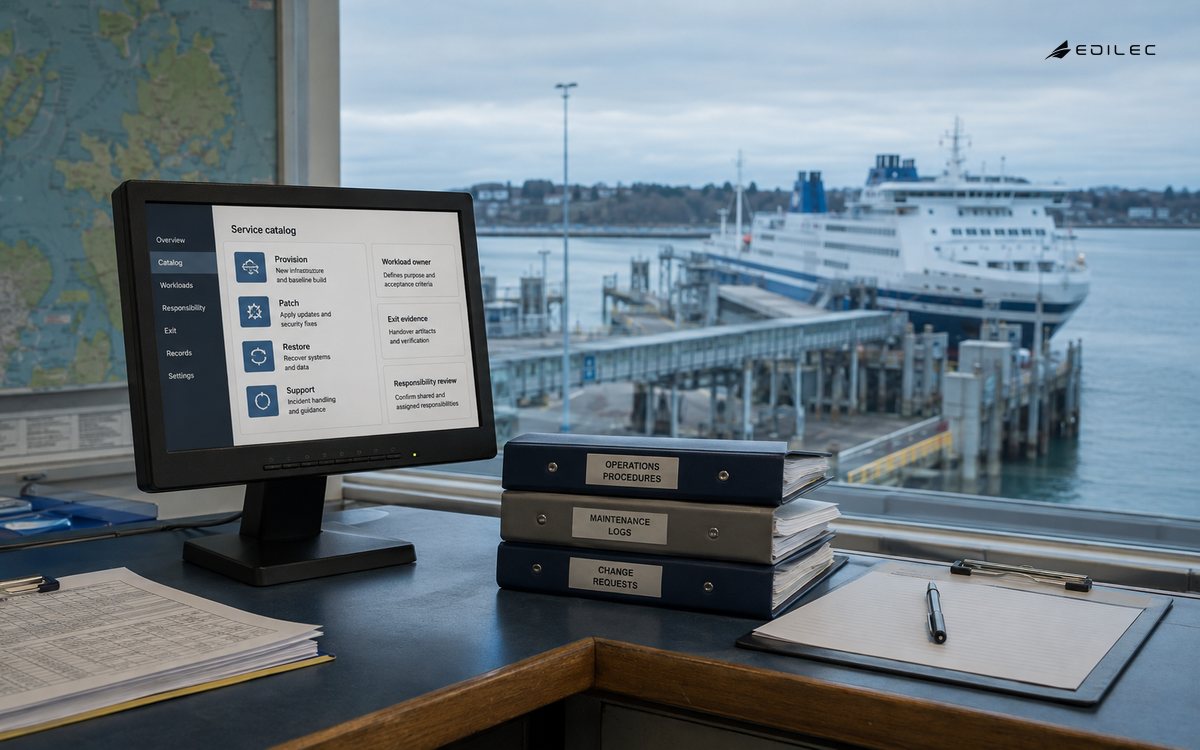
Use traces, metrics and logs with consistent resource identity so operators can connect user symptoms to platform and application dependencies. OpenTelemetry provides a vendor-neutral observability framework, but teams still need sampling, retention, access and alert ownership. Alert on actionable risk to objectives, not every infrastructure state change. Provide service health and planned-change communication that consumers can integrate into their own response.
| Control objective | Design evidence | Operational evidence | Review trigger |
|---|---|---|---|
| Identity and access | Role model, workload identity and emergency path | Privilege changes, denied access and break-glass review | Organization, platform or threat change |
| Resilience | Dependency map, recovery objectives and failure modes | Restore and failover results with data reconciliation | Material architecture or workload change |
| Vulnerability management | Asset ownership and remediation policy | Age by severity, exposure and exception | New exploit or support-status change |
| Lifecycle | Version, capacity and retirement policy | Upgrade adoption, unsupported assets and disposal proof | Vendor notice or forecast threshold |
Compare cost through transparent units and scenarios
Model compute, storage, network transfer, licenses, support, observability, security tooling, facilities, migration, people and retained organization costs. Include steady, peak, growth, failure, restore and exit scenarios. Separate fixed commitment from variable consumption and identify currency or index exposure. Compare equivalent responsibility and service level; a low infrastructure price may shift patching, integration and incident work back to product teams.
The FinOps Framework emphasizes collaboration among engineering, finance and business teams, accessible cost data and ownership of technology use. Allocate costs with stable account and metadata rules. Give service owners unit measures such as cost per environment, transaction, protected terabyte or active site. Forecast with demand owners, investigate anomalies and review commitments after architecture changes. Cost control should improve value and remove waste, not force risky under-capacity.
Transition in waves with service acceptance gates
Prove the operating model with representative low-to-medium-risk workloads before moving critical services. For each wave, confirm inventory, target design, connectivity, identity, data movement, monitoring, recovery, support, cost and rollback. Rehearse migration and measure outage and reconciliation. Avoid declaring migration complete while monitoring, backup, vulnerability or ownership remains temporary. Decommission old capacity only after retention, dependency and financial checks.
Use a hypercare period with named platform and application owners. Watch user outcomes, incidents, performance, security findings, cost anomalies and support demand. Convert recurring exceptions into platform improvements or explicit catalog exclusions. Review the service portfolio quarterly: adoption, objective attainment, unit cost, toil, risk, consumer satisfaction and lifecycle. Retire offerings that duplicate capability or cannot be operated to their promise.
Example: launch a managed container offering
Define eligible workloads, supported runtime features, network patterns, availability tiers and data restrictions. The platform team owns cluster lifecycle, baseline policy, ingress, identity integration and telemetry export. Product teams own images, resource requests, deployment, application objectives and runbooks. Provide templates with signed artifacts, namespace policy, secrets, probes, budgets and cost labels. Publish upgrade windows and a compatibility test environment.
Pilot a stateless API, a scheduled worker and a service with a managed database dependency. Exercise node loss, region impairment, certificate renewal, bad deployment, exhausted quota and control-plane unavailability. Restore application state, verify alerts and run joint incident response. Measure onboarding time, change failure, recovery, support effort and unit cost. Expand only after consumers can operate their part without hidden platform intervention.
Key takeaways
- Segment workloads and define offerings through consumer outcomes and constraints.
- Describe shared responsibility at the operational task level.
- Codify secure foundations and provide a versioned paved path for common workloads.
- Measure objectives across the full dependency chain and prove restoration.
- Compare full lifecycle cost, retained work, variable demand and exit scenarios.
Frequently asked questions
What does managed infrastructure normally include?
There is no universal package. It may include monitoring, patching, backup, incident response and lifecycle work, but scope and authority vary. Require a task-level responsibility matrix, service objectives, exclusions and evidence before comparing providers.
Should every offering be multi-cloud?
No. Multi-cloud can address specific resilience, regulatory or commercial needs, but duplicates skills, controls and integration. Decide per workload and test whether portability or recovery is real. Standard interfaces and exit readiness can reduce concentration risk without active deployment everywhere.
Is a provider SLA enough for critical workloads?
Usually not. The application depends on components and responsibilities beyond the provider measure. Build end-to-end objectives, dependency budgets, recovery procedures and tested incident coordination. A service credit does not restore a customer journey.
Provider selection should include an operational proof, not only a written response. Provision a representative workload, integrate identity and telemetry, execute a change, trigger an alert, restore data and export configuration and cost records. Ask the proposed service team to lead incident and escalation steps. Score the timeliness and usability of evidence, including subcontractor boundaries. This exercise exposes manual dependencies, unclear ownership and commercial assumptions before they become production constraints.
Maintain consumer documentation as tested product content. A service page should state eligibility, request path, architecture, responsibilities, limits, objectives, price, support and retirement status. Validate examples whenever templates change and collect onboarding failures as backlog. Give consumers a visible roadmap and deprecation notice. Platform adoption grows when teams can predict behavior and obtain help, not when use is mandated without a dependable service experience.
Publish capacity and quota policy with the offering. Consumers need lead times, burst behavior, regional constraints and escalation before demand arrives. Forecast shared bottlenecks and reserve critical headroom. Test quota exhaustion so rejection is visible and recoverable rather than surfacing as an unexplained application failure.
Conclusion
Infrastructure becomes a service when consumers receive a clear outcome, operating boundary, evidence and price. A small, automated catalog with measurable reliability, security, recovery and unit economics gives product teams a dependable foundation and gives leadership a portfolio it can govern.