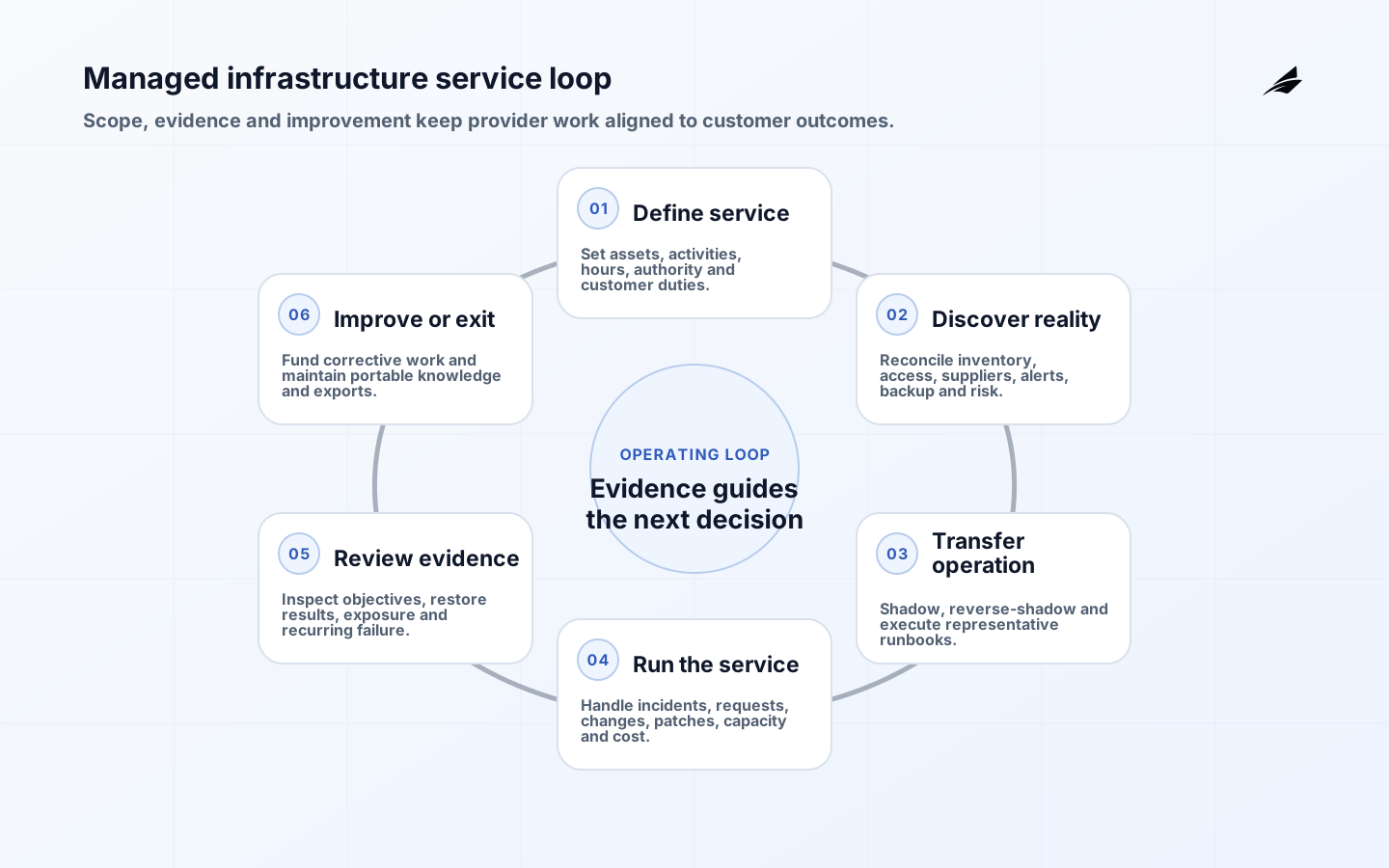
Managed IT infrastructure services place defined operational work under a continuing service relationship: monitoring, incidents, requests, changes, patching, backup, capacity, cloud administration or some combination of them. They do not transfer every technology risk to a supplier. A useful agreement identifies which assets are covered, what the provider can change, when people are available, how evidence is produced and what the customer must still decide.
This managed IT infrastructure services FAQ is for technology leaders comparing providers or repairing an ambiguous contract. Use the scope, cost and delivery guide to frame procurement and the managed infrastructure implementation checklist to run transition. Teams adding automation or AI operations should also examine the cognitive infrastructure FAQ before extending the service boundary.
What should managed infrastructure services include?
Scope should be expressed as asset classes and activities, not a product brochure. List cloud accounts, networks, servers, platforms, backup systems, identity components, endpoints and sites. For each, mark monitoring, administration, patching, vulnerability remediation, backup, restore, incident response, request fulfilment, capacity, licensing and lifecycle ownership. State support hours and geography. An asset can be monitored around the clock while changes are performed only in a regional business window; both facts belong in the service definition.
Build a responsibility matrix at task level. The AWS shared-responsibility model illustrates why this matters in cloud: provider and customer duties change with the service selected. A managed partner adds another operating party but does not erase customer accountability. Specify who approves privileged access, accepts vulnerabilities, declares a disaster, contacts regulators, authorizes spend and owns application behavior. Include suppliers that the provider coordinates but cannot control.
| Service component | Provider duty to define | Customer duty to retain |
|---|---|---|
| Monitoring | Sources, coverage, thresholds, triage and escalation | Business impact, priority and acceptable noise |
| Patching | Asset eligibility, test route, schedule and rollback | Application validation and exception approval |
| Backup | Jobs, retention, encryption, alerting and restore execution | RPO/RTO, legal retention and restored-data acceptance |
| Identity | Provisioning workflow, privileged tooling and review reports | Joiner/mover/leaver authority and access approval |
| Incidents | Detection, coordination, evidence and communication cadence | Severity, business decisions, legal and customer communication |
| Cost | Usage reports, anomalies and optimization actions | Budget, product priority and trade-off approval |
How does a safe service transition work?
Transition begins with discovery, not immediate control. Reconcile inventories from configuration systems, cloud APIs, network tools, contracts and interviews. Identify unsupported assets, shared credentials, unknown owners, broken alerts, failed backups and undocumented dependencies. Classify each gap as a launch blocker, a time-bound remediation or an accepted exclusion. Baseline availability, incident volume, patch state, restore results and run cost so later improvements can be demonstrated rather than asserted.
Run a period of shadow and reverse-shadow support. First, the provider observes customer staff resolving real work and updates runbooks. Then the provider leads while customer specialists watch. Test access, escalation and supplier contacts outside normal hours. Transfer knowledge through executed procedures: recover a service, rotate a credential, renew a certificate, replace a failed node and process an emergency change. Formal acceptance should list open risks and the owner of every deferred item.
How should SLAs and service objectives be designed?
An SLA should measure an outcome the provider influences and the customer values. Response time is useful, but it does not prove restoration or prevention. Define the clock start, pause conditions, service hours, severity authority, exclusions and data source. Pair response and restore targets with availability, change success, backup recovery, patch or vulnerability exposure, request ageing and user-facing service objectives. Avoid averages that conceal a few severe failures; report distributions and breached cases.
Use error budgets or equivalent tolerance where product teams can act on them. A service objective is not automatically a contractual penalty. It can be an operating signal that changes release pace, resilience work or capacity. Review targets when the business process changes. Credits may create commercial accountability, but they rarely repay operational damage. Strong governance focuses on corrective work, recurrence and evidence that a weak control has improved.
| Measure | Definition detail | Useful review question |
|---|---|---|
| Acknowledgement | Time from qualified alert or request to assigned response | Was the right resolver engaged? |
| Restoration | Time until agreed service is usable, excluding approved pauses | Did workaround quality meet the need? |
| Change failure | Changes causing rollback, incident or corrective work | Which change classes need better tests? |
| Restore success | Representative restores accepted within RTO/RPO | Can users actually use recovered data? |
| Patch exposure | Time critical assets remain beyond approved remediation windows | Are exceptions current and controlled? |
| Cost allocation | Spend assigned to an accountable service or owner | Can owners explain usage and anomalies? |
Who handles security, logs and incidents?
Security duties need their own schedule. The NIST Cybersecurity Framework 2.0 gives a common outcome vocabulary across govern, identify, protect, detect, respond and recover. Map provider work to those outcomes and name customer control owners. Require attributable privileged access, strong authentication, separation of duties, managed secrets, vulnerability workflows, configuration baselines, evidence retention and subcontractor controls. Make policy exceptions visible to both service and risk governance.
Logging is a service, not merely storage. NIST SP 800-92 covers enterprise log infrastructure and robust log-management processes. Define required sources, timestamp quality, transport, parsing, retention, access, integrity and alert use cases. Test that high-value events arrive and can be correlated. During an incident, preserve original evidence and record decisions. NIST SP 800-61 Rev. 3 embeds response in risk management; the contract should therefore cover preparation and improvement as well as emergency activity.
Does managed backup guarantee recovery?
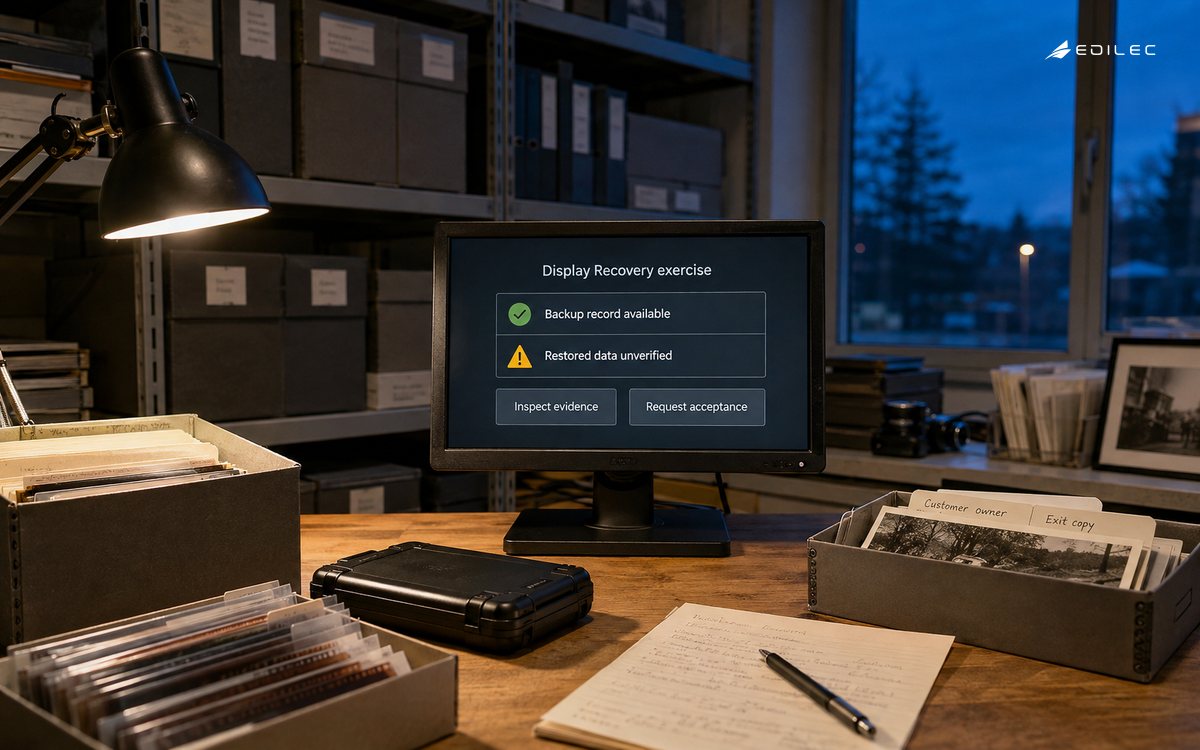
No. A successful backup job shows that a tool wrote data somewhere; it does not prove completeness, application consistency, key availability or usable recovery. Define recovery point and recovery time objectives from business impact. Inventory application data, configuration, identity dependencies, certificates, infrastructure code and external services needed to restore. Keep protected copies isolated from the credentials and failure modes that affect production. Test restores at representative scale and record the measured result.
The NIST contingency-planning guide links business impact analysis, recovery strategy, plan development, testing and maintenance. Apply that discipline to managed services. Specify who declares recovery, which environment is used, how data is validated, who communicates status and when failback occurs. Exercise provider unavailability as well as technology failure. A customer should retain enough access, documentation and capability to recover when the managed provider itself cannot respond.
How are managed services priced and governed?
Common models include per device, per user, per workload, consumption-based fees, retained capacity and fixed bundles with variable projects. Compare the demand assumptions beneath the headline: asset growth, event volume, support hours, included changes, travel, tooling, licenses, cloud consumption and major incident effort. Separate transition, steady-state operations and improvement work. Define rate changes and approval thresholds. A low fixed fee can create disputes if normal lifecycle work is repeatedly classified as a project.
Hold monthly service reviews and quarterly outcome reviews. The 2026 FinOps Framework emphasizes collaboration and financial accountability for technology value; use that principle beyond cloud bills. Monthly reviews should examine breached cases, recurring incidents, security exposure, capacity, cost, improvement commitments and customer dependencies. Quarterly reviews should revisit service objectives, roadmap, automation, technical debt, supplier risk and scope. Keep an auditable decision log instead of relying on slide status colors.
What belongs in an exit plan?
Agree exit provisions before transition. They should cover notice, assistance rates, asset and configuration export, documentation formats, repository access, data return, credential transfer, supplier novation, retained logs, deletion evidence and treatment of provider-owned tooling. Define the current-state inventory and named recipient for each artifact. Test a limited export during the contract so portability is not discovered under deadline pressure.
Protect operational independence. The customer should retain administrative ownership of domains, cloud tenants, critical subscriptions and source repositories wherever practical. Keep emergency contacts and recovery procedures outside the provider's ticketing system. Require knowledge updates throughout the service, not only at termination. Exit readiness is also a quality signal: a provider that maintains accurate inventories, automated configurations and clear decision records can usually transition work more safely in either direction.
What should happen in the first 90 days?
During the first month, reconcile scope, access, assets, alerts, backups, suppliers and open risk. In the second, complete reverse-shadow operation, test restore and incident paths, tune noisy monitoring and agree baseline measures. In the third, close launch-critical gaps, run the first outcome review and publish a prioritized improvement backlog. Timing can change with estate complexity, but acceptance should remain evidence-based.
- Confirm the provider can reach every in-scope asset through approved access.
- Identify unsupported systems, ownership gaps and credentials requiring remediation.
- Exercise one standard change, emergency change, incident and restore.
- Validate on-call contacts and supplier escalation outside business hours.
- Baseline service quality, vulnerability exposure, recovery and run cost.
- Approve steady state only with explicit owners for deferred transition work.
Key takeaways
- Define scope by assets, activities, hours and authority, including explicit customer responsibilities.
- Prove transition through reconciled inventories, paired operation and executed runbooks.
- Measure restoration, recovery, change quality, security exposure and cost accountability alongside response time.
- Treat logs, incident preparation and restore testing as operated controls with acceptance evidence.
- Write and exercise exit provisions while the relationship is healthy and knowledge is current.
Frequently asked questions
Can one provider own the whole infrastructure estate?
It can perform broad operational duties, but business accountability, risk acceptance, legal decisions and product priorities remain with the customer. Preserve named internal owners for services, data, security and finance. Even a prime provider depends on cloud, telecom, software and hardware suppliers, so escalation and accountability must remain explicit across the chain.
What does 24/7 support actually mean?
It may mean alert intake, initial triage, remote remediation or full access to every specialist; those are different services. Define covered severities, channels, response roles, language, geography, change authority and supplier escalation. Test the route outside business hours before accepting it.
Who should attend service reviews?
Include the customer service owner, provider service manager and the people accountable for operations, security, finance and affected products. Bring specialists when a decision requires them. Attendance matters less than authority: each meeting should resolve exceptions, approve priorities and assign improvement work with dates.
Conclusion
A managed infrastructure service succeeds when its boundaries, evidence and decisions remain visible. Scope tasks precisely, rehearse the transition, connect measures to user outcomes, test recovery and keep both incident and exit capability alive. That operating discipline turns outsourcing from a transfer of tickets into a controllable service relationship.