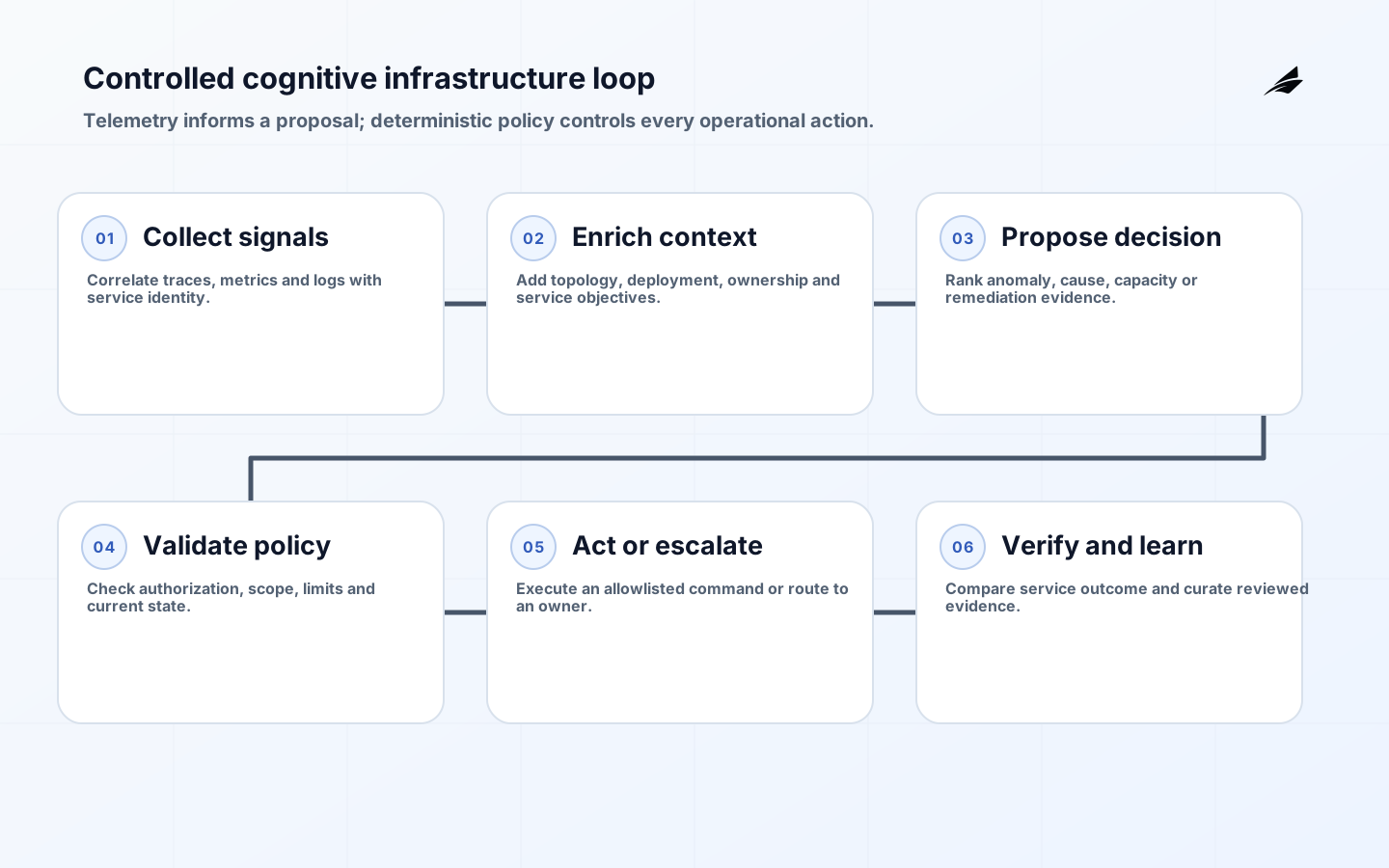
Cognitive infrastructure services apply analytics, machine learning and automation to operational telemetry so teams can detect patterns, correlate events, forecast demand or execute bounded remediation. The useful product is not an animated operations dashboard. It is a controlled decision path from trustworthy evidence to an operator or machine action, with known limits, authorization, rollback and measured service impact.
This guide extends Edilec's cognitive infrastructure implementation checklist, AIOps FAQ and infrastructure services plan. OpenTelemetry defines traces, metrics, logs and baggage as distinct signals; reliable AIOps starts by making their identities, ownership and quality consistent before fitting models to them.
Scope decisions, not an abstract intelligence layer
Choose one operational decision: suppress duplicate symptoms, route an incident, forecast capacity, detect configuration drift or restart a bounded stateless workload. Baseline alert volume, operator effort, service impact, false escalation and current recovery. Name the action owner and unacceptable outcomes. Avoid a platform-wide promise to predict every incident; rare failures, changing architecture and incomplete labels make universal claims untestable.
| Use case | Required evidence | Automation ceiling |
|---|---|---|
| Event correlation | Topology, time and incident history | Group and recommend |
| Anomaly detection | Seasonality and service context | Open a case |
| Capacity forecast | Demand, utilization and release plans | Propose change |
| Known remediation | Validated health and reversible command | Execute within limits |
| Cost optimization | Usage, price and service objective | Create reviewed recommendation |
Build a governed telemetry foundation
Create a service catalog with owner, criticality, dependencies and objectives. Standardize resource, service, environment and deployment identifiers so signals correlate across tools. Define collection, sampling, retention, sensitive fields and loss alerts. Instrument user-visible service indicators as well as infrastructure. Google SRE distinguishes black-box user behavior from white-box internals; both are needed because healthy CPU does not prove a successful customer transaction.
Track data quality as a product: missing sources, clock drift, parse change, cardinality, duplicate events and label coverage. Preserve raw evidence for representative incidents so correlation changes can be replayed. Restrict telemetry access because logs and traces can expose customer data, secrets and network structure. Cost the pipeline by useful decision, not ingestion volume.
Separate inference from operational authority
A safe architecture ingests signals, enriches them with service and change context, proposes a typed decision, validates policy, then sends a recommendation or allowlisted command to workflow automation. Keep credentials and authorization outside the model. Record model, rules, features, inputs, confidence, policy result, action and observed outcome. A natural-language explanation can help operators, but it cannot substitute for validated state.
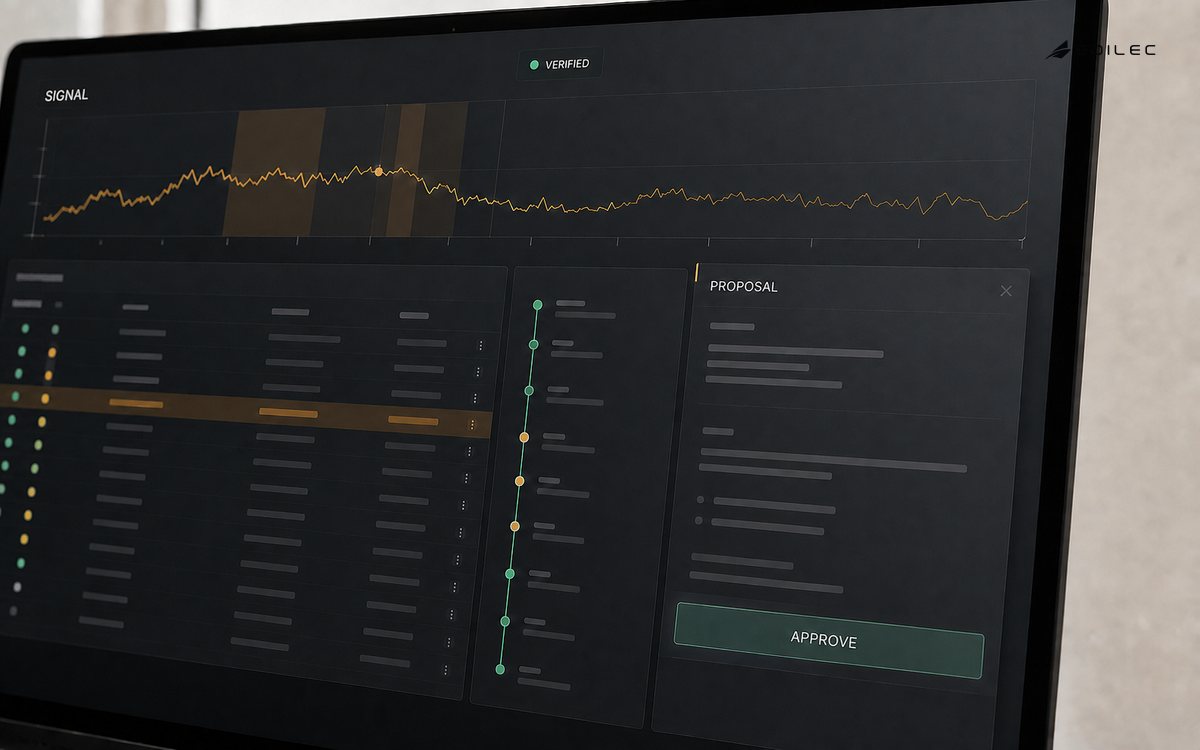
Design degraded modes. If enrichment, model or provider is unavailable, continue deterministic monitoring and route important alerts. Rate-limit actions by service and fleet, use idempotent commands and require health checks after execution. Kubernetes warns that poorly designed liveness probes can cause cascading failure; an intelligent layer that repeatedly acts on a bad health signal magnifies the same risk.
Evaluate models against operational consequences
Split incident history by time to avoid testing on leaked future patterns. Include normal peaks, deployments, dependency failures and rare severe cases. Measure precision, recall and calibration, then translate them into pages avoided, important cases missed, time to diagnosis, collateral action and reviewer effort. Shadow recommendations before automation. Review performance after topology, telemetry, model or operating policy changes.
Increase automation by consequence and reversibility
Begin with enrichment and recommendation. Move to approval-based execution when the command is tested, and to automatic execution only for bounded, frequent, reversible cases with reliable verification. Define maximum targets, duration, attempts and spend. Stop when service indicators worsen or evidence is ambiguous. Queue high-consequence actions for the current service owner and retain a manual route.
| Control | Before action | After action |
|---|---|---|
| Authorization | Current service and command scope | Actor and policy evidence |
| Blast radius | Target and fleet limit | Affected resources counted |
| Reversibility | Rollback command tested | Rollback remains available |
| Verification | Expected service signal defined | Outcome compared with threshold |
| Circuit breaker | Stop and rate limits configured | Further actions blocked on harm |
| Learning | Evaluation version recorded | Result enters reviewed dataset |
Model the full cost and value
Cost includes collectors, storage, egress, feature processing, model inference, licenses, integration, review and false actions. Drivers are signal volume and cardinality, retention, fleet diversity, model frequency, availability and assurance. Apply FinOps allocation so teams see service costs, then optimize usage without violating reliability. Compare cost with avoided interruption, reduced toil and faster recovery using a stable baseline.
Deliver through bounded operational trials
- Select one decision, owner, baseline and harm threshold.
- Reconcile service context and validate telemetry quality.
- Replay historical cases and test adversarial or missing evidence.
- Run in shadow mode and compare operator decisions.
- Enable approval-based action with rollback and verification.
- Expand autonomy only after stable production evidence and review.
Operate drift, incidents and change
Version feature extraction, model, thresholds, topology source, policy and runbook independently. A release record should state what changed, the evaluation run and rollback. Deploy to bounded services before fleet expansion. Monitor input distribution, confidence, recommendation mix, overrides, failed actions and service results. Define who investigates drift and what condition disables the capability.
Treat a harmful automated action as an operational incident. Stop execution, preserve evidence, restore service and review model, policy, telemetry and human assumptions together. Do not train automatically on every operator correction; responses made under pressure can be inconsistent. Curate reviewed outcomes and retain excluded cases for testing.
Maintain owners for data sources, platform, model, automation, service and risk. Review access, retention, dependencies, cost and recovery. Test model or vendor replacement while deterministic monitoring remains alive. The cognitive layer should be removable without making infrastructure unobservable or impossible to operate manually.
Select services with an evidence trial
Give suppliers a sanitized representative dataset and ask them to demonstrate cases, misses, explanations, integration and degraded behavior. Require data terms, model-change notice, API limits, processing location, security, incident cooperation, export and deletion. Compare reviewer effort and total pipeline cost, not demo accuracy. Contract a pilot with stop criteria before committing the telemetry estate.
Accept when operators can trace a recommendation to evidence, veto an action, restore a failed change, investigate missing telemetry and calculate unit cost. Document unsupported environments and limitations. This keeps procurement focused on an operable decision system rather than an impressive but unverifiable interface.
Key takeaways
- Start with one measurable operational decision.
- Treat telemetry identity, quality and access as core infrastructure.
- Keep policy, credentials and action validation outside probabilistic models.
- Scale automation according to consequence, reversibility and verification.
- Measure service outcomes, missed cases, reviewer effort and total cost.
Frequently asked questions
Is AIOps just anomaly detection?
No. It can include event correlation, topology enrichment, forecasting, recommendation and controlled remediation. An anomaly without service context or an accountable response path often adds noise rather than value.
Should remediation become fully autonomous?
Only for demonstrated low-regret actions with bounded scope, authorization, rollback and outcome verification. Novel, ambiguous or high-consequence incidents need accountable human judgment.
Should an organization build its own model?
Build only where proprietary context, control or economics justify the lifecycle burden. Many teams gain more from improving service catalogs, telemetry and runbooks, then evaluating vendor or open capabilities against representative cases.
Secure the cognitive operations plane
The platform sees sensitive topology and may hold powerful credentials, so separate ingestion, analysis and execution identities. Authenticate collectors and commands, encrypt transport, restrict tenant and service scope and log privileged access. Treat telemetry text as untrusted input because log messages, labels and ticket content can contain attacker-controlled strings. Never interpolate model output directly into a shell, query or infrastructure API.
Threat-model poisoned telemetry, evasion, prompt injection, compromised model artifacts, exposed dashboards and abuse of remediation tools. Validate artifact provenance and scan dependencies. Keep policy checks deterministic and close to execution. Use independent service health to verify actions so the same compromised signal cannot both trigger and declare success. Test credential revocation and provider isolation during an exercise.
Establish a review cadence
Weekly operations review should inspect misses, false escalations, overrides, failed actions, drift and source health. A monthly product review should compare service outcomes, toil and unit cost. A risk review should examine access, incidents, material model changes and autonomous scope. Use one backlog with owners rather than separate model and operations queues that hide shared causes.
Keep a catalog of capabilities showing decision, services covered, data, model, policy, automation level, owner, last evaluation and expiry. Remove experiments that never become decision-useful. Reapprove a capability when service criticality, data, model or action scope changes materially. This prevents a low-risk pilot from quietly becoming a high-consequence control.
Design continuity and exit
Export rules, features, cases, evaluation sets and action history in usable formats. Document which elements are supplier-specific. Test operating with models disabled and moving critical recommendations back to deterministic alerts. During exit, revoke provider and automation access, drain queued actions, preserve required evidence and verify ordinary monitoring. The infrastructure service must remain governable throughout the transition.
Document the manual decision path alongside every automated one. Operators should know which evidence to inspect, which command is safe, which owner can authorize it and how success is verified when the cognitive service is unavailable. Exercise that path periodically so human capability does not atrophy behind a reliable-looking recommendation layer.
A quarterly review should retire recommendations that add no measurable decision value. Removing weak automation is an improvement, not a failure of adoption.
Conclusion
Cognitive infrastructure creates value when evidence, authority and recovery stay explicit. Establish reliable telemetry, test one decision, preserve deterministic controls and raise autonomy only after observed outcomes justify it. The result is quieter, faster and more accountable operation, not infrastructure whose behavior is harder to explain than the incidents it manages.