An end-to-end managed cloud services FAQ should clarify what the provider will operate, what the customer must still own and how both parties prove the service works. The phrase can span landing zones, infrastructure, platforms, applications, databases, security, observability, incident response, cost optimization and supplier coordination. Without a named boundary, buyers compare broad promises while delivery teams inherit gaps. A credible service is an operating contract tied to each workload, with accountable decisions from onboarding through change, incident, recovery and eventual exit.
Cloud remains a shared operating environment even under a comprehensive contract. NIST's cloud computing definition distinguishes service and deployment models, while provider responsibilities vary by service choice. Managed service providers add another responsibility layer; they do not erase the customer's accountability for business priorities, data, acceptable risk and supplier oversight. This guide answers the questions that procurement, platform, security, finance and application owners should settle before relying on the service.
What does end-to-end managed cloud actually include?
The scope should be a service catalog, not a paragraph. For every product or workload, state covered environments, hours, regions, cloud accounts, technology layers and lifecycle activities. Identify whether the provider designs and builds the foundation, operates only approved configurations, administers databases, manages Kubernetes, supports application code or merely routes application incidents. Include request types, response targets, exclusions and prerequisites. An outcome such as restore availability needs a responsible operator, tested procedure and retained evidence; listing backup as included is insufficient.
Define service interfaces for routine requests, standard changes, high-risk changes, incidents, vulnerabilities, capacity, recovery tests and cost anomalies. Each interface needs required input, decision authority, expected output and escalation. Clarify ownership where cloud provider support, software vendors, telecommunications carriers and internal teams intersect. The companion managed cloud scope and delivery plan helps convert these definitions into commercial work packages, while the implementation checklist supports acceptance.
| Service layer | Questions the contract must answer | Evidence |
|---|---|---|
| Cloud foundation | Who owns accounts, identity, network, policy, logging and key services? | Architecture, control tests and named platform owner |
| Workload platform | Who patches, upgrades, scales and supports runtimes, clusters and databases? | Version inventory, maintenance record and support route |
| Application | Who diagnoses code, dependency, configuration and release failures? | Repository ownership, deployment trace and on-call handoff |
| Data protection | Who sets retention, monitors jobs, restores and validates business consistency? | Restore exercise with RPO and RTO evidence |
| Security operations | Who triages findings, contains incidents and communicates decisions? | Runbook, case timeline and authority matrix |
How should responsibility be divided and governed?
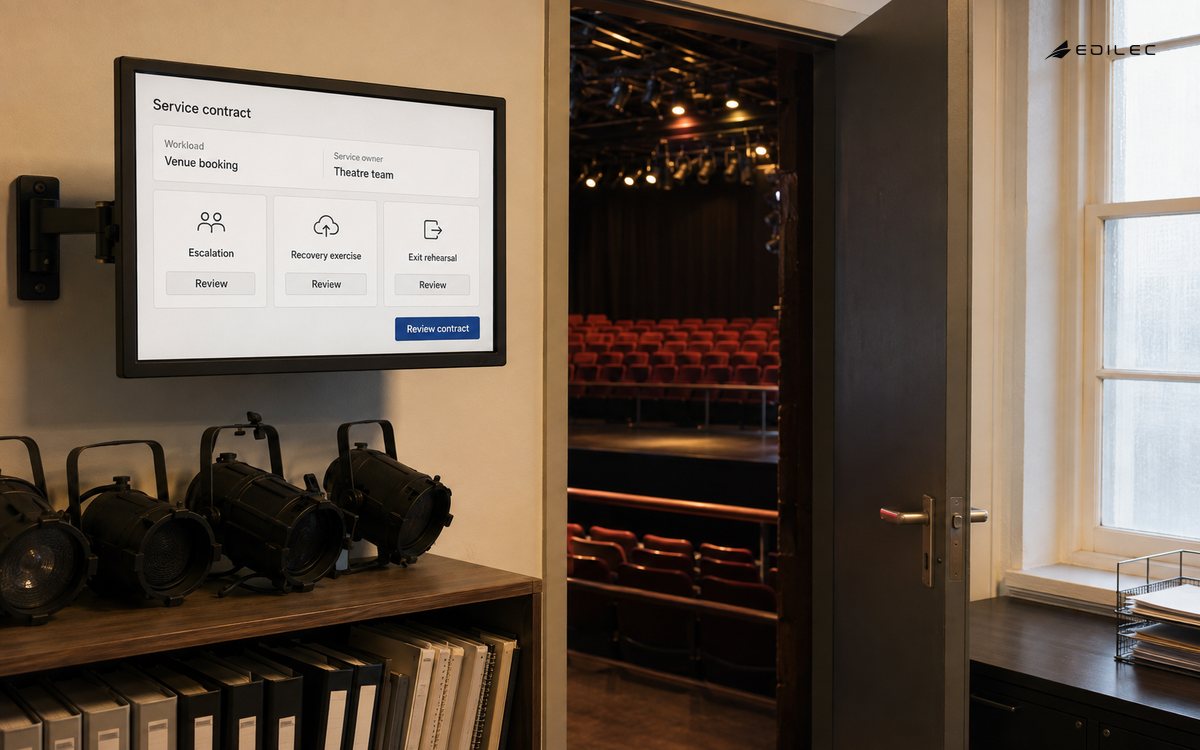
Create a responsibility matrix at control and operational-task level. A generic cloud shared-responsibility diagram does not say who reviews a privileged role, renews a certificate, approves an internet route or validates restored application data. Assign one accountable customer role and one performing role for each recurring task, then name consultation and notification paths. Keep regulatory accountability distinct from technical execution. Review the matrix when a workload changes service model, provider, criticality or data classification, because responsibility shifts as managed services replace customer-operated components.
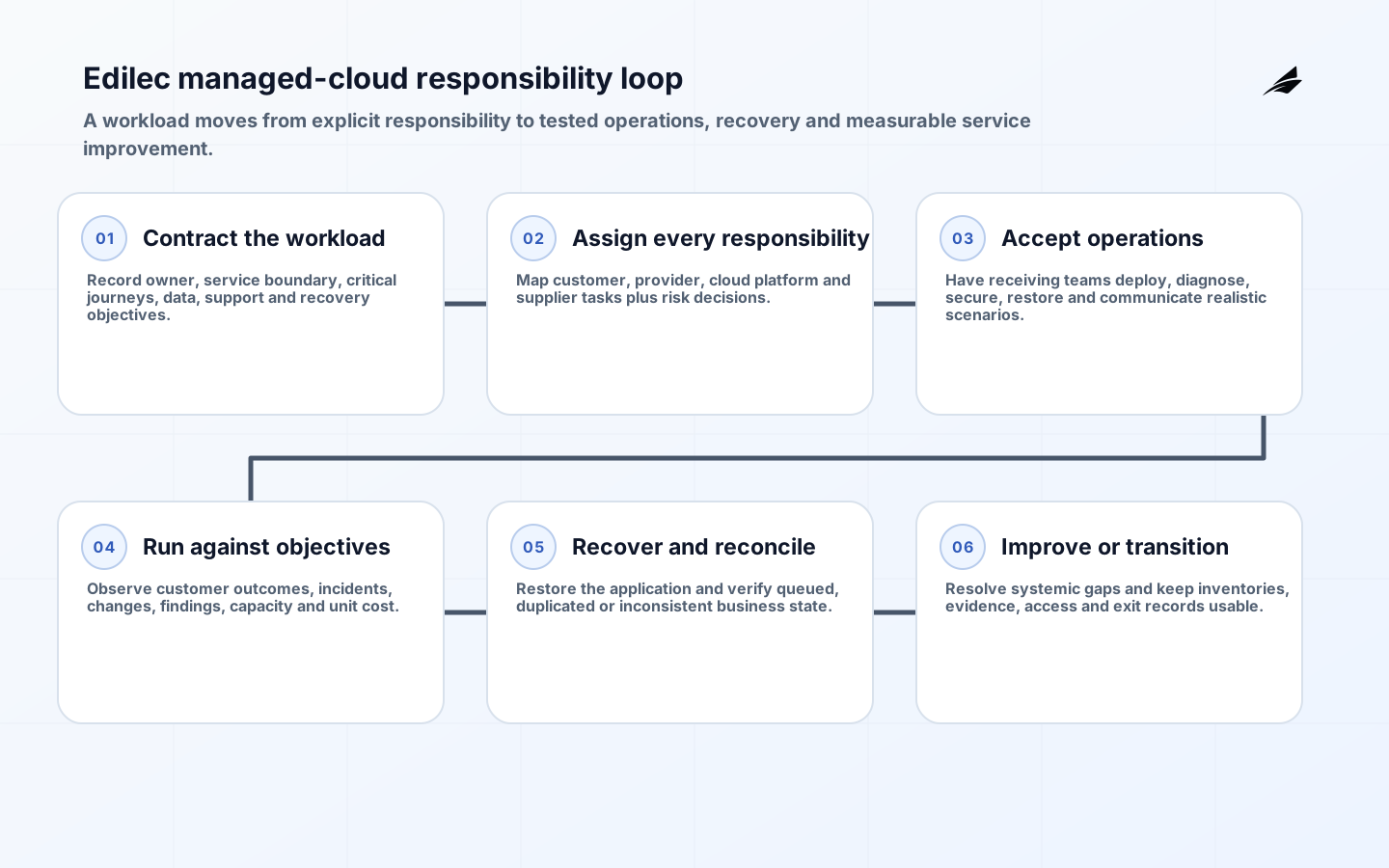
Govern the service through a single operating record. Incidents, problems, changes, risks, exceptions, capacity, cost and improvement actions should have owners and due dates visible to both parties. Separate operational reviews from executive service reviews: the first resolves near-term conditions; the second examines outcomes, systemic risk and contract fitness. The Edilec six-stage managed-cloud responsibility loop for this heading follows workload intent through acceptance, operation, recovery and improvement, making handoffs explicit instead of treating the provider as an opaque destination.
What should happen during workload onboarding?
Onboarding begins with discovery, not credential transfer. Capture the workload's business owner, users, critical journeys, architecture, dependencies, data classification, compliance obligations, traffic pattern, deployment method, support history and recovery objectives. Reconcile the actual estate with diagrams and infrastructure code. Resolve unsupported versions, unknown resources and missing ownership before acceptance or record them as time-bound risks. Baseline availability, latency, incidents, cost and operational toil so later improvement claims have a reference point.
Acceptance should be demonstrated by the team that will operate the service. They must deploy a known change, receive and diagnose alerts, access logs and traces, engage suppliers, restore representative data, rotate a credential and communicate an incident. Verify least-privileged access and emergency elevation. Ensure monitoring reaches the correct on-call route and that documentation is usable under pressure. Microsoft frames cloud adoption as continuous strategy, planning, readiness, adoption, governance, security and management in its Cloud Adoption Framework; managed-service transition should preserve that lifecycle rather than start at operations.
How should SLAs, SLOs and incident response work?
A service-level agreement defines a commercial commitment; a service-level objective guides engineering and operating decisions. Measure customer-relevant outcomes such as successful checkout, order processing or clinician access, not infrastructure uptime alone. Specify the observation point, calculation window, exclusions, data source and consequence. Use error budgets or an equivalent policy to balance feature change with reliability. AWS describes operational excellence as organizing, preparing, operating and evolving workloads in its Well-Architected guidance; that progression requires learning signals beyond SLA credits.
Incident severity should follow business impact and urgency. Define who may declare an incident, contain a system, invoke continuity, contact regulators or customers and accept residual risk. Maintain one timeline with facts, decisions, hypotheses and actions across organizations. Status updates should distinguish what is known from what is being tested. After restoration, reconcile queued or duplicated transactions and monitor for recurrence. Problem review should produce changes to architecture, detection, procedures or responsibility, with effectiveness checked later; a polished report without verified follow-through does not improve the service.
| Measure | Precise definition | Decision it should support |
|---|---|---|
| Availability SLI | Valid requests completed at the user-facing boundary over eligible requests | Whether reliability work or feature change takes priority |
| Time to qualified ownership | Elapsed time until a responder with authority accepts the incident | On-call and escalation design |
| Change failure rate | Production changes requiring remediation, rollback or incident response | Release risk and automation investment |
| Restore success | Exercises meeting recovery objectives and business reconciliation criteria | Resilience gaps and backup design |
| Unit cloud cost | Allocated service cost divided by a stable business unit | Demand, architecture and commercial optimization |
Who owns security, compliance and cloud cost?
The customer owns risk decisions and legal obligations; the provider may perform many controls. Map identity, configuration, vulnerability, logging, detection, incident, encryption, backup and evidence tasks explicitly. Require named administrative identities, just-in-time privilege where practical, protected audit logs and monitored automation credentials. Exceptions need rationale, compensating controls, expiry and approver. Evidence should be available at the frequency the customer's assurance process requires, not assembled once per year. Test the path from a cloud finding to workload impact, accountable remediation and closure.
FinOps is a cross-functional operating practice, not a monthly discount exercise. Allocate costs to services and owners, expose anomalies quickly, forecast material commitments and connect usage to business demand. Providers can recommend rightsizing, scheduling, storage-tier and commitment actions, but product owners must decide performance and roadmap trade-offs. The FinOps Framework organizes capabilities that finance, engineering and business roles can use together. Contract incentives should avoid rewarding simple spend reduction when it damages reliability, security or delivery speed.
How are resilience, suppliers and exit handled?
Resilience starts with workload failure modes and business recovery objectives. Confirm whether backups are independent of the failure and identity boundary they protect. Test restore with keys, infrastructure, configuration, application dependencies and data reconciliation, not just storage recovery. Multi-region architecture adds replication and failover complexity; it does not guarantee continuity. Google Cloud's operational excellence guidance emphasizes continuous improvement, incident and problem management, capacity and change, all of which should be exercised across the actual provider chain.
Plan transition at contract entry. The customer should retain authoritative inventories, architecture, infrastructure definitions, runbooks, access records, service history and evidence in usable formats. Define data return, verified deletion, credential revocation, knowledge transfer, parallel operation and supplier-notification duties. Price exit activities and specify cooperation periods. Test portability for critical configurations before a crisis, while recognizing that managed platform choices can be rational even when they are not portable. The aim is informed dependency with a workable transition, not an unrealistic promise of frictionless provider replacement.
End-to-end managed cloud takeaways
- Turn broad scope into a workload-level catalog with explicit inclusions, prerequisites and service interfaces.
- Assign operational tasks and risk decisions across customer, provider, cloud platform and other suppliers.
- Require the receiving operations team to prove deployment, diagnosis, security and recovery before acceptance.
- Use customer-facing indicators and clear incident authority rather than relying on infrastructure uptime.
- Operate cost, security and reliability as shared decisions with traceable owners and evidence.
- Design contractual and technical exit paths at entry, then keep the required records current.
Frequently asked questions
Can one provider manage a multicloud estate end to end? Yes, but capability and access do not remove differences between provider services, controls and failure modes. Require platform-specific expertise, one operating record, consistent evidence fields and explicit escalation to each underlying provider.
Is a 24/7 service desk the same as 24/7 engineering support? No. Confirm which skills and decision authorities are available at each hour, how quickly qualified ownership is reached and whether application, platform, security and supplier responders can actually restore the service.
Should managed-cloud fees be fixed or consumption-based? Either model can work. Separate predictable baseline duties from variable projects or event volumes, define the units and quality thresholds, and test incentives against reliability and cost outcomes. Unbounded ticket pricing can discourage useful reporting; vague fixed scope can encourage disputes.
Conclusion
End-to-end managed cloud services are dependable when the end points and the responsibilities between them are visible. Buyers should expect a workload contract, tested onboarding, meaningful objectives, clear incident authority, recoverable architecture, financial accountability and a maintained exit record. That combination turns outsourced activity into an operable service whose quality can be measured and improved instead of inferred from a provider label.