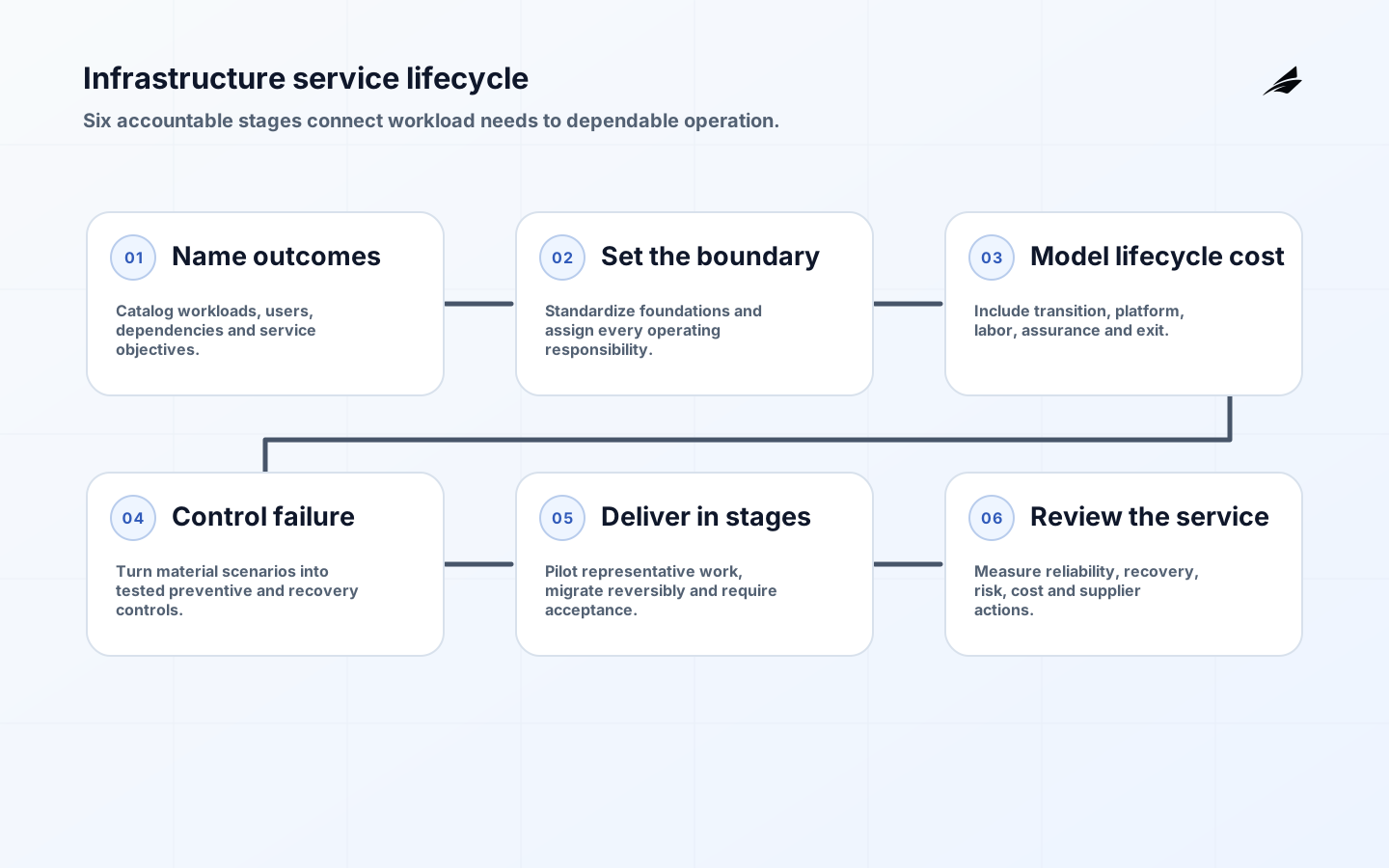
An infrastructure services scope cost and delivery plan starts with the business capability that must remain available, not with a shopping list of servers, accounts or tickets. The service may include cloud foundations, networks, identity, compute, storage, databases, backup, observability, patching and incident response. Its useful boundary is the point at which ownership, risk and measurable outcomes change hands. This guide shows buyers and delivery teams how to define that boundary, estimate full lifecycle cost and move from discovery to accountable operation.
Use the infrastructure implementation checklist when work enters delivery, the infrastructure services FAQ for procurement questions, and the managed IT infrastructure delivery plan when a provider will own day-to-day operations. Those companion pieces are most useful after executives agree which workloads matter, what failure means, and which decisions remain with the customer.
Define the service through workload outcomes
Inventory workloads by user journey and business process. For each one, record owner, users, peak periods, data classification, dependencies, recovery needs, regulatory constraints and current pain. A payroll platform and a public brochure site should not inherit the same availability target merely because both run in one cloud. The AWS Well-Architected Framework separates operational excellence, security, reliability, performance, cost and sustainability; use those lenses as review prompts while keeping the final priorities tied to each workload.
Convert vague expectations into service level indicators. Availability may measure successful checkout attempts rather than virtual-machine uptime; backup success is weaker than restore success; incident response time is different from restoration time. The Google SRE guidance on service level objectives recommends beginning with what users care about and then selecting indicators. Define the measurement window, exclusions, source and action when the objective is missed. This prevents a provider from meeting infrastructure metrics while the business service remains unusable.
| Scope artifact | Decision it fixes | Acceptance evidence |
|---|---|---|
| Workload catalog | What is included and who owns it | Named owner and dependency map |
| Service boundary | Where provider responsibility starts and ends | RACI tied to real activities |
| Service objectives | Which user outcomes must be protected | SLI formula, target and response |
| Data map | Where sensitive and critical data moves | Classification and approved locations |
| Exit plan | How service can change provider or platform | Export, handover and deletion procedure |
Choose an architecture and operating boundary
Decide what will be standardized before designing individual workloads: account or subscription structure, identity federation, network zones, approved regions, logging destinations, encryption and key ownership, tagging, backup tiers, base images and deployment paths. Express repeatable controls as versioned infrastructure code and policy where the platform supports it. Keep exceptions visible with an owner and expiry date. Standardization should reduce variation that creates operational risk; it should not force a fragile central dependency into every application.
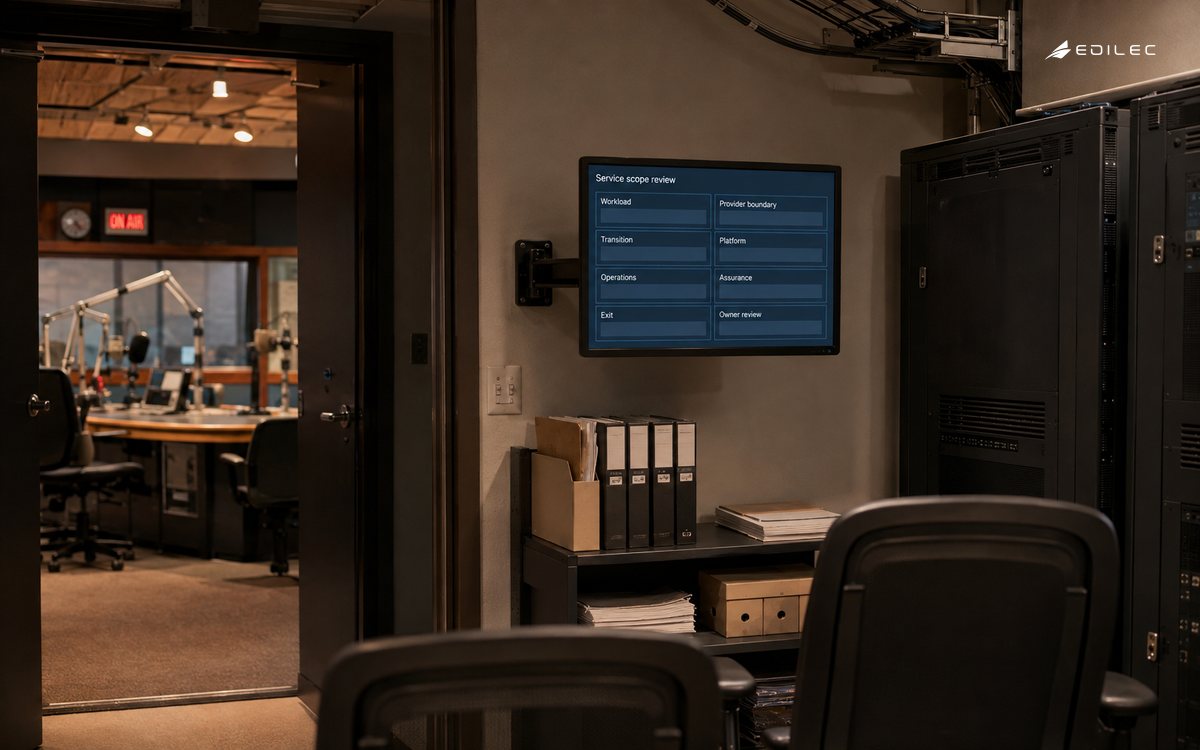
Write a responsibility matrix at task level. Cloud providers secure underlying facilities and managed services within their published boundaries, but customers still configure identities, data access, networks, retention and applications. A managed-service contract creates another layer, not a transfer of accountability. Specify who approves privileged access, applies operating-system and database patches, reviews alerts, tests restores, manages certificates, responds after hours and communicates with customers. For every shared task, name the party that initiates, verifies and records completion.
Estimate lifecycle cost instead of a monthly hosting number
Build a three-year cost model with one-time transition, recurring platform, recurring labor and risk-contingency lines. Include discovery, migration, parallel operation, data transfer, support plans, observability ingestion, security tooling, backups, licenses, testing environments, provider management and eventual exit. Model a normal case plus demand growth, incident-heavy and accelerated-exit scenarios. Separate costs that scale with usage from step changes such as an additional on-call rotation or higher support tier. State tax and currency assumptions rather than burying them in totals.
Normalize provider billing before it reaches a dashboard. The FOCUS 1.2 specification defines vendor-neutral billing concepts that support allocation, forecasting and chargeback across cloud and SaaS data. Even in a single-cloud estate, preserve invoice identifiers, billing periods, service, region, resource, usage quantity, pricing category, commitments, credits and amortized cost. Reconcile the model to invoices monthly. Optimization should then connect spend to demand and service objectives, not reward deleting necessary resilience.
| Cost group | Typical contents | Control |
|---|---|---|
| Transition | Discovery, landing zone, migration, dual running | Milestone budget with exit criteria |
| Platform | Compute, storage, network, managed services | Owner tags and unit-cost trends |
| Operations | Support, monitoring, on-call, maintenance | Service catalog and capacity plan |
| Assurance | Security testing, audit evidence, recovery exercises | Risk-based annual plan |
| Exit | Data export, knowledge transfer, contract closure | Funded exit runbook |
Design controls around material failure modes
Run a threat and failure workshop for identity compromise, accidental deletion, region or provider disruption, expired certificates, capacity exhaustion, dependency failure, ransomware, billing spikes and loss of key staff. Rank scenarios by business impact and plausible frequency, then assign preventive, detective and recovery controls. The NIST Cybersecurity Framework 2.0 adds Govern to Identify, Protect, Detect, Respond and Recover, which is a useful reminder that policies, risk appetite, suppliers and accountability belong in the operating design.
Test controls with evidence. Restore an application and validate data consistency; remove an administrator and confirm access disappears; rotate a key without downtime; simulate loss of a dependency; and reconcile resources to the inventory. A backup report, policy document or green dashboard is not proof of recoverability. Retain test inputs, timestamps, results, defects and remediation owners. High-impact controls deserve independent verification, especially when the same provider designs, operates and reports on them.
Deliver in reversible stages
Begin with discovery and a thin foundation, then migrate a representative low-to-medium-risk workload. The pilot should exercise identity, network, deployment, telemetry, backup, support and cost allocation rather than prove only that an application starts. Define entry and exit criteria for each stage. Use small, reversible changes, maintenance windows appropriate to user impact, and a tested backout route. Do not schedule a migration wave until the previous wave's incidents and operating gaps have named resolutions.
A practical sequence is foundation, pilot, controlled waves, stabilization and service acceptance. During dual running, define which system is authoritative and how changes are synchronized. At cutover, freeze only what is necessary, verify business transactions, and maintain a decision log. Service acceptance should require runbooks, inventories, monitoring, access reviews, restore evidence, cost ownership, unresolved-risk approval and support handover. Project completion without operating acceptance simply moves unfinished work into an incident queue.
Operate incidents, changes and suppliers as one service
Create severity definitions from user and business impact, with on-call roles, escalation contacts, communications cadence and decision authority. NIST SP 800-61 Revision 3 integrates incident response into broader cybersecurity risk management. Apply that principle by connecting incident findings to architecture, supplier, training and investment decisions. Review near misses as well as outages, and distinguish restoration from full remediation so temporary workarounds do not become permanent unknowns.
Govern changes according to risk, not paperwork volume. Pre-authorize well-tested routine changes, require peer review and automated checks, and escalate changes that alter security boundaries, data location or recovery behavior. Review service performance monthly: user-facing SLOs, incident recurrence, restore success, vulnerability exposure, capacity, unit cost, exception age and provider actions. Quarterly, revisit workload criticality and contract assumptions. The service remains healthy when its controls and ownership evolve with the business, not when its original design remains untouched.
Close the commercial loop with a service acceptance pack. It should contain the signed boundary, workload inventory, responsibility matrix, current architecture, service objectives, open-risk register, privileged-access population, tested recovery results, cost baseline, provider contacts and exit dependencies. Assign an expiry or review date to assumptions such as traffic, retention and staff coverage. Withhold final acceptance for missing critical evidence rather than accepting a promise to document it later. This pack becomes the baseline for quarterly service review and for judging whether a later change has increased risk, cost or operating effort. Both parties should sign it.
Key takeaways
- Define infrastructure services by workload outcomes and precise responsibilities.
- Estimate migration, operations, assurance and exit alongside platform consumption.
- Turn material failure scenarios into controls that are tested with retained evidence.
- Use reversible migration stages and require operational acceptance before closure.
- Measure user-facing reliability, recovery, risk and unit economics together.
Frequently asked questions
How long does an infrastructure services transition take?
A small, well-inventoried environment may establish a foundation and pilot in weeks; a regulated or highly coupled estate can take many months. Workload dependencies, data movement, identity redesign, test windows and recovery evidence drive duration more than resource count. Estimate by stage and acceptance evidence, then add contingency for discovery findings instead of promising one date before the inventory is credible.
Should one provider own architecture and operations?
It can, provided the customer retains accountable ownership and obtains independent challenge for material controls. Separate approval from execution for privileged access, risk acceptance and major changes. Contract for evidence, portability and cooperation with auditors or replacement providers. Concentration may simplify coordination, but it also makes exit design and objective assurance more important.
What pricing model works best?
Use fixed prices for bounded deliverables with clear assumptions, consumption pricing for measurable platform use, and capacity or retainer pricing for ongoing skills and response. Avoid a single fixed fee that hides service volume or a pure ticket model that rewards preventable work. Tie service credits to meaningful outcomes, while using governance and remediation plans for problems that credits cannot repair.
Conclusion
A sound infrastructure services plan joins business outcomes, technical standards, explicit ownership, full lifecycle economics and proven recovery. Scope the service around real workloads, price its complete operating life, test its critical controls and accept it only when people can run it. That discipline turns infrastructure from an opaque collection of assets into a service the organization can understand, govern and change.