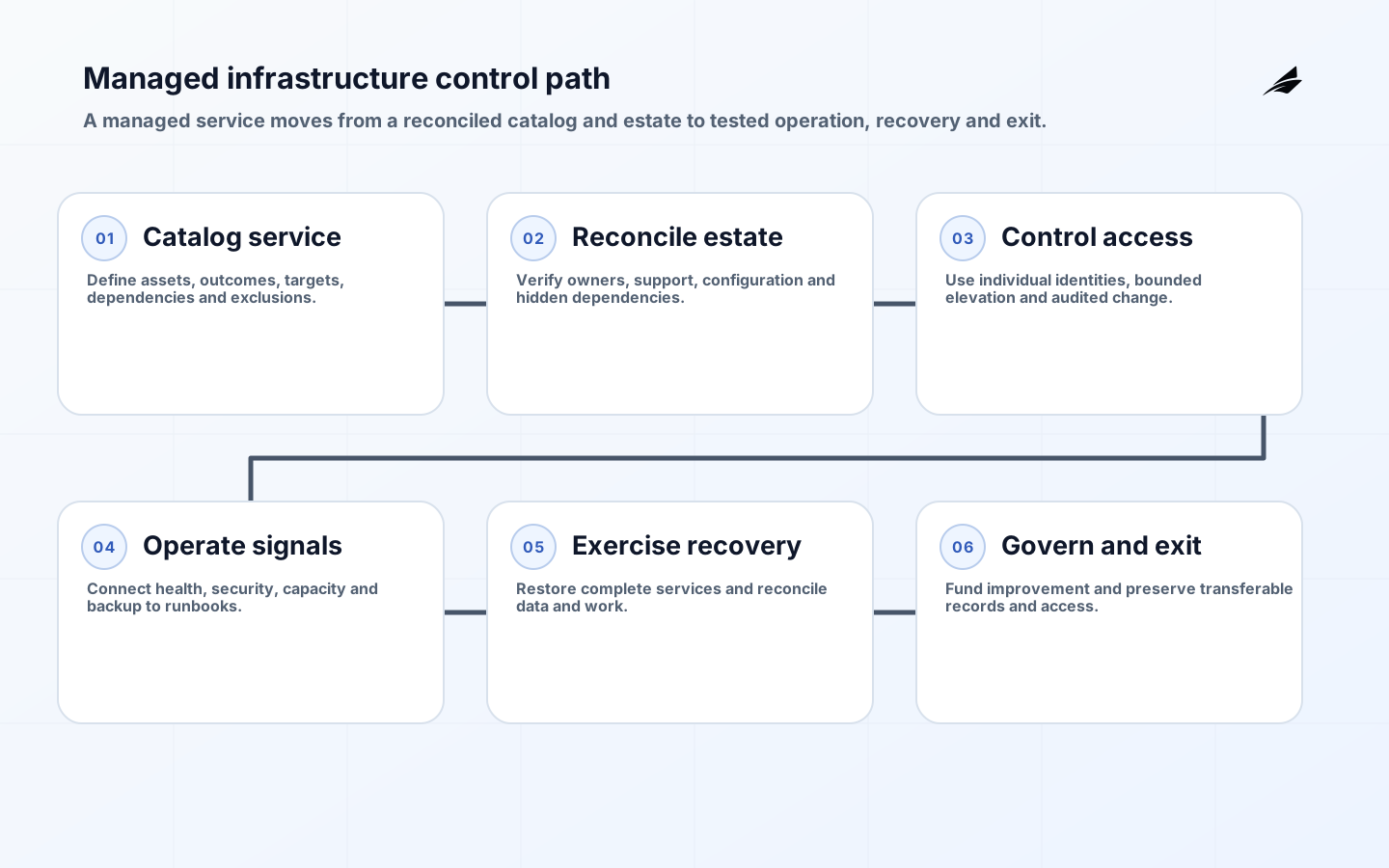
This managed IT infrastructure services implementation checklist starts from a simple boundary: a provider can take on defined operating work, but not accountability for the business services that depend on it. The implementation must state which networks, servers, endpoints, cloud resources, platforms and facilities are covered; which actions the provider may take; how performance is measured; and which responsibilities remain with application, security, finance and business owners. The target is a service that can be observed, exercised and exited without relying on a few individuals.
Begin with service outcomes: reliable user access, supported platforms, recoverable data, controlled change, useful monitoring and predictable cost. Avoid broad promises such as “24/7 management” until the catalog defines eligible assets, hours, event severity, request targets, dependencies and exclusions. Use NIST CSF 2.0 outcomes to connect infrastructure work to governance, identification, protection, detection, response and recovery instead of treating operations and security as separate supplier conversations.
Create a service catalog and responsibility map
For each catalog item, describe trigger, inputs, standard action, approval, target, evidence and exception route. Patching should identify platforms, classification, testing, deployment windows, emergency handling and verification. Backup should identify protected data, frequency, retention, encryption, failed-job response and restore testing. Monitoring should list sources, coverage, thresholds, escalation and degraded mode. Distinguish recurring service, chargeable change and project work so lifecycle maintenance does not become a contract dispute.
Map design, build, operate, verify and decide responsibilities by layer. The provider may operate a virtual machine while the application team owns software behavior and data reconciliation. Security may approve baseline policy while the provider applies it. Finance may approve commitments while engineering controls consumption. Name incident and emergency authority, not only RACI participation. Interfaces between parties need data and tooling: asset IDs, change records, alert routes and escalation contacts must reconcile.
| Service area | Managed activity | Retained decision | Evidence |
|---|---|---|---|
| Configuration | Apply approved baselines | Approve risk and exception | Drift and exception report |
| Patching | Test, schedule and deploy | Set urgency and downtime tolerance | Version and verification record |
| Backup/recovery | Operate jobs and exercises | Set RPO/RTO and accept recovery | Restore and reconciliation result |
| Monitoring | Collect, triage and escalate | Set business severity | Alert and incident chronology |
| Capacity/cost | Forecast and recommend | Approve budget and commitments | Allocation and forecast variance |
Reconcile inventory, dependencies and support status
Build inventory from authoritative cloud, virtualization, network, endpoint and procurement sources rather than accepting one spreadsheet. Assign stable IDs, owner, business service, environment, location, data class, support status, backup policy and monitoring status. Discover unknown assets and resolve duplicates. Record dependencies such as identity, DNS, certificates, network routes, storage and third-party support. A provider cannot meet a restoration target if the application’s hidden dependency is outside scope.

Identify unsupported operating systems, firmware, appliances and management protocols before handover. Give each a remediation or bounded exception with expiry. Baseline configuration and current capacity. Preserve architecture, address management, certificate ownership and licensing records. Test that provider tools can reach assets through approved paths without introducing a universal administrator account. Transition should pause when critical assets lack owners, recoverable configuration or lawful software support.
Control privileged access and infrastructure change
Use named workforce identities, strong authentication, least privilege and time-bound elevation. Separate provider administration from customer approval and audit. Emergency access needs a trigger, secure credential path, logging and retrospective review. Service automation should have narrowly scoped identities and protected source. Review provider and subcontractor access regularly and revoke promptly after role or contract change. Shared passwords and unmanaged remote tools are go-live blockers.
Define change classes, risk assessment, test evidence, approvals, maintenance communication, validation and rollback. Standard changes are pre-authorized only after repeatability is proven. Emergency changes still need a record and review. Coordinate infrastructure and application changes using service dependencies. Measure change success and restoration, not volume. Configuration-as-code can improve consistency, but live drift, manual exceptions and supplier consoles still require reconciliation against the declared state.
Make monitoring and incident response actionable
Collect health, performance, capacity, configuration, security and backup signals with source and owner. Test representative events from each critical layer. Alert design should connect a symptom to a service and runbook; raw device alarms create noise. Protect and retain logs according to purpose. Monitor the monitoring path itself, including collector silence and time synchronization. CISA and NIST logging guidance can inform a risk-based design, but the organization must select signals relevant to its scenarios.
Integrate provider operations into one incident command model. Define severity, declaration, escalation, secure communications, decision authority, evidence preservation and customer updates. Rehearse identity outage, network isolation, storage failure and cloud-region impairment. NIST SP 800-61 Rev. 3 treats incident response as part of broader risk management; include infrastructure lessons in architecture and control improvement rather than closing the event when a device returns green.
Prove backup, recovery and continuity
Backup success is not recovery evidence. Exercise restoration into an isolated environment, recover identity and management dependencies in the right order, validate data integrity and reconcile transactions created during disruption. Measure actual recovery time and data loss against business objectives. Protect backups from the same identities and destructive paths as production. Test key and credential availability. Document manual business operation and the conditions for returning to normal service.
Use NIST contingency-planning guidance as a structure for impact analysis, recovery strategy, plan development, testing and maintenance. Tailor frequency to consequence and material change. Component restores can occur frequently; full service exercises may be less frequent but must include application and business owners. Record findings, owners and dates. A signed plan that has never been executed with current access, suppliers and data is not an accepted control.
| Transition gate | Required proof | Stop condition |
|---|---|---|
| Inventory | Assets, owners and dependencies reconcile | Critical unknown or unsupported asset |
| Access | Routine and emergency paths exercised | Shared credentials or excessive standing privilege |
| Operations | Representative requests, alerts and changes complete | Runbook or tool unavailable |
| Recovery | Restore meets measured service needs | Backup cannot be validated |
| Exit | Configuration, history and access can transfer | Provider is sole holder of authoritative records |
Govern service quality, economics and exit
Measure service availability, incident duration, repeated failure, patch and baseline coverage, backup restore results, capacity headroom, request age, change failure, monitoring gaps and cost allocation. Avoid rewarding ticket volume. Sample completed work for correctness and business outcome. Review operational issues frequently, service improvement monthly and material risk at executive cadence. Keep a funded backlog for automation, resilience, security and documentation so urgent operations do not consume all capacity.
Design exit at onboarding. Customer-owned accounts, repositories and keys reduce dependency. Specify export of configuration, infrastructure definitions, inventories, monitoring rules, tickets, incident history, licenses, cost records and runbooks. Define deletion and access-return evidence and transition support. Periodically test a partial service transfer. Portability is not perfect, but the organization should retain enough knowledge and authority to govern a replacement or resume critical operation.
Sequence transition by service risk, not asset count
Start with a bounded service that exercises the provider’s normal toolchain without carrying the organization’s highest consequence. Run shadow operations, then reverse shadowing in which the provider acts and the incumbent observes. Move authority only after routine requests, changes, alerts and escalation succeed. Continue by dependency groups so identity, network, monitoring and backup ownership remain coherent. A bulk transfer of thousands of assets can look efficient while leaving the most important cross-service decisions unresolved.
Keep a transition issue register separate from steady-state tickets. Classify missing inventory, access, documentation, unsupported technology, tooling and contractual dependency; assign acceptance authority and target. Do not normalize inherited risk silently. The customer may accept a bounded exception, fund remediation or remove an asset from scope, but the decision must remain visible. Close transition only when permanent governance owns the residual register and service reporting includes it.
Validate operational knowledge with role-based scenarios rather than attendance records. Ask service-desk staff to route an alert, engineers to perform a standard and emergency change, incident leaders to invoke provider escalation, and finance owners to explain an anomalous charge. Record where access, terminology or authority slows the task. Update the catalog and runbooks, then repeat the scenario. This turns knowledge transfer into demonstrated capability.
Protect service continuity while old and new teams overlap. Define exactly who is authoritative for each asset and event on each transition date, and avoid two parties making independent changes. Keep a shared freeze and emergency process. Reconcile open incidents, changes and maintenance before the handoff. The provider should accept known work explicitly instead of discovering it after ownership has moved.
Key takeaways
- Define managed infrastructure as cataloged outcomes with explicit exclusions.
- Reconcile inventory and dependencies before authority transfers.
- Use individual, time-bound privileged access and controlled change.
- Test monitoring, incident response and restoration with real tools.
- Preserve customer access, evidence and exit artifacts throughout the contract.
Frequently asked questions
Is an uptime SLA enough?
No. It may be useful, but service quality also depends on response, restoration, data recovery, patching, change success, monitoring coverage and business-period impact. Define measurement sources and inspect critical events, not monthly averages alone.
Should the provider use its own management tools?
It can, if access, data location, integration, export, security and exit are acceptable. The customer should retain visibility and authoritative records. Tool convenience must not create an untestable operating dependency.
How long should transition take?
Duration depends on estate size and evidence quality. Use service-by-service gates rather than one date. Authority should move only when inventory, access, runbooks, monitoring, recovery and escalation have been exercised for that scope.
Conclusion
Managed infrastructure is ready when the provider and customer can operate a normal request, control a risky change, respond to a failure, restore a service and export the evidence using current identities and tools. That test reveals more than a polished transition report. Close the handoff gaps before scaling, and govern continuous improvement as an explicit service outcome.