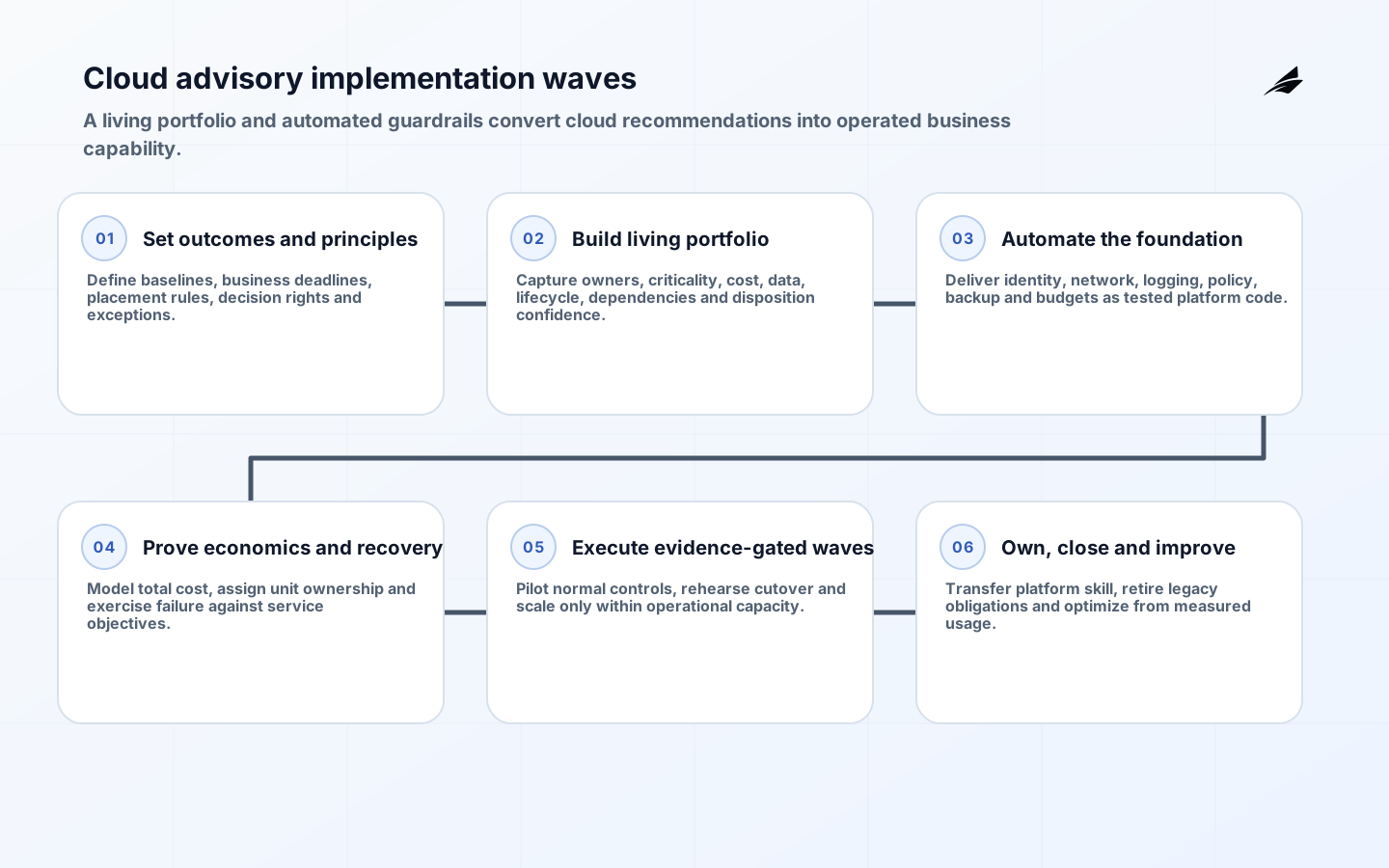
Consulting cloud advisory strategy becomes actionable when business outcomes, portfolio evidence, platform guardrails, operating capability and workload decisions form one plan. A provider selection or migration target is not a strategy by itself. The implementation must explain which capabilities move, why they move, how risk is controlled and who will operate the resulting estate.
This checklist turns advisory recommendations into owned delivery. Use the cloud advisory scope, cost and risk plan and cloud advisory FAQ for companion decisions. Apply the steps across public, private, hybrid or multi-cloud plans according to actual constraints.
1. Translate consulting cloud advisory strategy into outcomes and principles
Name the business capabilities, deadlines and constraints driving the work: data-center exit, resilience, faster environment delivery, global reach, analytics or product modernization. Establish baselines and target measures. Write principles for workload placement, managed services, identity, data residency, portability and automation, including an exception process. Principles should guide trade-offs without pretending every workload has the same answer.
Create a sponsor-led governance group with business, architecture, security, finance and operations authority. Define decisions reserved centrally and those delegated to workload teams. Google’s Cloud Adoption Framework groups readiness around lead, learn, scale and secure. Use such themes to expose organizational gaps, not as a vendor-specific score that replaces a business case.
| Strategy outcome | Baseline | Implementation evidence |
|---|---|---|
| Faster delivery | Environment and release lead time | Automated path used by pilot teams |
| Improved resilience | Current recovery evidence and incidents | Tested objectives and fault exercises |
| Estate exit | Facilities, contracts and dependencies | Dated waves and decommission proof |
| Cost transparency | Allocated run cost and waste | Owner-visible unit and forecast reporting |
2. Build a living workload and dependency portfolio
Inventory owner, business criticality, lifecycle, users, technology, data, compliance, availability, recovery, cost, incidents and dependencies. Mark confidence and prioritize gaps around early decisions. AWS’s application portfolio assessment guidance treats discovery, prioritized assessment, planning and continuous improvement as linked activities. Keep portfolio data current through delivery rather than freezing it in a spreadsheet.
Choose disposition per workload: retain, retire, relocate, rehost, replatform, repurchase, refactor or another clearly defined option. Record rationale, dependencies, target, effort range, risks and prerequisites. Group waves by technical and business dependency, not only server count. Include identity, network, batch, reporting, vendor and manual processes that do not appear in infrastructure discovery.
3. Implement the platform foundation and security guardrails
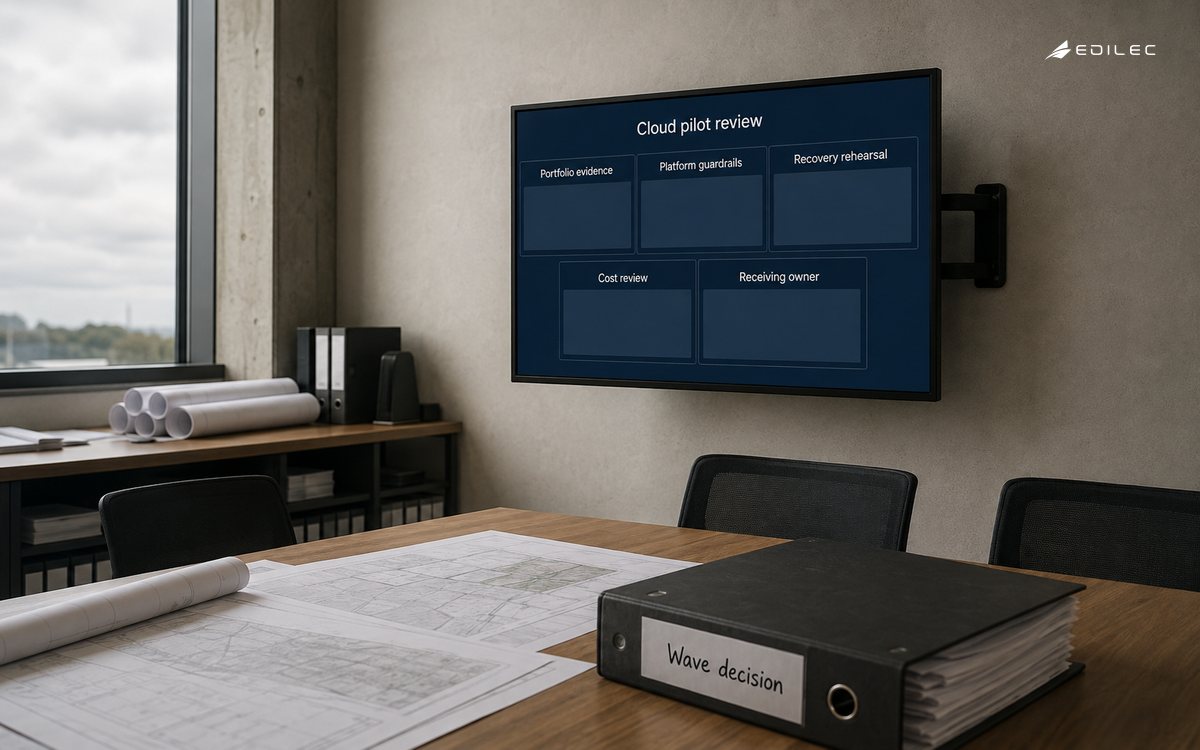
Define organization and account hierarchy, identity federation, privileged access, network patterns, DNS, encryption, key custody, logging, policy enforcement, backup, region use, tagging and budgets. Deliver the foundation as versioned automation with tests and a documented request path. A landing zone should accelerate safe teams; a central ticket queue for every change simply relocates delay.
NIST Zero Trust Architecture supports protecting resources through explicit policy decisions based on identity and context rather than trusted network location. Apply this to workforce, workload and pipeline identities. Eliminate shared administrators, use short-lived access where supported, centralize audit and test break-glass. Map regulatory controls to evidence produced by the platform and workloads, with clear shared responsibility.
| Foundation capability | Default guardrail | Exception evidence |
|---|---|---|
| Identity | Federated named access and strong authentication | Owner, duration and compensating control |
| Networking | Approved ingress, egress and segmentation patterns | Data flow and threat review |
| Data protection | Classification-led encryption and retention | Legal and risk approval |
| Operations | Central telemetry, backup and incident routing | Equivalent evidence and test results |
4. Validate economics, resilience and provider dependency
Model total cost by workload and scenario: compute, storage, requests, data transfer, licenses, support, migration, coexistence, platform team and modernization. Compare against a credible current baseline and include growth. Assign tagging and allocation before scale, set budgets and anomaly alerts, and define who may buy reserved commitments. Unit economics connected to a service are more actionable than one enterprise bill.
Translate criticality into tested availability and recovery objectives. Design backup independence, restore, failover, dependency degradation and incident communication. Multi-region or multi-cloud designs add cost and complexity and should answer a named risk. AWS guidance on cloud transformation challenges warns against reducing adoption to simple rehosting; economics and capability must be assessed together.
5. Execute pilot and migration waves with evidence gates
Select pilots that exercise identity, network, data, deployment and operations without concentrating unacceptable business risk. Define entry and exit criteria: owner, dependency map, target design, security, cost, performance, reconciliation, rollback, runbook and support readiness. Capture changes needed in the platform and feed them back as reusable patterns. A showcase that bypasses normal controls proves little.
For each wave, rehearse cutover and rollback, freeze conflicting changes, communicate user impact and reconcile data. Limit parallel waves to platform and operations capacity. AWS’s migration implementation guidelines call for wave planning, dependency ownership, landing-zone readiness, change control, communications and an operating model before scaling migration sprints. Use readiness evidence to sequence, not to delay indefinitely.
6. Transfer ownership and improve the cloud operating model
Define responsibility for platform products, workload reliability, security response, cost, vendor management and architecture exceptions. Publish service interfaces and objectives for the platform team. Train through paired workload delivery and incident exercises. Advisers should leave editable automation, decision records and skill in internal teams, not a proprietary roadmap that requires continuing interpretation.
Monitor adoption lead time, policy exceptions, reliability, recovery tests, security findings, utilization, forecast variance and legacy decommission. Review by service owner and wave. Retire old infrastructure, accounts, circuits, licenses, backups and credentials after verified transition. Optimize managed-service selection and capacity after real usage, and revisit principles as business constraints change.
7. Establish architecture, security and financial assurance
Create review paths matched to change risk. A team adopting an approved pattern should receive fast automated feedback; a new public ingress, data residency exception or privileged identity model deserves multidisciplinary review. Capture decisions and compensating controls with expiry. Measure review lead time and repeated exception themes, then improve platform patterns. Assurance that produces reusable evidence becomes part of delivery rather than an avoidable queue.
Continuously verify the estate against policy and inventory. Detect unowned resources, public exposure, stale credentials, disabled logging, unencrypted data, backup gaps and unsupported runtimes. Route findings to accountable service owners with severity and remediation evidence. Central teams should avoid silent production changes unless emergency authority is explicit; partner with workload owners so fixes do not disrupt hidden dependencies.
Join architecture and financial reviews. Unexpected spend may reveal faulty scaling, data movement, abandoned environments or inefficient design; aggressive cost reduction can weaken recovery and performance. Review unit cost, utilization, commitments and service objectives together. Forecast material migrations and retain variance explanations. Chargeback or showback should help owners decide, not create arbitrary accounting that drives unsafe behavior.
Review provider service changes and roadmap dependencies. Managed services reduce maintenance only when teams understand lifecycle notices, quotas, backup semantics and support boundaries. Assign owners for deprecations and test upgrades before deadlines. Maintain architecture records showing where replacement would be difficult, what data must be exported and how long continuity would take. This turns concentration risk into a managed decision instead of a vague instruction to avoid lock-in.
Treat data movement as its own workstream where scale or sensitivity warrants it. Inventory databases, files, analytical copies, backup sets and exchange paths. Define target authority, replication lag, validation, cutover and deletion of temporary copies. Test throughput and transfer cost with representative volumes. During coexistence, make freshness visible rather than allowing two systems to appear equally current.
Plan organizational continuity through migration. On-call schedules, service desks, vendor escalation, certificate renewal and vulnerability response must cover both estates. Update asset records as waves progress. Do not move experienced operators away from legacy systems before risk ends, but pair them with target teams so knowledge follows the workload. Budget coexistence rather than treating it as free overhead.
Define retirement evidence for every wave: no production traffic, retained data handled, dependencies removed, contracts changed, monitoring closed, credentials revoked and recovery copies disposed according to policy. Obtain business and technical approval. A powered-off server is not complete retirement when teams still depend on its data, license, network path or emergency image.
Maintain a skills map for platform engineering, security, networking, data, reliability and financial operations. Connect training to upcoming workload waves and verify capability through paired delivery, not course completion alone. Protect time for communities of practice and reusable patterns. Where managed providers fill gaps, name the internal role that retains architectural and commercial accountability. A strategy dependent on scarce individuals needs succession and documentation before adoption accelerates.
Revisit the sourcing model as capability grows. Work that required specialist advisers during foundation may belong with internal platform teams later. Make the transition explicit in budgets, contracts, repositories and on-call responsibility so no essential control sits between organizations.
Key takeaways
- Connect workload decisions to measurable outcomes and explicit principles.
- Maintain portfolio confidence and dependencies throughout migration.
- Deliver guardrails as tested automation with usable team interfaces.
- Model full economics and test recovery before scaling waves.
- Close legacy obligations and transfer operational capability.
Frequently asked questions
Should the strategy require multiple cloud providers?
Only when distinct capability, regulatory need, acquisition reality or resilience analysis justifies the additional skills and integration burden. Portability has degrees; define which components must move and test that requirement instead of demanding lowest-common-denominator design everywhere.
What makes a good first migration wave?
It has committed owners, manageable dependencies and enough production significance to exercise real controls. Avoid both the trivial sandbox and the most entangled critical estate. The wave should teach the organization how its normal delivery path works.
When is cloud strategy implementation complete?
When planned capabilities operate under accountable ownership, outcomes are measured and displaced obligations are closed. Strategy then becomes a recurring portfolio and platform practice rather than a one-time program document.
Conclusion
Cloud advisory creates value when its recommendations become a secure platform, evidence-based workload choices and capable operating teams. A living portfolio, automated guardrails, honest economics and disciplined wave closure keep adoption connected to business value long after the advisers leave.