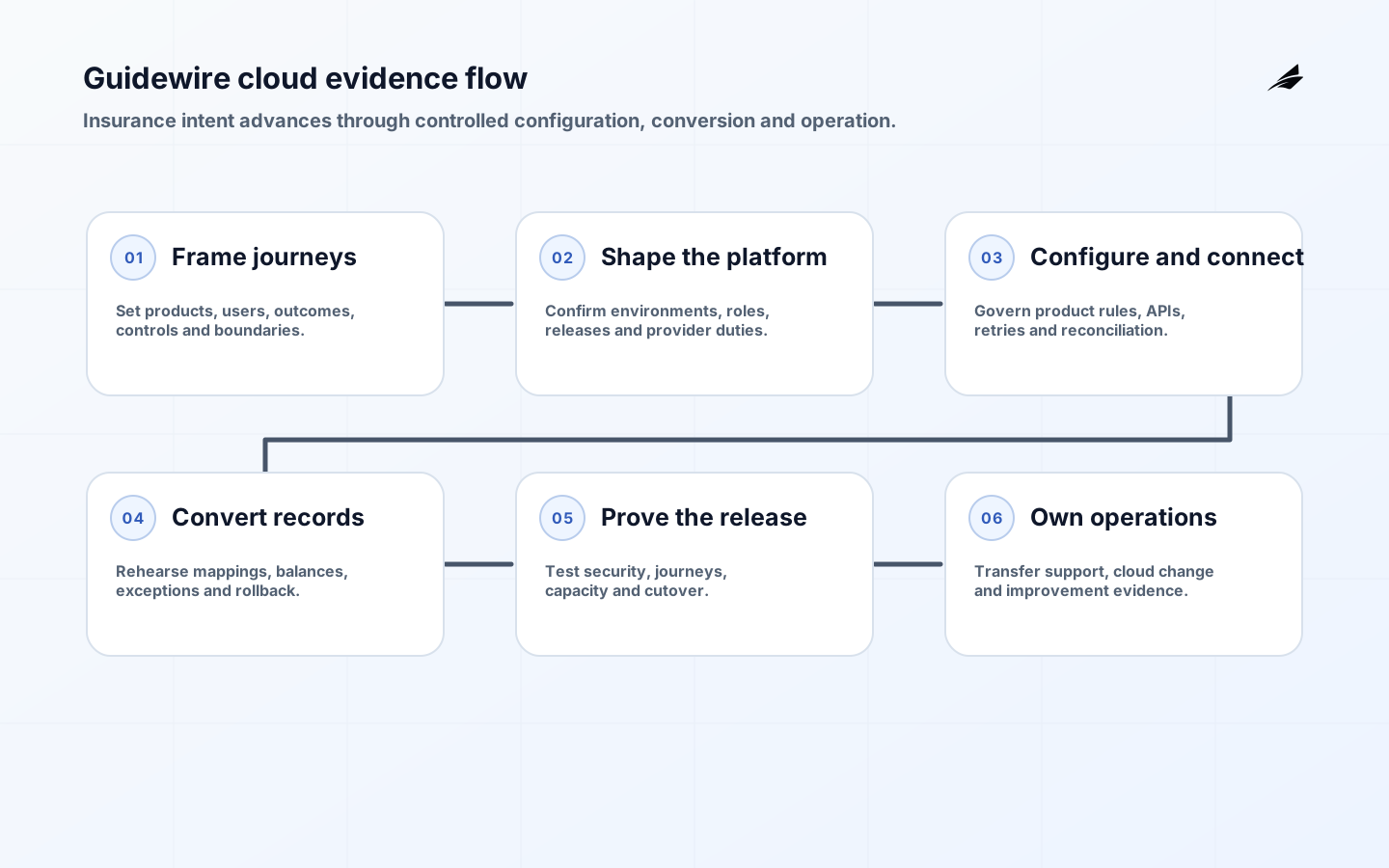
A managed cloud implementation for an insurance core platform is an operating-model change, not a conventional infrastructure move. Policy, billing and claims applications sit inside underwriting, servicing, payment and claim journeys where incorrect configuration or incomplete data can create customer, financial and regulatory harm. The implementation therefore needs a traceable path from insurance outcomes to product configuration, integrations, loaded records, release evidence and day-two ownership. This checklist is for insurer sponsors, product owners, architects, delivery partners, security teams and operations leaders who need to decide whether a release is genuinely ready.
Use the checklist with Edilec's delivery plan for core-system cloud migration, the configuration, conversion and cutover checklist and the cloud services FAQ. Those guides provide commercial and architectural context; this article concentrates on evidence at each gate of the ongoing managed service. Exact platform capabilities and limits vary by provider, contracted products and release, so validate decisions against current provider documentation and the contract.
1. Define the insurance scope and measurable outcomes
Start with bounded insurance journeys, not application modules. Name the first products, jurisdictions, channels, user groups and transactions that will move. For each journey, record the current baseline and intended outcome: quote turnaround, straight-through processing, billing accuracy, claim cycle time, leakage, contact volume or change lead time. Identify statutory notices, financial controls and service commitments that the journey must preserve. A line of business that looks small by policy count may still be complex because of endorsements, producer compensation, catastrophe handling or historical claims.
Create a capability map that distinguishes adopt, configure, integrate, load and retire. Challenge every proposed customization with a business rule, owner and measurable value. Many managed core platforms are updated on the provider's release cadence; where that applies, the model rewards configuration and stable extension points that remain supportable through releases. Keep a decision log for deviations, including the rejected standard behavior, lifecycle cost, test obligation and removal trigger. Scope data retention, reporting, document generation, correspondence and downstream finance at the same time as core transactions.
| Gate | Questions to settle | Required evidence |
|---|---|---|
| Outcome | Which journeys and business measures change? | Approved outcome baseline and scope map |
| Product | Which products, jurisdictions and rules are included? | Versioned product definition and acceptance examples |
| Boundary | What is configured, integrated, loaded or retired? | Capability disposition and deviation log |
| Control | Which financial, privacy and regulatory duties apply? | Control matrix with accountable owners |
| Release | What proves a cohort can move safely? | Entry, pause, rollback and acceptance criteria |
2. Settle the managed delivery model and release flow
Confirm the contracted application set, environments, regions, service limits, release policy, support boundary and non-production capacity before detailed design. Ask how code and configuration reach the service: where source and configuration repositories live, who owns them and whether anything reaches preproduction or production other than through build promotion. Turn the answers into a responsibility matrix covering source control, build promotion, test data, identity, integration endpoints, monitoring, incidents and release approval.

Separate environments by purpose and control who may promote between them. Establish branch, package and dependency policies; do not let a long-lived development environment become the only reproducible statement of the product. If the provider exposes build, artifact and log data through an API, use it to collect evidence without bypassing platform promotion. Define how emergency fixes enter the same version history and how provider release changes are assessed, tested and communicated.
3. Control configuration and integration boundaries
Model insurance products, rules, authority limits, workflows, roles and screens as governed configuration. Give each rule a business owner and executable examples for normal, boundary and exception cases. Protect upgradeability by preferring documented extension points and versioned APIs over changes to the core codebase. For every interface, define the system of record, data contract, identity, authorization, idempotency, timeout, retry, ordering and reconciliation behavior. The OWASP API Security Top 10 is a practical prompt for the authorization and resource-consumption flaws that interface reviews should look for.
Map synchronous dependencies on critical journeys and remove avoidable chains. A quote should not become unavailable because a noncritical enrichment provider is slow. Define bounded fallbacks and manual recovery for document services, payment providers, rating data, fraud signals and enterprise data platforms. Use correlation identifiers across the core platform, integration services and external systems. Test duplicate delivery, delayed response, partial success and ambiguous timeout outcomes; a technically successful HTTP response is not proof that premium, payment or claim state reconciled correctly.
4. Rehearse data loading, refresh and recovery with insurance reconciliation
Inventory source systems and profile data before designing mappings. Decide what must be active in the platform, what can remain in an accessible archive and what should be disposed of under retention policy. Define canonical identifiers for account, contact, policy, risk, billing item, payment, claim, exposure, reserve and document references. Transformation rules need business approval because a technically valid load can still change coverage meaning, financial balance or claim history. Mask production data used outside production and preserve representative edge cases in synthetic fixtures.
Run repeatable mock loads at realistic scale. Reconcile record counts, control totals and relationships, then sample complete business journeys. Financial checks should cover written and earned premium, receivables, commissions, payments, reserves and recoveries as relevant. Claims checks should preserve status, exposure, notes, documents, authority and litigation context. Measure rejects and unresolved exceptions by reason and owner. Require the cutover rehearsal to demonstrate extraction, transformation, load, validation and rollback within the available window. Then test the steady-state duties: refresh a non-production environment with masking applied, restore a deleted record and a whole environment from backup, and compare the measured results with the contract's recovery targets.
| Evidence area | Acceptance check | Failure response |
|---|---|---|
| Configuration | Approved examples pass for products and exceptions | Correct rules and rerun regression pack |
| Integration | Contracts survive retry, delay and duplicate delivery | Quarantine, reconcile and correct ownership |
| Data load | Counts, balances and sampled journeys agree | Trace mapping defect and rerun mock load |
| Security | Roles, service accounts, logs and secrets meet policy | Remove excess access and retest |
| Operations | Alerts, runbooks, restore and escalation are exercised | Close readiness gap before cohort release |
5. Make security and quality release conditions
Apply least privilege to business roles, administrators, integration identities and delivery tooling. Under a shared-responsibility model, which public guidance such as NIST SP 800-144 describes for public cloud services, the insurer typically remains responsible for secure configuration of its own tenant, data and access; confirm the exact split in the provider's security documentation. Integrate authentication with the enterprise identity lifecycle, restrict service-account scope, rotate secrets, review privileged access and send relevant audit events to the insurer's monitoring service. Test segregation of duties for refunds, write-offs, claim payments, product changes and access administration.
Build a risk-based test portfolio: configuration examples, API contract tests, data reconciliation, role tests, financial controls, end-to-end journeys, accessibility, performance, resilience and operational exercises. Automate stable regression paths, but retain exploratory testing by insurance specialists. Test with realistic product combinations and data volumes rather than an idealized happy path. Keep defects linked to affected journeys and release criteria. A test pass is meaningful only when the build, configuration, fixtures and environment are identifiable and the result can be reproduced.
6. Rehearse cutover and transfer operating ownership
Release by a controlled product, branch, region or user cohort where the business allows it. The runbook should name decision authority, timing, data freeze, final extraction, reconciliations, interface switching, user verification, communications, pause thresholds and rollback constraints. Conduct a timed rehearsal with the people who will execute production. Define how in-flight quotes, payments, correspondence and claims are handled. Do not describe rollback as a database restore unless dependent systems, messages and customer actions can also be returned to a coherent state.
Before go-live, permanent teams must own monitoring, access, configuration releases, integration support, data correction, incident command, supplier escalation and release assessment. Agree how an incident is raised with the provider, what information it needs and who speaks to the business; the NIST incident handling guide is a useful outline for roles and phases. Establish journey-level service indicators and business controls, not only component uptime. Track failed transactions, queue age, reconciliation differences, billing exceptions and claims payment delays. Where the provider ships releases as part of the service, maintain a recurring impact, regression and adoption cadence rather than treating launch as the end of change.
Plan business adoption as a controlled product change. Train by role and journey using realistic cases, then verify proficiency through completed work rather than course attendance. Prepare supervisors for exception handling and floor support. Update procedures, controls, customer communications and performance measures before release. Monitor workarounds and abandoned transactions during hypercare; they often reveal configuration or training gaps that technical health checks miss. Assign each adoption finding to the product backlog or an operational owner with a due date.
Review value after stable operation. Compare the original baseline with current product-change lead time, transaction quality, customer effort, operational cost and control evidence. Separate benefits from volume or market changes where possible. Retire duplicate reports, interfaces, licenses and legacy access once retention and reconciliation are complete. If old platforms remain indefinitely, the insurer carries two operating models and weakens the economic case for the cloud implementation.
Key takeaways
- Scope complete insurance journeys and measurable outcomes before modules or customization.
- Prefer governed configuration and documented APIs so releases remain supportable.
- Reconcile data in insurance and financial terms, and prove refresh and restore as well as the first load.
- Treat security, resilience and operational exercises as release evidence.
- Transfer decision rights, runbooks and release ownership to permanent insurer teams before go-live.
Frequently asked questions
Can an insurer customize a managed core platform? Configuration and supported extensions are expected, but each deviation should have an owner, value case and lifecycle test. Must all history be loaded? No; active processing needs, legal retention and usable archive access should determine the split. What is the most important data test? End-to-end reconciliation of insurance meaning and financial controls. Who approves production? The insurer's accountable business and technology owners should approve against agreed evidence, with provider input. What should a partner hand over? Versioned configuration, mappings, tests, runbooks, known limitations, access records and unresolved risk.
Conclusion
A dependable managed cloud implementation connects product intent, platform constraints, loaded insurance records and operational control in one evidence chain. Insurers that bound journeys, resist unnecessary core change, rehearse reconciliation and prepare permanent owners can gain release velocity without weakening accountability. The practical completion test is simple: the insurer can explain, operate, verify and safely change every production journey after the implementation team leaves.