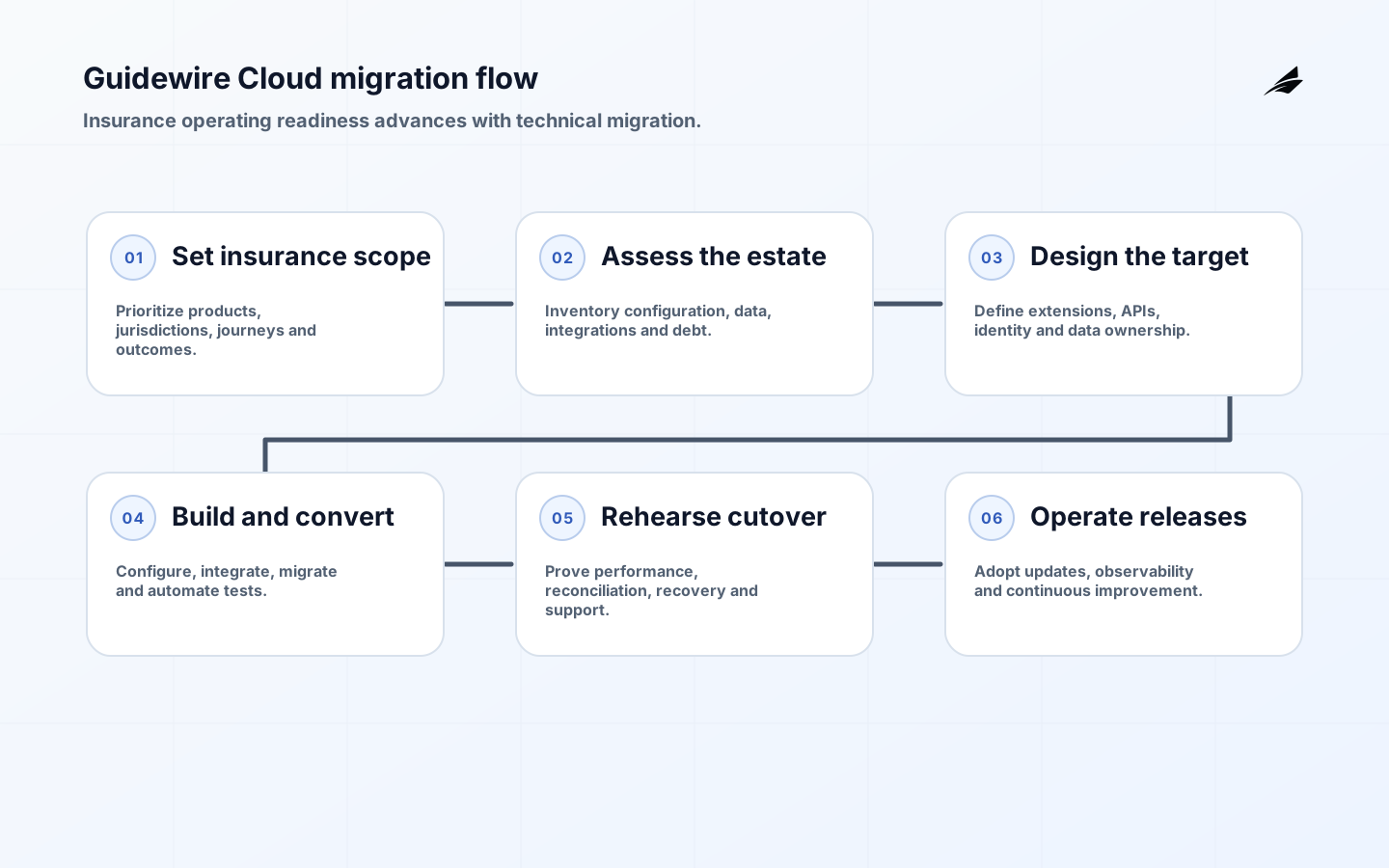
A policy administration modernization is an insurance operating-model change expressed through product configuration, rating, data, integrations and release practices. Quoting, issuance, endorsement, renewal and cancellation touch regulated data, financial transactions, distribution partners and customer service, so a technically valid deployment can still fail if product rules, reconciliation or operational ownership are incomplete. This checklist gives insurer, platform-vendor and implementation-partner teams a shared path from scope to production adoption.
Use the policy administration delivery plan and the policy administration modernization FAQ to establish commercial and architectural context. Compare the related insurance core system cloud migration delivery plan and insurer cloud migration checklist for adjacent migration decisions. Confirm the exact products, release, licensed capabilities and vendor documentation available to the program; product behavior changes over time.
1. Define insurance outcomes and implementation scope
Scope by line of business, jurisdiction, product, channel and customer journey. Name the policy transactions, rating methods, billing plans, payment paths, forms and documents, underwriting referrals, authority limits and regulatory reports included in each release. Establish baseline measures such as quote completion, straight-through issuance, endorsement turnaround, billing exceptions, product-change lead time and service availability. Record what remains on the legacy system and how users will navigate split processes during transition.
Turn the business case and roadmap into insurer-owned gates rather than relying on a generic vendor or integrator path. Identify product, underwriting, distribution, billing, finance, compliance, actuarial, data and support owners. Define decision rights across the insurer, the platform vendor and the systems integrator. A RACI is useful only when every critical deliverable has one accountable insurer owner and a timely escalation route.
| Scope domain | Decision to settle | Evidence before build |
|---|---|---|
| Product and rating | Which coverages, rates, rules, forms and jurisdictions enter the release? | Approved product inventory, rate basis and effective dates |
| Process | Which user journeys and exceptions change? | Validated current and target cases |
| Data | Which history is converted, archived or accessed on demand? | Retention, ownership and quality profile |
| Integration | Which real-time, batch and document interfaces remain? | Dependency and transaction catalog |
| Operations | Who supports configuration, integrations and production decisions? | Operating model and escalation map |
| Release | How will new platform releases and the insurer's own changes be evaluated and adopted? | Regression, compatibility and change calendar |
2. Design product configuration, rating and environments
Prefer standard configuration and supported extension patterns over reproducing every legacy customization. For each customization, document the business rule, user, frequency, control need, standard alternative and retirement decision. Maintain a decision register linking each requirement to configuration, extension, integration or process change. Keep product definitions, rating tables, rules and form templates under version control with effective dates, so any quote or renewal can be reproduced under the rules in force on its transaction date. Use the documentation for the actual release rather than the conventions of an older implementation.

Separate development, test, pre-production and production duties. Define source control, branching, build reproducibility, artifact promotion, environment configuration and secrets. Map those environments to approval and evidence requirements, including who may change a rating table and who may promote it. Production promotion should use an identified artifact tested in lower environments, with compatible configuration, data-change handling and a recovery decision.
3. Engineer integrations and data conversion
Inventory every producer, consumer, protocol, schedule, volume, data owner, service expectation and failure consequence. Classify interactions as synchronous command, query, event, batch, file or document. Typical policy-system exchanges include billing set-up and invoice triggers, document generation, agent and customer portals, payment services and rating-data providers. Use the target system's supported APIs and release-specific definitions, enforce caller identity and business authorization, and design idempotency, pagination, rate handling and correlation deliberately.
Treat conversion as a repeatable product. Define source-to-target rules, code mappings, defaulting, survivorship, referential integrity and reconciliation. Profile real data early, including malformed addresses, duplicate contacts, inconsistent producer codes, mid-term changes and long-tail policies. Decide how much history users need transactionally versus through an archive. Run multiple timed conversions using production-scale copies under privacy controls. Reconcile counts and premium amounts by legal entity, product and accounting period, then require business owners to validate representative policies, invoices and payments.
| Test stream | Representative proof | Exit criterion |
|---|---|---|
| Product and rating rules | Boundary values, dates, jurisdiction and endorsement changes | Expected premium, coverage and forms |
| Renewal and billing | Renewal offers, payment plans, delinquency, cancellation and reversal paths | Financial events and controls reconcile |
| Integration | Timeout, duplicate, ordering, unavailable dependency and replay | No lost or duplicated business effect |
| Conversion | Open and historical records with difficult source conditions | Counts, amounts and relationships accepted |
| Performance | Peak quote, renewal-run and billing-run patterns | User and batch targets met with headroom |
| Recovery | Failed deployment, integration backlog and data restoration | Runbook completes within agreed objectives |
4. Implement security, privacy and financial controls
Federate workforce identities, automate lifecycle where supported and design roles around insurance duties. Separate product configuration, deployment, payment, premium adjustment, data export and security administration. Apply field and record restrictions to sensitive policyholder, medical, payment and identity data. Log privileged and material business actions with attributable identities. Encrypt data in transit and at rest, manage secrets and keys outside code, restrict non-production data, and test access removal. Emergency access needs time limits, justification and review.
Request independent assurance evidence that applies to the contracted service, such as audit reports or ISO/IEC 27001 certification where the provider offers them, and map provider, insurer and integrator responsibilities. Corporate certification does not prove that insurer-defined roles, integrations, data exports and custom code are correctly controlled.
5. Prove end-to-end behavior, compare in parallel and rehearse cutover
Build a regression portfolio around business risk, not an indiscriminate script inventory. Cover product and rating rules, authority, financial calculations, documents, integrations, conversion, security, accessibility, performance and recovery. Maintain stable test data and expected results. Include renewal and accounting cycles that span dates, time zones and releases. Automate deterministic high-frequency checks while preserving exploratory testing for complex underwriting and servicing work. Record defects against the configuration or rule version that produced them.
Run a rating and transaction comparison before cutover. Feed the same quote, endorsement and renewal inputs through the legacy and new systems, and compare premiums, coverages, forms and effective dates. Agree tolerances and a named adjudicator for differences, and record whether each difference is a defect, an intended rule change or an error in the legacy system. Decide whether live dual operation is needed or comparison is enough, and write down the criteria that end the parallel period.
Rehearse conversion, integration quiescence, final reconciliation, deployment, smoke tests, business validation and communications as one timed event. Define go/no-go criteria, decision authority and the latest reversible point. A rollback may require more than redeployment after new policies, payments or endorsements enter the target system; design forward recovery and transaction reconciliation. Staff hypercare by business journey and technical component, with one incident route and clear severity. Exit hypercare only after trend-based criteria, not an arbitrary date.
6. Operate the new platform through regular releases
Assign owners for product configuration, integrations, data, platform coordination, security, testing and service management. Establish service indicators for user journeys, batch completion, API errors, integration backlog, document generation and financial reconciliation. Connect platform observability with enterprise incident and business monitoring. Every alert should have an owner and response. Review recurring defects and manual corrections as product backlog, not permanent support demand.
Plan for the continuing release model of the platform. Maintain a change calendar, release-impact assessment, supported dependency inventory and automated regression suite. Test custom code and integrations against available release environments, review deprecated behavior and brief business users on material changes. Measure deployment frequency, failed change, recovery, escaped defect and update-adoption lag together. Faster updates are valuable only when the insurer can safely absorb and use them.
Treat organizational adoption as a testable workstream. Map how underwriters, billing specialists, service representatives, agents and finance teams will perform changed tasks. Build role-based scenarios from real work, provide practice environments and identify local support before launch. Measure completion and error patterns rather than attendance. Update procedures, authority documents and downstream reports at the same time as the application. Preserve a controlled route for urgent production guidance so users do not create private workarounds that bypass the new record and control model.
Plan decommissioning with the same rigor as cutover. Inventory legacy interfaces, reports, scheduled jobs, accounts, archives, licenses and infrastructure. Confirm that converted or archived records satisfy service, legal, actuarial and audit needs and that retention holds remain enforceable. Disable inbound transactions, monitor for unexpected calls, revoke access and preserve final reconciliation evidence before shutdown. Track avoided cost only when contracts and infrastructure actually end. A successful go-live does not by itself remove legacy risk or expense.
Create an operational ownership matrix for every integration. Name who detects a failed message, who can inspect payloads, who decides replay, who contacts the counterparty and who reconciles insurance and financial effects. Define support-safe diagnostic views that avoid broad database access. For high-volume or legally significant interfaces, retain sequence and business identifiers sufficient to prove completeness. This is especially important for payments, documents and agent feeds, where a recovered technical connection may still leave missing or duplicated transactions.
Key takeaways
- Scope the modernization by insurance product, journey, jurisdiction and operating outcome.
- Challenge legacy customization and use current supported platform and API patterns.
- Make conversion repeatable and reconcile premium and financial completeness as well as technical completeness.
- Compare rating and transactions in parallel before committing to cutover.
- Rehearse cutover as an end-to-end business event and build capability for continuing releases.
Frequently asked questions
Is a greenfield implementation easier than migration?
It avoids some legacy conversion and customization debt but still requires product, integration, data, control and operating decisions. Greenfield programs often carry difficult coexistence and organizational-change work. Compare risk by release scope and dependency, not by label.
Do converted policies need to be re-rated?
Usually not at conversion. A converted in-force policy represents a contract already issued, so its premium, coverages and forms should match what was issued. Re-rating is a decision for the next renewal or endorsement, taken with underwriting and compliance owners, and any exception needs documented approval.
Who should own the implementation?
An accountable insurer executive and product leadership should own outcomes and risk. The platform vendor and integrators provide product and delivery expertise, but insurer owners must decide product behavior, data, control, acceptance and operational priorities.
Conclusion
A policy administration modernization succeeds when insurance behavior and delivery discipline are designed together. Keep product scope, supported extension, integration contracts, conversion evidence, security responsibility and release operations connected from the start. That turns core modernization into an operable insurance capability rather than a one-time platform move.