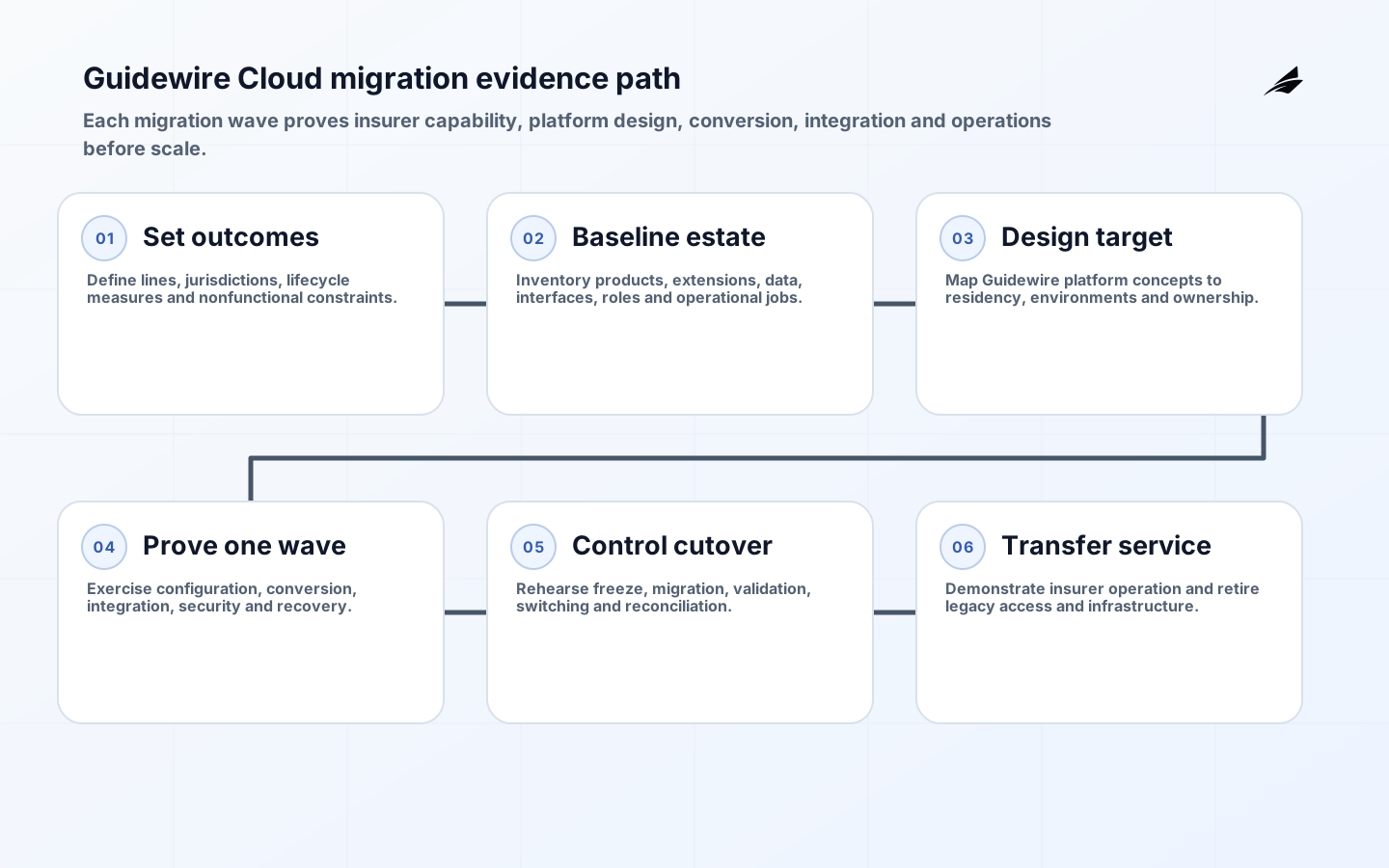
Managed cloud services for an insurance core platform should deliver a dependable insurance capability, not merely move hosting to a provider. A service provider runs the platform layer under the policy, billing or claims applications, while the insurer keeps product rules, data, access decisions and the business outcome. The scope may include configuration, data loading, integrations, testing, release engineering, security, onboarding and support. Each workstream changes different evidence and ownership. A delivery plan must connect them through policy, billing and claims outcomes so that component completion cannot conceal an unusable end-to-end service.
This plan is distinct from the implementation checklist for insurance core platform cloud services and the cloud services FAQ. It is vendor-neutral and concentrates on the ongoing managed service. Exact capabilities differ by provider, product, release, region and contract, so confirm them in writing. Start with insurer decisions and constraints; then choose the smallest onboarding scope that proves configuration, data, integration and operations together.
1. Define outcomes and service boundaries
Name the lines of business, jurisdictions, distribution channels, user groups and lifecycle transactions in scope. Set outcome baselines such as product-change lead time, quote completion, billing accuracy, claim handling time, release effort, incident exposure and infrastructure burden. Record nonfunctional constraints for availability, recovery, catastrophe capacity, close periods, privacy and residency. “Move to cloud” is not an outcome; it cannot determine whether a design trade-off is acceptable.
Build a service decomposition across provider-operated platform capabilities, insurer configuration, implementation-partner work, external systems and business operations. For each item record who runs it, who approves a change and who answers when it fails. Assign accountable owners for product rules, integrations, data, identity, testing, onboarding and production service. A provider can run the platform, but the insurer must own product intent and residual risk. Keep commercial deliverables linked to usable business increments rather than documents or component counts.
2. Baseline the current estate and design the target service
Inventory applications and versions, product models, extensions, batch jobs, documents, reports, integrations, identities, data stores and archives. Link each item to a business capability and owner. Analyze incident history, release bottlenecks, unsupported technology and manual workarounds. Do not let an incomplete inventory delay all progress, but close gaps around the first onboarding scope before design is approved.

Design the target service using the provider’s documented, supported patterns for the selected release. Map tenancy, regions and account boundaries to residency, business units and lifecycle environments. Decide how the core applications, integration services, data services and external platforms interact. Record architecture decisions with alternatives and consequences. Avoid reproducing every on-premises boundary when a simpler supported service meets the business requirement.
| Workstream | Core artifact | Acceptance evidence |
|---|---|---|
| Service scope and responsibility | Responsibility matrix per environment and control | Named owners confirmed in a tabletop exercise |
| Product and configuration | Approved product and rule design | Lifecycle scenario results |
| Data and integration | Versioned mappings and owned interface contracts | Control totals, failure, retry and reconciliation tests |
| Operations | Service model, runbooks and service levels | Observed incident and recovery rehearsal |
3. Plan environments, data and integration together
Decide which environments the service needs and what each is for, from development to production. State who can create, refresh or retire one, and what it costs. Profile source data for completeness, duplicates, relationships, history and sensitive fields, then decide what loads, what archives and what is retired. Define canonical identifiers, transformation rules and financial control totals, and rehearse the load with measured duration. Loaded data must work in real transactions, not only satisfy counts; test renewal, endorsement, billing and claim activity on representative records.
Catalog interfaces with contract, ownership, authentication, volume, latency, retry, ordering, reconciliation and degraded behavior. Confirm which connectivity options the provider supports, such as public TLS endpoints or private links, and who operates each end. Redesign unsupported or tightly coupled exchanges rather than wrapping them blindly. Sequence external-system changes with data loading and cutover because data authority moves across the same boundary. During coexistence, name the writer of record and prevent uncontrolled dual updates. Make replay idempotent and integration exceptions visible to the business.
4. Establish security, privacy and operating controls
Apply the provider’s shared-responsibility statement to the actual solution. Typically the insurer owns data classification, approved use, roles and any components it introduces; the provider operates the underlying platform; and partners implement controls under insurer authority. Design identity federation, privileged access, service identities and emergency paths. Keep production data out of lower environments unless expressly authorized and protected. The NAIC Insurance Data Security Model Law, for example, asks insurers to exercise due diligence in selecting third-party service providers and to require appropriate protective measures of them; check what applies in each jurisdiction.
Protect code, configuration and infrastructure definitions through reviewed repositories, separated credentials, automated checks and traceable promotion. Threat-model custom extensions, integrations and web experiences. Define vulnerability triage and remediation across organizations. Logs should reconstruct security and business events without uncontrolled personal-data duplication. Confirm penetration-testing boundaries and incident evidence access before a real event.
5. Prove the service through a representative onboarding scope
Choose a scope narrow enough to control but complete enough to expose hard seams: one meaningful product or jurisdiction, realistic data, core integrations, user roles and operational support. A demonstration with clean new-business cases will not prove in-force change, billing reconciliation or claims. Set entry and exit evidence for configuration, data, security, performance, accessibility, operations and business acceptance, using production-like volume and governed data.
Run release and failure rehearsals. Deploy the exact promoted artifact, test rollback or forward repair, interrupt dependencies, restore data, invoke downtime procedures and reconcile after recovery. Compare measured recovery time and recovery point with the contract targets. Include catastrophe or peak scenarios relevant to the insurer. Track defects by business consequence and root condition, not only severity labels. The scope is complete when permanent teams can run it and evidence meets thresholds, not when the project calendar reaches its planned end.
| Cost category | Often missed item | Planning treatment |
|---|---|---|
| Implementation | Insurer subject-matter capacity | Named allocation by phase |
| Platform | Variable usage, extra environments and higher support tiers | Scenario range and owner |
| Transition | Dual run and reconciliation | Time-bounded explicit budget |
| Exit | Data return, legacy archive and decommissioning | Closure criteria and retained obligation |
6. Model cost, service levels and risk transparently
Build a work breakdown for design, configuration, remediation, data loading, integration, testing, environments, partner services, training, dual run, cutover and decommissioning. Add insurer subject-matter time and ongoing platform, usage and support charges. Use ranges with assumptions rather than false precision, and schedule around product filings, renewals, billing close, catastrophe seasons and change freezes. Price rework from unknown customization and poor data quality explicitly. Read each service level as an operating commitment: what is measured, how an outage is counted and what the remedy is.
Maintain a risk register with trigger, consequence, mitigation, contingency, owner and review date. Typical risks include unsupported extensions, underestimated data work, partner capacity, integration dependency, provider lock-in, role conflict and insufficient operating skill. Do not hide uncertainty in a fixed-price boundary; unresolved assumptions usually reappear as change requests or reduced acceptance scope.
7. Onboard, transfer ownership and plan the exit
Plan the move into the service as a timed, rehearsed control procedure. Define data freeze, final extraction, validation, interface switching, smoke tests, business confirmation, communication and go/no-go authority. Establish rollback feasibility and a forward-repair path for transactions that cannot be reversed. Staff technical and business command and reconcile every deferred or manually handled transaction after service begins.
Transfer production ownership through demonstrated capability. Permanent teams should deploy, monitor, handle an incident, restore data, resolve an integration exception and explain escalation, including when to call the provider. Deliver current source, configuration, data mappings, tests, runbooks and open risks into insurer-controlled systems. Agree exit terms while leverage is highest: data return format and timing, transition help and the cost of both. Retire legacy jobs, credentials, interfaces, licenses and data according to policy. Review results against outcome baselines and fund the next release backlog.
Maintain an acceptance ledger that links each material requirement to an owner, implementation evidence, test result, residual limitation and review date. Sample the evidence with the people who operate the service. Re-open acceptance when a provider, data source, integration, user population or authority boundary changes. This ledger prevents a successful launch label from concealing expired assumptions, incomplete handover or controls that were demonstrated once but cannot be exercised by the permanent team.
Before closing each onboarding phase, reconcile the insurer’s production topology with the design inventory. Confirm which environments and applications contain sensitive data, which integrations can create financial or policy state, which batch jobs must finish before business opens and which provider and supplier contacts can act outside normal hours. Review pending provider release changes against customer configuration and regression coverage. This topology becomes the basis for cutover command, incident routing and release planning; without it, knowledge stays divided among partner specialists.
Key takeaways
- Anchor scope in measurable insurance outcomes and jurisdictions.
- Map provider responsibility to insurer and partner ownership, control by control.
- Design data loading, integrations and coexistence as one transition system.
- Use a representative scope to prove business, recovery and operational evidence.
- Transfer capability, agree exit terms and decommission legacy obligations before declaring completion.
Frequently asked questions
What usually drives the cost of a managed core platform service?
Product and process variation, customization remediation, data quality, integration count, number of environments, test breadth, organizational change and coexistence typically drive effort. Platform subscription, usage and support commercials add separate fixed and variable elements.
Is a single-step cutover ever appropriate?
It may be necessary where state is tightly coupled or long coexistence is riskier. It requires stronger data rehearsal, capacity testing, command structure, downtime planning, reconciliation and rollback or forward-repair evidence.
What should remain under insurer control?
Business rules, data definitions, architecture decisions, production approvals, authoritative repositories, test evidence, risk acceptance and service ownership should remain controlled by the insurer even when providers and partners perform substantial delivery work.
Conclusion
Managed cloud services create value when they leave the insurer with a current, operable core platform and the ability to change it safely. The plan must integrate product, data, interfaces, security, release and business adoption. Treating these as separate supplier tracks increases late discovery and weakens acceptance.
Use evidence gates at each phase, confirm provider assumptions against current documentation and the contract, and make insurer ownership visible throughout delivery. Close the program only after permanent teams operate their share of the service, exit terms are agreed and legacy obligations are retired. That is the difference between completing a hosting project and establishing a sustainable capability.