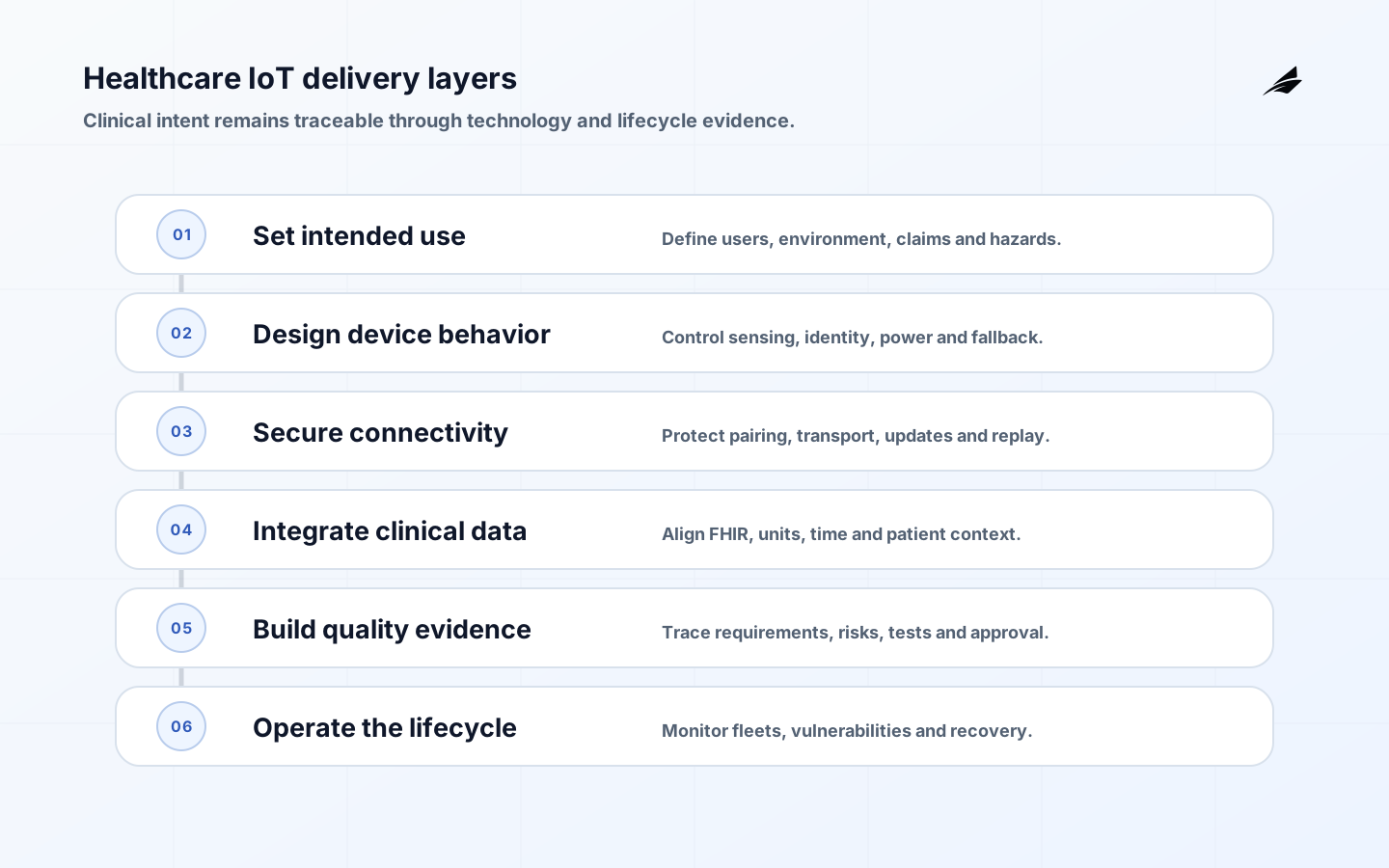
A healthcare IoT software development company may build device software, gateways, mobile applications, cloud services, clinical integrations, fleet operations or some combination. Those components sit inside a care and quality system where timing, identity, data meaning, cybersecurity and recovery can affect safety. Selecting a partner therefore starts with intended use and responsibility boundaries, not a list of frameworks. Buyers need evidence that the company can translate clinical hazards and regulatory duties into architecture, tests, records and postmarket operation.
This guide complements Edilec's healthcare IoT implementation checklist and healthcare IoT FAQ. For products centered on a software service rather than connected devices, compare the healthcare SaaS delivery guide. Regulatory classification and obligations depend on intended use, market and role, so obtain qualified regulatory and clinical advice for the product.
Define intended use and the device boundary
Write who uses the system, for which patient population, in what environment, for what purpose and with what clinical consequence. Distinguish wellness, operational monitoring, clinical decision support, alarm, diagnosis and therapy. Map the physical device, embedded software, phone, gateway, network, cloud, clinician interface, EHR and support tools. State which company is the legal manufacturer or regulated entity, who owns each record and which parties can change software after release.
Convert intended use into safety and performance claims that can be verified. Include normal use, foreseeable misuse, home connectivity, depleted power, clock drift, sensor detachment, wrong-patient association, lost device, delayed data, duplicate observations and unavailable cloud service. A dashboard warning cannot compensate for an architecture that silently presents stale measurements as current. Define local behavior when connectivity fails and how users can distinguish measured, calculated, delayed and corrected information.
| Scope layer | Decision to make | Principal risk | Acceptance evidence |
|---|---|---|---|
| Device | Sensing, control and local fallback | Unsafe or misleading state | Bench and hazard tests |
| Connectivity | Protocol, pairing and offline behavior | Loss, replay or wrong association | Disruption and identity tests |
| Cloud | Ingestion, tenancy, rules and storage | Delayed or cross-patient data | End-to-end trace and isolation test |
| Clinical integration | FHIR resources, units and workflow | Semantic mismatch | Profile and clinician validation |
| Operations | Provisioning, update and incident response | Unmanaged fleet or failed patch | Fleet exercise and recovery record |
Establish the quality and regulatory operating model
In the United States, FDA's Quality Management System Regulation became effective on February 2, 2026 and incorporates ISO 13485:2016 by reference for applicable device manufacturers. The FDA QMSR page explains applicability and inspection changes. A development partner should show how requirements, risk management, design reviews, supplier controls, verification, validation, configuration, complaints and corrective action fit the buyer's quality system, including who approves records.
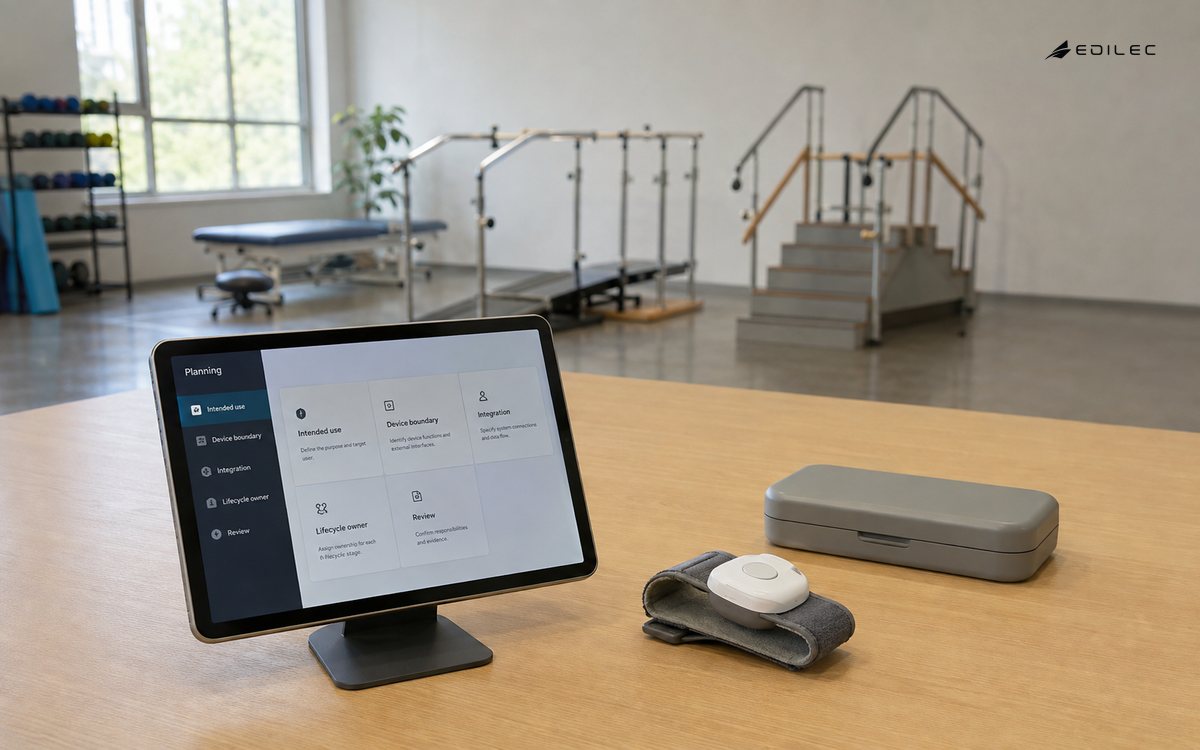
Ask for a responsibility matrix that distinguishes product decisions from development execution. Review the partner's traceability from user and system requirements through hazards, architecture, code, tests and release. Inspect a representative design-history record, change-control example and unresolved-defect process. Outsourcing development does not outsource the accountable manufacturer's obligations. Contracts should grant access to source, build instructions, test evidence, component inventory, vulnerabilities and records needed for submissions, audits and safe maintenance.
Design cybersecurity as a safety lifecycle
FDA's February 2026 medical-device cybersecurity guidance addresses design, labeling and recommended premarket documentation for devices with cybersecurity risk. Build a threat model around assets, trust boundaries, clinical harms and abuse paths. Include device identity, authenticated updates, least privilege, secure defaults, protected communications, data integrity, logging, vulnerability management, coordinated disclosure and recovery.
NISTIR 8259A's IoT device capability baseline covers identification, configuration, data protection, logical access, software update and cybersecurity-state awareness. Tailor these capabilities to the intended use. Test key provisioning, factory reset, decommissioning, expired credentials, rollback protection and operation during unavailable update infrastructure. Maintain an SBOM and support policy that connects components to deployed device cohorts. Plan how urgent security updates will be validated and distributed without creating unacceptable clinical interruption.
Make clinical interoperability semantic and secure
HL7 FHIR is a healthcare data-exchange standard, not a complete plug-and-play clinical model. Choose version, implementation guide, profiles, terminology, identifiers, units, effective time, provenance and conformance behavior. Decide whether a reading is an Observation, DeviceMetric or another resource in the target workflow, and how device, patient, encounter and performer are linked. Validate with receiving clinicians and systems, including corrections, duplicates and unavailable mappings.
FHIR is not itself a security protocol. HL7's FHIR security guidance calls for secured communication, authentication, authorization, audit and input validation in production implementations. Enforce patient and tenant scope before querying or writing resources. Record purpose and provenance where required. Synchronize clocks and carry time-zone meaning. Test malicious narrative, oversized attachments, revoked consent, token scope, bulk export and audit-event completeness across the actual integration.
| Evidence set | What it should connect | Buyer review | Lifecycle trigger |
|---|---|---|---|
| Requirements trace | Intended use to tests | Missing or ambiguous claims | Design change |
| Risk file | Hazard, control and residual risk | Clinical and security review | New hazard or incident |
| SBOM and architecture | Components to deployed cohorts | Support and vulnerability path | Component update |
| Interoperability profile | Resource, terminology and workflow | Receiving-system conformance | Interface version change |
| Release record | Artifact, tests, approval and rollback | Reproducible deployment | Every production release |
Engineer privacy and data governance across the fleet
Map data from sensor to support export. Minimize collection, separate device operations from clinical content where practical, define retention and restrict effective access. In US covered-entity and business-associate contexts, the HHS HIPAA Security Rule establishes safeguards for electronic protected health information; other jurisdictions and roles differ. Determine responsibility for patient requests, correction, deletion where applicable, breach response and secondary use.
Support and observability tools deserve the same scrutiny as the clinical application. Avoid placing direct identifiers or raw measurements in unrestricted logs. Use cohort and device identifiers with controlled lookup, role-based access and auditable emergency support. Test cross-organization access, abandoned devices, reassignment and data remaining after decommissioning. Contracts should identify subprocessors, locations, notification duties, return or deletion and evidence available to the buyer.
Use a risk-led delivery and validation plan
Stage work through discovery, feasibility, architecture, controlled prototype, design verification, validation in intended-use conditions, regulatory preparation, limited rollout and monitored scale. Separate exploratory prototypes from controlled product code and data. Use representative hardware early; simulators help repeat edge cases but cannot prove radio, battery, sensor, thermal or user-handling behavior. Include clinicians, biomedical engineering, security, privacy, quality, regulatory, operations and support at defined reviews.
Validation should use representative users and environments and should test the complete task, labeling and fallback. Exercise network loss, stale data, alarm fatigue, wrong-patient risk, interrupted update, cloud outage, restoration and record reconciliation. Define release criteria and unresolved-anomaly disposition. A successful technical transfer proves the buyer can build, sign, deploy, observe, update and recover the system using controlled records and authorized identities.
Estimate total lifecycle cost and vendor fit
Cost includes product discovery, industrial and firmware work, cloud and mobile software, quality-system participation, cybersecurity, interoperability, test equipment, clinical evaluation, regulatory support, manufacturing integration, connectivity, hosting, monitoring, support, vulnerability response, updates and retention. Hardware revisions and certification can make late architectural changes expensive. Model cost per active device and patient episode under expected and stressed connectivity, storage and support demand.
Evaluate companies with a paid discovery or scenario exercise using the real workflow. Ask how they would handle a duplicated observation, revoked device credential, vulnerable component, interrupted update and delayed clinical message. Review comparable evidence, staff continuity, subcontractors, quality audit history, secure-development practice and transfer rights. The manufacturing IoT delivery guide can help separate general fleet capability from healthcare-specific clinical and quality work.
Run evidence-based vendor diligence
Ask finalists to trace one representative requirement from intended use through hazard analysis, architecture, implementation, verification and release approval. Inspect how they control firmware, mobile, cloud and infrastructure configurations as one product system. Review a redacted corrective-action example and ask how the root cause changed process or design. Verify that clinical, quality, regulatory and security specialists are available to the delivery team rather than appearing only in sales material.
Check operational evidence: fleet inventory, device identity, certificate rotation, update success by cohort, vulnerability intake, complaint escalation, backup restoration and supplier monitoring. References should involve a comparable device lifecycle and market, not merely a healthcare website. Contract milestones should include traceability, risk and transfer artifacts alongside software. Reserve the right to audit relevant records and approve consequential subcontractors, and define how records remain accessible if the supplier is acquired or ceases trading.
Score proposals on demonstrated capability, responsibility clarity, lifecycle support, architecture fit, evidence quality and total cost. Treat an unrealistically low estimate as a question about omitted verification, quality or postmarket work. Run technical and quality diligence together: a strong code sample cannot compensate for uncontrolled records, and polished templates cannot compensate for an unsafe architecture. Document the selection rationale and risks accepted by the accountable product owner.
Healthcare IoT software development company FAQ
Does FHIR compliance guarantee EHR interoperability?
No. Teams must align FHIR version, profiles, terminology, identifiers, workflow, security and receiving-system behavior. Prove conformance and clinical meaning with the target integration rather than relying on a generic claim.
Can a medical IoT product depend entirely on cloud availability?
That depends on intended use and hazard analysis. Define safe local behavior, visible degradation, buffering, recovery and reconciliation. A connectivity assumption must be tested in the actual use environment and reflected in labeling and operations.
What is a credible first release?
A narrow intended use with controlled hardware, one validated clinical workflow, defined integrations, complete safety and cybersecurity evidence, fleet operations and support. Removing controls to move faster creates expensive evidence debt and may invalidate the product boundary.
Key takeaways
- Select a partner against intended use, clinical hazards and responsibility boundaries.
- Integrate development evidence with the accountable quality system.
- Treat cybersecurity, updates and vulnerability response as safety lifecycle work.
- Validate semantic interoperability and patient association end to end.
- Budget for the complete device, cloud, quality and postmarket lifecycle.
Conclusion: buy an evidence-producing delivery capability
The right healthcare IoT software development company can connect clinical intent to dependable devices, secure services, interoperable records and lifecycle operation. Make ownership and intended use explicit, inspect quality evidence, exercise failure and transfer the capability to maintain the product. That standard protects patients and the buyer far better than choosing on technical breadth or prototype speed alone.