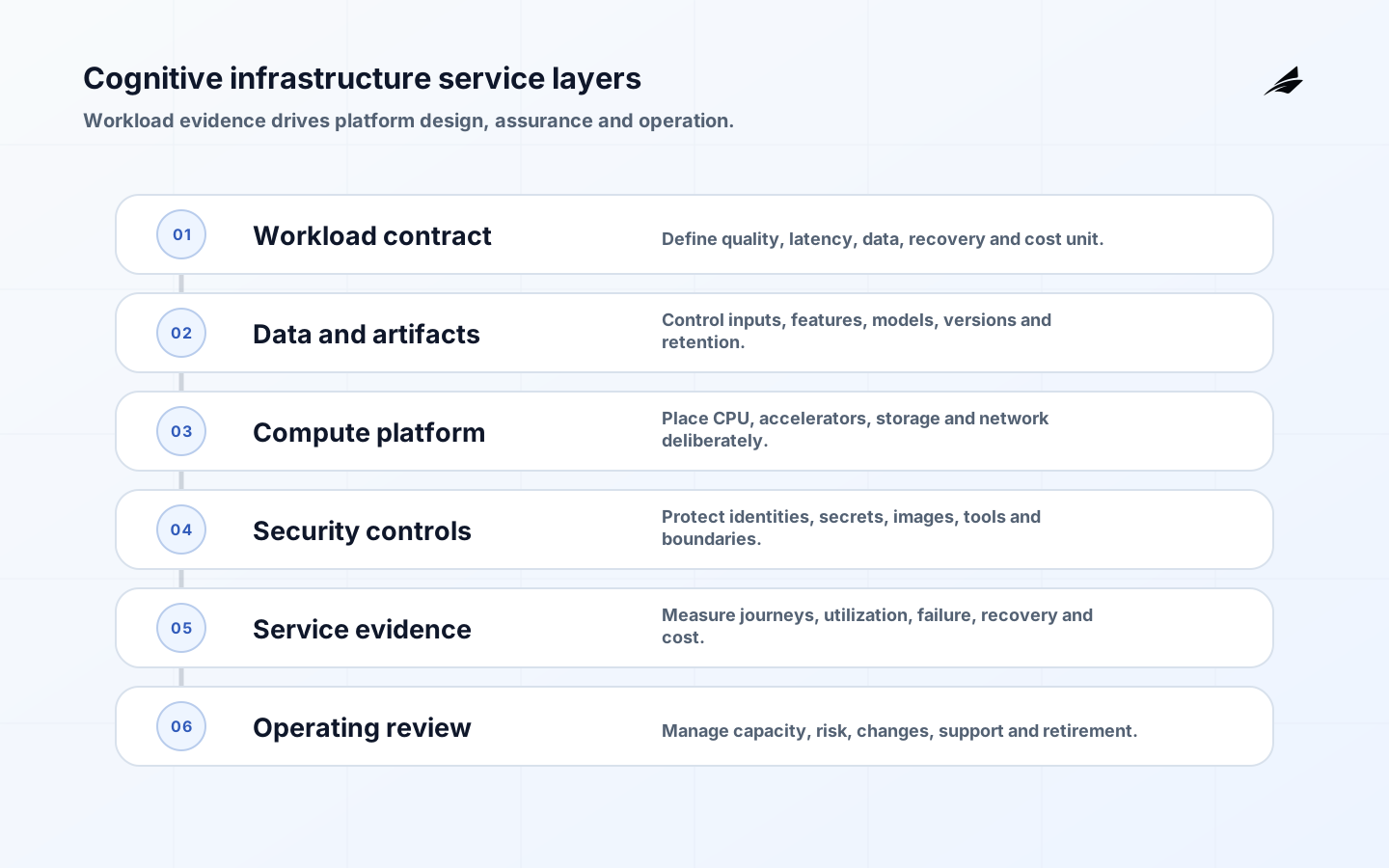
This cognitive infrastructure services FAQ is designed for teams moving from research to an accountable delivery decision. Use the cognitive infrastructure implementation checklist, scope, cost and risk plan and production implementation checklist for adjacent scope, implementation and operating questions. The practical standard here is evidence: named owners, explicit boundaries, representative tests and a route to stop or correct the system when assumptions fail.
Cognitive infrastructure services combine compute, data, orchestration, model delivery, security and operations for AI-enabled workloads. The phrase does not identify one product or architecture. A useful evaluation starts with workload evidence and operating responsibility. Kubernetes documents how accelerators become schedulable resources through device plugins, while OpenTelemetry signals provide a vendor-neutral basis for traces, metrics and logs. The NIST AI RMF adds lifecycle risk questions that infrastructure metrics alone cannot answer.
What do cognitive infrastructure services include?
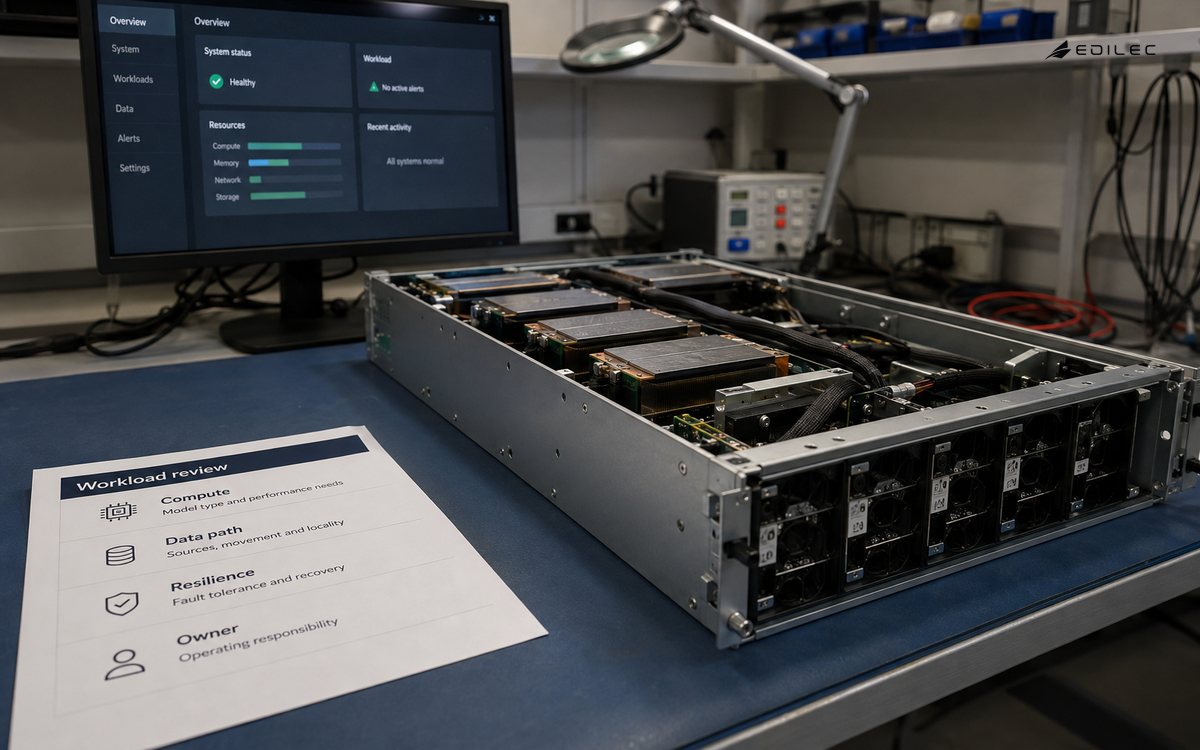
The service should include only the capabilities needed to run declared workloads reliably: environments, CPU and accelerator pools, storage, network, identity, secrets, images, orchestration, model or artifact registry, deployment paths, telemetry, backup, capacity and support. It may support training, batch inference, online inference, retrieval, feature computation or conventional analytics, but those patterns have different latency, data and recovery needs. Start with a workload card recording owner, users, data classification, software stack, accelerator profile, concurrency, input and output sizes, latency or completion objective, availability, recovery, geographic limits and cost unit. Separate platform responsibilities from model and application responsibilities. A managed cluster can be healthy while an unsafe or inaccurate model remains a business failure. The service catalog should state what the platform guarantees, what teams configure and what requires a separate assurance process.
How should teams choose an architecture?
Choose from workload and failure evidence rather than defaulting to a large shared cluster. Training favors throughput, checkpoints and queue fairness; interactive inference favors predictable tail latency, rapid scaling and safe degradation; retrieval adds index freshness and authorization; batch work may tolerate interruption but requires restartability. Map the full data path from source and preprocessing to artifact, endpoint and downstream action. Record residency, egress, key ownership and deletion. Decide which components are pooled, isolated or dedicated, and define triggers for moving between them. Kubernetes GPU scheduling exposes accelerators as custom resources after vendor drivers and plugins are installed, but scheduling support does not solve topology, fragmentation, health, model fit or fair allocation. Benchmark representative models and data before committing capacity.
| Workload | Primary objective | Capacity evidence | Safe fallback |
|---|---|---|---|
| Training | Time to validated artifact | Epoch throughput and checkpoint time | Resume from checkpoint |
| Online inference | Tail latency and availability | Concurrent representative requests | Smaller model or human path |
| Batch inference | Deadline completion | Items per hour and restart cost | Delay or partition batch |
| Retrieval | Authorized freshness | Index lag and query latency | Bounded direct search |
| Experiment | Learning within budget | Quota and expiry | Stop environment |
Which security and governance controls matter?
Federate human identity, give workloads distinct identities, minimize standing privilege, protect secrets outside images and notebooks, verify artifacts, restrict network paths and log administrative changes. Separate development from production and constrain sensitive data to approved workspaces. Apply the NIST SSDF to platform code, images, dependencies and deployment automation so vulnerabilities and provenance are addressed through the lifecycle. For AI-specific risk, the NIST AI RMF organizes work around govern, map, measure and manage. Connect each use case to an accountable owner, evaluation, human review, fallback and incident route. Treat prompts, retrieved documents and model output as untrusted across application boundaries. Infrastructure approval should never be interpreted as blanket approval for every model or use of the data.
How are performance and cost controlled?
Set service objectives at the user journey and workload levels: queue delay, time to first response, completion latency, throughput, error rate, deadline success and recovery. Measure by model, version, tenant, hardware class and request shape because fleet averages hide contention. Track utilization together with useful work; high GPU allocation can coexist with low computation due to data stalls or oversized reservations. Estimate cost per training run, evaluated model, batch item or successful inference, including storage, egress, idle reservation, licenses and operations. Use quotas, budgets, queue priorities, autoscaling bounds and expiry for experiments. Compare smaller models, quantization, batching, caching and CPU paths where they preserve required quality. Cost control is an engineering feedback loop, not a one-time discount negotiation.
What must observability and resilience prove?
Correlate request or job identity across gateway, application, scheduler, worker, model server, storage and dependency. OpenTelemetry describes traces, metrics and logs as complementary signals; add model version, safe tenant context, token or batch characteristics, accelerator health, queue time and cost without placing sensitive prompts in unrestricted telemetry. Define symptoms and ownership for data delay, artifact corruption, GPU failure, quota exhaustion and provider outage. Test checkpoint restore, endpoint rollback, registry recovery, secret rotation and capacity loss. Keep an approved degraded mode such as a smaller model, delayed batch or human queue where it serves the use case safely. Recovery is complete only after the user journey works and interrupted work is reconciled, not when nodes merely return to ready state.
| Evidence area | Question | Proof before production | Owner |
|---|---|---|---|
| Identity | Who or what can act? | Effective-access and secret-rotation test | Security |
| Artifacts | What code and model run? | Signed provenance and rollback | Platform |
| Telemetry | Can a request be traced? | Correlated journey under load | Reliability |
| Recovery | Can service and work return? | Restore plus reconciliation exercise | Service owner |
| Cost | Is useful work economical? | Unit-cost baseline and budget alerts | FinOps owner |
How should a provider be evaluated?
Use the exact service boundary and evidence, not a broad brand claim. Compare supported hardware and regions, isolation, identity integration, encryption and key options, artifact controls, telemetry export, quotas, recovery, support, vulnerability response, subprocessors, data use terms and deletion. Require a representative benchmark and failure exercise in the intended configuration. Clarify responsibility for drivers, plugins, base images, cluster upgrades, model servers, incident triage and capacity reservation. Review lock-in at data, artifact, orchestration, telemetry and commercial layers. Export a model and its deployment configuration, restore required metadata and prove a minimal alternate path before renewal. The lowest unit price can be expensive if capacity is unavailable, utilization is opaque or the team cannot diagnose failures.
Who owns day-to-day operation?
Assign a platform product owner, service reliability owner, security owner, cost owner and named workload owners. Publish intake criteria, supported patterns, maintenance windows, escalation, service objectives and deprecation policy. Platform teams own the paved path and shared controls; workload teams own data fitness, model evaluation, application behavior and demand forecasts; risk owners approve consequential use and residual risk. Review capacity, reliability, security findings, model changes, cost and support demand together because optimizing one can damage another. Maintain versioned infrastructure and policy as code, canary changes across representative workload classes and record exceptions with expiry. Cognitive infrastructure is mature when a workload can be admitted, deployed, observed, recovered and retired predictably without relying on one engineer’s memory.
Define workload admission and production acceptance
Create gates for workload fit, security, reliability, cost and operation. Use representative models, request shapes, data sizes and concurrency, checking quality before and after optimization. Show schedulable resources, queue behavior, artifact provenance, identity boundaries, secret rotation and policy enforcement. Exercise rollback, accelerator failure, dependency loss, checkpoint or index restoration and reconciliation of interrupted work. Report useful throughput and idle allocation under normal and peak demand. Demonstrate correlated telemetry, an actionable alert, runbook and support handoff in the intended region and service tier. New workloads submit a workload card, data classification, demand forecast, evaluation, dependencies and nominated operators. Revalidate when model architecture, hardware, region, sensitive data, tool authority or demand changes materially. Maintain headroom from tested service objectives and scaling lead time. Practice retirement by disabling endpoints, draining queues, preserving required records, revoking identities, deleting artifacts under policy and releasing reservations. A lifecycle that supports deployment but not admission, change and removal accumulates unknown cost and exposure.
Review the service by workload class and shared dependency. Weekly operations can examine capacity, queue delay, failures and spend; monthly governance can examine security findings, unsupported versions, model changes, exceptions and service objectives; quarterly planning can revisit reservations, providers and recovery. Trigger immediate review after a driver or orchestrator upgrade, new accelerator family, region move, sensitive-data use, major model change or repeated capacity denial. Publish deprecation dates with migration support and block new workloads on obsolete paths. These routines keep a shared platform from optimizing for its earliest tenants while silently becoming unsuitable for newer risk, cost and performance needs.
Use the NIST Cybersecurity Framework 2.0 to connect platform safeguards and incidents to enterprise governance, identification, protection, detection, response and recovery outcomes.
Key takeaways
- Define the service from workloads and responsibilities, not a product label.
- Benchmark representative data, models and failure conditions.
- Separate platform assurance from model and use-case assurance.
- Measure useful work, tail performance and unit cost together.
- Test degraded operation, recovery and portability before dependence grows.
Frequently asked questions
Is cognitive infrastructure just GPU cloud capacity?
No. Accelerators are one resource. A production service also needs data paths, orchestration, identity, artifact controls, telemetry, recovery, support and an operating model. Many workloads can use CPUs or managed endpoints effectively.
Should every AI team share one cluster?
Not automatically. Pooling can improve utilization and standardization, but isolation, topology, software conflicts, latency and regulated data may require separate pools or managed services. Define explicit placement criteria.
What should a pilot prove?
It should prove representative quality, latency or completion time, unit cost, access controls, observability, rollback and one meaningful failure recovery. A notebook demonstration does not establish production fitness.
Conclusion
A strong cognitive infrastructure services FAQ should lead to testable decisions. Bound the workload, choose pooling and isolation deliberately, secure identities and artifacts, measure user performance and unit cost, and prove failure recovery. The useful outcome is an operated platform whose limits and responsibilities are visible to every workload owner.