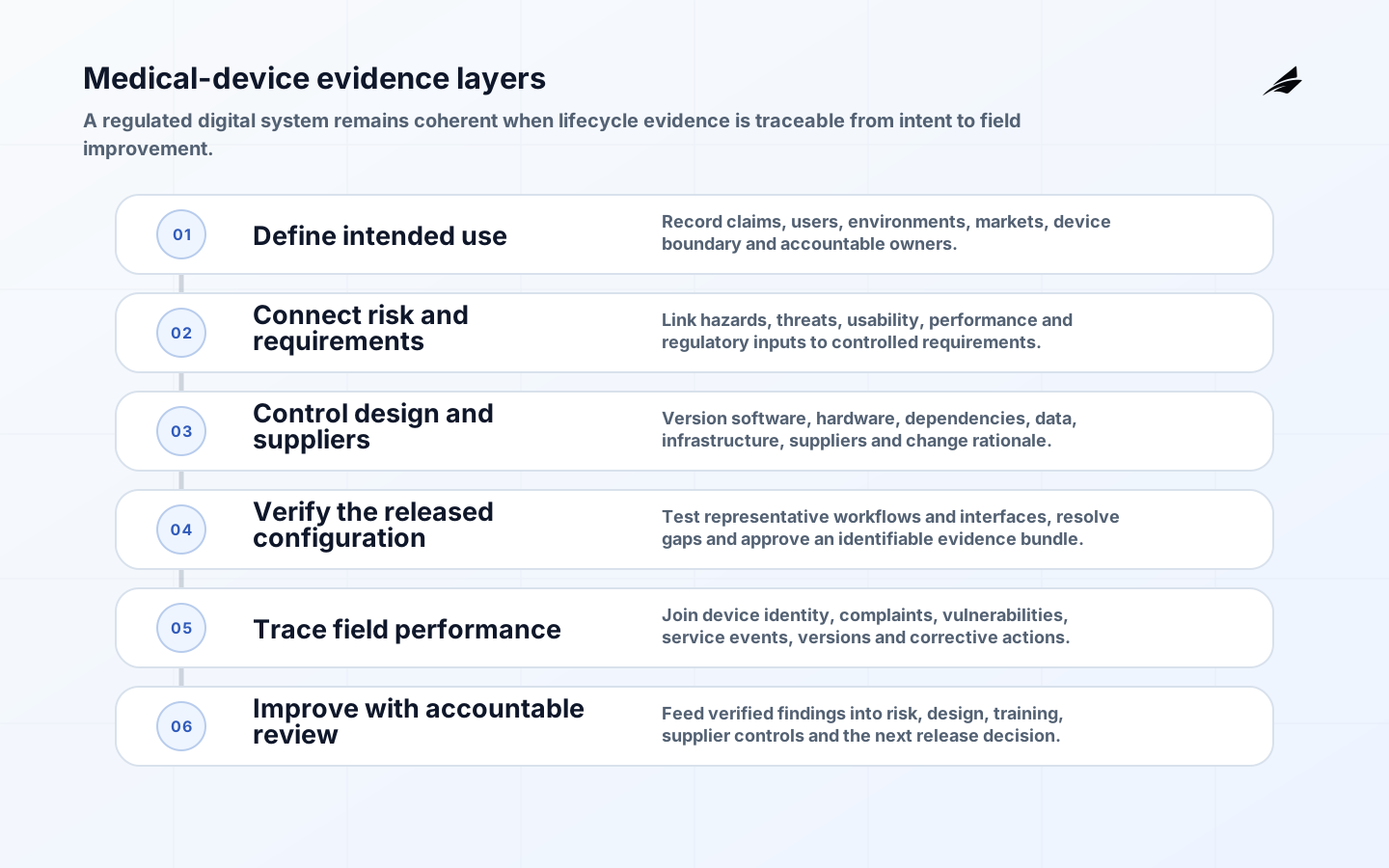
Pharma medical devices depend on digital systems that make product intent, risk, design, production, release and field performance visible to the people accountable for them. The system may include requirements management, laboratory records, manufacturing execution, software delivery, device connectivity, complaint handling, analytics and supplier portals. Its purpose is not to make a regulated process look modern. Its purpose is to preserve trustworthy evidence while the product changes, the market expands and real users encounter conditions that were not present in a test environment.
Business teams can use the pharma medical devices implementation checklist for execution gates and the pharma medical devices FAQ for common buying questions. The broader cognitive infrastructure implementation checklist helps when cloud, data and automation services become part of the operating foundation. This playbook focuses on the decisions that keep those services aligned with quality and regulatory evidence.
The current baseline has moved. The FDA states that the Quality Management System Regulation became effective on February 2, 2026 and incorporates ISO 13485:2016 by reference. The European Commission maintains the MDR and IVDR overview, while its MDCG guidance index explains that guidance is not legally binding but supports a common practical understanding. Teams should use these materials with product-specific regulatory and quality advice, not as a substitute for it.
Define intended use, product boundary and market path
Begin with the finished product and its intended use. Record users, clinical or laboratory purpose, operating environment, claims, foreseeable misuse, connected accessories, software functions and markets under consideration. Decide which component is the device, which is an accessory, which is a service and which is ordinary business infrastructure. A mobile app, cloud service or algorithm may change the evidence plan when it influences a device function or a medical claim. Keep the classification rationale, approver and effective date in a controlled record.
Define the boundary before procurement. Identify the manufacturer, legal manufacturer where relevant, authorized representatives, critical suppliers, notified-body or FDA interactions, production sites and post-market owners. Separate what the technology provider can configure from what the product company must approve. If a new market, claim, patient population, connectivity path or AI capability is introduced, trigger an impact assessment rather than assuming the original validation still applies.
| Scope question | Why it matters | Evidence to request |
|---|---|---|
| What is the intended use? | It sets claims, users, risk and evidence expectations. | Approved intended-use statement and change history |
| Which markets are in scope? | MDR, IVDR, FDA and other pathways do not collapse into one checklist. | Market matrix with responsible regulatory owner |
| What is software's role? | Device function, accessory, infrastructure and administrative tools have different controls. | Software qualification and system-boundary rationale |
| Who can approve change? | Technical release authority is not automatically quality or regulatory authority. | Decision-rights map and approval record |
Build one evidence model across quality and software

Design the evidence model around traceability, not around the screens of a selected tool. A requirement should connect to hazards, risk controls, design outputs, verification results, release configuration and the record that shows the product was operated as intended. Use stable identifiers for product, device version, software build, component, supplier, lot, complaint and field event. Preserve effective dates and the reason for a correction. A data lake or document repository is not authoritative merely because it stores a copy.
Make status visible. Distinguish draft, reviewed, approved, released, superseded and retired evidence. Record who performed an action, under which role, with which configuration and after which review. Design the system so a business user can answer a focused question without editing source evidence accidentally. If a manual reconciliation is required, retain the input, decision, reviewer and result. This is the difference between a searchable archive and an operating quality system.
Translate QMSR into controlled digital work
The FDA describes QMSR as applying to finished device manufacturers that intend to commercially distribute medical devices and incorporates ISO 13485:2016 as the foundational quality-management framework. The FDA also notes that some exemptions from current good manufacturing practice do not remove complaint-file or general record obligations. Treat the change as an operating-model requirement: quality, engineering, production, service and suppliers need a shared way to plan, perform, review, approve and preserve work.
For a digital platform, convert that expectation into controls that can be demonstrated. Use versioned requirements, controlled templates, role-based approval, immutable audit history, validated calculations, test evidence, training status and a documented change-impact route. Do not let a configuration edit bypass the same assessment required for code. Define which environments are development, verification, production and field support; restrict data movement between them; and retain evidence that a released configuration matches the one that was tested.
Treat software, cybersecurity and AI as lifecycle work
The FDA's February 2026 medical-device cybersecurity guidance addresses cybersecurity device design, labeling and recommended premarket-submission documentation, including section 524B considerations for cyber devices. Use it to ask concrete questions: which assets and interfaces can be attacked, which security objectives protect the device function, how are updates authenticated, what happens when a dependency is unavailable, and what evidence will support the submission and later vulnerability response?
A secure medical-device service needs an inventory of software components, identities, keys, interfaces, update channels, third-party dependencies and support access. Define vulnerability triage, disclosure, compensating controls, patch qualification and customer communication before the first field issue. If an AI-enabled function is considered, use the FDA's digital-health guidance index as a starting point and separately establish data provenance, performance limits, human review, drift detection and change control. A model update is a product change when it can change a user-facing result.
| Risk area | Control expectation | Evidence of control |
|---|---|---|
| Uncontrolled configuration | Versioned parameters, approvals, environment separation and rollback | Configuration comparison and approved release bundle |
| Vulnerable dependency | Component inventory, monitoring, triage and update decision | Current inventory, assessment and remediation record |
| Data or model drift | Quality thresholds, representative evaluation and human escalation | Performance review with change trigger |
| Privileged support access | Named identity, least privilege, time limit and session record | Access log and sampled review |
| Field failure | Complaint, vigilance, incident and corrective-action linkage | Reconstructed case from signal to decision |
Plan EU traceability, UDI and post-market signals
For European distribution, map the product and evidence model to the applicable MDR or IVDR path. The Commission overview records that MDR applied from May 26, 2021 and IVDR from May 26, 2022, with transition provisions and later amendments that teams must examine for their device. Do not copy a US record set into an EU submission and assume equivalence. Identify the obligations, actor roles, clinical or performance evidence, notified-body interaction and post-market outputs that are actually in scope.
The Commission's UDI and device-registration page explains that MDR and IVDR introduce a unique-device-identifier system and require manufacturers to submit UDI and device information in EUDAMED for devices placed on the EU market. Its June 2026 update says the first four EUDAMED modules became mandatory on May 28, 2026. Treat traceability as operational data: connect device identity, version, lot or batch, distribution, service event, complaint, field action and correction without exposing more personal or clinical data than the workflow needs.
Post-market evidence should arrive at the same decision table as design evidence. A complaint, cybersecurity signal, returned device, quality deviation or supplier notice needs a stable link to the deployed configuration and risk record. Define thresholds for investigation, escalation, reporting and corrective action. The MDCG guidance page lists guidance for cybersecurity, software qualification, UDI and post-market surveillance; use the relevant documents to refine the workflow rather than treating a completed registration as the end of traceability.
Govern suppliers, cloud services and shared responsibility
Supplier qualification should inspect the service that will actually operate, not only the vendor's corporate certification. Ask where source, data, logs, keys, backups and support sessions live; which subcontractors can access them; how changes are announced; what evidence is available; and how a failed component is isolated or replaced. Define the customer's authority over intended use, risk acceptance, release, incident communication, field update and records. A cloud provider may operate infrastructure, but the device manufacturer retains product obligations and must be able to prove what happened.
Make the contract testable. Include service boundaries, support windows, response and notification rules, audit access, vulnerability handling, retention, recovery targets, data export, verified deletion, continuity, subcontractor approval and exit assistance. Require a responsibility matrix that separates configuration, validation, monitoring, access, backup, restore, incident and regulatory decisions. Run a tabletop with quality, regulatory, engineering, security and procurement before production; ambiguity discovered during a field incident is expensive and difficult to defend.
Gate release, field change and improvement
A release gate should answer four questions: was the approved requirement implemented, were risks and interfaces tested, is the intended configuration known, and can the responsible team detect and recover a failure? Test representative hardware, software, data, network, user roles and external services. Include negative cases such as missing consent, invalid calibration, expired credentials, malformed input, unavailable dependency and partial update. Record residual risk and the authority that accepted it.
After release, compare field performance with the expected baseline. Feed deviations into complaint, vigilance, risk, supplier, training and corrective-action processes. When a change is urgent, keep the reason, scope, affected versions, decision authority, test depth, communication and follow-up review visible. Improvement is not a separate innovation stream; it is the disciplined use of evidence to make the product safer, more effective, more supportable or more transparent without losing the history that explains the transition.
Key takeaways for pharma medical devices
- Set intended use, claims, markets, device boundary and decision authority before selecting technology.
- Connect requirements, risk, design, verification, release configuration and field evidence with stable identifiers.
- Translate QMSR, MDR or IVDR expectations into controlled digital work that can be demonstrated under inspection or review.
- Treat cybersecurity, software updates, AI behavior and supplier access as lifecycle responsibilities.
- Make UDI, EUDAMED, complaints, vigilance and corrective action part of the operating data model.
- Require recovery, change, audit, data-return and exit evidence from every important service provider.
Frequently asked questions
What is the first digital decision for a pharma medical device program? Define intended use, claims, users, markets, device boundary and accountable quality and regulatory owners before selecting a platform or supplier.
Does QMSR change how software teams should work? It raises the importance of controlled design and development evidence, risk management, records and change decisions that fit the finished-device lifecycle. The exact implementation still depends on the product and applicable requirements.
How should medical-device cybersecurity be handled? Treat it as a lifecycle property spanning design, documentation, release, vulnerability response, updates, support access and post-market monitoring. Make the threat, control, owner and evidence visible.
Which evidence should business leaders request from a supplier? Request a responsibility map, validation approach, change and incident records, security evidence, data and audit access, recovery tests, subcontractor visibility and a realistic exit path.
Conclusion
A pharma medical devices digital system is credible when it preserves the chain from intended use to field evidence. Business teams do not need to own every technical detail, but they do need clear boundaries, accountable decisions, traceable records, secure change, supplier visibility and a recovery plan. Build those conditions into the workflow before scale, and technology becomes an instrument of product quality rather than another place where evidence can disappear.