A cloud application management FAQ should begin with the service the application provides. Management is not a monitoring console or a collection of infrastructure tickets. It is the continuing ability to release, observe, secure, scale, recover and improve an application while preserving its data and customer commitments. Cloud services reduce some infrastructure work and introduce dependencies on provider control planes, managed runtimes, quotas and rapidly changing products. A reliable operating model assigns ownership across those layers and verifies behavior at the user-facing boundary.
This FAQ applies to cloud-native applications, migrated systems and hybrid services. It helps product owners, application teams, platform engineers, security teams and managed providers settle the decisions that are often deferred until an incident. AWS describes operational excellence through organization, preparation, operation and evolution in its Well-Architected guidance. That lifecycle is a useful frame: application management is a product capability that changes with architecture, demand and risk, not a one-time handover.
What is included in cloud application management?
Scope should cover the application journey from approved change to production outcome. Typical capabilities include service inventory, environments, deployment, configuration, secrets, database and runtime operations, observability, incident and problem management, vulnerability remediation, capacity, backup, recovery, cost allocation, compliance evidence and retirement. State which hours, regions, accounts and versions are covered. Separate application code, platform products and cloud-provider services, then assign who acts and who decides for each. Managed databases still require customer decisions about schema, access, retention, performance and recovery.
Create a service profile for each application: business owner, technical owner, users, critical journeys, architecture, dependencies, data class, service objectives, recovery targets, deployment route, support model, supplier contacts and cost center. Keep it tied to the live estate through automation where practical. The cloud application management practical guide can establish operating boundaries, while the implementation checklist turns them into acceptance evidence.
| Capability | Application responsibility | Platform or provider dependency |
|---|---|---|
| Release | Build, test, approve and reconcile application behavior | Pipeline, artifact, identity and deployment services |
| Observability | Instrument critical journeys and define useful signals | Collection, storage, query and notification platform |
| Security | Fix code, dependency and data-access risk | Cloud controls, findings, keys and identity foundation |
| Recovery | Restore and validate business consistency | Backup, replication and infrastructure recovery mechanisms |
| Cost | Explain demand and architecture choices | Billing data, allocation, rates and commitments |
Who should own the application in production?
One service owner should be accountable for customer outcome, with named engineering and operations roles. A product team that writes code but cannot diagnose or recover it creates delayed handoffs; an operations team without code or roadmap context can only treat symptoms. Use a joint model in which platform teams provide supported paths and application teams own workload behavior. Define on-call expectations, escalation, risk acceptance, production access and supplier engagement. Responsibility must follow service model changes because moving from virtual machines to a managed runtime shifts tasks but does not remove accountability.
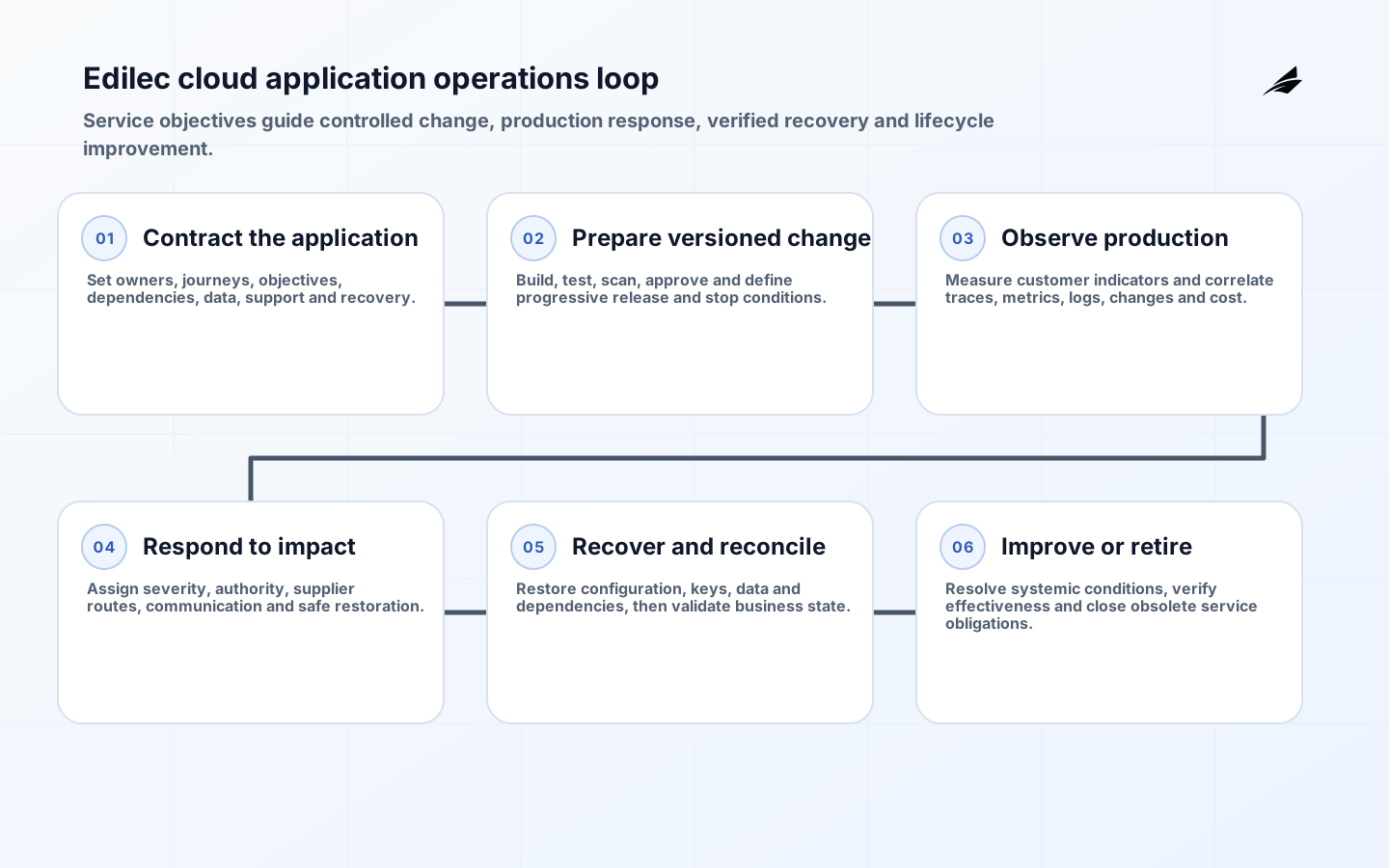
Maintain one work system for incidents, problems, reliability risk, security findings, cost and improvement. Operational review should prioritize systemic change, not only close tickets. The six-stage Edilec cloud application operations loop at this heading starts with service objectives, prepares a versioned change, observes production behavior, responds to impact, verifies recovery and feeds evidence into the next priority. Google Cloud's operational excellence guidance similarly emphasizes change, incident, problem, capacity and continuous improvement as connected practices.
How should observability and service objectives be designed?
Start with critical user journeys and define indicators at the boundary customers experience. Availability can be valid requests completed successfully; latency can measure the portion meeting a task-specific threshold. Add data freshness, queue age or completion correctness where those determine value. Set objectives that guide engineering trade-offs, and establish an error-budget or equivalent policy for reliability work. Infrastructure measures such as CPU and pod count support diagnosis but do not prove the application works. Every alert needs an owner, decision and action that cannot wait for routine review.
Instrument requests with consistent identity and context across services. OpenTelemetry explains traces, metrics and logs in its observability primer; use those signals together to move from symptom to cause. Protect telemetry because it can contain customer and security data. Set retention and sampling according to investigation needs and cost. Test dashboards and alerts during failure exercises. If responders need to add basic instrumentation during an outage, production was not sufficiently observable for that failure mode.
How should releases, incidents and problems work together?
Release small, versioned changes through automated build, security and deployment checks. Promote immutable artifacts and record configuration, database migration, flags and dependencies with the release. Use progressive exposure for material change and define stop conditions. Preview infrastructure changes, detect drift and reconcile actual deployment. Microsoft recommends version control, pipelines, staged tests and infrastructure as code in its guidance for administering a cloud estate. Emergency changes need explicit authority, evidence and retrospective review.
Incident response should optimize safe restoration while preserving facts and decisions. Severity follows business impact and urgency. Keep one timeline, distinguish observations from hypotheses and communicate honestly. After recovery, reconcile delayed, lost or duplicated business transactions. Problem analysis should identify conditions the system allowed, not search for an individual to blame. Connect corrective actions to architecture, tests, alerts, procedures or ownership, and check effectiveness later. Track change failure and recovery time alongside customer impact; a fast rollback may still leave inconsistent data that requires careful correction.
| Operational signal | Question to ask | Management action |
|---|---|---|
| Objective burn | Which journey and population are consuming reliability margin? | Constrain change and address the dominant failure mode |
| Alert noise | Which alerts do not drive urgent decisions? | Remove, aggregate or route them to routine review |
| Recurring incident | Which architecture or process condition remains? | Create a problem action with effectiveness measure |
| Change failure | Was batch size, test fidelity or rollout control inadequate? | Adjust delivery path and progressive exposure |
| Recovery gap | Which dependency, key or data check prevented restoration? | Repair the recovery design and repeat the exercise |
How are security and resilience managed continuously?
Apply least privilege to people and workloads, use short-lived credentials where possible and protect secrets outside code and images. Maintain dependency and asset inventories tied to deployed versions. Route findings by exploitability, exposure and business consequence, with time-bounded exceptions. Review internet paths, data flows and trust boundaries after architecture change. The NIST Cybersecurity Framework can organize governance, identification, protection, detection, response and recovery outcomes; application teams still need precise controls and evidence for their technology and obligations.
Design recovery around service objectives and failure domains. Backups should be independent from the credentials and destructive events they protect against. Restore the complete application, including infrastructure, configuration, keys, data, identities and dependent services. Validate business consistency and reconnect integrations carefully. High availability and disaster recovery answer different questions: redundancy may handle component failure, while recovery addresses wider corruption or outage. Exercise likely scenarios and preserve elapsed time, data loss, manual steps and follow-up actions. Revisit objectives when business criticality or architecture changes.
How should cost, capacity and application retirement be controlled?
Allocate spend to the application and meaningful environments, then connect it to demand. Track unit cost for a stable transaction, user or workload measure where possible. Investigate anomalies by price, usage, architecture and waste. Rightsizing is useful but should consider peaks, resilience and performance. Forecast commitments with product roadmaps and test the downside of uncertain demand. Platform teams can expose efficient defaults; service owners decide trade-offs. Cost reviews should generate owned actions rather than annotate an invoice after the opportunity has passed.
Capacity includes provider quotas, database limits, queues, downstream services and human response, not only compute. Test scaling and degradation before expected peaks. Every application needs a retirement trigger and owner. Retirement means stopping traffic, preserving or deleting data lawfully, revoking identities and keys, removing DNS and integrations, closing monitoring, canceling licenses and updating inventories. Confirm no dependent consumer remains. Dormant cloud resources create security and cost exposure, while undocumented data copies can outlive the purpose for which they were created.
Cloud application management takeaways
- Define management as the full application service lifecycle, with a live service profile and clear boundaries.
- Keep product, application, platform, security and provider responsibilities explicit as service models change.
- Measure customer journeys and instrument the context needed to explain unfamiliar failures.
- Connect controlled releases, incident restoration and problem improvement in one operating system.
- Exercise complete recovery and treat security findings as ongoing product work.
- Manage unit cost, capacity and retirement with the same ownership used for reliability.
Frequently asked questions
Is cloud application management the same as cloud infrastructure management? No. Infrastructure management covers resources and foundational services. Application management includes code, data, dependencies, customer journeys, release and business recovery. The two must share context and escalation.
Can a managed service provider own the application outcome? A provider can perform defined work and accept contractual commitments, but the customer retains business priorities, legal accountability and risk decisions. Name an internal service owner even when operations are outsourced.
How many metrics should an application use? Use a small set of customer-facing indicators for objectives and enough diagnostic telemetry to investigate. Alert only on conditions requiring timely action. More dashboards do not create clearer ownership or better decisions.
Conclusion
Cloud application management is effective when a named team can explain the service, change it safely, detect customer impact, restore it with evidence and account for its cost. The cloud platform supplies powerful mechanisms, but disciplined ownership connects them to application behavior. A lifecycle operating model keeps day-two work from becoming reactive support and turns incidents, demand and change into measurable service improvement.